7,363 open-source and SaaS tools, with GitHub stats refreshed every day.

8 alternatives ranked by real activity

Open-source Alarm.com alternatives

A curated, ranked list of the 8 best open-source alternatives to Alarm.com.

The best open-source alternative to Alarm.com is Home Assistant. If that doesn't suit you, other good options are Frigate, Home Assistant OS, Scrypted and ZoneMinder.

Alarm.com alternatives are mainly home automation & IoT tools. 8 of them shipped code in the last 30 days, 8 can be self-hosted, and 4 use a permissive licence.

Last updated October 3, 2026 · ranked by GitHub stars, growth and recent commits

Home Assistant

Open-source home automation software built around local control and privacy, with automations, dashboards, voice assistants and over 1,500 integrations.

GitHub stars
91k
Last commit
today
Latest release
2026.9.4
Licence
Apache-2.0
Self-hosted
Yes
home-assistant.ioHome Assistant homepage screenshot

Home Assistant is open-source home automation software built around local control and privacy. It runs on hardware you own, such as a Raspberry Pi or a small home server, and brings smart lights, sensors, switches, thermostats and other devices together in one place. The core is written in Python and released under the Apache-2.0 license.

The documentation is organized around automations and dashboards, voice control, grouping devices by area, tracking energy use and templating, with configuration through the interface or YAML files. The project lists more than 1,500 integrations, and it can be controlled through assistants such as Alexa and Google Assistant. Companion hardware, including Home Assistant Green and the Voice Preview Edition, makes first-time setup simpler.

Home Assistant is a project of the Open Home Foundation, a non-profit that states the project cannot be sold or acquired. It suits tinkerers and DIY enthusiasts who want a home automation hub that does not depend on a single vendor's cloud, as well as people who want to unify devices from many brands under one dashboard.

Key features

  • Automations for lights, sensors and other devices
  • Customizable dashboards for your home
  • Voice assistant support
  • Energy management tools
  • Templating and YAML-based configuration
  • 1,500+ device and service integrations

Pricing: Free and open source under the Apache-2.0 license; the project also sells optional hardware.

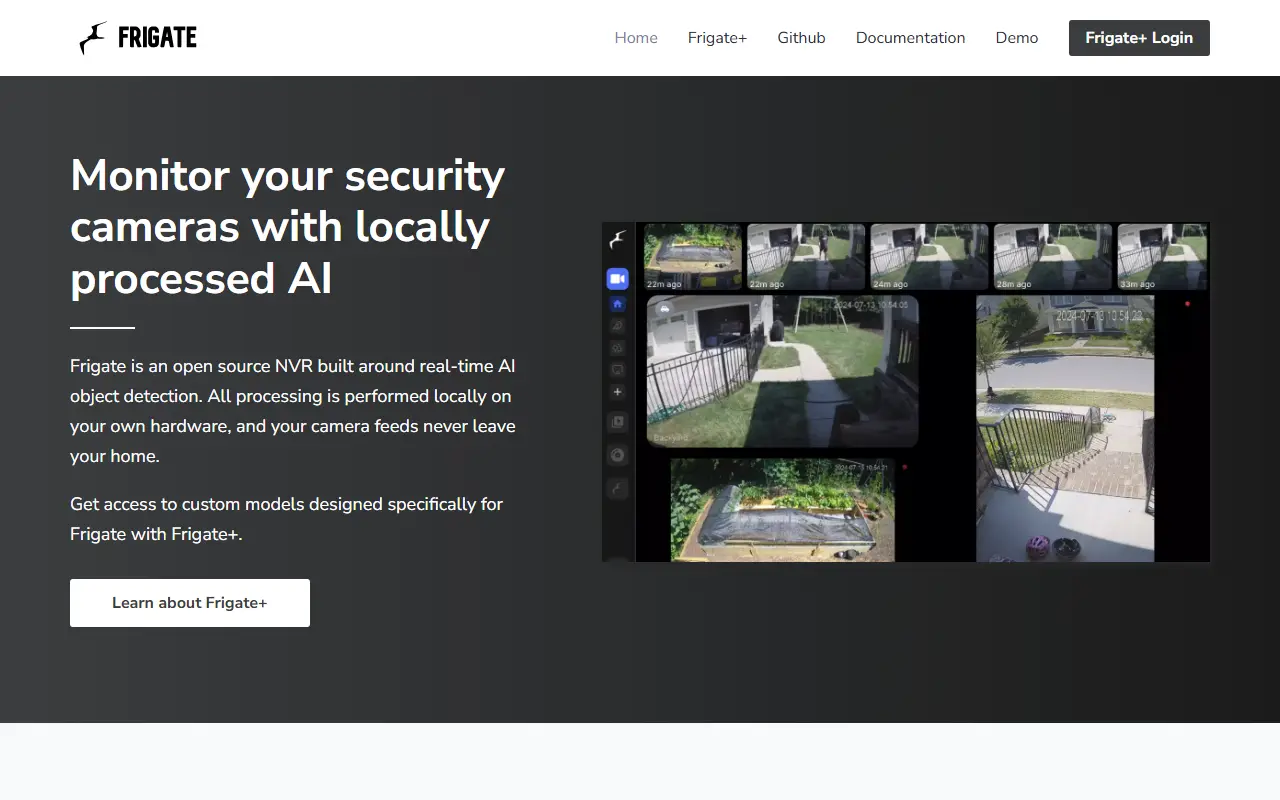
Frigate

Frigate is a local network video recorder that runs real-time AI object detection on IP camera streams and integrates with Home Assistant.

GitHub stars
36k
Last commit
today
Latest release
v0.18.0
Licence
MIT
Self-hosted
Yes
frigate.videoFrigate homepage screenshot

Frigate is a network video recorder (NVR) built around local, real-time object detection for IP cameras. It was designed for Home Assistant and uses OpenCV and TensorFlow to detect objects on your own hardware, so camera footage does not have to be analyzed in a third-party cloud. The code is MIT licensed, written in Python, and the Frigate name and logo are trademarks of Frigate, Inc.

To save resources, Frigate runs inexpensive motion detection first and only applies object detection where and when it is needed. Detection runs in separate processes to keep frame rates high, and the project recommends a GPU or AI accelerator for good performance. It communicates over MQTT, records video with retention rules based on detected objects, supports 24/7 recording, and can re-stream cameras over RTSP. WebRTC and MSE provide low-latency live view.

Key features

  • Real-time local object detection on camera feeds
  • Tight integration with Home Assistant
  • Motion-triggered detection to save resources
  • Recording with object-based retention settings
  • MQTT messaging and RTSP re-streaming
  • Low-latency live view via WebRTC and MSE

Pricing: Free and open source under the MIT license; donations are accepted via GitHub Sponsors.

Home Assistant OS

Home Assistant Operating System is a Buildroot-based Linux OS, formerly HassOS, built to run Home Assistant on Raspberry Pi, ODROID and x86-64 devices.

GitHub stars
7.5k
Last commit
yesterday
Latest release
18.3
Licence
Apache-2.0
Self-hosted
Yes

Home Assistant Operating System, formerly called HassOS, is a Linux distribution tuned for hosting Home Assistant and its apps. It is aimed at people who want a dedicated home automation appliance rather than installing Home Assistant on top of a general-purpose distribution.

It uses Docker as its container engine and by default deploys the Home Assistant Supervisor as a container, which in turn controls Home Assistant Core and its apps in separate containers. The system is built with Buildroot instead of being based on a distribution such as Ubuntu. It targets single board computers such as the Raspberry Pi and ODROID, and it also supports x86-64 systems with UEFI.

Listed features include a lightweight, memory-efficient design, minimized I/O, over-the-air updates, offline updates and a modular architecture. The project is written mostly in Python, licensed under Apache-2.0, and its supported hardware is defined in architecture decision records, with the official getting started guide covering installation.

Key features

  • Lightweight, memory-efficient Linux system
  • Over-the-air and offline updates
  • Docker-based modular architecture
  • Runs the Home Assistant Supervisor
  • Supports Raspberry Pi, ODROID and x86-64
  • Minimized disk I/O

Pricing: Free and open source under the Apache-2.0 licence.

Scrypted

Scrypted is a home video integration platform and NVR that streams cameras with low latency to HomeKit, Google Home and Alexa, extended through plugins.

GitHub stars
6k
Last commit
4 days ago
Latest release
v0.147.0
Self-hosted
Yes
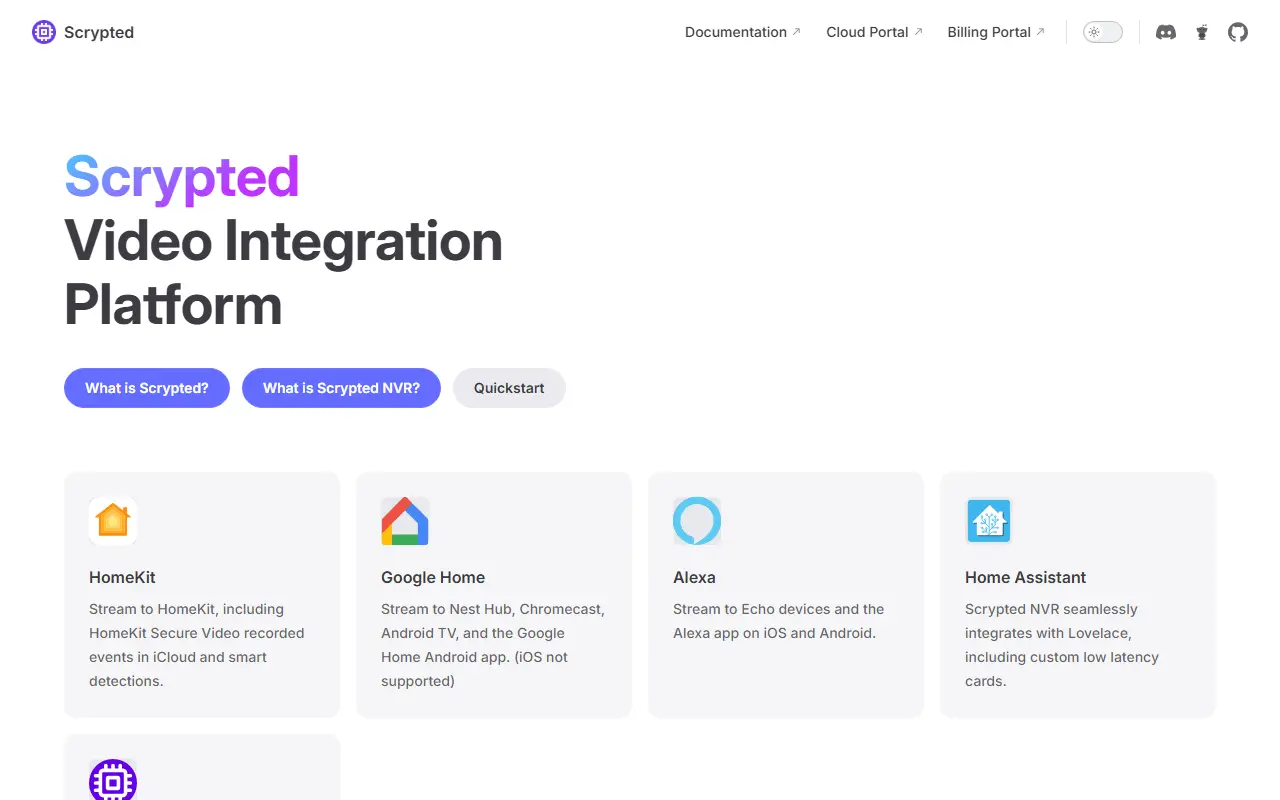
scrypted.appScrypted homepage screenshot

Scrypted is a home video integration platform and network video recorder with smart detections. It connects security cameras to smart home ecosystems, streaming video to HomeKit, Google Home and Alexa with very little delay, and it supports most cameras.

The server provides hosting and an RPC mechanism for plugins, and the functionality for specific cameras and ecosystems comes from those plugins. A Plugin SDK with documentation lets developers write their own, and the README explains how to debug plugins such as the HomeKit plugin in VS Code, where changes deploy to a running server without a restart. Installation and camera onboarding instructions are in the documentation.

Scrypted is written in TypeScript. The repository lists its licence as other, so check the project for the exact terms. Community help is available on Discord, Reddit and GitHub, and it is intended to be run on your own hardware at home.

Key features

  • Low-latency camera streaming to HomeKit
  • Google Home and Alexa integration
  • NVR with smart detections
  • Plugin architecture with SDK
  • Support for most camera brands

ZoneMinder

ZoneMinder is free, open-source CCTV software for Linux that captures, analyzes, records and monitors IP, USB and analog cameras.

GitHub stars
5.9k
Last commit
yesterday
Latest release
1.38.4
Licence
GPL-2.0
Self-hosted
Yes

ZoneMinder is closed-circuit television (CCTV) software for Linux that is free and open source. It is an integrated set of applications that provides a surveillance solution for capturing, analyzing, recording and monitoring CCTV or security cameras attached to a Linux machine.

It is designed for distributions that support the Video For Linux interface, has been tested with cameras connected to BTTV cards and various USB cameras, and supports most IP network cameras. Repository topics mention H.264 and H.265, and a distributed, scalable design. All documentation is hosted online on Read the Docs.

ZoneMinder is written in PHP and licensed under GPL-2.0. The README recommends installing from a package repository, with packages maintained for Ubuntu, Debian, RHEL and CentOS clones, Fedora, openSUSE, Mageia, Arch and Gentoo, and it discourages building from source. The Dockerfile now lives in a separate zmdockerfiles repository.

Key features

  • Capture and recording from IP, USB and analog cameras
  • Analysis and monitoring of CCTV feeds
  • Video For Linux support
  • H.264 and H.265 video
  • Packages for major Linux distributions

Pricing: Free and open source under the GPL-2.0 licence.

Viseron

Viseron is a self-hosted, local-only network video recorder with AI-based object detection, motion detection and face recognition.

GitHub stars
3.6k
Last commit
today
Latest release
v3.7.0
Licence
MIT
Self-hosted
Yes

Viseron is self-hosted software that combines a network video recorder with AI computer vision, and it works entirely on local infrastructure. You connect your cameras and it can watch a home, office or any other location, detecting objects and motion and recognizing faces. Nothing needs to leave your own network.

Its functionality is delivered through components, which you can browse in a Component Explorer. Project topics point to object detection with TensorFlow, Darknet and YOLO models, hardware acceleration with CUDA and Google Coral EdgeTPU devices, RTSP and IP camera support, and face and license plate recognition. These let you choose a detection setup that matches your hardware.

Getting started means running a Docker container and editing the configuration through the built-in web interface. The software is written in Python and released under the MIT license. Help is available through a Discord server and the issue tracker, and the project accepts contributions and sponsorship.

Key features

  • Local-only network video recorder
  • Object detection and motion detection
  • Face recognition and license plate recognition
  • Component-based architecture with a component explorer
  • Hardware acceleration with CUDA and Coral EdgeTPU
  • Configuration through a built-in web interface

Pricing: Free and open source under the MIT license.

Read more about ViseronGitHub

Clearcam

Software that adds object detection, tracking, notifications and search to any RTSP security camera, with an optional premium remote viewing service.

GitHub stars
1.6k
Last commit
yesterday
Latest release
0.2.8
Licence
GPL-3.0
Self-hosted
Yes
Hosted version
Available
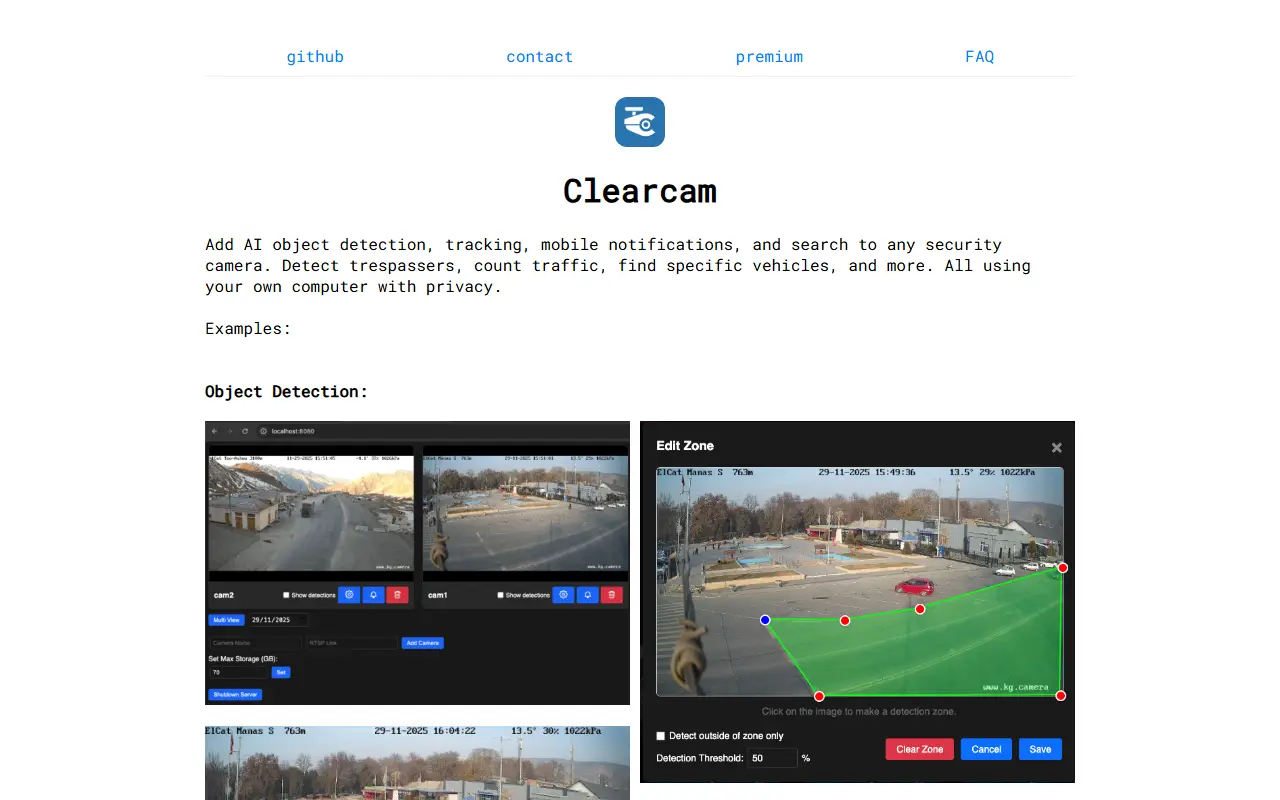
clearcam.orgClearcam homepage screenshot

Clearcam adds AI features to ordinary security cameras. It runs a network video recorder and inference pipeline in Python that connects to cameras over RTSP, detects objects and people, tracks them, and makes the footage searchable, so a basic camera gains the smart alerts usually associated with commercial systems.

You run it from source on a Mac, Linux or Windows computer, then open a local web interface on port 8080. Notifications can be sent to a URL of your choice, so Home Assistant, Pushover, n8n or any program can receive alerts, and a sample Pushover server is included. The README also mentions AI notification summaries and an iOS app that can be built from source. Topics mention YOLOv9, CLIP and tinygrad.

The code is licensed under GPL-3.0. Remote features such as viewing live feeds, receiving notifications and watching event clips away from home, with end-to-end encryption, are offered through a Clearcam Premium sign-up on the project website or in the iOS app. It suits home users and hobbyists who want local detection on their own hardware.

Key features

  • Object and person detection on camera streams
  • RTSP camera support
  • Searchable event footage
  • Custom notification URL for alerts
  • Local web interface
  • iOS app with optional premium remote access

Pricing: The core software is free under GPL-3.0; remote viewing and notifications use an optional Clearcam Premium subscription.

openHAB

openHAB Core is the Java framework of core bundles that underpins the openHAB smart home and IoT automation runtime.

GitHub stars
1.1k
Last commit
today
Licence
EPL-2.0
Self-hosted
Yes
openhab.orgopenHAB homepage screenshot

openHAB Core contains the core bundles of the openHAB runtime, an open-source platform for home automation and the Internet of Things. The README is explicit that Core is not a product by itself but a framework for building solutions on top of it. The repository is mainly an artifact repository of OSGi bundles that the main openHAB distribution picks up and that can be used within smart home products.

Building it uses Maven and a Java SE Development Kit 21. The README walks through checking out the source, setting Maven options, and running a clean install with the spotless formatter, with quicker variants that skip tests or checks for faster local builds. The code is Java and licensed under EPL-2.0.

People who want to run openHAB at home normally install the main distribution instead of building Core. The repository itself is aimed at developers and contributors, and it points to contribution guidelines. Topics mention home automation, the Internet of Things and Java.

Key features

  • OSGi bundles for the openHAB runtime
  • Framework for smart home solutions
  • Maven-based build
  • Picked up by the main openHAB distribution
  • Contribution guidelines for developers

Pricing: Free and open source under the EPL-2.0 license.

Alarm.com alternatives: questions

What is the best open-source alternative to Alarm.com?
Home Assistant is the top-ranked open-source alternative to Alarm.com on Enlisted: Open-source home automation software built around local control and privacy, with automations, dashboards, voice assistants and over 1,500 integrations. Other strong options are Frigate, Home Assistant OS, Scrypted and ZoneMinder.
Are these Alarm.com alternatives free?
All 8 are open source, so the code is free to use under its licence, and all of them can be self-hosted on your own server or computer. 1 also offers a paid or managed cloud version if you'd rather not host it yourself.
How is this list of Alarm.com alternatives ranked?
By a score built from GitHub stars, star growth over the last 30 days and how recently the code changed. 8 of these projects shipped code in the last 30 days. Data is refreshed daily, and nobody can pay to move up.

People also look for alternatives to…

View all