
About Para
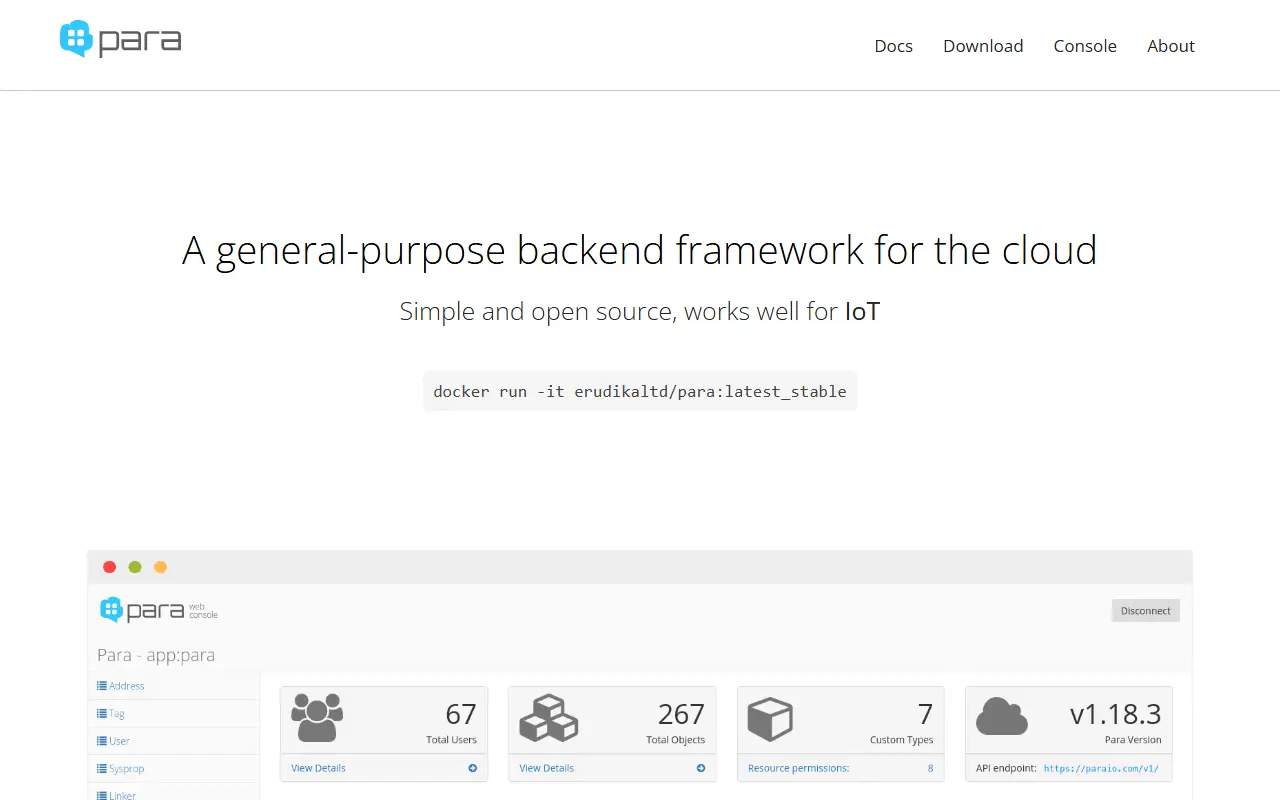
Para is a scalable, multitenant backend server and framework for object persistence and retrieval, aimed at helping developers build and prototype web and mobile apps faster by handling backend operations. It can be embedded in a JVM application or deployed as a standalone API server that multiple applications and clients connect to. Its name means steam in Bulgarian.
It exposes a RESTful JSON API secured with Amazon's Signature V4 algorithm and is database-agnostic, designed for scalable data stores such as DynamoDB, Cassandra and MongoDB. Features include full-text search with Lucene or Elasticsearch, distributed and local caching with Hazelcast or Caffeine, multitenancy where each app has its own table, index and cache, webhooks with signed payloads, flexible security based on Spring Security with LDAP, SAML and social login, JWT authentication, resource permissions, constraint validation, optimistic locking, metrics for monitoring, plugins and i18n utilities.
Para is written in Java, licensed under Apache-2.0, and funded and supported by Erudika, an independent bootstrapped company. It can be self-hosted, and the project also describes a hosted option.
Key features
- Multitenant REST API backend
- Database-agnostic storage
- Full-text search with Lucene or Elasticsearch
- JWT, LDAP, SAML and social login
- Signed webhooks
- Plugin architecture
Good fit for
- →Rapid backend for web and mobile prototypes
- →Shared backend serving several apps
- Built with
- Java
- Tags
- backend-as-a-service
- java
- rest-api
- multitenant
- search
- self-hosted
- api-server
- jwt
Para: questions and answers
- What is Para used for?
- Para is a multitenant Java backend server for object persistence, search and authentication that can run standalone or embedded, self-hosted or hosted. It is a good fit for rapid backend for web and mobile prototypes, and shared backend serving several apps.
- Is Para open source?
- Yes. Para is open source under the Apache-2.0 licence. Its source code is on GitHub at Erudika/para and is written mainly in Java.
- Is Para free?
- Yes. Para is open source, so the software itself is free to use. A managed cloud version is also available.
- Can I self-host Para?
- Yes. Para can be self-hosted on your own server or infrastructure.
- What is Para an alternative to?
- Para is an open-source alternative to Firebase. Other open-source alternatives to Firebase include Parse Server, Supabase and Appwrite.
- Is Para actively maintained?
- Yes. The most recent commit to Para was on 1 October 2026, and the latest release is 1.56.1, published on 1 October 2026. The project has 575 stars on GitHub.
Open-source alternatives to Para
See all
Parse Server
Backend as a Service
Parse Server for Node.js / Express
Apache-2.0vs Firebase★ 21k
Supabase
Backend as a Service
The Postgres development platform. Supabase gives you a dedicated Postgres database to bui
Apache-2.0vs Firebase★ 111k
Appwrite
Backend as a Service
Appwrite is an open-source developer platform with Auth, Databases, Storage, Functions, Me
BSD-3-Clausevs Firebase★ 58k
pREST
Backend as a Service
PostgreSQL ➕ REST, low-code, simplify and accelerate development, ⚡ instant, realtime, hig
MITvs Firebase★ 4.6k
Conduit Platform
Backend as a Service
Batteries-included backend that works with any stack.
MITvs Firebase★ 924
CloudBoost
Backend as a Service
Realtime JavaScript Backend.
Apache-2.0vs Firebase★ 1.5k
SaaS alternatives to Para
See all
Firebase
Backend as a Service
Firebase is Google's mobile and web app development platform, bundling authentication, databases, hosting, messaging and analytics as a managed backend.
SaaS
Apple CloudKit
Backend as a Service
Apple iCloud-backed database and storage service for iOS and macOS apps
SaaS
Back4App
Backend as a Service
Hosted backend built on Parse Server with a database, auth and cloud functions
SaaS
Backendless
Backend as a Service
Visual backend platform with a database, user management and API services
SaaS
Huawei AppGallery Connect
Backend as a Service
Huawei backend services suite for auth, storage, cloud functions and push
SaaS
Xano
Backend as a Service
No-code backend builder with a database, API editor and business logic
SaaS