
About Ladybird
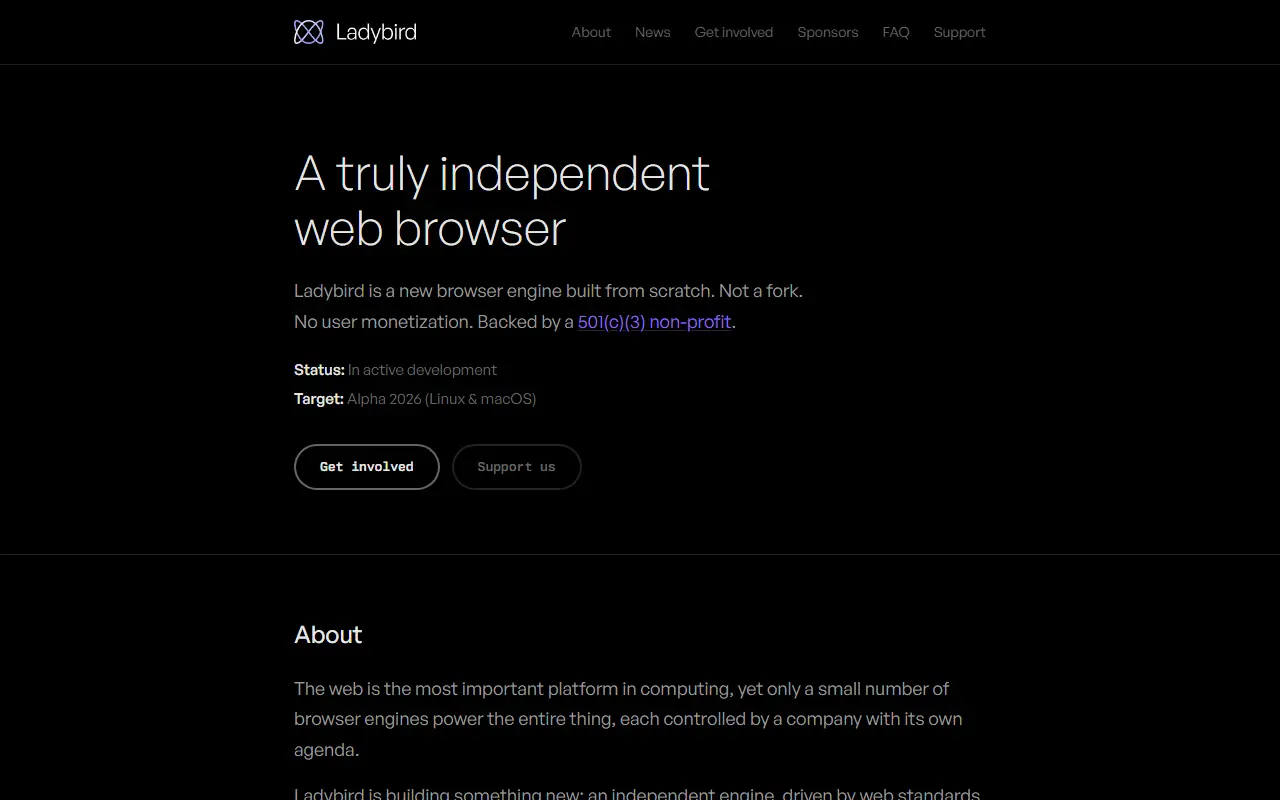
Ladybird is an independent web browser that uses a new engine based on web standards. The goal is a full-featured, practical browser that can handle today's web, but it is currently pre-alpha software that only developers should try. It is written in C++ and released under the BSD-2-Clause license.
Its architecture is multi-process: a main UI process alongside multiple WebContent renderers, an ImageDecoder process and a RequestServer process. Decoding images and making network requests both occur outside the main process to be more resilient against malicious content, and each tab has its own sandboxed renderer. Many core library components are currently inherited from SerenityOS, including LibWeb for rendering, LibJS for JavaScript, LibWasm for WebAssembly and LibGfx for 2D graphics.
Ladybird runs on Linux, macOS, Windows through WSL2 and several other platforms, with build instructions and code documentation in the repository. The community gathers on Discord, and the project has an issue policy and guidelines for reporting problems. It suits developers and browser-engine enthusiasts who want to follow or contribute to an independent engine.
Key features
- Independent browser engine built on web standards
- Multi-process architecture with per-tab renderers
- Out-of-process image decoding and networking
- LibWeb rendering and LibJS JavaScript engine
- WebAssembly support through LibWasm
- Builds on Linux, macOS and Windows with WSL2
Good fit for
- →Following an independent browser engine
- →Contributing to browser development
- Built with
- C++
- Tags
- web-browser
- browser-engine
- cpp
- web-standards
- browser
- open-source
- independent
Ladybird: questions and answers
- What is Ladybird used for?
- Ladybird is an independent open-source web browser with its own engine built on web standards, currently pre-alpha and intended for developers. It is a good fit for following an independent browser engine and contributing to browser development.
- Is Ladybird open source?
- Yes. Ladybird is open source under the BSD-2-Clause licence. Its source code is on GitHub at LadybirdBrowser/ladybird and is written mainly in C++.
- Is Ladybird free?
- Yes. Ladybird is open source, so the software itself is free to use.
- Can I self-host Ladybird?
- Yes. Ladybird can be self-hosted on your own server or infrastructure; there is no official hosted version.
- What is Ladybird an alternative to?
- Ladybird is an open-source alternative to Google Chrome, Safari and Microsoft Edge. Other open-source alternatives to Google Chrome include Firefox, Floorp and Waterfox.
- Is Ladybird actively maintained?
- Yes. The most recent commit to Ladybird was on 2 October 2026. The project has 66k stars on GitHub.
Open-source alternatives to Ladybird
See all
Firefox
Productivity
The official repository of Mozilla's Firefox web browser.
OSSvs Google Chrome★ 13k
Floorp
Productivity
All of source code of Floorp 12, the most Advanced and Fastest Firefox derivative 🦊
MPL-2.0vs Google Chrome★ 8.4k
Waterfox
Productivity
The official Waterfox 💧 source code repository
OSSvs Google Chrome★ 6.3k
Brave Browser
Productivity
Brave browser for Android, iOS, Linux, macOS, Windows.
MPL-2.0vs Google Chrome★ 24k
Zen Browser
Productivity
Welcome to a calmer internet
MPL-2.0vs Google Chrome★ 45kUngoogled Chromium
Productivity
Google Chromium, sans integration with Google
BSD-3-Clausevs Google Chrome★ 28k
SaaS alternatives to Ladybird
See all
Google Chrome
Productivity
Web browser from Google with profile sync, extensions and built-in translation
SaaS
Safari
Productivity
Apple web browser for macOS, iOS and iPadOS with iCloud tab and password sync
SaaS
Microsoft Edge
Productivity
Chromium-based web browser from Microsoft with sidebar tools and Copilot
SaaS
Opera
Productivity
Web browser with a built-in VPN, ad blocker and sidebar messengers
SaaS
Vivaldi
Productivity
Customizable web browser with tab stacking, built-in notes and mail client
SaaS
ChatGPT Atlas
AI Tools
OpenAI web browser with built-in ChatGPT and an agent mode
SaaS