7,363 open-source and SaaS tools, with GitHub stats refreshed every day.

11 alternatives ranked by real activity

Open-source Xano alternatives

A curated, ranked list of the 11 best open-source alternatives to Xano.

The best open-source alternative to Xano is Supabase. If that doesn't suit you, other good options are PocketBase, Appwrite, Directus and Hasura.

Xano alternatives are mainly backend-as-a-service tools, but some are also CMS tools and low-code & internal tools. 8 of them shipped code in the last 30 days, 10 can be self-hosted, and 9 use a permissive licence.

Last updated October 2, 2026 · ranked by GitHub stars, growth and recent commits

Supabase

An open-source Postgres development platform bundling a database, auth, auto-generated APIs, realtime, storage and vector tools, often chosen as a Firebase alternative.

GitHub stars
111k
Last commit
yesterday
Latest release
v1.26.08
Licence
Apache-2.0
Self-hosted
Yes
Hosted version
Available
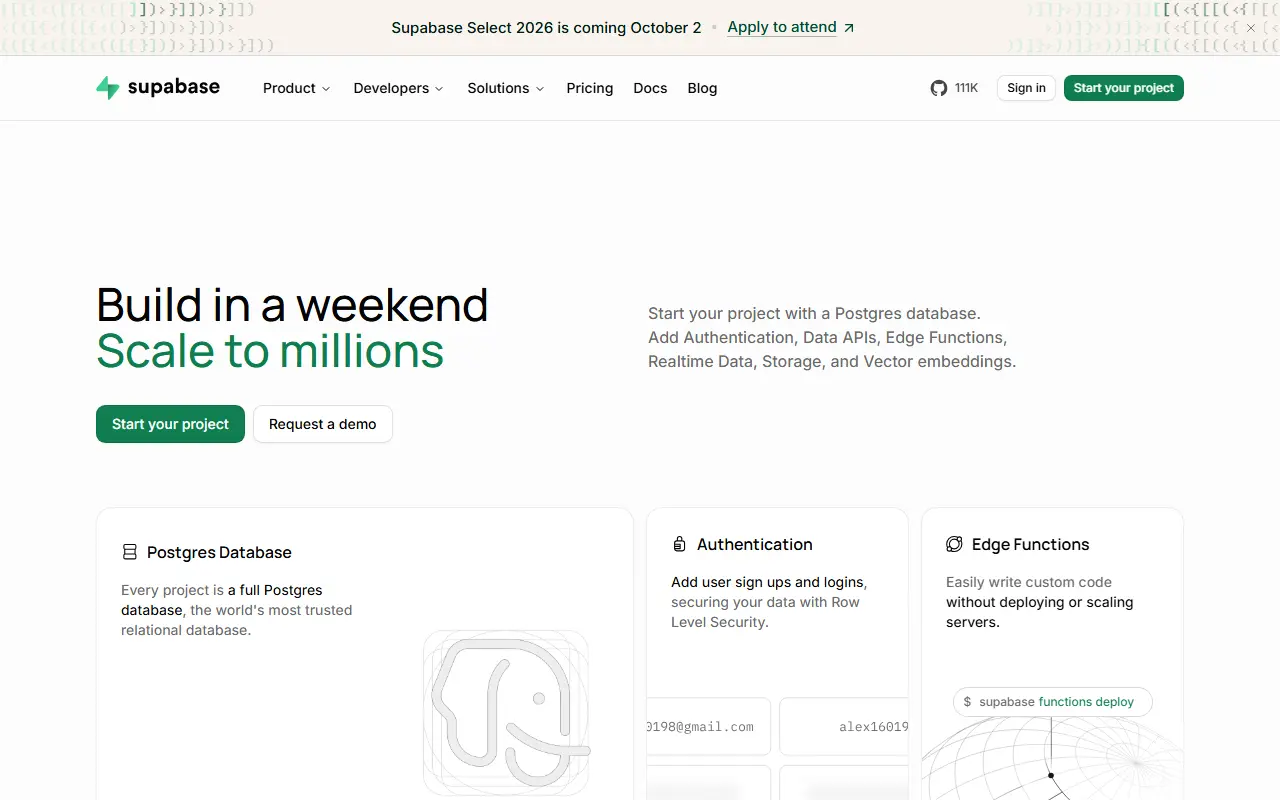
supabase.comSupabase homepage screenshot

Supabase is a backend platform built around a dedicated Postgres database. It packages the pieces most web, mobile and AI apps need, including authentication and authorization, auto-generated APIs, file storage, serverless functions and a dashboard, so developers can start without assembling separate services. Its stated aim is a developer experience similar to Firebase, built from open-source components.

APIs are generated from your schema as REST and GraphQL, with realtime subscriptions over websockets. Logic can live in database functions or in Edge Functions that run on Deno. For AI work there is a toolkit for vectors and embeddings built on pgvector, and Postgres extensions such as PostGIS are available. Supabase combines existing open tools with ones it builds itself when nothing suitable exists.

The code is Apache-2.0 licensed. Supabase is offered as a hosted platform you can sign up for without installing anything, and the same stack can be self-hosted or run locally for development. It suits teams that want Postgres at the core of their app but prefer not to build the surrounding backend themselves.

Key features

  • Hosted Postgres database with a dashboard
  • Authentication and authorization
  • Auto-generated REST and GraphQL APIs
  • Realtime subscriptions over websockets
  • Edge Functions and database functions
  • File storage for user uploads
  • Vector and embeddings toolkit with pgvector

Pricing: Free plan with 50,000 monthly active users. Pro starts at $25 and Team at $599 per month, with usage and extra compute billed on top; Enterprise is custom.

PocketBase

An open-source backend packaged as a single Go executable, with an embedded SQLite database, realtime subscriptions, user and file management and an admin dashboard.

GitHub stars
61k
Last commit
yesterday
Latest release
v0.40.4
Licence
MIT
Self-hosted
Yes
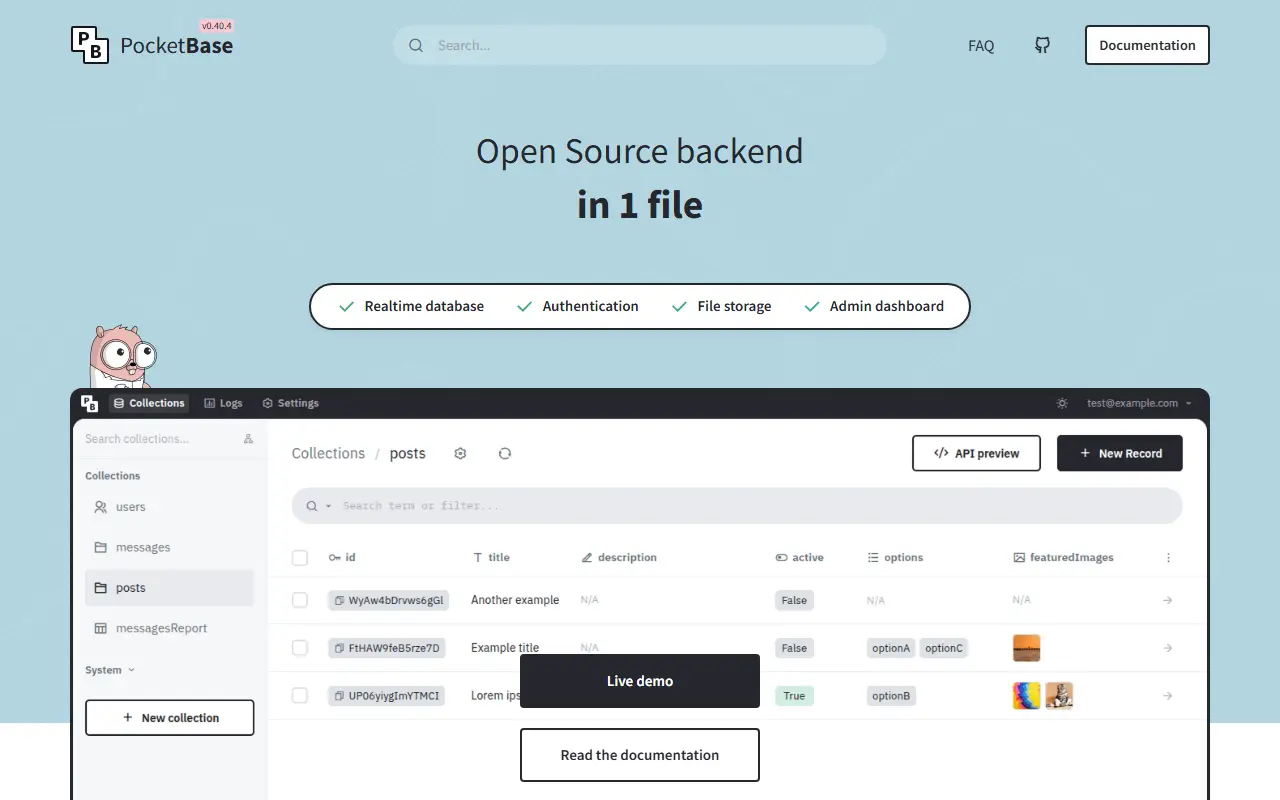
pocketbase.ioPocketBase homepage screenshot

PocketBase is an open-source backend written in Go that ships as one file. It bundles an embedded SQLite database with realtime subscriptions, built-in management of users and files, a convenient admin dashboard and a simple REST-style API, which makes it quick to stand up a backend for a small web or mobile project.

You can use it as a standalone application by downloading the prebuilt executable for your platform and running its serve command, or you can extend it as a Go library to add custom routes and logic. The prebuilt binaries come with a JavaScript VM plugin enabled for scripting. Official SDK clients exist for JavaScript, covering browsers, Node.js and React Native, and for Dart, covering web, mobile, desktop and CLI.

PocketBase is MIT licensed. The maintainers warn that it is still under active development and that backward compatibility is not guaranteed before version 1.0.0, so upgrades deserve some care. It suits solo developers and small teams who want a simple, self-contained backend without managing a database server separately.

Key features

  • Embedded SQLite database with realtime subscriptions
  • Built-in user authentication and file management
  • Admin dashboard for managing data
  • REST-style API for client access
  • Official JavaScript and Dart SDKs
  • Single executable that can also extend as a Go library

Pricing: Free and open source under the MIT license.

Appwrite

An open-source backend platform offering auth, databases, storage, functions, messaging, realtime and hosting, available as a managed cloud or self-hosted with Docker.

GitHub stars
58k
Last commit
yesterday
Latest release
2.3.0
Licence
BSD-3-Clause
Self-hosted
Yes
Hosted version
Available
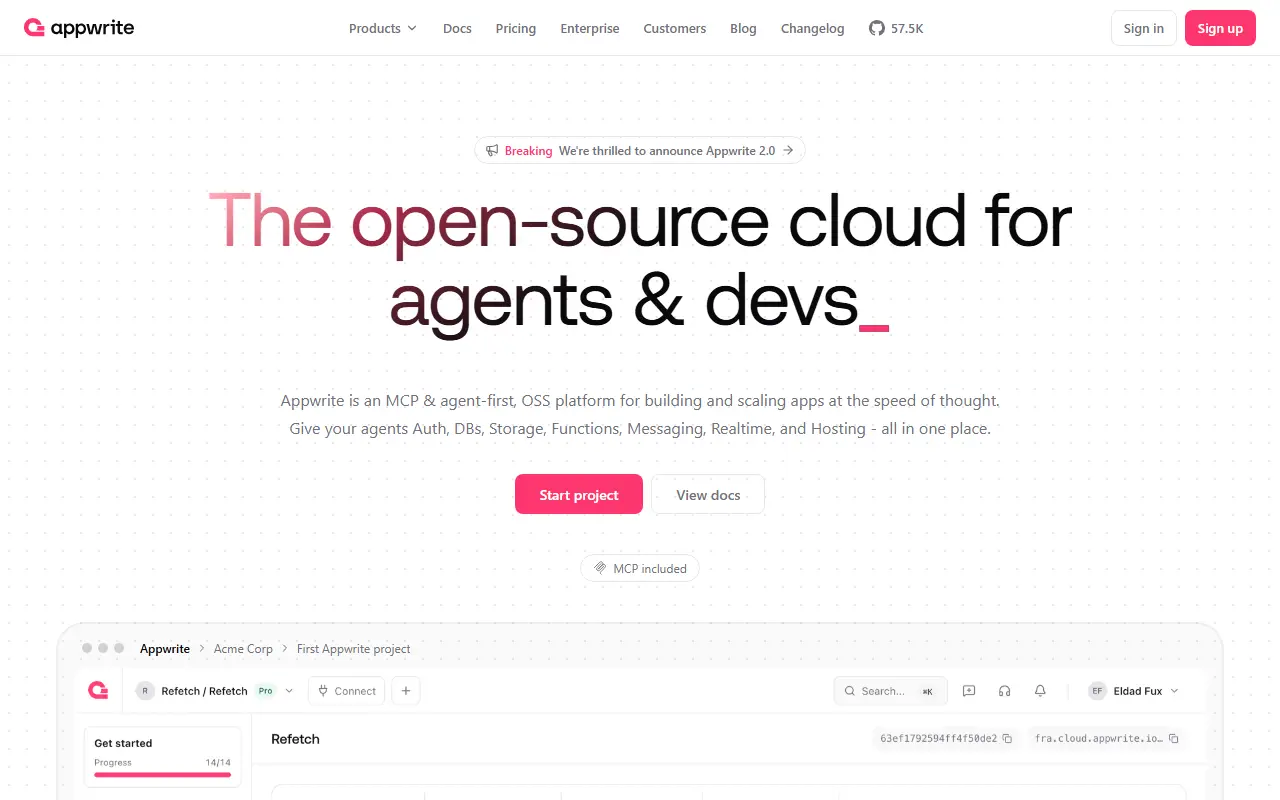
appwrite.ioAppwrite homepage screenshot

Appwrite is an open-source platform for building and scaling web, mobile and AI apps. It bundles the backend services most apps need, namely auth, databases, storage, functions, messaging, realtime and hosting, and presents them as an agent-friendly cloud with MCP support. It can run as a managed cloud platform or be self-hosted on infrastructure you control.

Auth supports email, SMS, OAuth, anonymous sessions and magic URLs. Databases can be modeled and queried through Appwrite itself or backed by managed PostgreSQL and MySQL. Storage keeps files with compression, encryption, image transformations and permission controls, and Functions run serverless code in isolated runtimes triggered by events. Sites deploys static, SSR and CSR frontends from Git with previews, and Messaging sends email, SMS and push notifications.

Developers integrate through client and server SDKs, including Flutter, Swift, React Native and JavaScript, or let coding agents such as Cursor, Claude Code and Codex operate a live project through a hosted MCP server. Appwrite is BSD-3-Clause licensed and written mainly in PHP, with Docker-based self-hosting for Unix and Windows.

Key features

  • Auth with email, SMS, OAuth and magic URLs
  • Databases including managed PostgreSQL and MySQL
  • File storage with encryption and image transformations
  • Serverless functions in isolated runtimes
  • Messaging via email, SMS and push
  • Realtime updates and static or SSR site hosting
  • Hosted MCP server and client and server SDKs

Pricing: A free plan and a Pro plan exist, but the captured page does not show their prices. Dedicated databases start at $10 a month each and go up to $960 a month; serverless databases have no fixed fee.

Directus

A self-hostable data platform that wraps any SQL database with instant REST and GraphQL APIs, a no-code admin app, authentication and an MCP server.

GitHub stars
38k
Last commit
yesterday
Latest release
v12.4.1
Self-hosted
Yes
Hosted version
Available
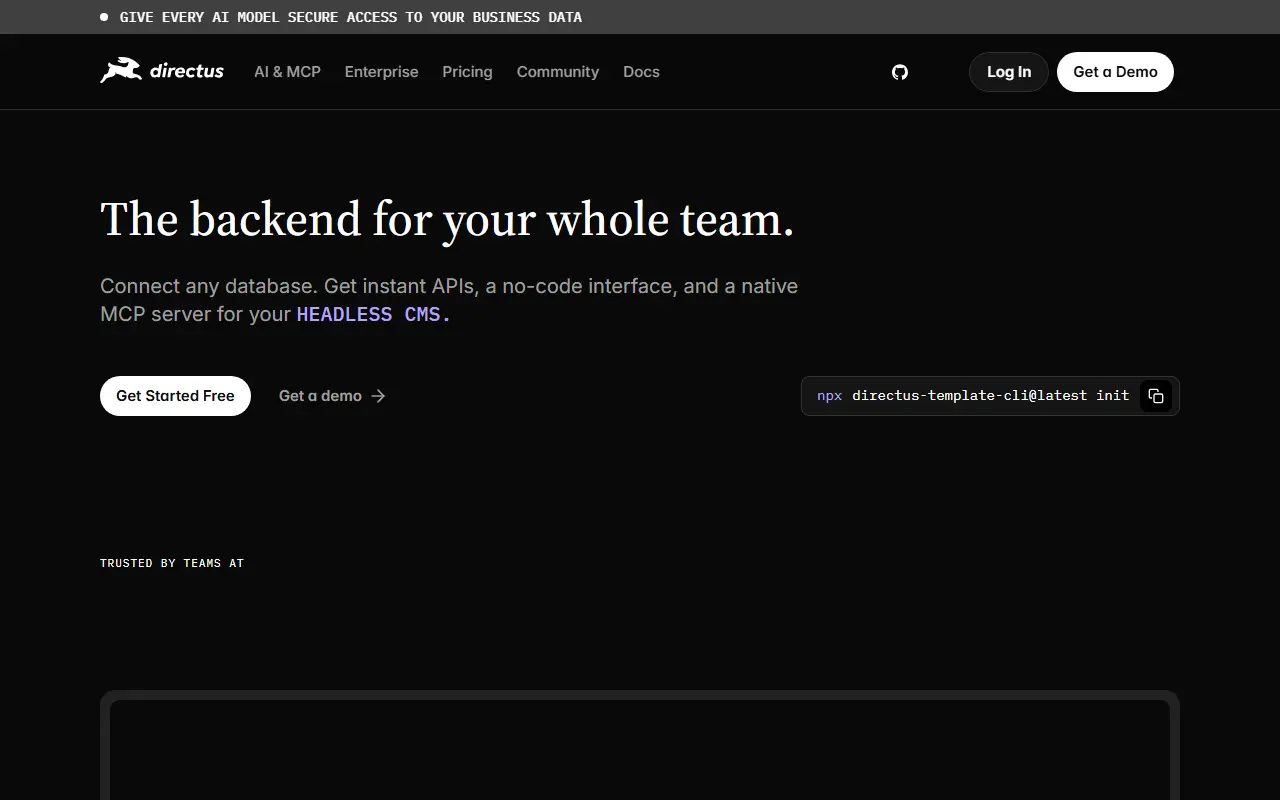
directus.comDirectus homepage screenshot

Directus is a collaborative backend and headless CMS that sits on top of an existing SQL database. You connect a database, and it generates production-ready REST and GraphQL APIs, leaving your schema exactly as built, along with a no-code interface where non-developers can manage content and data.

Beyond content management it provides authentication and access control, so the same install can power websites, apps, admin panels and internal tools. A native Model Context Protocol server gives AI assistants such as Claude, ChatGPT and Cursor secure access to business data. Supported databases include SQLite, MySQL, PostgreSQL and SQL Server, and the app is built with TypeScript and Vue. A template CLI, run through npx, can initialize a project quickly.

Directus can be self-hosted on servers you control, or run on the vendor's Directus Cloud. The repository license is listed as 'Other', so review the terms to see which uses are free. It suits teams that want an API and admin layer over data they already have, without writing a custom backend.

Key features

  • Instant REST and GraphQL APIs over any SQL database
  • No-code data and content interface
  • Authentication and role-based access
  • Native MCP server for AI assistants
  • Works with SQLite, MySQL, PostgreSQL and SQL Server
  • Project templates via npx CLI

Pricing: Core is free with 3 seats. Team is $599 per month billed monthly or $499 per month on an annual commitment; Enterprise is custom. Directus Cloud hosting is a $99 per month add-on, with a 14-day cloud trial.
Hasura

Hasura GraphQL Engine gives applications a single, secure API over databases such as PostgreSQL, MongoDB, ClickHouse and SQL Server.

GitHub stars
32k
Last commit
11 days ago
Latest release
v2.50.3
Licence
Apache-2.0
Self-hosted
Yes
Hosted version
Available
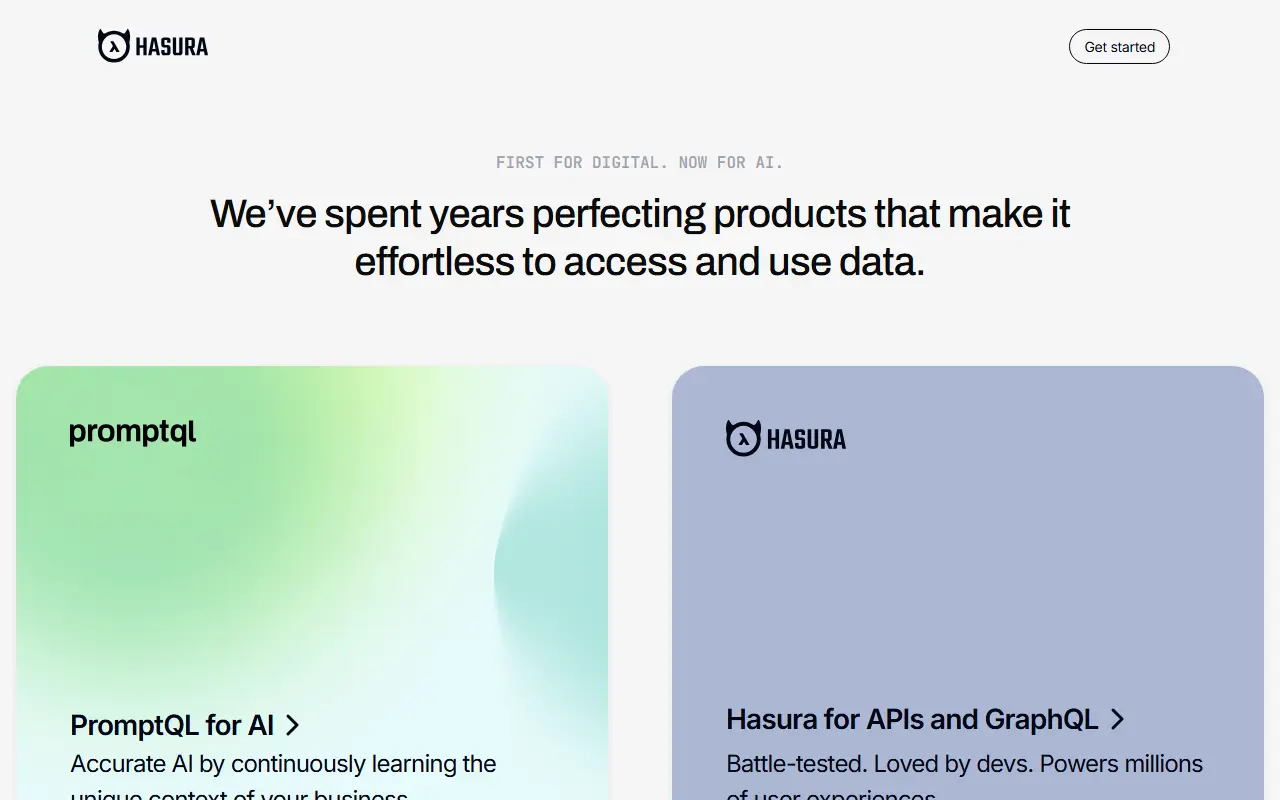
hasura.ioHasura homepage screenshot

Hasura GraphQL Engine is an open-source project for building applications on top of existing data through a single, composable and secure API endpoint. It creates GraphQL APIs automatically, adds fine-grained access control, and can trigger webhooks on database events. The repository holds two generations: V2, the current stable engine, and the V3 engine that powers Hasura DDN. It is released under the Apache-2.0 license.

V3 supports PostgreSQL and its flavors, MongoDB, ClickHouse and Microsoft SQL Server, and lets you write custom business logic with TypeScript, Python and Go connector SDKs. Data connectors link sources to the engine, and the connectors are available as open source from the Connector Hub. The repository's topics also mention BigQuery, REST APIs and subgraph support. The repository is a large mono-repo, so shallow clones are recommended.

Key features

  • Automatic GraphQL APIs over your data
  • Fine-grained access control rules
  • Webhooks triggered by database events
  • Support for PostgreSQL, MongoDB, ClickHouse and SQL Server
  • Connector SDKs for TypeScript, Python and Go
  • V2 stable engine and V3 engine in one repository

Pricing: DDN Free costs nothing. DDN Advanced starts at $30 per active model per month, with a free trial; DDN Base also has a trial but its price is not shown. Private DDN and Enterprise support are by sales.

PostgREST

A standalone server written in Haskell that turns any existing PostgreSQL database into a RESTful API, delegating validation and authorization to the database.

GitHub stars
28k
Last commit
yesterday
Latest release
v16.4
Licence
MIT
Self-hosted
Yes
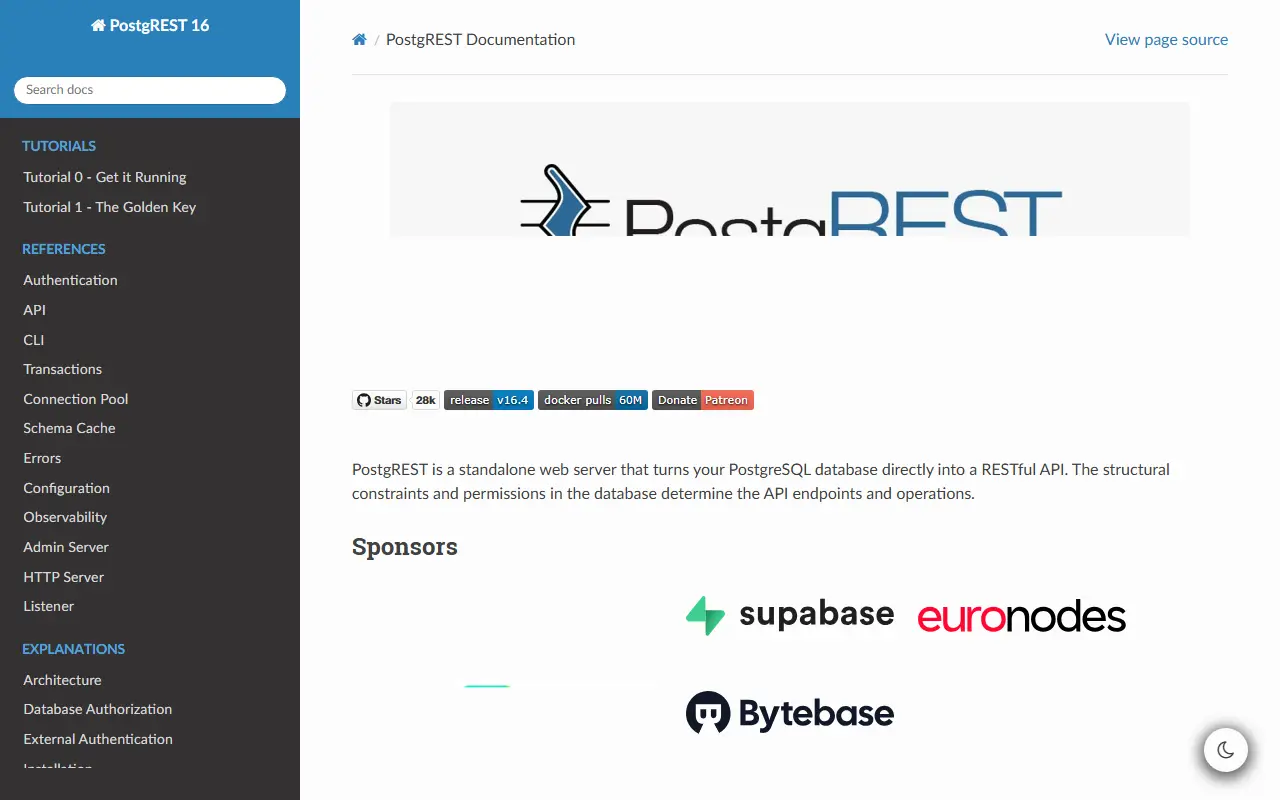
postgrest.orgPostgREST homepage screenshot

PostgREST is a web server that serves a fully RESTful API from an existing PostgreSQL database. The project claims it provides a cleaner, more standards-compliant and faster API than most teams would write by hand, because the database schema itself defines the endpoints.

The server is a Haskell program built on the Warp HTTP library, and it gets its speed from a compiled language with lightweight threads and from pushing as much work as possible into PostgreSQL. That covers building JSON responses directly in SQL, validating data, checking authorization, and counting and fetching rows or posting data in one command. The README cites subsecond response times at around two thousand requests per second on a small hosted instance, though results vary with setup.

To use it you install the binary for your platform or run the Docker image, then point it at your database. PostgREST is MIT licensed, with documentation at postgrest.org and sponsorship through Patreon. It suits developers who want an instant API layer over Postgres, including as a building block inside backend-as-a-service stacks.

Key features

  • REST API generated from a PostgreSQL schema
  • Compiled Haskell server using Warp
  • JSON serialization done inside the database
  • Authorization delegated to PostgreSQL
  • Docker image and platform binaries
  • Extensive online documentation

Pricing: Free and open source under the MIT license.

Nhost

An open-source Firebase alternative built on PostgreSQL, Hasura GraphQL, authentication, storage and serverless functions, available hosted or self-hosted.

GitHub stars
9.3k
Last commit
yesterday
Latest release
cli@1.51.2
Licence
MIT
Self-hosted
Yes
Hosted version
Available
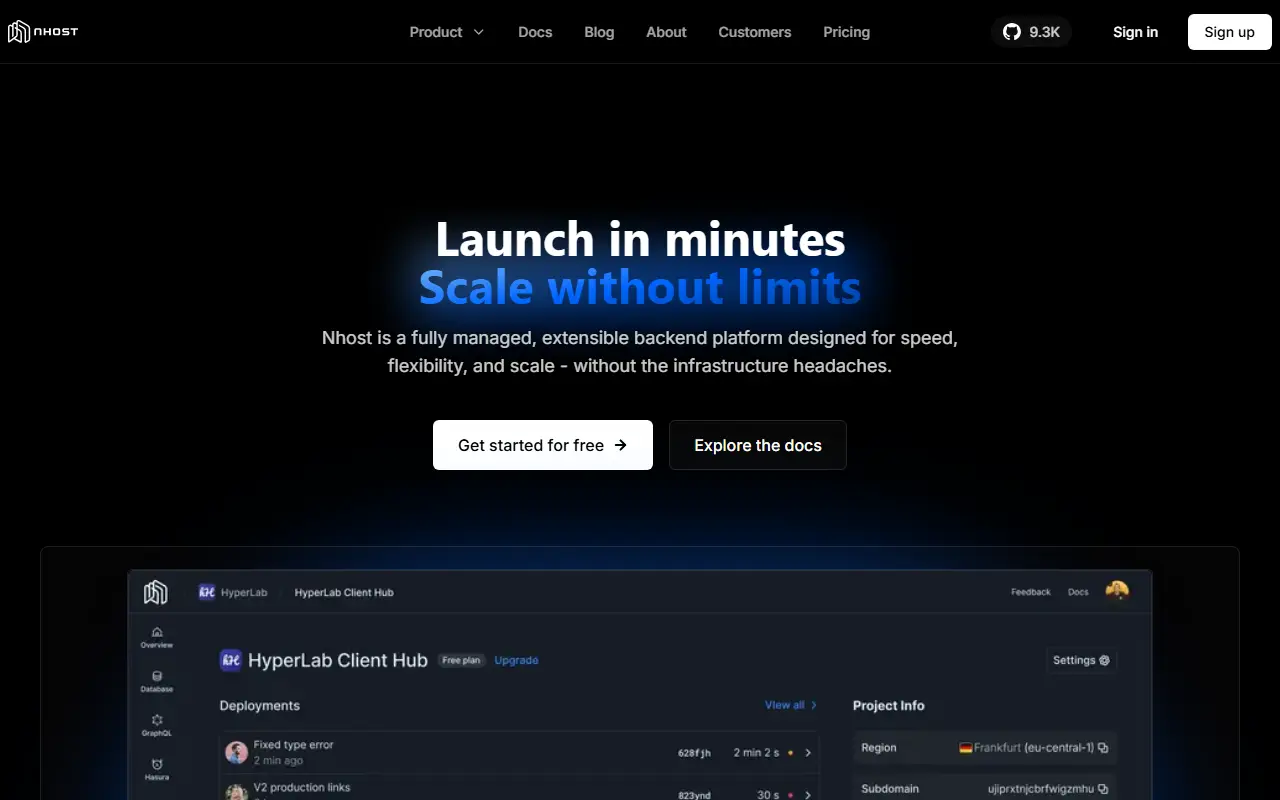
nhost.ioNhost homepage screenshot

Nhost is an open-source backend platform positioned as a Firebase alternative with GraphQL. It is built around open source, GraphQL, SQL and a good developer experience, and gives frontend developers a complete backend without writing server code.

The stack combines a PostgreSQL database, an instant GraphQL API through Hasura, an authentication service, a storage service and serverless functions written in Node.js, in JavaScript or TypeScript. The Nhost CLI creates a local development environment that follows database migrations and Hasura metadata, and a client package called nhost-js is used from the app. Nhost is frontend agnostic, with topics listing Next.js, React, Vue and Flutter.

You can use the Nhost hosted platform, develop locally with the CLI or self-host the entire stack, with an example docker-compose file provided. The project is written in TypeScript and licensed under MIT. It suits developers who prefer SQL and GraphQL to a proprietary NoSQL backend.

Key features

  • PostgreSQL as the core database
  • Instant GraphQL API via Hasura
  • Built-in authentication service
  • File storage service
  • Serverless functions in Node.js
  • CLI for local development
  • Docker Compose self-hosting

Pricing: Free Starter plan with one active project. Pro starts at $25 and Team at $599 per month plus usage; Enterprise is custom. A self-hosted option is also listed.

pREST

pREST turns a PostgreSQL database into an instant REST API, with auth, access control, custom SQL routes and a read-only MCP endpoint.

GitHub stars
4.6k
Last commit
2 days ago
Latest release
v2.4.2
Licence
MIT
Self-hosted
Yes

pREST, short for PostgreSQL REST, is a production-ready service that exposes an existing or new Postgres database as an HTTP API. It delivers CRUD endpoints, custom SQL routes, authentication and access control lists without you having to hand-write a back end, and it adds a read-only endpoint for the Model Context Protocol so AI clients can query data.

It requires PostgreSQL 9.5 or newer and can be obtained with Docker, Homebrew or Go. The documentation covers configuration, an API reference, MCP over HTTP, multi-database setups and the roadmap, plus guidance for AI clients such as Cursor and Claude. Topics list JWT, OpenAPI, TimescaleDB and microservice use, and it is written in Go.

pREST is licensed under MIT and is self-hosted. It suits developers who want a quick, low-code back end on top of Postgres for prototypes, internal tools or microservices, without adopting a larger backend-as-a-service platform.

Key features

  • Instant REST API over PostgreSQL
  • CRUD endpoints without custom backend code
  • Custom SQL routes
  • Authentication, JWT and ACL
  • Read-only MCP endpoint
  • Support for multiple databases

Pricing: Free and open source under the MIT license.

Amplication

Platform for generating and maintaining backend services from live templates that embed company standards, with a service catalog and AI-assisted generation.

GitHub stars
16k
Last commit
3 mo ago
Latest release
v3.15.0
Self-hosted
Yes
Hosted version
Available
amplication.comAmplication homepage screenshot

Amplication helps teams build, maintain, and scale backend services that follow their organization's standards. Platform engineers define live templates that capture best practices, which Amplication uses to generate microservices with the APIs, data models, DTOs, and other pieces needed for a business domain, so engineers can concentrate on business logic. The input lists its license only as other.

The project describes these templates as golden paths: streamlined workflows that improve consistency, onboarding, and delivery across teams. Generated services stay up to date because Amplication handles package updates, patches, and versioning, reducing technical debt. It also includes a service catalog, and its topics reference NestJS, Prisma, GraphQL, Node.js, and .NET code generation.

Amplication suits platform engineering teams and larger development organizations that want to standardize how new services are created. The repository is open source, and a hosted platform is available from the vendor, so check the repository and website for licensing and plan details.

Key features

  • Live templates embedding company best practices
  • Generated microservices with APIs and data models
  • Service catalog
  • Automatic package updates and patches
  • AI-assisted code generation
  • Node.js and .NET code generation

FastSchema

Go backend-as-a-service and headless CMS that generates database tables and CRUD APIs from schemas, with an admin interface and role-based access.

GitHub stars
575
Last commit
2 mo ago
Latest release
v0.15.1
Licence
MIT
Self-hosted
Yes
fastschema.comFastSchema homepage screenshot

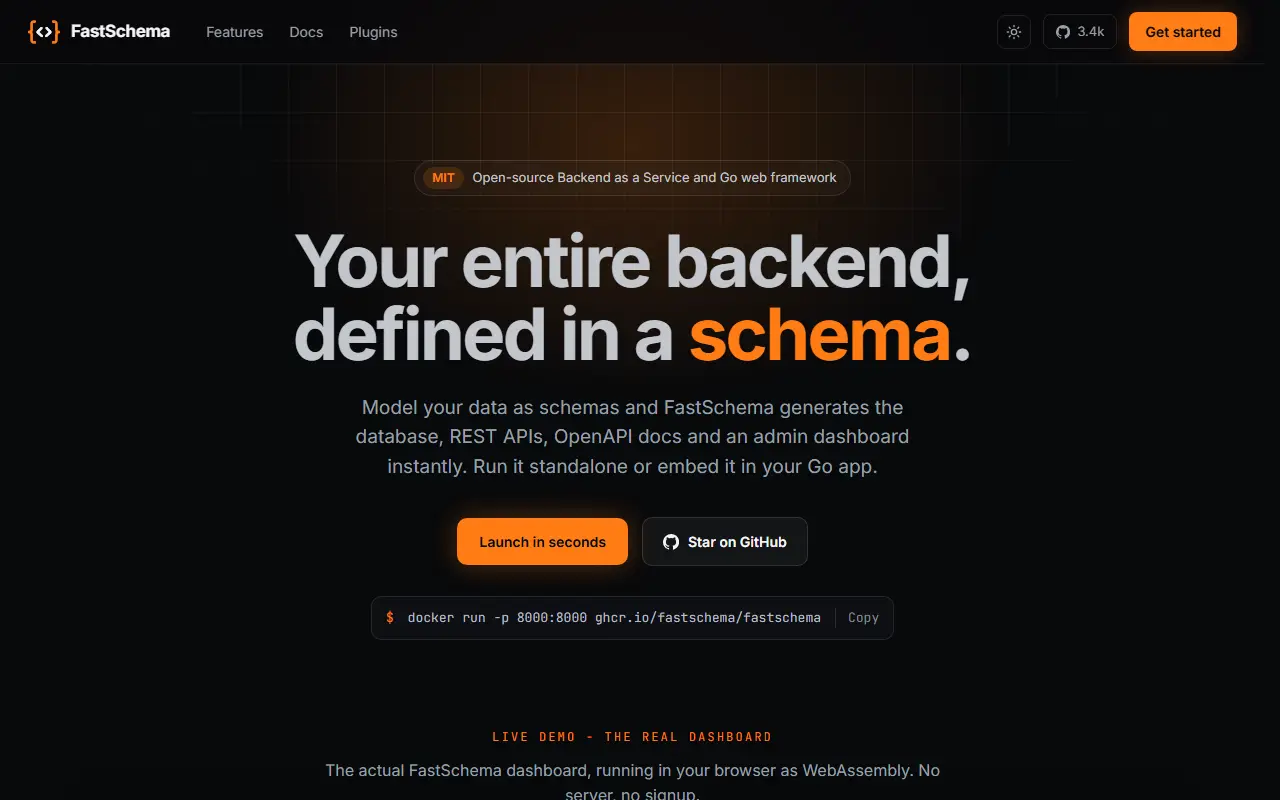
FastSchema is a backend-as-a-service and Go web framework for building dynamic web applications. It is built around schemas that describe the structure of your content; from those it generates database tables and ready-to-use CRUD API endpoints, so developers can have a working backend or headless CMS without hand-writing the plumbing. It can be used as a no-code style BaaS or as a framework inside Go projects.

Running the Docker container prints a setup token and starts a setup page at the local server, where you create the initial configuration. The project lists headless CMS capabilities, structured content management and real-time data handling, and its topics mention role-based access control, no-code and low-code use. The front-end admin interface is built with React.

The README states that FastSchema is in beta and under active development, and the maintainers welcome feedback and contributions. It is written in Go and licensed under MIT. It suits small teams and solo developers who want to avoid assembling a CMS, API layer and permissions system themselves.

Key features

  • Schema-driven database and API generation
  • Ready-made CRUD endpoints
  • Headless CMS capabilities
  • Docker-based quick start
  • Usable as a Go web framework
  • Role-based access control

Pricing: Free and open source under the MIT license.

1 more Xano alternative

Xano alternatives: questions

What is the best open-source alternative to Xano?
Supabase is the top-ranked open-source alternative to Xano on Enlisted: An open-source Postgres development platform bundling a database, auth, auto-generated APIs, realtime, storage and vector tools, often chosen as a Firebase alternative. Other strong options are PocketBase, Appwrite, Directus and Hasura.
Are these Xano alternatives free?
All 11 are open source, so the code is free to use under its licence, and 10 of them can be self-hosted on your own server or computer. 7 also offer a paid or managed cloud version if you'd rather not host it yourself.
How is this list of Xano alternatives ranked?
By a score built from GitHub stars, star growth over the last 30 days and how recently the code changed. 8 of these projects shipped code in the last 30 days. Data is refreshed daily, and nobody can pay to move up.

People also look for alternatives to…

View all