7,363 open-source and SaaS tools, with GitHub stats refreshed every day.

9 alternatives ranked by real activity

Open-source WordPress.com alternatives

A curated, ranked list of the 9 best open-source alternatives to WordPress.com.

The best open-source alternative to WordPress.com is Ghost. If that doesn't suit you, other good options are Halo, WordPress, Grav and EmDash.

WordPress.com alternatives are mainly CMS tools. 9 of them shipped code in the last 30 days, 9 can be self-hosted, and 4 use a permissive licence.

Last updated October 2, 2026 · ranked by GitHub stars, growth and recent commits

Ghost

An open-source publishing platform for blogs, newsletters, memberships and paid subscriptions, available as the Ghost(Pro) managed service or self-hosted on Node.js.

GitHub stars
55k
Last commit
today
Latest release
v6.67.0
Licence
MIT
Self-hosted
Yes
Hosted version
Available
ghost.orgGhost homepage screenshot

Ghost is a publishing platform for independent writers and media businesses. It handles blogging, newsletters, memberships and subscriptions in one product, so a creator can publish articles, email them to subscribers and charge for access without stitching several tools together.

The project is written in JavaScript and TypeScript on Node.js. The official way to get a production site running is the Ghost(Pro) managed service, which launches a site with a worldwide CDN, backups, security and maintenance handled for you, and the maintainers state that all revenue from it funds the nonprofit Ghost Foundation. If you prefer to run your own instance, a CLI tool installs Ghost locally in about a minute or on a server with automatic SSL through Let's Encrypt.

Ghost is MIT licensed and comes with official documentation, a forum and an active contributor community. It suits journalists, bloggers and publishers who want a focused publishing and membership tool rather than a general-purpose CMS.

Key features

  • Publishing editor for blogs and articles
  • Built-in newsletters sent to subscribers
  • Memberships and paid subscriptions
  • CLI installer with automatic SSL
  • Managed hosting with CDN and backups
  • Extensible through documented APIs and themes

Pricing: Ghost(Pro) managed hosting starts at $18 per month billed yearly for Starter, then $29 for Publisher and $199 for Business; Custom is quoted. Plans can be tried free.


Read more about GhostWebsite GitHub

Halo

An open-source website builder written in Java for blogs, knowledge bases, company sites and online stores, with a plugin and theme marketplace and Docker setup.

GitHub stars
40k
Last commit
2 days ago
Latest release
v2.26.1
Licence
GPL-3.0
Self-hosted
Yes
halo.runHalo homepage screenshot

Halo is an open-source website building tool written in Java. It targets a range of needs, from personal blogs and knowledge bases to corporate websites and online shops, and aims to cover them all in a single, easy-to-use system. Its documentation and project text are primarily in Chinese.

A quick-start Docker command launches a trial environment, and the maintainers recommend deploying with the 1Panel server management panel for reverse proxy, SSL certificates and upgrade and backup handling. An application market offers more than 100 free themes and plugins, and developers can publish their own. A public demo environment is available for exploring the admin interface.

Halo comes in three editions. The Community edition is free under GPL-3.0 and suits individual developers and open-source projects. The Professional edition adds features such as a mobile app, AI site generation, phone number login and a paid theme and plugin market. A Commerce edition adds an integrated online store with payment support for the Chinese market, including WeChat Pay and Alipay.

Key features

  • Website builder for blogs and company sites
  • Theme and plugin application market
  • Docker quick start
  • Knowledge base and documentation sites
  • Optional online store in the Commerce edition
  • Mobile app and AI site generation in Professional edition

Pricing: The Community edition is free and open source under GPL-3.0; Professional and Commerce editions add paid features.

Read more about HaloWebsite GitHub

WordPress

WordPress is an open-source publishing platform and CMS for building websites, blogs and online stores with themes, blocks and plugins.

GitHub stars
21k
Last commit
today
Self-hosted
Yes
Hosted version
Available
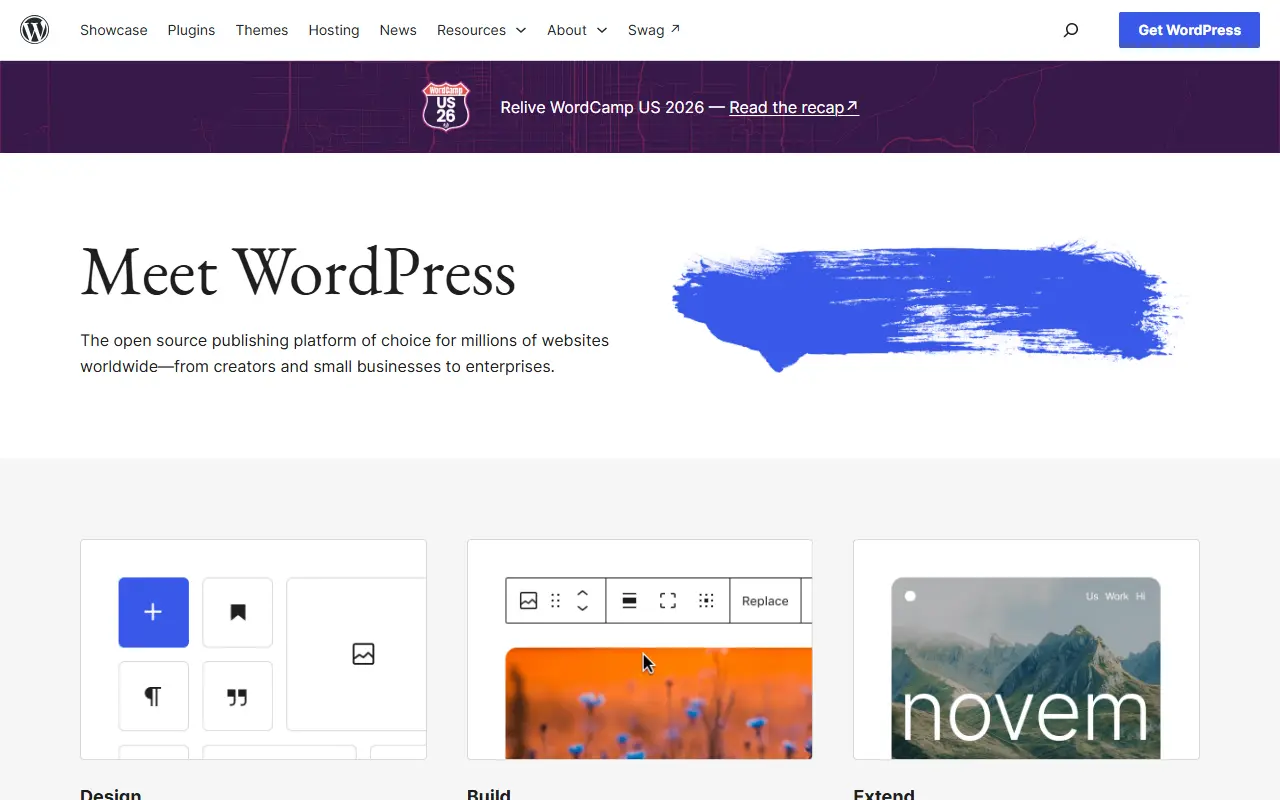
wordpress.orgWordPress homepage screenshot

WordPress is a content management system and publishing platform for building websites, blogs and apps. People write and organize content in a browser-based editor, choose how the site looks with themes, and publish without writing code. Its own site describes it as the platform behind millions of websites, from creators and small businesses to enterprises.

Design and editing are built around blocks, so pages can be assembled and rearranged visually with a live preview as content changes. Styling can be adjusted for different screen sizes and interactive states without writing CSS. Functionality is extended through a large library of plugins that add features such as stores, analytics, newsletters and social media integration.

The software is written in PHP and is open source; the GitHub repository is a read-only mirror of the project's Subversion repository, with development happening elsewhere. You can run it on your own hosting, and a managed service is also available through WordPress.com. It suits individual bloggers, small businesses and larger organizations alike.

Key features

  • Block-based page and post editor
  • Themes for site design
  • Plugin library for extra functionality
  • Site editor with responsive styling controls
  • Media library with a built-in editor
  • Runs on your own PHP hosting

Pricing: The software is free and open source; costs come from hosting and any paid themes or plugins you choose.

Read more about WordPressWebsite GitHub

Grav

A flat-file CMS written in PHP that needs no database, using Markdown content, Twig templates and YAML configuration, with a package manager for plugins and themes.

GitHub stars
16k
Last commit
yesterday
Latest release
2.2.4
Licence
MIT
Self-hosted
Yes
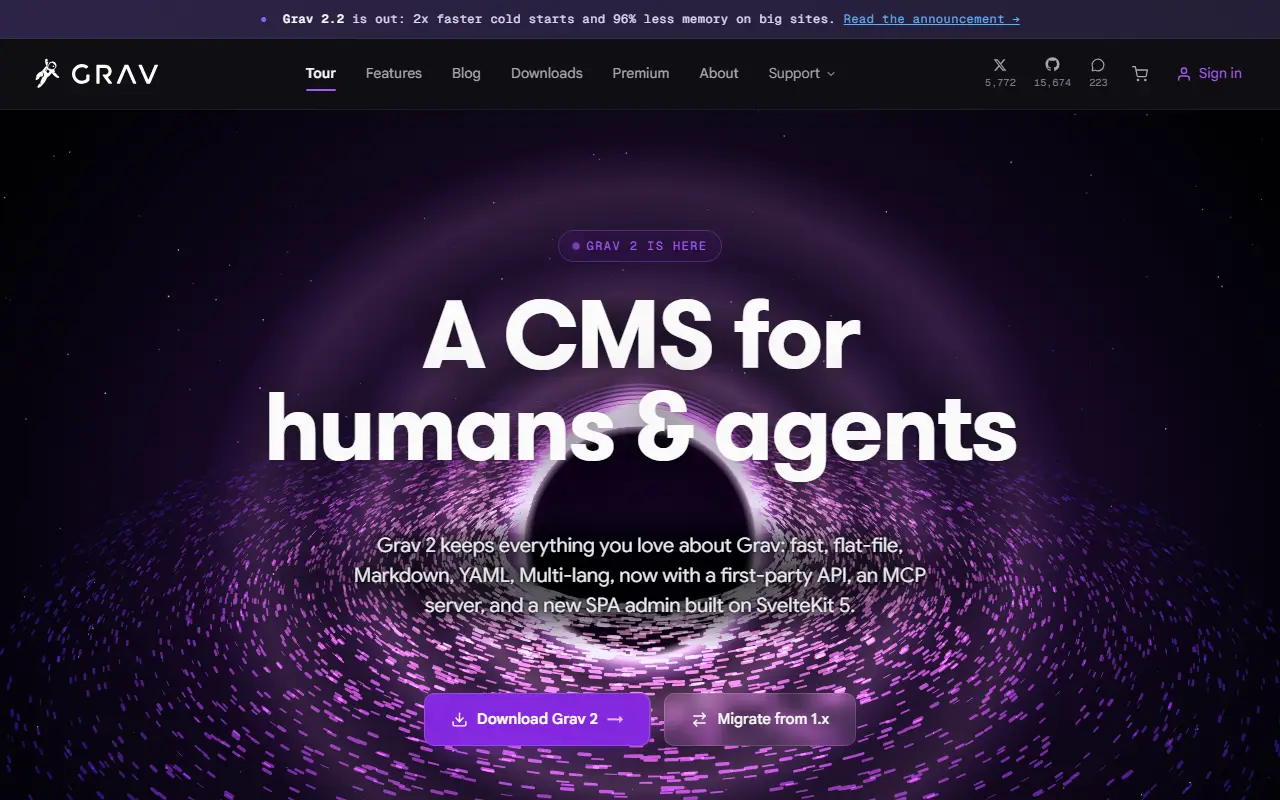
getgrav.orgGrav homepage screenshot

Grav is a file-based web platform written in PHP. There is nothing to install in the traditional sense: you extract the archive and the site is running, and content lives in plain files rather than a database. It follows the flat-file CMS approach but with its own design philosophy.

Content is written in Markdown, templates use Twig, and configuration is in YAML. Under the hood it relies on established components, including Parsedown for Markdown, Symfony Cache, the Pimple dependency injection container, the Symfony Event Dispatcher for plugin events, Symfony Console for the command line and the Gregwar image library for dynamic image handling. A built-in package management system makes installing and upgrading plugins and themes straightforward, and it can update Grav itself.

Grav is MIT licensed and aimed at developers and small organizations that want a fast, simple CMS they can version in Git and host on cheap PHP hosting. Its topics cover website building and generation, and an admin plugin offers a web interface for those who prefer one.

Key features

  • Flat-file CMS with no database
  • Markdown content and Twig templates
  • Configuration written in YAML
  • Package manager for plugins and themes
  • Architecture built on Symfony components
  • Dynamic image manipulation

Pricing: Free and open source under the MIT license.

Read more about GravWebsite GitHub

EmDash

A TypeScript content management system on Astro and Cloudflare that carries WordPress-style extensibility into a serverless design, with plugins isolated in sandboxes.

GitHub stars
13k
Last commit
today
Latest release
@emdash-cms/plugin-test@0.2.7
Licence
MIT
Self-hosted
Yes
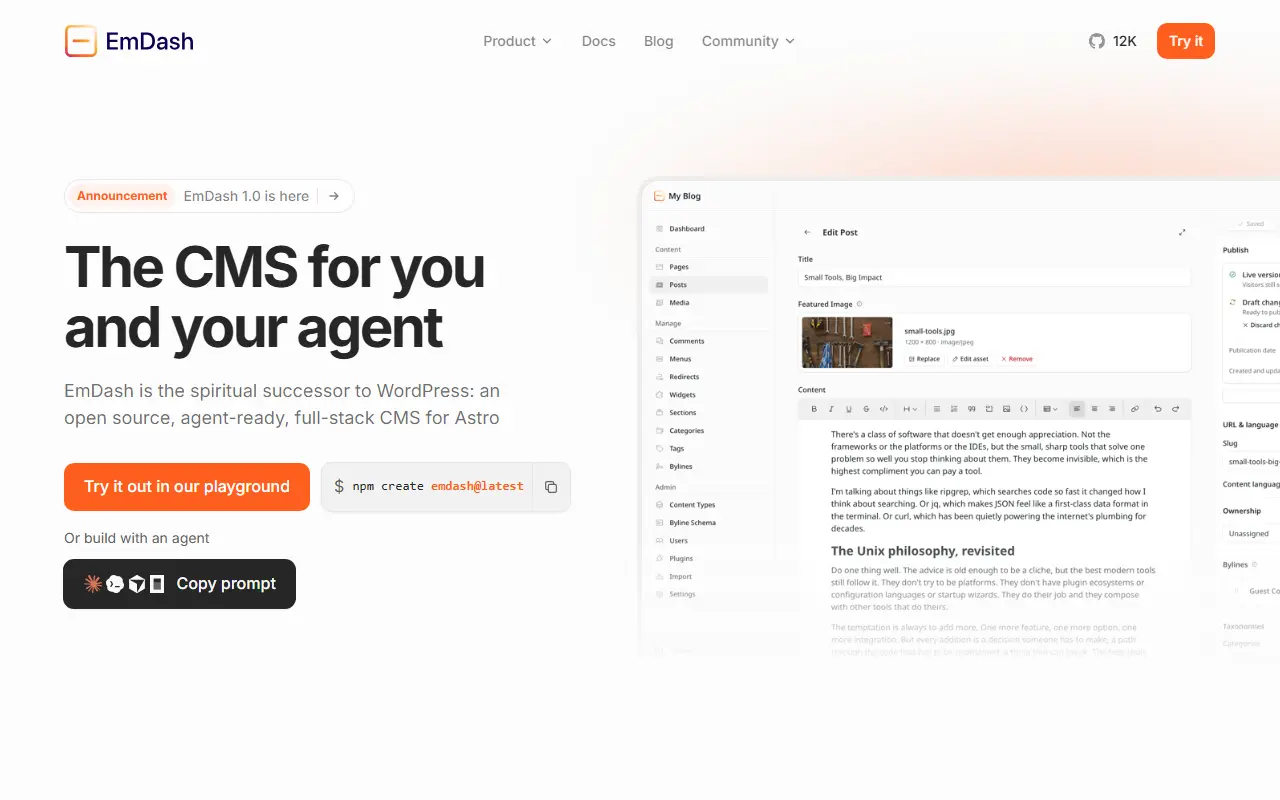
emdashcms.comEmDash homepage screenshot

EmDash is a full-stack TypeScript content management system built on Astro and Cloudflare. It borrows what made WordPress popular, including extensibility, a friendly admin and a large plugin ecosystem, and re-implements it on a serverless, type-safe base with no PHP or separate hosting tier.

A key design choice is that plugins run in sandboxed Worker isolates, each with a declared capability manifest, so a plugin that asks for permission to read content and send email can do just that. This is meant to address the security problems of WordPress plugins having broad access to the database and filesystem. The README also describes structured content in place of serialized HTML.

EmDash runs on Cloudflare using D1, R2 and Workers, or on any Node.js server with SQLite, and can be deployed directly to a Cloudflare account. It ships with three starter templates, a blog, a marketing landing page and a portfolio. The project is MIT licensed and began in April 2026, so it is young and still evolving.

Key features

  • Built on Astro with TypeScript
  • Sandboxed plugins in Worker isolates
  • Capability manifests for plugin permissions
  • Runs on Cloudflare or Node.js with SQLite
  • Blog, marketing and portfolio starter templates
  • Structured content instead of serialized HTML

Pricing: Free and open source under the MIT licence.

Read more about EmDashWebsite GitHub

Joomla

Joomla is a long-established open-source PHP content management system for building multilingual websites, with a large extension ecosystem.

GitHub stars
5.1k
Last commit
today
Latest release
6.1.4
Licence
GPL-2.0
Self-hosted
Yes
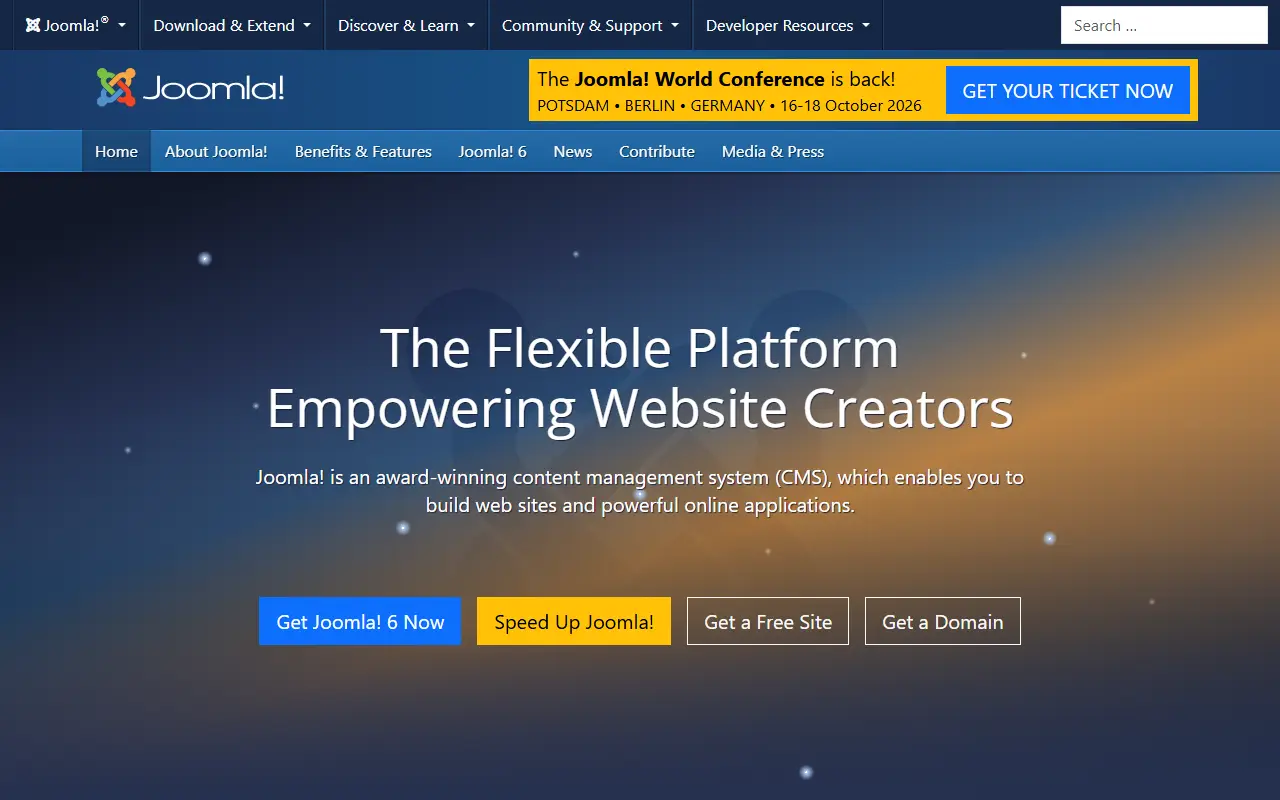
joomla.orgJoomla homepage screenshot

Joomla is a free, open-source content management system written in PHP. It lets site owners and developers build, organize and publish websites and web applications through an administrator interface, and it is tagged as both a CMS and a website builder with multilingual capabilities.

This repository contains the source of the current Joomla CMS, with version history and detailed changelogs published on the project site and continuous integration status shown for PHP and Node. Joomla relies on a large community of extension developers and translators to extend the core, and the project promotes contributions through Hacktoberfest.

Joomla is licensed under GPL-2.0 and installed on your own web hosting with a database. It suits small business sites, community portals, publishers and agencies that want a mature, extensible PHP CMS with built-in support for multiple languages.

Key features

  • PHP content management system
  • Multilingual website support
  • Administrator back end for editors
  • Extensions and templates ecosystem
  • Published version history and changelogs
  • Active community development

Pricing: Free and open source under GPL-2.0.

Read more about JoomlaWebsite GitHub

Drupal

A mirror of the Drupal core repository, an open-source content management platform used for sites from personal blogs to large community websites.

GitHub stars
4.3k
Last commit
today
Self-hosted
Yes
drupal.orgDrupal homepage screenshot

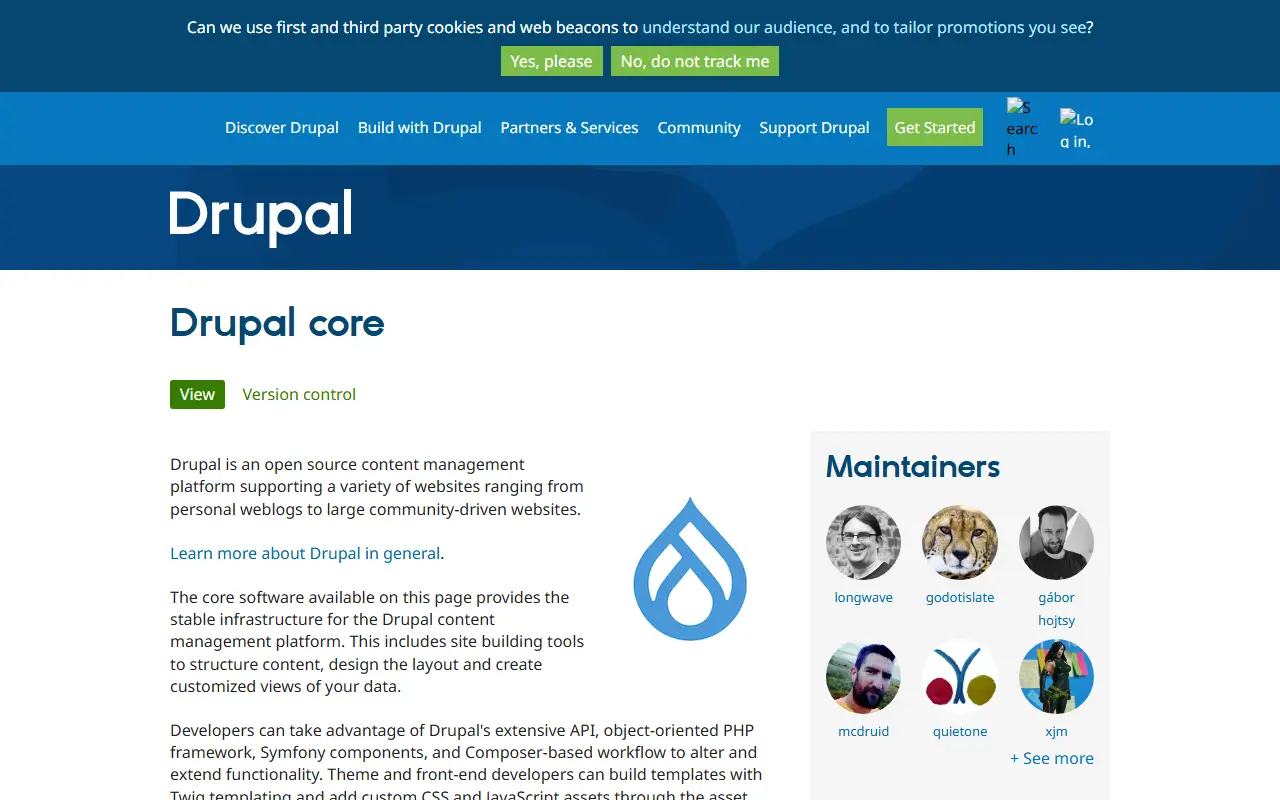
Drupal is an open-source content management platform that supports websites ranging from personal weblogs to large community-driven sites. This GitHub repository is a verbatim mirror of the Drupal core repository on git.drupal.org, and pull requests are not accepted here.

Development takes place on Drupal.org, which has hosted the international Drupal community since 2001 and provides the GitLab repository, issue queue and documentation. Contributors use issue forks and merge requests. The core feature set can be extended with thousands of free, open-source modules, and many projects can be built mostly by assembling those modules before writing custom code.

Drupal keeps detailed change records covering notable breaking changes and new features since 2011, publishes security advisories through a page and RSS feed, and describes a formal security process. The software is written in PHP, and, as is widely known, it is released under the GPL.

Key features

  • Content management platform
  • Thousands of free community modules
  • Detailed change records
  • Security advisories with RSS feed
  • Issue forks and merge requests workflow

Pricing: Free and open source.

Read more about DrupalWebsite GitHub

Microweber

Microweber pairs a visual drag-and-drop site builder with a Laravel CMS, and adds e-commerce, blogging and ready-made modules.

GitHub stars
3.4k
Last commit
3 days ago
Latest release
v2.0.20
Licence
MIT
Self-hosted
Yes

Microweber combines a drag-and-drop page builder with a content management system on the PHP Laravel framework. It aims to let people create websites, online stores and blogs without technical skills, while still giving developers a modern code base to extend.

The README describes an array of modules, customizations and features tailored for e-commerce, and the current 2.0 version runs on Laravel 10. A shopping cart and content management features sit alongside the visual editor, and the documentation covers system requirements, installation and getting started. Topics include website builder and drag-and-drop.

Microweber is MIT-licensed and can be installed on your own hosting. It suits small businesses, freelancers and agencies that want to build a site or store visually, on an open-source PHP stack they can still modify.

Key features

  • Drag-and-drop page builder
  • CMS built on Laravel
  • Built-in e-commerce and shopping cart
  • Blog and content management
  • Modules and customizations
  • Runs on Laravel 10

Pricing: Free and open source under the MIT license.

Read more about MicroweberWebsite GitHub

ClassicPress

ClassicPress is a community-led, lightweight CMS forked from WordPress 6.2 that keeps the classic editor and drops the block editor.

GitHub stars
861
Last commit
yesterday
Latest release
2.7.3+dev
Licence
GPL-2.0
Self-hosted
Yes
classicpress.netClassicPress homepage screenshot

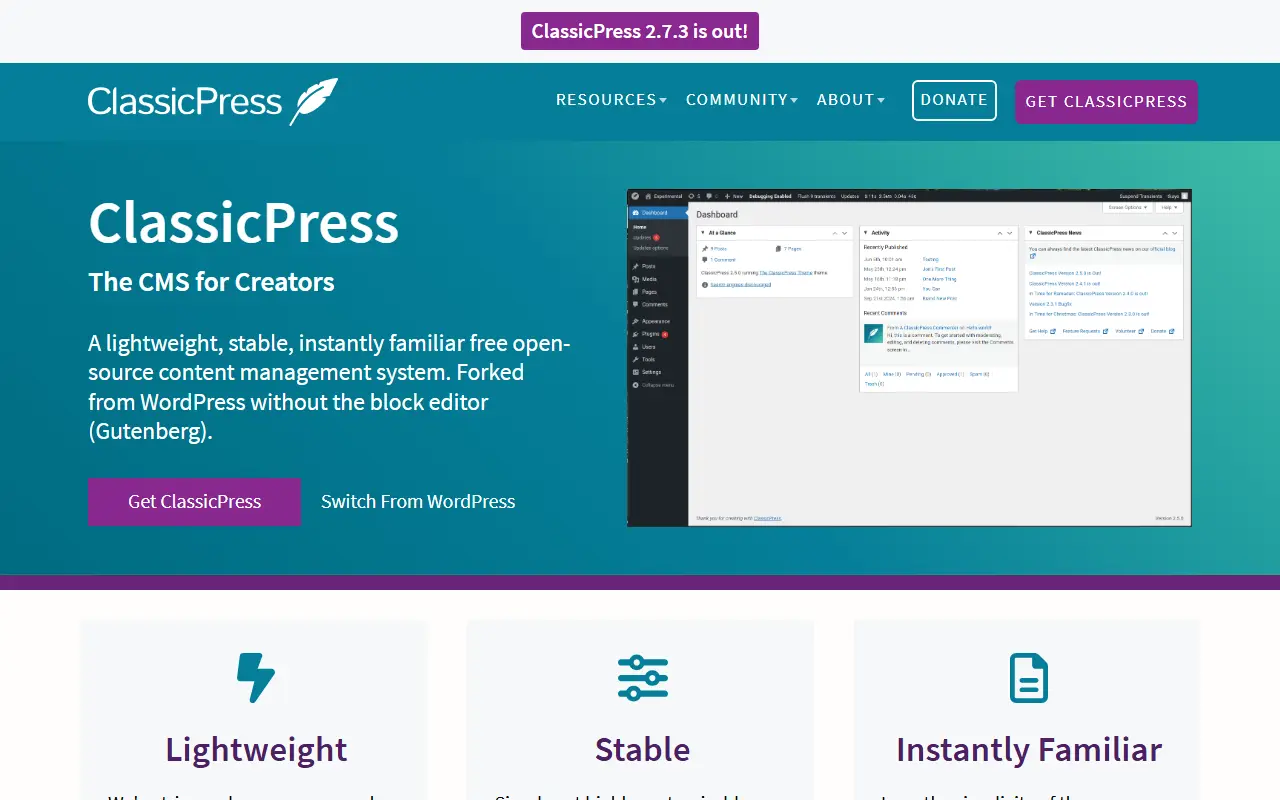
ClassicPress is a community-led open-source content management system for creators. It is a fork of WordPress 6.2 that preserves the classic TinyMCE editor as the default, so site owners who prefer the traditional editing experience keep a familiar interface.

According to the project, it is about half the size of WordPress, carries less bloat for better performance and does not include the block editor (Gutenberg) or full site editing. Because it descends from WordPress, its PHP code, admin interface and extension model remain familiar to WordPress developers, and the project credits the long history of WordPress contributions.

ClassicPress is written in PHP and licensed under GPL-2.0, and you host it on your own PHP web hosting. Governance, documentation and a feature-suggestion process are published on the project site, and it is funded through corporate sponsors and donations.

Key features

  • Fork of WordPress 6.2
  • Classic TinyMCE editor by default
  • No block editor or site editing
  • Smaller codebase than WordPress
  • Familiar admin interface
  • Community governance

Pricing: Free and open source under the GPL-2.0 license.

WordPress.com alternatives: questions

What is the best open-source alternative to WordPress.com?
Ghost is the top-ranked open-source alternative to WordPress.com on Enlisted: An open-source publishing platform for blogs, newsletters, memberships and paid subscriptions, available as the Ghost(Pro) managed service or self-hosted on Node.js. Other strong options are Halo, WordPress, Grav and EmDash.
Are these WordPress.com alternatives free?
All 9 are open source, so the code is free to use under its licence, and all of them can be self-hosted on your own server or computer. 2 also offer a paid or managed cloud version if you'd rather not host it yourself.
How is this list of WordPress.com alternatives ranked?
By a score built from GitHub stars, star growth over the last 30 days and how recently the code changed. 9 of these projects shipped code in the last 30 days. Data is refreshed daily, and nobody can pay to move up.

People also look for alternatives to…

View all