#1
A fair-code workflow automation platform that mixes a visual canvas with custom code and AI agent features, for teams connecting apps and automating processes.
- GitHub stars
- 210k
- Last commit
- today
- Latest release
- n8n@2.47.5
- Self-hosted
- Yes
- Hosted version
- Available
n8n.io
n8n is a workflow automation platform for connecting apps, moving data between them and triggering actions without writing a full integration from scratch. Workflows are built on a visual canvas, and when a step needs more logic you can drop in JavaScript or Python and use npm packages. It is often compared with Zapier and Make, but the source is public and it can run on your own infrastructure.
Recent versions put a lot of weight on AI. You can build multi-step agents and LLM workflows that call OpenAI, Anthropic, Google or open-source models, add human approval steps, and inspect what happened afterward. The project advertises over a thousand integrations and a large library of ready-made workflow templates, and you can extend it with your own nodes.
n8n is distributed under a fair-code model: the Sustainable Use License, plus a separate enterprise license for additional features. The code is always visible and can be self-hosted, for example with Docker, but it is not an OSI-approved open-source license, so commercial redistribution is restricted. A managed cloud edition is available if you would rather not run it yourself.
Key features
- Visual workflow canvas with branching logic
- JavaScript and Python code steps with npm packages
- Multi-step AI agents with human approval
- Over 1,500 integrations plus reusable templates
- Connects to OpenAI, Anthropic, Google or local models
- Role-based access and audit trails
- Self-hosting with Docker or managed cloud
Pricing: Free self-hosted Community Edition. Hosted plans cost 20€ (Starter), 50€ (Pro) and 667€ (Business) per month billed annually, scaled by workflow executions; Enterprise is custom. Free trial available.
#2
Temporal is a durable execution platform whose server runs application workflows resiliently, retrying failed operations automatically.
- GitHub stars
- 24k
- Last commit
- yesterday
- Latest release
- v1.32.2
- Licence
- MIT
- Self-hosted
- Yes
- Hosted version
- Available
docs.temporal.io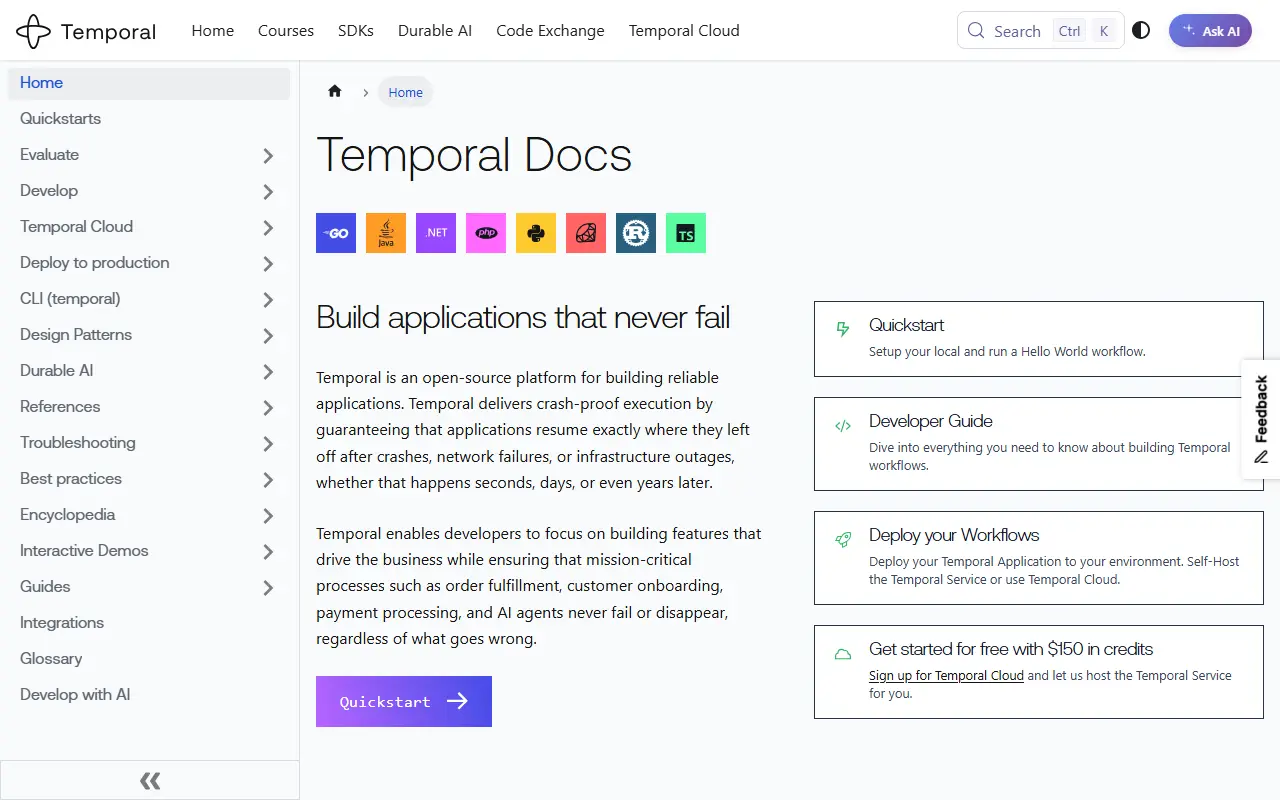
Temporal is a durable execution platform that helps developers create scalable applications while keeping both productivity and reliability. The Temporal server runs units of application logic called Workflows, handling intermittent failures and retrying failed operations automatically. It started as a fork of Uber's Cadence and is developed by Temporal Technologies, a company founded by Cadence's creators. The server is written in Go and released under the MIT license.
This repository contains the source of the server only. To implement Workflows, Activities and Workers you use one of the supported language SDKs. The getting started guide shows how to download and run a pre-built image with its dependencies locally, try samples written for Go or Java, interact with the server through the Temporal CLI, and watch workflows in the Web UI at port 8233. Repository topics cover workflow engines, distributed cron, microservice orchestration and durable execution.
Key features
- Durable execution of long-running workflows
- Automatic retries for failed operations
- SDKs for writing Workflows and Activities
- Temporal CLI for interacting with the server
- Web UI for viewing running workflows
- Distributed cron-style scheduling
Pricing: Server is free and open source under the MIT license; a managed cloud service is also offered by Temporal Technologies.
#3
An Apache workflow orchestration platform where data teams author, schedule and monitor pipelines as Python code, widely used for data engineering and ELT jobs.
- GitHub stars
- 47k
- Last commit
- today
- Latest release
- 3.4.0
- Licence
- Apache-2.0
- Self-hosted
- Yes
airflow.apache.org
Apache Airflow is a workflow platform where you write, schedule and watch over pipelines in code. Workflows are defined as Python code in the form of directed acyclic graphs, or DAGs, where each task and its dependencies are explicit, so pipelines can be versioned, tested and reviewed like any other software.
A scheduler runs tasks on a defined cadence and workers execute them, while a web interface shows the status of each run, lets you inspect logs and retry failures. Airflow is used heavily in data engineering, including data integration, ELT and ETL pipelines, data orchestration and machine learning workflows, and its topics cover data science and automation. It has a large ecosystem of providers and operators for connecting to databases, cloud services and other systems, and the 3.x line is the current series.
Airflow is an Apache Software Foundation project under the Apache-2.0 license and runs on your own infrastructure, from a single machine to Kubernetes. Several vendors offer managed Airflow services, but the project itself is self-hosted software. It suits data engineers who prefer code-first orchestration over drag-and-drop tools.
Key features
- Workflows defined as Python DAGs
- Scheduler for recurring and dependent tasks
- Web UI for monitoring runs and logs
- Retries and task dependency management
- Large provider ecosystem of integrations
- Runs on single machines or Kubernetes
Pricing: Free and open source under the Apache-2.0 license.
#4
Activepieces is an open-source, self-hostable no-code automation platform with AI agents and integrations written as TypeScript pieces.
- GitHub stars
- 25k
- Last commit
- yesterday
- Latest release
- 0.93.0
- Self-hosted
- Yes
- Hosted version
- Available
activepieces.com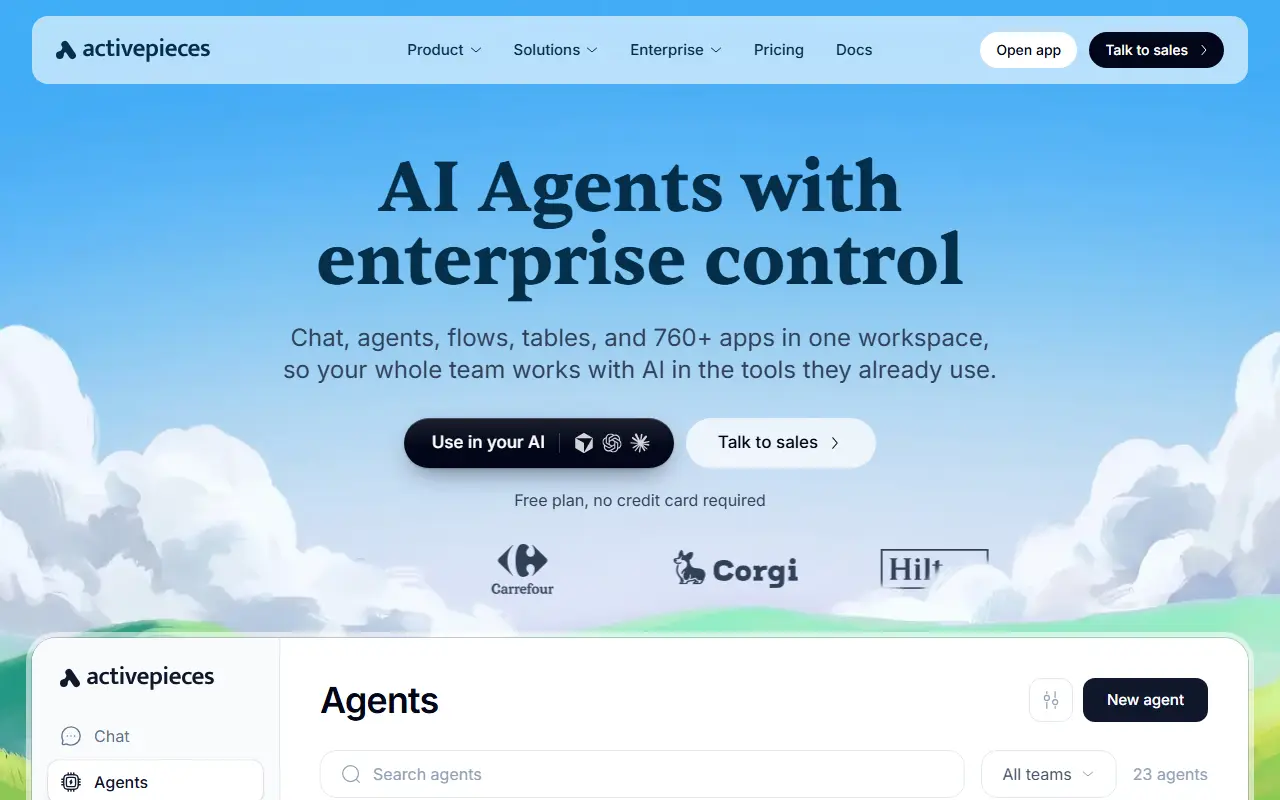
Activepieces is an open-source replacement for Zapier, positioned as an all-in-one AI automation tool. Automations are built from pieces, which are type-safe TypeScript npm packages, and the interface is meant to work for both technical and non-technical users. The topics also describe it as an alternative to n8n. The repository metadata lists the license as Other.
Pieces that are contributed to the project automatically become available as MCP servers, so LLM clients such as Claude Desktop, Cursor and Windsurf can use them. The platform includes native AI pieces for working with different providers, an AI SDK for building agents inside the builder, and human-in-the-loop steps that delay execution or require approval. Developers can set up tools, then others in the organization use the no-code builder. It can be self-hosted, including in network-gapped environments, and supports branding customization.
Key features
- No-code workflow builder
- Integrations written as TypeScript npm packages
- Pieces exposed as MCP servers for LLM clients
- Native AI pieces and AI SDK
- Human-in-the-loop delays and approvals
- Self-hosting with branding customization
Pricing: A free plan includes 1,000 credits a month. Plus is $20 and Team $200 per month on monthly billing, with overage at $0.007 per credit; Ultimate and self-run Enterprise are custom, and Embed starts from $36k a year.
#5
An open-source developer platform that turns scripts into APIs, background jobs, workflows and auto-generated UIs, positioned against Retool, Pipedream and Temporal.
- GitHub stars
- 19k
- Last commit
- today
- Latest release
- v1.871.1
- Self-hosted
- Yes
- Hosted version
- Available
windmill.dev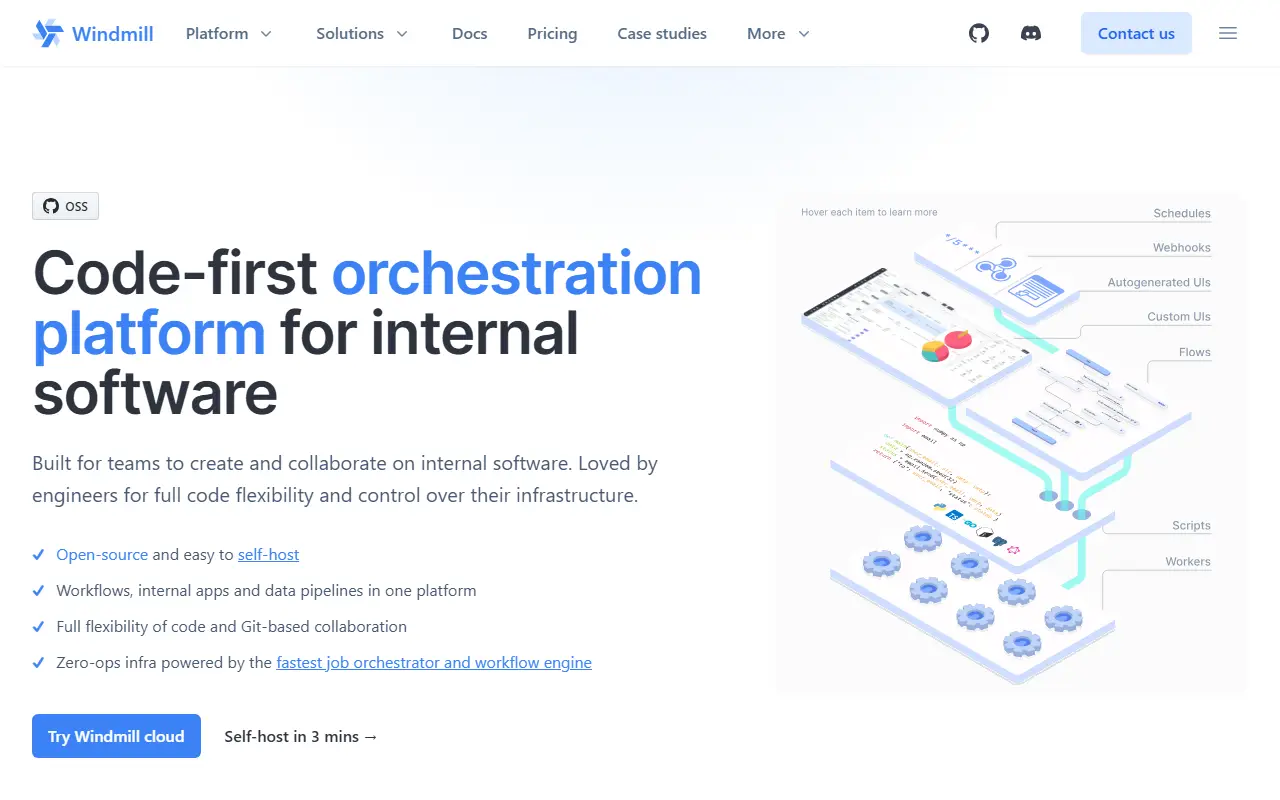
Windmill is an open-source platform for developers to run internal code as APIs, background jobs, workflows and user interfaces. It is pitched as a self-hostable alternative to Retool, Pipedream and Superblocks and as a simplified version of Temporal, and it automatically generates UIs so a script can be shared and triggered as an internal app.
Scripts can be written in languages including Python, TypeScript, Go, Bash, SQL, PowerShell, Rust and GraphQL. They can be composed into flows or used within richer apps built with its low-code builder. The backend is written in Rust on PostgreSQL, and the README describes it as a very fast self-hosted workflow engine, citing a comparison with Airflow. Sections of its documentation cover main concepts, local development, architecture, security, performance and self-hosting with Docker Compose.
Windmill is open source under AGPLv3, and Windmill Labs sells dedicated instances, commercial support and licenses, so the repository license is listed as 'Other' on GitHub. It suits engineering teams that want to turn existing scripts into reliable internal tools and automations without building each interface by hand.
Key features
- Scripts turned into APIs and auto-generated UIs
- Multi-language support including Python and TypeScript
- Workflows composed from scripts
- Low-code builder for internal apps
- Rust workflow engine on PostgreSQL
- Self-hosting with Docker Compose
Pricing: The Community Edition is free to self-host. Team is $10 per seat per month; Enterprise is $20 per developer and $10 per operator per month, with a one-month trial.
#6
A Python workflow orchestration framework for turning scripts into resilient, observable data pipelines with scheduling, retries, caching and event-driven automation.
- GitHub stars
- 24k
- Last commit
- today
- Latest release
- 3.9.2
- Licence
- Apache-2.0
- Self-hosted
- Yes
- Hosted version
- Available
prefect.io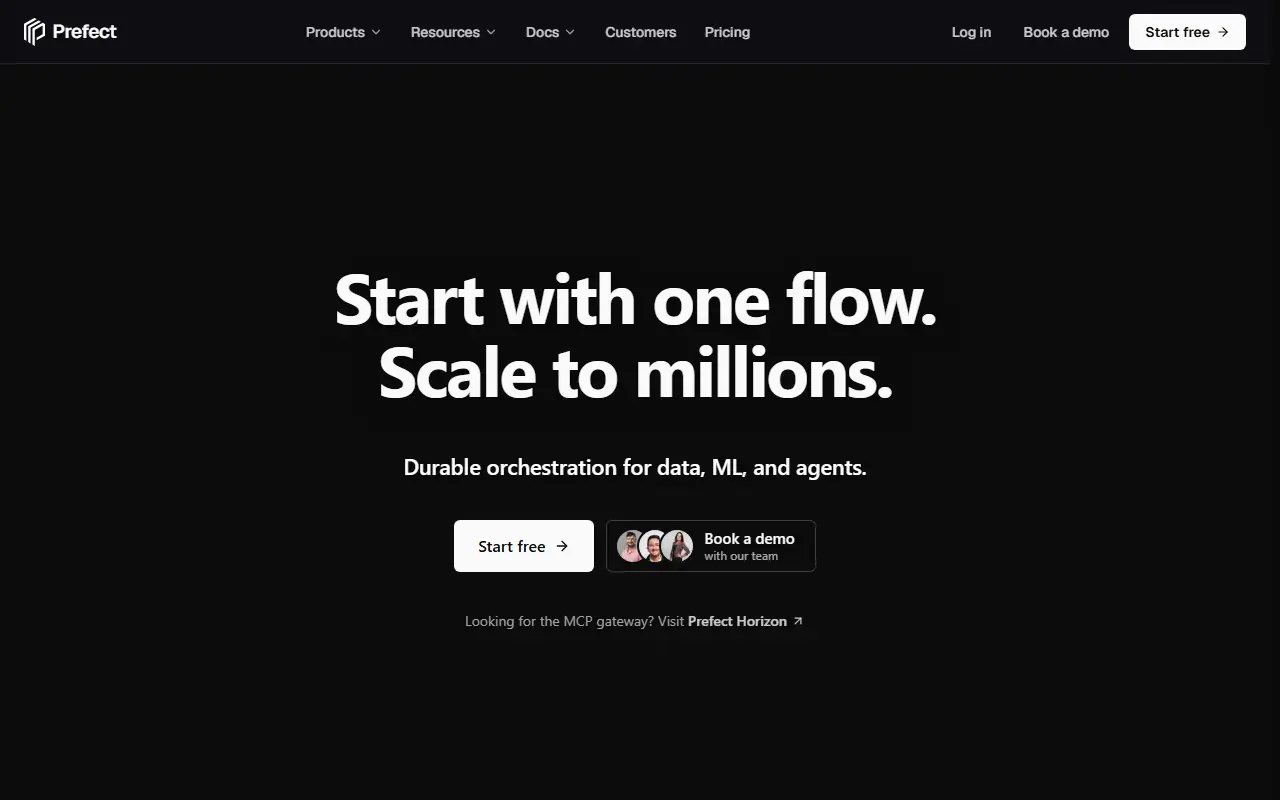
Prefect is a Python framework for orchestrating workflows and building data pipelines. It aims to be the simplest way to lift an ordinary script into a production workflow: you add flow and task decorators, and Prefect adds the machinery that makes pipelines dependable and visible.
That machinery includes scheduling, caching, retries and event-based automations, and flows can express dependencies and complex branching logic. The goal is dynamic pipelines that react to changes in the world and recover from unexpected failures. Run activity is tracked, and you can monitor it from a self-hosted Prefect server or from the managed Prefect Cloud dashboard. Prefect requires Python 3.10 or newer, and the documentation covers installation, quickstart, building and deploying workflows and agent setup.
Prefect is licensed under Apache-2.0. Topics list data engineering, ML ops and observability among its uses. It is aimed at data teams who prefer to write workflows as plain Python code, and who want a choice between running the orchestrator themselves or using a hosted control plane.
Key features
- Flows and tasks defined with Python decorators
- Scheduling and event-based automations
- Automatic retries and caching
- Complex branching and dependencies
- Self-hosted server or Prefect Cloud monitoring
- Deployment of workflows to infrastructure
Pricing: Prefect Cloud's Hobby tier is free. Starter is $100 per month and Team $100 per user per month, both billed monthly; Enterprise is custom and billed annually.
#7
A low-code, flow-based programming tool for event-driven applications, where you wire together devices, APIs and services in a browser-based editor.
- GitHub stars
- 24k
- Last commit
- yesterday
- Latest release
- 5.0.9
- Licence
- Apache-2.0
- Self-hosted
- Yes
nodered.org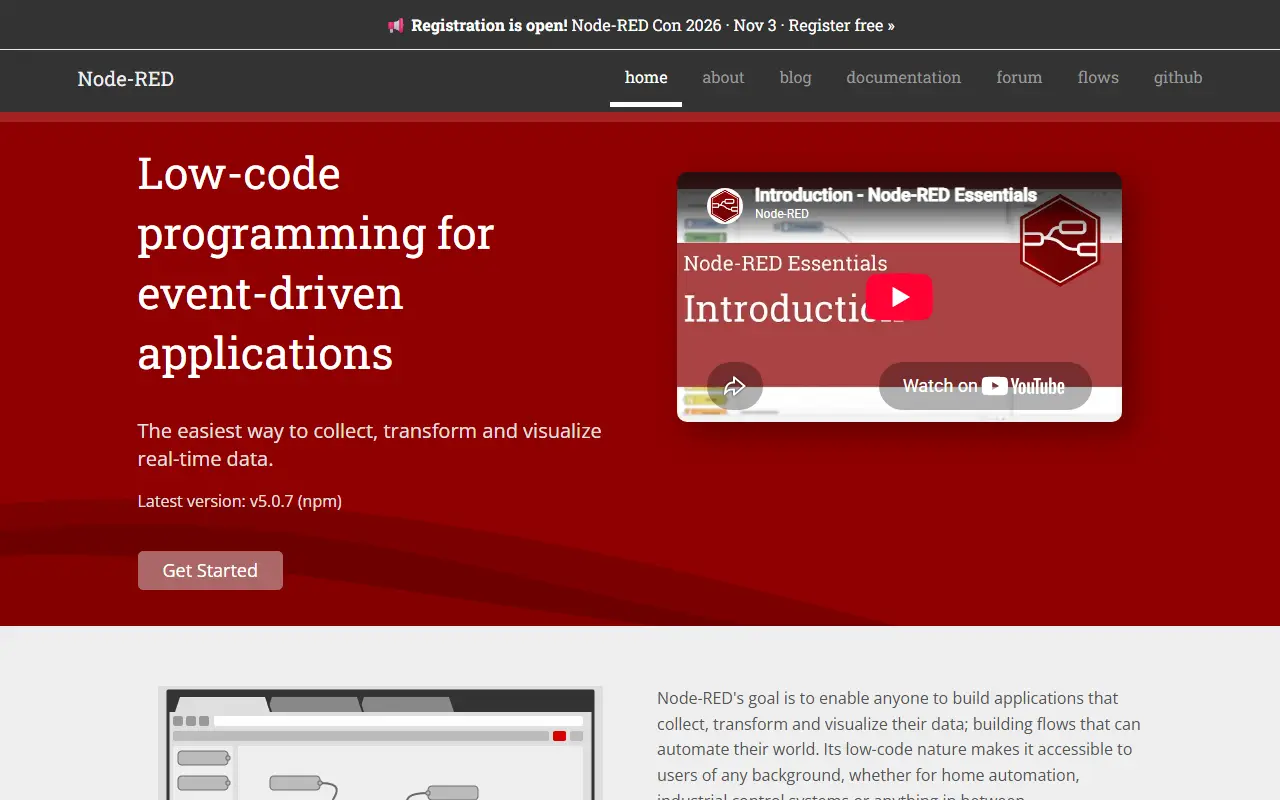
Node-RED is a low-code programming tool for event-driven applications built on flow-based, visual programming. Instead of writing everything as code, you connect nodes that represent inputs, processing steps and outputs, which makes it popular for IoT projects, home automation and wiring together APIs and online services. It is a project of the OpenJS Foundation.
Getting started takes a couple of commands: install it globally with npm, start it with the node-red command, and open it in your browser. A large ecosystem sits around it, with a library of custom nodes and integrations, shared flows and node collections, plus documentation, a forum and a Slack community. Developers can also run the latest code from git by cloning the repository, installing dependencies and building it.
Node-RED is written in JavaScript on Node.js and licensed under Apache-2.0. You run it on your own computer, a Raspberry Pi, a server or in a container, so there is no hosted service to depend on. It suits makers, integrators and engineers who want to prototype and automate event-driven logic quickly.
Key features
- Flow-based visual programming
- Browser-based visual editor
- Large library of community nodes
- Shareable flows and node collections
- Install with npm in one command
- Runs on small devices and servers
Pricing: Free and open source under the Apache-2.0 license.
#8
A hosted integration platform for developers to connect apps and build event-driven workflows using pre-built actions plus custom Node.js, Python, Go or Bash code.
- GitHub stars
- 12k
- Last commit
- today
- Self-hosted
- No
- Hosted version
- Available
pipedream.com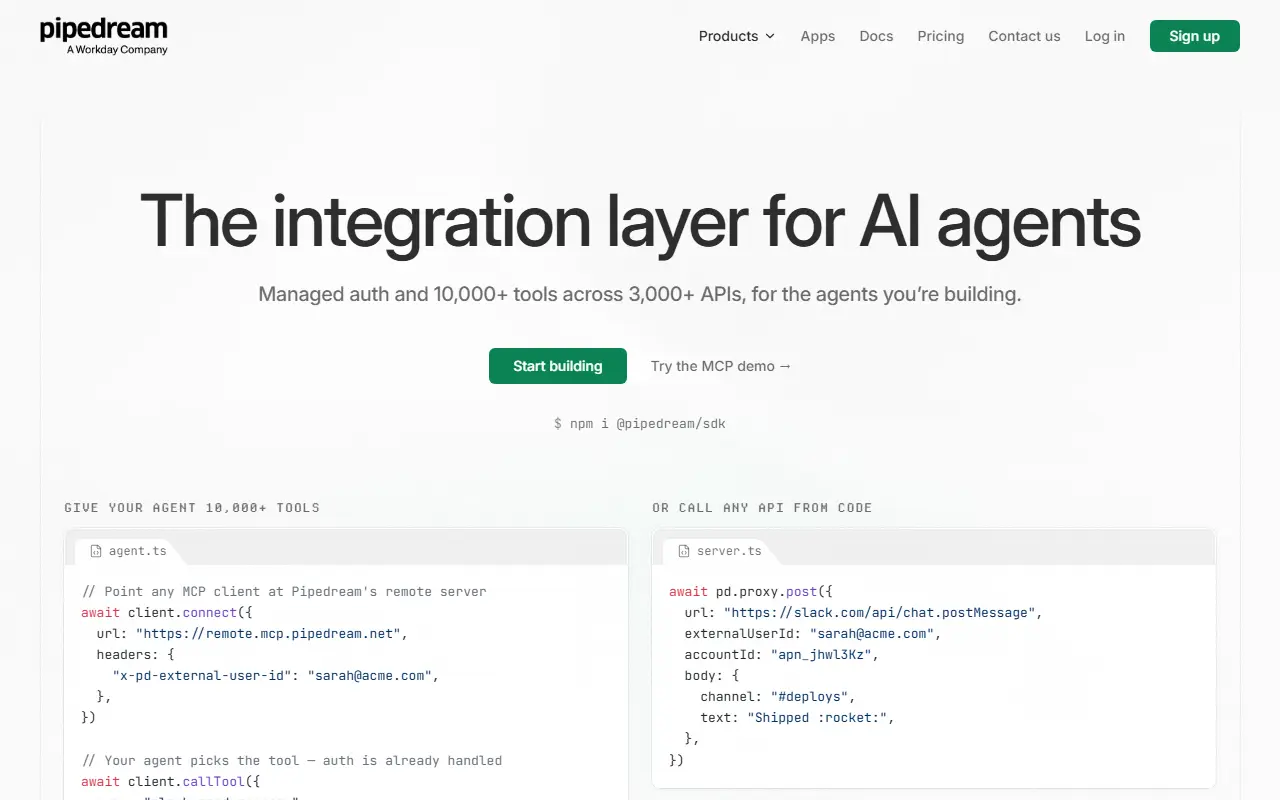
Pipedream is an integration platform for developers. It is a hosted platform, advertised as free for developers, for connecting applications and building event-driven automations. The GitHub repository holds the code for the pre-built integration components, the product roadmap and the documentation.
Workflows are sequences of steps, which can be pre-built actions or custom code, and each workflow is started by an event such as an HTTP request, a timer or a new row in a spreadsheet. Event sources emit events from services like GitHub, Slack, Airtable and RSS, while actions cover common operations such as sending a message or adding a spreadsheet row. More than 1,000 integrated applications are available, and any Node.js, Python, Go or Bash code can be run for custom logic.
The README says the company has demonstrated SOC 2 compliance. Because the platform itself is run by Pipedream, this is mostly a hosted service with an open repository of components rather than software you install, and the repository lists its license as Other. It suits developers who want webhook-driven glue code without managing servers.
Key features
- Workflows triggered by HTTP, timers or app events
- Event sources for GitHub, Slack and Airtable
- Pre-built actions across 1,000+ apps
- Custom code in Node.js, Python, Go or Bash
- Import of packages from language ecosystems
- Open repository of integration components
Pricing: Free to build and test. Startup, for production, is $150 per month ($99 billed annually) and includes 100 users and 10,000 usage credits; Business is custom.
#9
ByteChef is an open-source platform for AI agents and workflow automation that you can self-host or embed in your SaaS product, positioned against Zapier and n8n.
- GitHub stars
- 1.1k
- Last commit
- yesterday
- Latest release
- v0.36.0
- Self-hosted
- Yes
bytechef.io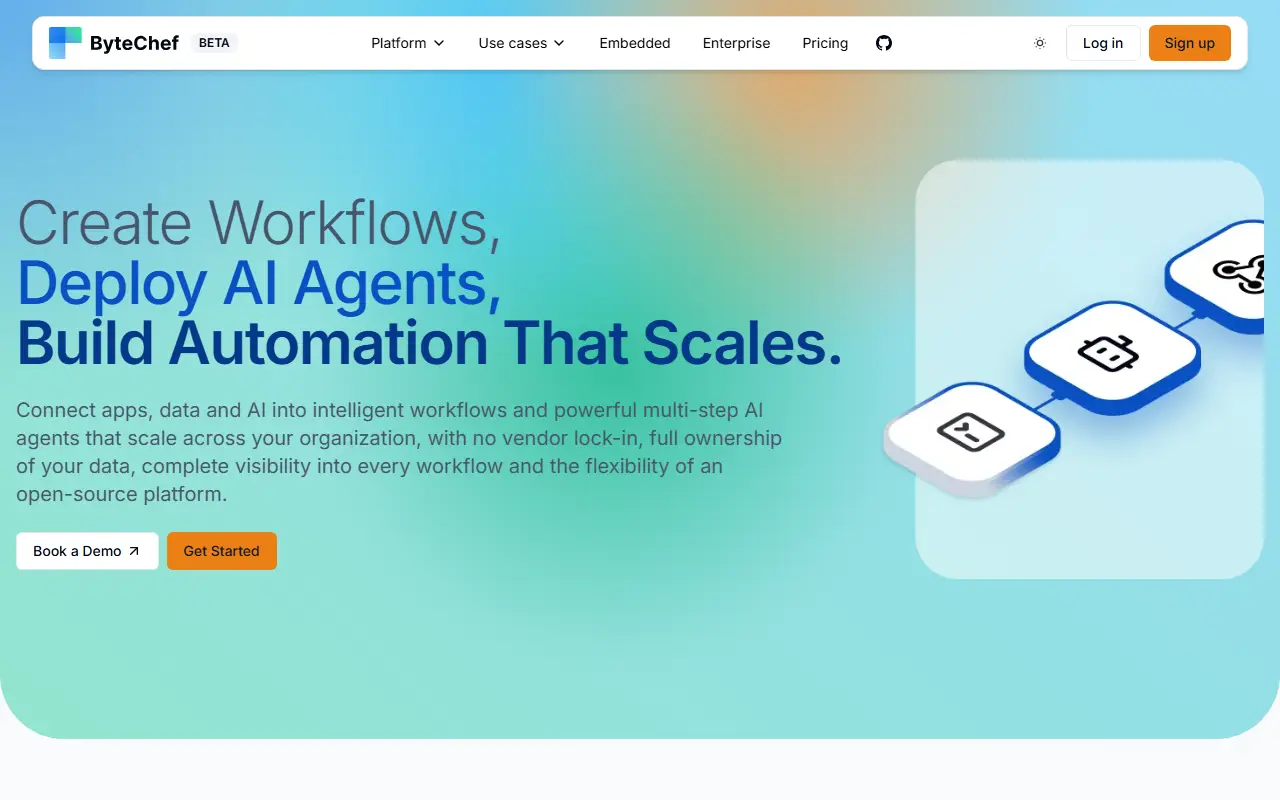
ByteChef is an open-source platform that brings AI agents and workflow automation into one product. It can be self-hosted or embedded inside a SaaS application, and it is presented as an alternative to tools like Zapier and n8n, with a drag-and-drop workflow editor for building automations across APIs.
An AI Agent component runs the full agent loop of model, tool selection, execution and observation as a step in a durable workflow, so a failed or paused run resumes from that step. The README lists support for many LLM providers such as OpenAI, Anthropic, Azure OpenAI, Bedrock, Mistral, Groq, DeepSeek and Ollama, components that double as agent tools, several memory backends, and guardrails. Topics also mention MCP, embedded iPaaS and Workato-style integrations.
The core is licensed under Apache 2.0 according to the README, while the repository metadata lists the licence as other. ByteChef is written in Java and TypeScript, with an embedded edition for shipping the same agents in your own product, plus documentation, templates and a connector developer guide. It suits engineering teams that want automation and agents under their own control.
Key features
- Drag-and-drop workflow editor
- AI agents as workflow steps
- Support for many LLM providers
- Components usable as agent tools
- Durable runs that resume after failures
- Embedded edition for SaaS products
Pricing: An open source edition can be self-hosted for free. Automation plans cost $23 (Starter) or $135 (Growth) per month, including 5000 tasks, with a free trial; Enterprise is tailored on request.
#10
Self-hosted, no-code workflow automation tool that connects services such as Slack and Twitter, positioned as an open-source alternative to Zapier.
- GitHub stars
- 14k
- Last commit
- 9 mo ago
- Latest release
- v0.15.0
- Self-hosted
- Yes
automatisch.io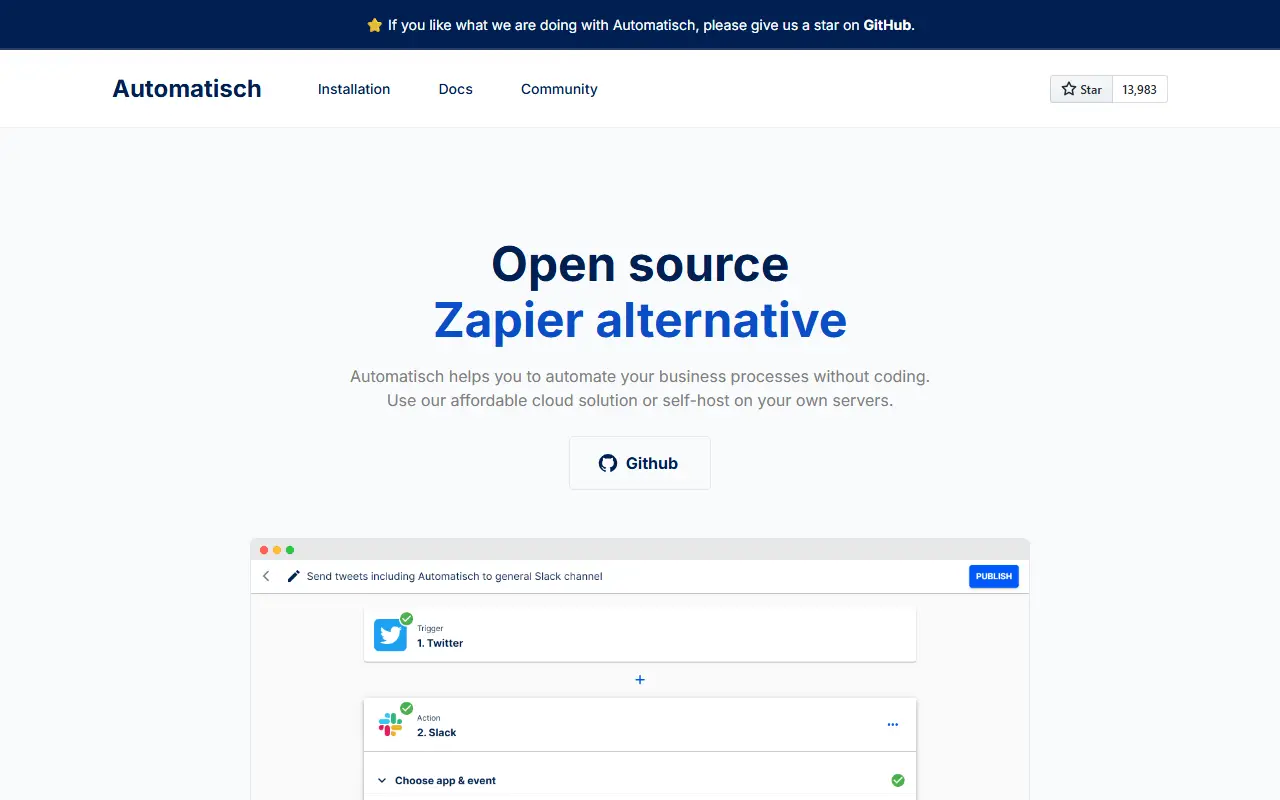
Automatisch is a business automation tool that connects different online services so that tasks flow between them without manual work. It is described as an open-source Zapier alternative, and no programming knowledge is needed to build workflows. The input lists its license only as other, so check the repository for the exact terms.
Its main selling point is control over data: because you run it on your own servers, information stays out of third-party clouds, which matters for industries such as healthcare and finance and for European companies subject to GDPR. The project also stresses the absence of vendor lock-in, since you hold your data and can move to another provider more easily than between cloud services.
Documentation is available at automatisch.io/docs, and the project is written in JavaScript. Automatisch suits small businesses, agencies, and technical teams that want to automate integrations between SaaS tools without paying per-task fees, and that are comfortable hosting a small service.
Key features
- Visual workflow builder without coding
- Connects services such as Slack and Twitter
- Data stays on your own servers
- No vendor lock-in
- Open-source with community contributions
- Official documentation and installation guide
3 more Tray.ai alternatives
Tray.ai alternatives: questions
- What is the best open-source alternative to Tray.ai?
- n8n is the top-ranked open-source alternative to Tray.ai on Enlisted: A fair-code workflow automation platform that mixes a visual canvas with custom code and AI agent features, for teams connecting apps and automating processes. Other strong options are Temporal, Airflow, Activepieces and Windmill.
- What are the best commercial alternatives to Tray.ai?
- SnapLogic, Celigo, Microsoft Power Automate, Boomi and MuleSoft are among the hosted, closed-source alternatives to Tray.ai listed on Enlisted, which lists 26 in total. Compare their pricing and features on each tool page.
- Are these Tray.ai alternatives free?
- All 13 are open source, so the code is free to use under its licence, and 12 of them can be self-hosted on your own server or computer. 6 also offer a paid or managed cloud version if you'd rather not host it yourself.
- How is this list of Tray.ai alternatives ranked?
- By a score built from GitHub stars, star growth over the last 30 days and how recently the code changed. 11 of these projects shipped code in the last 30 days. Data is refreshed daily, and nobody can pay to move up.
 TrackMedia
 TrackRev