7,363 open-source and SaaS tools, with GitHub stats refreshed every day.

4 alternatives ranked by real activity

Open-source Testfully alternatives

A curated, ranked list of the 4 best open-source alternatives to Testfully.

The best open-source alternative to Testfully is Hoppscotch. If that doesn't suit you, other good options are Bruno, Karate and Step CI.

Testfully alternatives are mainly API tools, but some are also testing & QA tools. 3 of them shipped code in the last 30 days, 4 can be self-hosted, and 4 use a permissive licence.

Last updated October 2, 2026 · ranked by GitHub stars, growth and recent commits

Hoppscotch

An open-source API development tool for building and testing REST, GraphQL and WebSocket requests, on web, desktop and CLI, as a Postman alternative.

GitHub stars
81k
Last commit
2 days ago
Latest release
2026.9.0
Licence
MIT
Self-hosted
Yes
Hosted version
Available
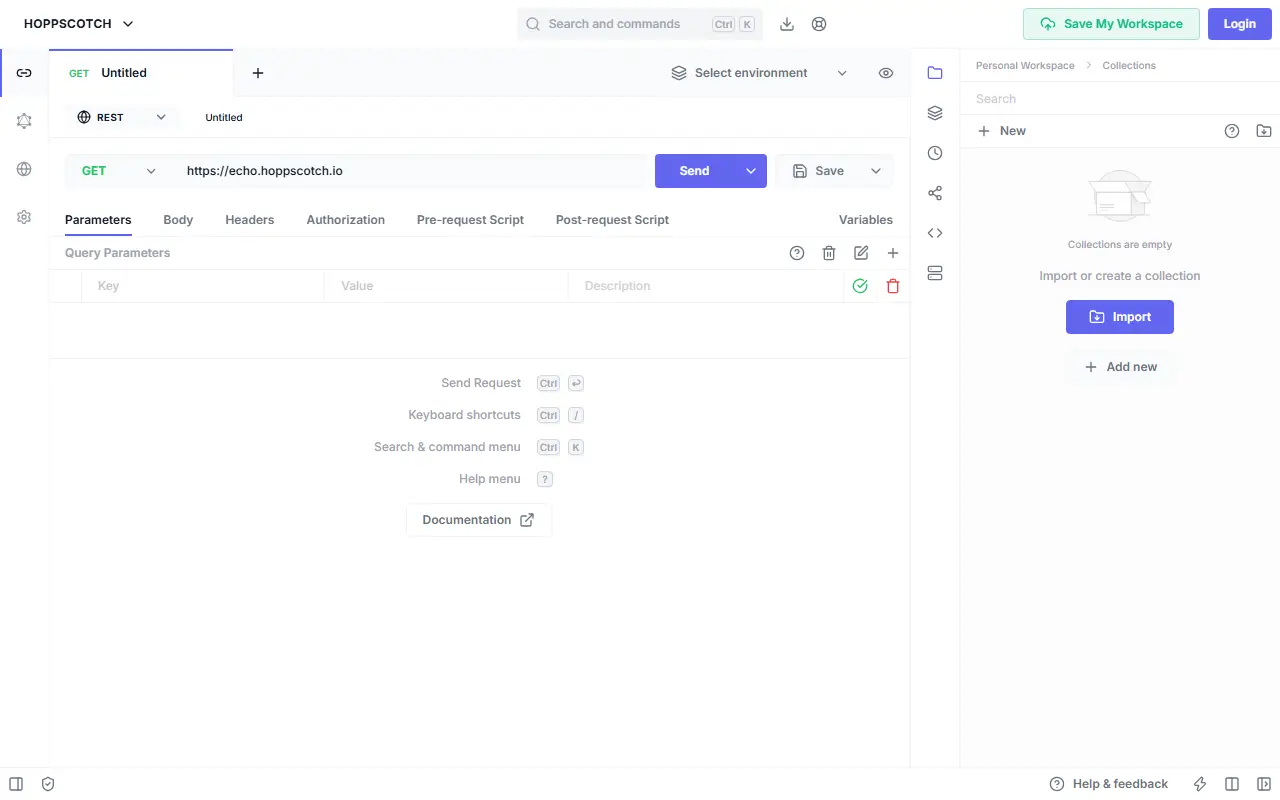
hoppscotch.ioHoppscotch homepage screenshot

Hoppscotch is an open-source API development ecosystem for sending requests, inspecting responses and organizing API work. It is positioned as an alternative to Postman and Insomnia and runs in the browser, as a desktop app and from a command line interface, with offline, on-premises and cloud options.

The request builder supports the standard HTTP methods plus custom ones, and the toolset extends to GraphQL and WebSocket testing. You can generate code snippets for more than ten languages and frameworks, share requests through public URLs, and install the web app as a progressive web app for offline use. The interface is lightweight, with light, dark and black themes, a choice of accent colors and a distraction-free Zen mode.

Hoppscotch is MIT licensed and written mainly in TypeScript with Vue. Teams that need to keep API traffic and collections inside their own network can self-host it, while the hosted service at hoppscotch.io suits individuals who just want to start sending requests.

Key features

  • REST, GraphQL and WebSocket request testing
  • Code snippet generation for 10+ languages
  • Installable offline-capable progressive web app
  • Shareable request URLs
  • Web, desktop and CLI clients
  • Custom themes and accent colors

Pricing: Free and open source under the MIT license; a hosted version is available at hoppscotch.io.

Bruno

A Git-friendly, offline-only API client for REST, GraphQL, gRPC and WebSocket that stores collections as plain text files, an open-source alternative to Postman.

GitHub stars
47k
Last commit
yesterday
Latest release
v4.2.1
Licence
MIT
Self-hosted
Yes
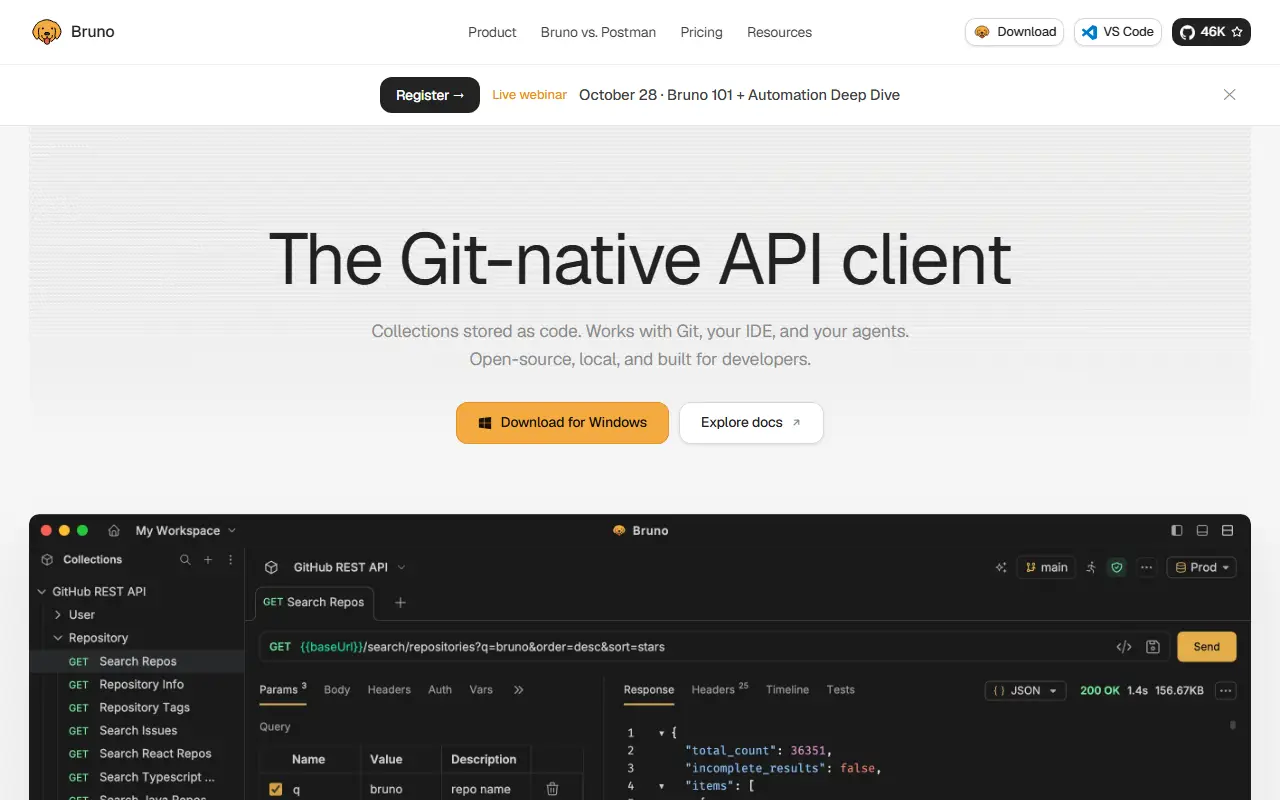
usebruno.comBruno homepage screenshot

Bruno is an open-source API client and testing environment, described as a lightweight alternative to Postman and Insomnia. It supports REST, GraphQL, gRPC and WebSocket requests, and runs on macOS, Windows and Linux.

Its distinguishing idea is that collections live directly in a folder on your filesystem, saved in a plain text markup language called Bru. That means you can version and share API collections with Git or any version control system you already use. Bruno is offline only, and the maintainers state they have no plans to add cloud sync, because they believe your data should stay on your device. A CLI runs collections from the command line for automated testing and CI/CD, and a Docker option is also documented.

The core is MIT licensed, and the project offers paid versions that add further features for teams that want them. Bruno can be installed from the website or through Homebrew, Chocolatey, Scoop, Snap, Flatpak and Apt. It suits developers who prefer keeping API definitions next to their code.

Key features

  • REST, GraphQL, gRPC and WebSocket requests
  • Collections stored as plain text Bru files
  • Git-based collaboration on API collections
  • Offline-only with no cloud sync
  • Bruno CLI for CI/CD test runs
  • Install via Homebrew, Chocolatey, Snap and more

Pricing: The open-source edition is free. Pro costs $6 and Ultimate $11 per user per month, billed annually, and Ultimate has a 14-day free trial.

Read more about BrunoWebsite GitHub

Karate

An open-source framework for test automation that brings API checks, mocks, performance tests and UI automation together under one readable syntax.

GitHub stars
9k
Last commit
yesterday
Latest release
v2.1.3
Licence
MIT
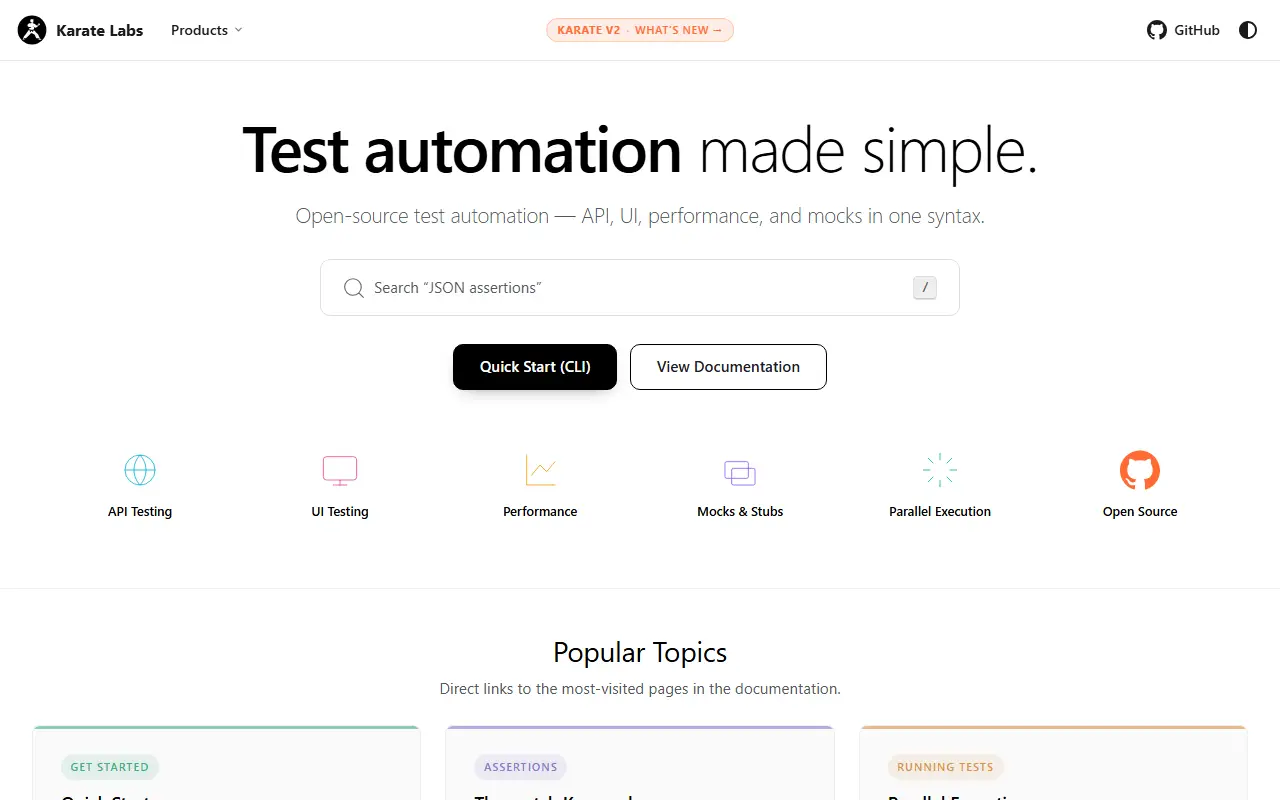
docs.karatelabs.ioKarate homepage screenshot

Karate is an open-source tool that unifies API testing, mocks, performance testing and UI automation in one framework with a single readable syntax. Tests are written as feature files, so people who are not Java developers can read and write them, and the project is written in Java.

Its documentation highlights the match keyword for validating complete responses, headers and arrays, parallel execution of features, scenarios and example rows, reusable flows by calling one feature from another, and test doubles that stand up HTTP, gRPC and message-queue mocks from a feature file. Karate v2 adds virtual threads, a single-binary CLI, JavaScript debugging and soft assertions. There are extensions for VS Code and IntelliJ, plus Karate Agent and Karate Xplorer products.

Tests can be run through JUnit, the command line or CI/CD pipelines. Karate is licensed under MIT, and topics mention BDD, Cucumber, contract testing, load testing and WebDriver. It suits QA engineers and developers who want one tool for API-level and UI-level checks.

Key features

  • API testing in readable feature files
  • Built-in HTTP, gRPC and queue mocks
  • Performance testing from the same tests
  • UI automation with a browser driver
  • Parallel test execution
  • JUnit, CLI and CI/CD runners
  • VS Code and IntelliJ extensions

Pricing: The open-source framework is free. Pro is $64 per user per month ($640 per user per year) and IDE Plus is $100 per user per year; Enterprise is custom. Everything runs self-hosted.

Step CI

Step CI is a free, open-source, self-hosted API quality assurance framework for testing REST, GraphQL, gRPC, tRPC and SOAP APIs with YAML, JSON or JavaScript workflows.

GitHub stars
1.9k
Last commit
2 yr ago
Latest release
2.8.2
Licence
MPL-2.0
Self-hosted
Yes
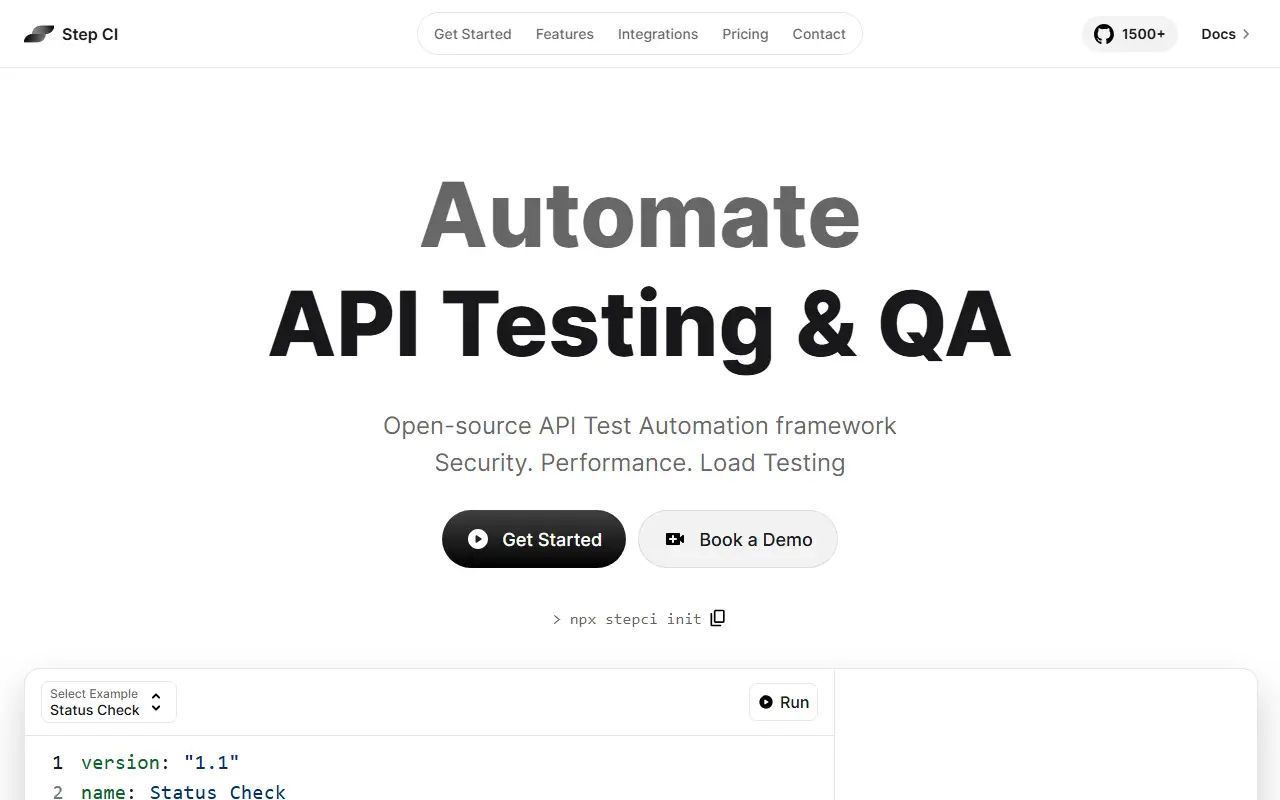
stepci.comStep CI homepage screenshot

Step CI is an API quality assurance framework aimed at developers who need to test several different API styles within the same test workflow, rather than using separate tools for REST, GraphQL and other protocols. It is language-agnostic, letting workflows be configured in YAML, JSON or JavaScript.

It supports testing REST, GraphQL, gRPC, tRPC and SOAP APIs, can run self-hosted on a local network, locally, or inside a CI/CD pipeline, and integrates with other tooling such as GitHub Actions. The README specifically calls out migration guidance for users coming from Postman and Insomnia, and an online playground is available to try workflows without installing anything.

The CLI can be installed via Node.js or Homebrew, and by default collects anonymous usage data, including a unique user ID, OS name, Node version and which commands are run, which can be disabled with an environment variable. Step CI is written in TypeScript and released under the Mozilla Public License 2.0, with a separate paid support plan offering SLA-backed support, onboarding and prioritized feature requests on top of the free core.

Key features

  • Tests REST, GraphQL, gRPC, tRPC and SOAP APIs
  • YAML, JSON or JavaScript workflow configuration
  • Self-hosted or CI/CD-integrated testing
  • Online playground for trying workflows
  • Optional anonymous usage analytics (can be disabled)

Pricing: Free and open source under the Mozilla Public License 2.0; a paid support plan with SLA and prioritized support is available separately.

Testfully alternatives: questions

What is the best open-source alternative to Testfully?
Hoppscotch is the top-ranked open-source alternative to Testfully on Enlisted: An open-source API development tool for building and testing REST, GraphQL and WebSocket requests, on web, desktop and CLI, as a Postman alternative. Other strong options are Bruno, Karate and Step CI.
Are these Testfully alternatives free?
All 4 are open source, so the code is free to use under its licence, and all of them can be self-hosted on your own server or computer. 1 also offers a paid or managed cloud version if you'd rather not host it yourself.
How is this list of Testfully alternatives ranked?
By a score built from GitHub stars, star growth over the last 30 days and how recently the code changed. 3 of these projects shipped code in the last 30 days. Data is refreshed daily, and nobody can pay to move up.

People also look for alternatives to…

View all