6,598 open-source and SaaS tools, with GitHub stats refreshed every day.

5 alternatives ranked by real activity

Open-source Sigma alternatives

A curated, ranked list of the 5 best open-source alternatives to Sigma.

The best open-source alternative to Sigma is Superset. If that doesn't suit you, other good options are Metabase, Lightdash, Frappe Insights and Briefer.

Sigma alternatives are mainly BI & Dashboards tools. 4 of them shipped code in the last 30 days, 5 can be self-hosted, and 1 uses a permissive licence.

Last updated October 2, 2026 · ranked by GitHub stars, growth and recent commits

Superset

A web-based business intelligence platform from the Apache project with a no-code chart builder, SQL editor and dashboards that connects to most SQL databases.

GitHub stars
75k
Last commit
today
Latest release
6.1.0
Licence
Apache-2.0
Self-hosted
Yes
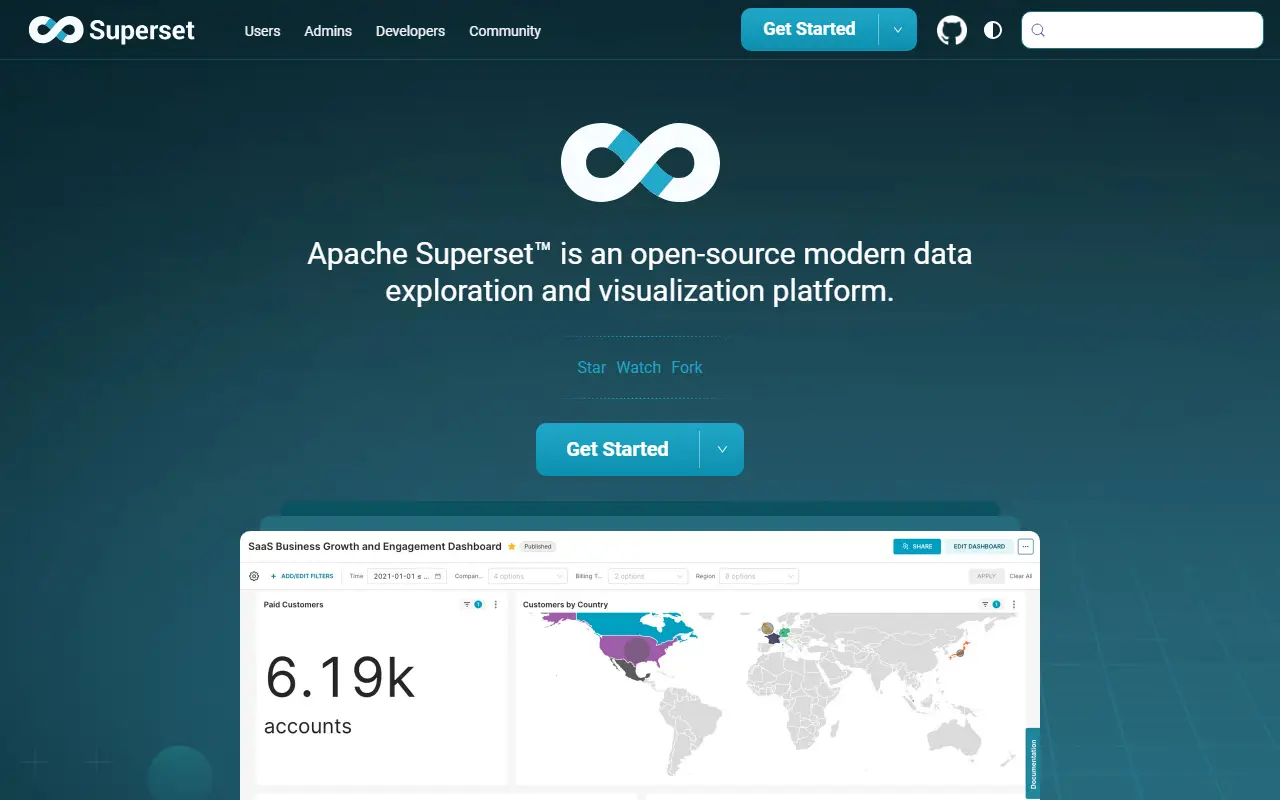
superset.apache.orgSuperset homepage screenshot

Apache Superset is a data exploration and visualization platform that runs as a web application. Analysts and business users can connect it to a database, build charts without code, assemble them into dashboards and share them, so it can augment or replace proprietary business intelligence tools for many teams.

The no-code chart builder sits next to a web-based SQL editor for advanced queries, and a lightweight semantic layer lets teams define reusable dimensions and metrics. Visualizations range from simple bar charts to geospatial views. Superset can query any SQL datastore or engine provided a matching Python database driver and SQLAlchemy dialect exist, including Presto, Trino and Athena. A configurable caching layer reduces database load, and security roles and authentication options are extensible.

The stack is Python with Flask on the back end and React on the front end, under the Apache-2.0 license. A REST API and extension framework allow programmatic control and customization. Documentation is split into guides for users, administrators and developers, and it is a typical choice for organizations that want a self-managed BI layer.

Key features

  • No-code chart builder
  • Web-based SQL editor
  • Shareable interactive dashboards
  • Lightweight semantic layer for metrics
  • Connects to any SQL database with a driver
  • Caching layer and security roles
  • REST API for programmatic customization

Pricing: Free and open source under the Apache-2.0 license.

Metabase

An open-source BI and embedded analytics tool for exploring data, building dashboards and asking questions without SQL, self-hosted or through Metabase Cloud.

GitHub stars
50k
Last commit
today
Latest release
v0.63.19
Self-hosted
Yes
Hosted version
Available
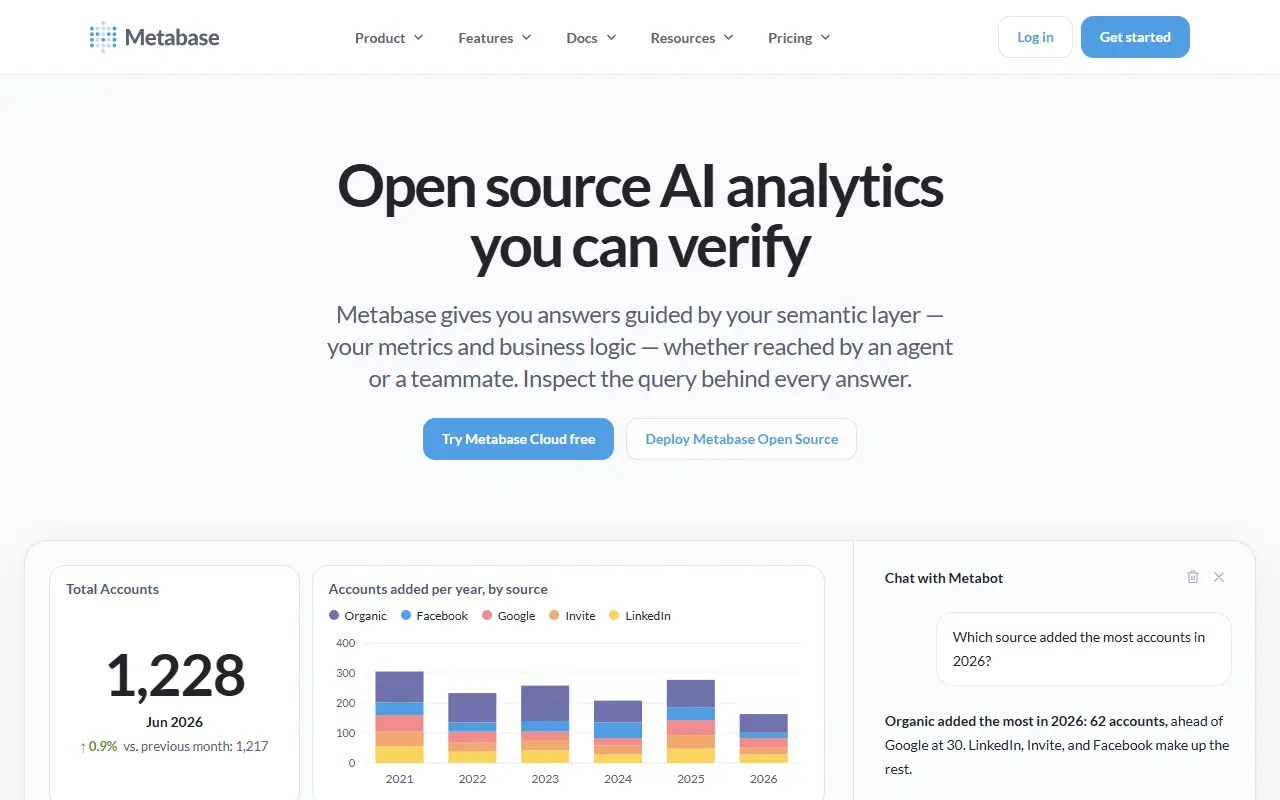
metabase.comMetabase homepage screenshot

Metabase is an open-source business intelligence and embedded analytics tool meant for everyone in a company, not only analysts. People can ask questions about their data without knowing SQL, while an SQL editor is available for more complex queries. Written in Clojure, it connects to databases such as PostgreSQL and MySQL.

Its features include interactive dashboards with filters, auto-refresh and custom click behavior, plus documents for long-form analysis that colleagues can comment on. An AI assistant called Metabot helps answer questions and write queries, and you can build your own AI agent against your data. Data Studio supports transforming raw data into analytics-ready tables and defining canonical metrics. Alerts and scheduled dashboard subscriptions go to email, Slack or a webhook, and a Library plus Git integration help version your work.

Metabase can also be embedded in your own product with components for charts, dashboards, a data browser and AI chat, and granular permissions work for internal teams and embedded customers. You can self-host it or use Metabase Cloud, which the project says includes support, backups, upgrades and a free trial. The repository license is listed as 'Other', so review its terms.

Key features

  • Question builder that needs no SQL
  • SQL editor for complex queries
  • Interactive dashboards with filters and auto-refresh
  • Alerts and scheduled subscriptions to email or Slack
  • Embedding of charts and dashboards in apps
  • Granular permissions for teams and customers
  • Metabot AI assistance for queries

Pricing: The open-source edition is free. Cloud Starter is $100 per month and Pro $575 per month with a 14-day trial; extra users cost $6 or $12 per month. Enterprise starts at $20,000 per year.

Lightdash

Lightdash is an open-source BI platform that defines metrics as code, with dashboards, AI agents and data apps built on a shared context layer.

GitHub stars
6.2k
Last commit
today
Latest release
2.423.2
Self-hosted
Yes
Hosted version
Available
lightdash.comLightdash homepage screenshot

Lightdash is an open-source business intelligence platform that it describes as agentic BI, meant for data teams that want analytics to be shipped like software. Metrics, joins, permissions, business logic and caching are defined once in a context layer, and that layer feeds MCP, SDKs, embedded analytics, data apps, AI agents and dashboards.

Analytics can be built as code: metrics, charts and dashboards live as files that you can edit with coding agents, preview from the Lightdash CLI, validate in CI and review in pull requests. Business users can pose questions in plain English, browse dashboards or build custom data apps, all while governance stays in place. Agents answer from the context layer rather than guessing from raw tables, respect permissions and return queries that can be inspected. The repository topics mention dbt.

Lightdash is written in TypeScript. The vendor recommends starting with Lightdash Cloud, which needs no infrastructure to run, and also offers a live demo, documentation and a sales call. The repository lists its licence as other, so check the terms before self-hosting.

Key features

  • Context layer for metrics and permissions
  • BI as code with CLI and CI validation
  • AI agents that answer from governed metrics
  • Dashboards and custom data apps
  • Embedded analytics, SDKs and MCP
  • dbt-based workflow

Pricing: Self-hosted Open Source edition with community support. Cloud Pro is $3000 per month with unlimited users and a 21-day trial; Enterprise is quoted.

Frappe Insights

Frappe Insights is an open-source business intelligence tool with a no-SQL query builder, charts, dashboards and support for MySQL, PostgreSQL, DuckDB and BigQuery.

GitHub stars
1k
Last commit
yesterday
Latest release
v3.14.2
Licence
AGPL-3.0
Self-hosted
Yes
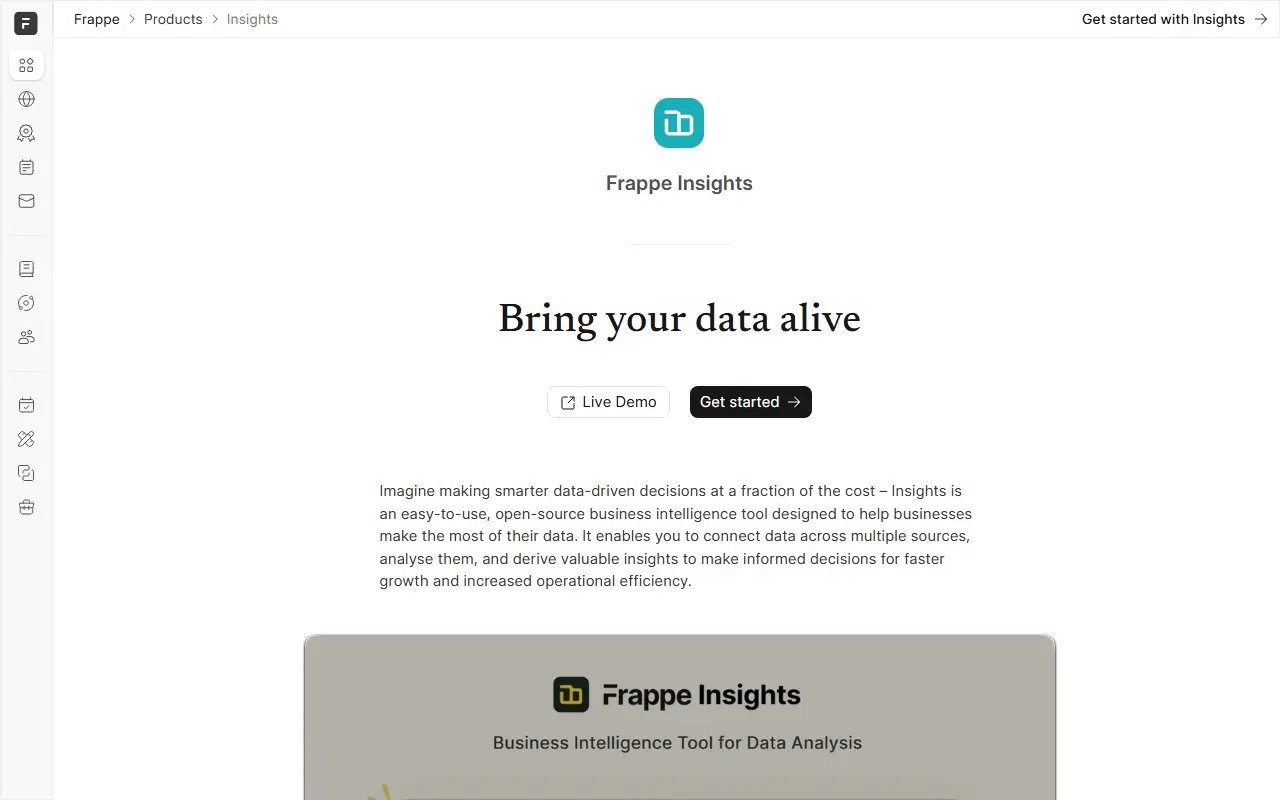
frappe.ioFrappe Insights homepage screenshot

Frappe Insights is an open-source business intelligence tool that aims to make data analysis and reporting accessible to both technical and non-technical users. It grew out of the experience of working with Frappe Framework applications, where building structured data was easy but extracting reports usually required SQL knowledge.

You can connect multiple sources, including databases, files and spreadsheets, and use a step-by-step query builder to select tables, add joins, apply filters and calculations without writing SQL. Results can be visualized with various charts, with the tool suggesting a fitting chart, and dashboards are assembled by drag and drop with dashboard filters. Supported databases include MySQL, PostgreSQL, DuckDB and BigQuery. A SQL editor is also available.

Insights is built on the Frappe Framework, Frappe UI with Vue, and the Ibis library for composing SQL with dataframe APIs. It is written in Python, licensed under AGPL-3.0, and can be self-hosted, with a live demo and documentation. It suits ERPNext and Frappe users as well as teams wanting a lightweight BI tool.

Key features

  • Query builder that needs no SQL
  • Connections to multiple data sources
  • Chart suggestions and visualizations
  • Drag-and-drop dashboards with filters
  • MySQL, PostgreSQL, DuckDB, and BigQuery support
  • SQL editor for advanced users

Pricing: Free and open source under the AGPL-3.0 licence.

Briefer

Briefer is an open-source, Notion-like tool for building notebooks and dashboards with Python, SQL and native visualizations, with scheduling and real-time collaboration.

GitHub stars
4.3k
Last commit
1 yr ago
Licence
AGPL-3.0
Self-hosted
Yes
Hosted version
Available

Briefer combines notebooks and dashboards in a single product, aimed at technical users who need the flexibility of code for analysis while making results easy for non-technical colleagues to view and interact with. It is described by its creators as similar to Notion, but built for code notebooks and dashboards rather than general documents.

Users can create notebooks and dashboards combining Markdown, Python, SQL and native visualizations, build interactive data apps with inputs, dropdowns and date pickers, generate code and queries with an AI that understands the connected database schema, schedule notebooks and dashboards to refresh periodically, and create write-back pipelines for testing changes against data. It also supports real-time multiplayer editing so multiple people can work on the same notebook or dashboard together.

The README states that Briefer has been acquired by Resend, with further updates referenced in the project's blog. It can be run locally by installing it with pip, which requires Docker, or used through a hosted cloud version; it is released under the AGPL-3.0 license and lists PostgreSQL among its supported data sources.

Key features

  • Notebooks combining Python, SQL and Markdown
  • Native dashboard visualizations
  • AI-assisted code and query generation
  • Scheduled notebook and dashboard runs
  • Real-time multiplayer editing
  • Interactive data apps with inputs and dropdowns

Pricing: Open source under the AGPL-3.0 license and self-hostable via pip and Docker; a hosted cloud version is also available. The project has been acquired by Resend.

Sigma alternatives: questions

What is the best open-source alternative to Sigma?
Superset is the top-ranked open-source alternative to Sigma on Enlisted: A web-based business intelligence platform from the Apache project with a no-code chart builder, SQL editor and dashboards that connects to most SQL databases. Other strong options are Metabase, Lightdash, Frappe Insights and Briefer.
Are these Sigma alternatives free?
All 5 are open source, so the code is free to use under its licence, and 5 of them can be self-hosted on your own server. 3 also offer a paid or managed cloud version if you'd rather not host it yourself.
How is this list of Sigma alternatives ranked?
By a score built from GitHub stars, star growth over the last 30 days and how recently the code changed. 4 of these projects shipped code in the last 30 days. Data is refreshed daily, and nobody can pay to move up.

People also look for alternatives to…

View all