7,363 open-source and SaaS tools, with GitHub stats refreshed every day.

5 alternatives ranked by real activity

Open-source Replit alternatives

A curated, ranked list of the 5 best open-source alternatives to Replit.

The best open-source alternative to Replit is code-server. If that doesn't suit you, other good options are Onlook, Magic Cloud, Sandboxd and Micracode.

Replit alternatives are mainly AI tools, but some are also developer tools. 4 of them shipped code in the last 30 days, 5 can be self-hosted, and 5 use a permissive licence.

Last updated October 2, 2026 · ranked by GitHub stars, growth and recent commits

code-server

Runs Visual Studio Code on a remote machine and serves it in the browser, so you can code from any device that has a web browser.

GitHub stars
80k
Last commit
yesterday
Latest release
v4.140.0
Licence
MIT
Self-hosted
Yes
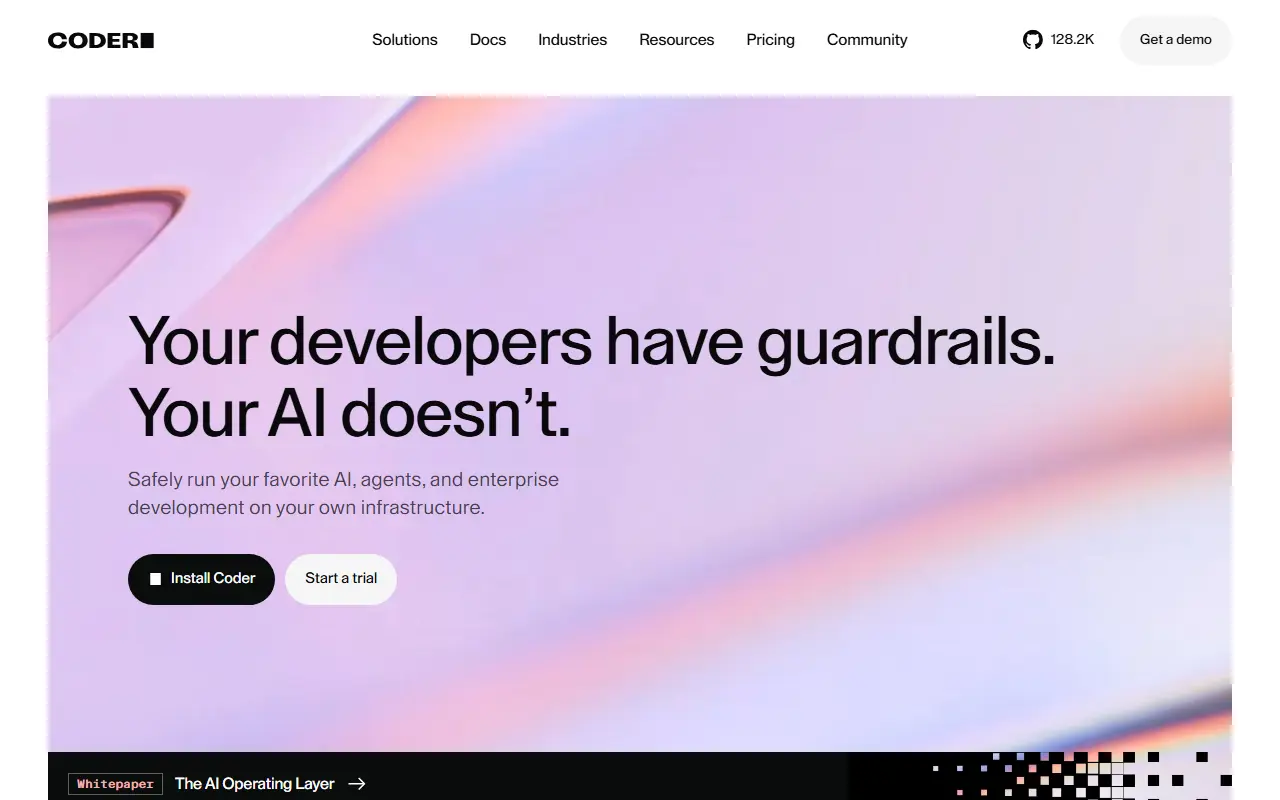
coder.comcode-server homepage screenshot

code-server is an open-source project that runs VS Code on a server and makes the editor available in a web browser. It lets developers keep their development environment on a remote machine and reach it from any device with a browser. The project is maintained by Coder, is written in TypeScript and is released under the MIT license.

Because the editor runs remotely, heavy work such as builds and language tooling happens on the server rather than on a laptop or tablet. Its GitHub topics highlight remote work, VS Code Remote and browser-based IDE use. Coder, the company behind it, also sells a commercial platform for self-hosted cloud development environments, while code-server is the simpler open-source editor-in-a-browser project.

It suits individuals who want a consistent coding environment across devices, remote teams working on shared servers, and users who want a browser-based IDE on their own hardware or a cloud instance they control.

Key features

  • VS Code running in the browser
  • Development environment hosted on a remote machine
  • Access from any device with a browser
  • Remote workflows similar to VS Code Remote
  • Runs on your own server or cloud instance

Pricing: Free and open source under the MIT license.

Onlook

An open-source visual editor for Next.js and Tailwind apps that lets designers and developers edit real code in the browser with AI, an alternative to Bolt.new and Lovable.

GitHub stars
27k
Last commit
1 mo ago
Latest release
v0.2.32
Licence
Apache-2.0
Self-hosted
Yes
Hosted version
Available
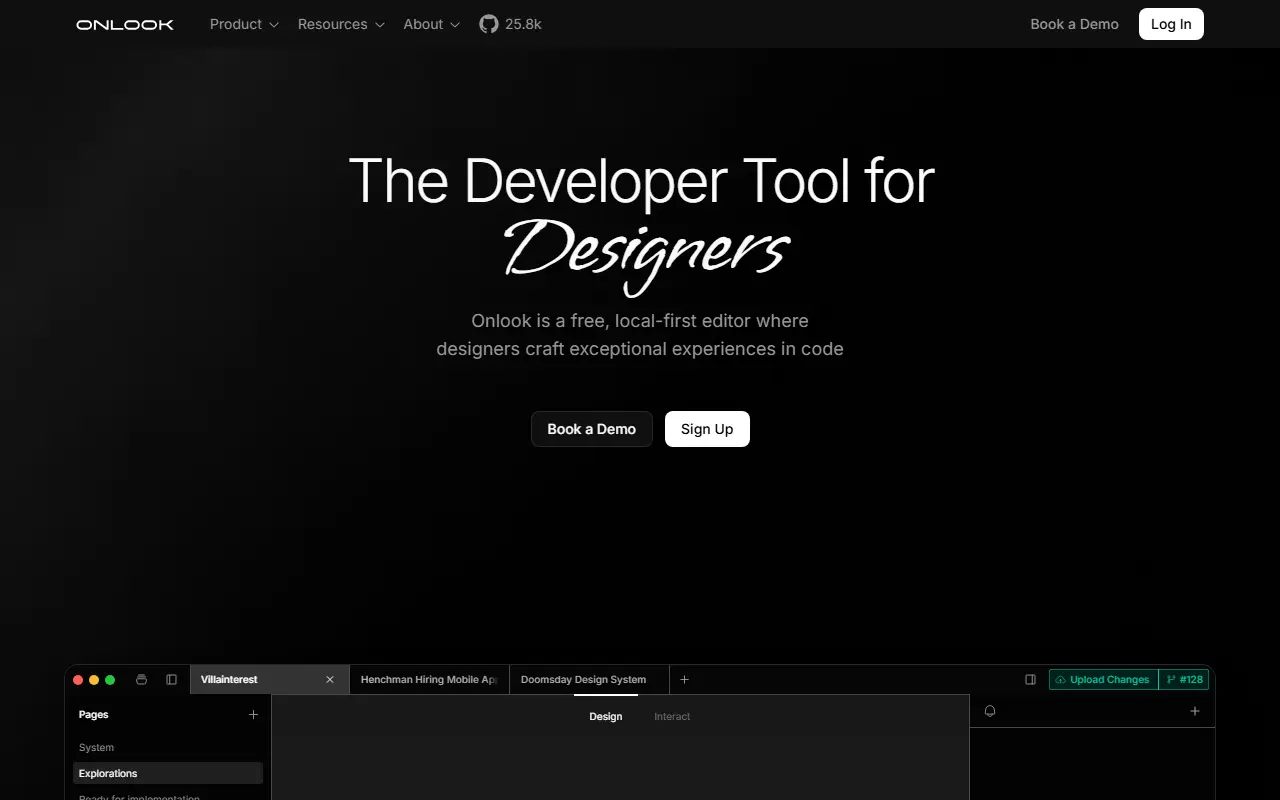
onlook.comOnlook homepage screenshot

Onlook is an open-source, visual-first code editor for building websites, prototypes and designs in Next.js and Tailwind CSS. Edits are made directly on the browser DOM with a Figma-like interface, while the changes are written to real code, so design and development share one source of truth.

You can create a Next.js app from text or an image or start from templates, then edit it visually, manage brand assets and tokens, create pages, browse layers and manage images. Developer tools include a real-time code editor, checkpoints you can restore, branching for design experiments, a CLI, an app marketplace, one-click deploys, shareable links and custom domains. Team collaboration is on the roadmap.

The README describes this repository as the open-source editor that started Onlook, while the hosted product for AI-native designers is in early access through a waitlist. It is licensed under Apache-2.0 and presented as an open alternative to tools such as Webflow, Figma Make, V0, Replit Agent, Lovable and Bolt.new. It suits designers who want to ship real code and developers who want a visual layer.

Key features

  • Visual editing on the browser DOM
  • Figma-like interface for Next.js apps
  • Start from text prompts or images
  • Real-time code editor with checkpoints
  • Branching for design experiments
  • Brand assets and design tokens
  • One-click deployment with custom domains

Pricing: Onlook can be self-hosted for free. The hosted cloud version is in closed beta with custom team pricing arranged by contacting the team.

Magic Cloud

Magic turns plain-English descriptions into full-stack apps and AI agents with a database, secure API and MCP server, running on your own hardware.

GitHub stars
1.2k
Last commit
3 days ago
Latest release
v24.0.3
Licence
MIT
Self-hosted
Yes
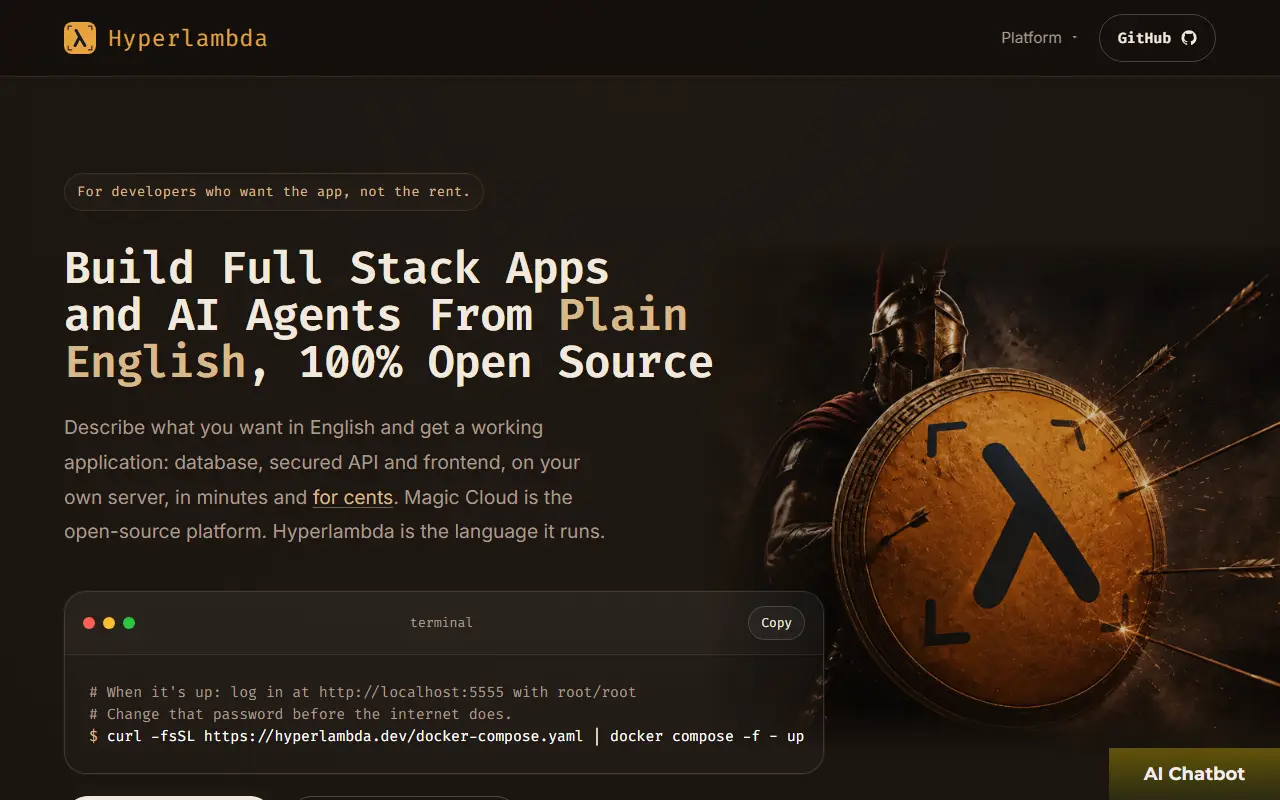
hyperlambda.devMagic Cloud homepage screenshot

Magic is an open-source platform for generating full-stack applications and AI agents from natural language. It produces the database layer, a secured API, business logic and a frontend, and positions itself as an alternative to Lovable, Bolt and Replit that gives you the whole backend on your own hardware without lock-in.

An API wizard can point at an existing MySQL, PostgreSQL, SQL Server or MariaDB database and generate a complete secured REST API, which you can then extend in plain English without a build or deploy step. It can wrap third-party APIs from an OpenAPI or Swagger URL, build database-driven agents behind role-based access control, create embeddable chatbots grounded in crawled website content, run scheduled jobs and serve static sites and single-page apps. An MCP server exposes every endpoint as a tool for Claude, Cursor or Codex.

Magic is built on .NET with the Hyperlambda language and is licensed under MIT. It runs locally in about a minute using Docker, and its stated use cases include CRM systems, admin panels, booking systems and internal tools. It suits developers who want AI-generated apps with a self-hosted, auditable backend.

Key features

  • Natural-language app and API generation
  • API wizard for existing SQL databases
  • MCP server exposing endpoints as tools
  • Database-driven AI agents with RBAC
  • Wrappers for OpenAPI and Swagger APIs
  • Scheduled background jobs

Pricing: The software is free to self-host. Managed cloudlets cost $100 (Professional) or $300 (Enterprise) per month with unlimited users and a 14-day trial; a Managed Services add-on is $3,000 per month.

Sandboxd

Sandboxd is an open-source, self-hosted AI app builder that runs a coding agent in isolated Docker sandboxes and serves each app at a preview URL.

GitHub stars
957
Last commit
3 days ago
Latest release
v0.3.21
Licence
MIT
Self-hosted
Yes
Hosted version
Available
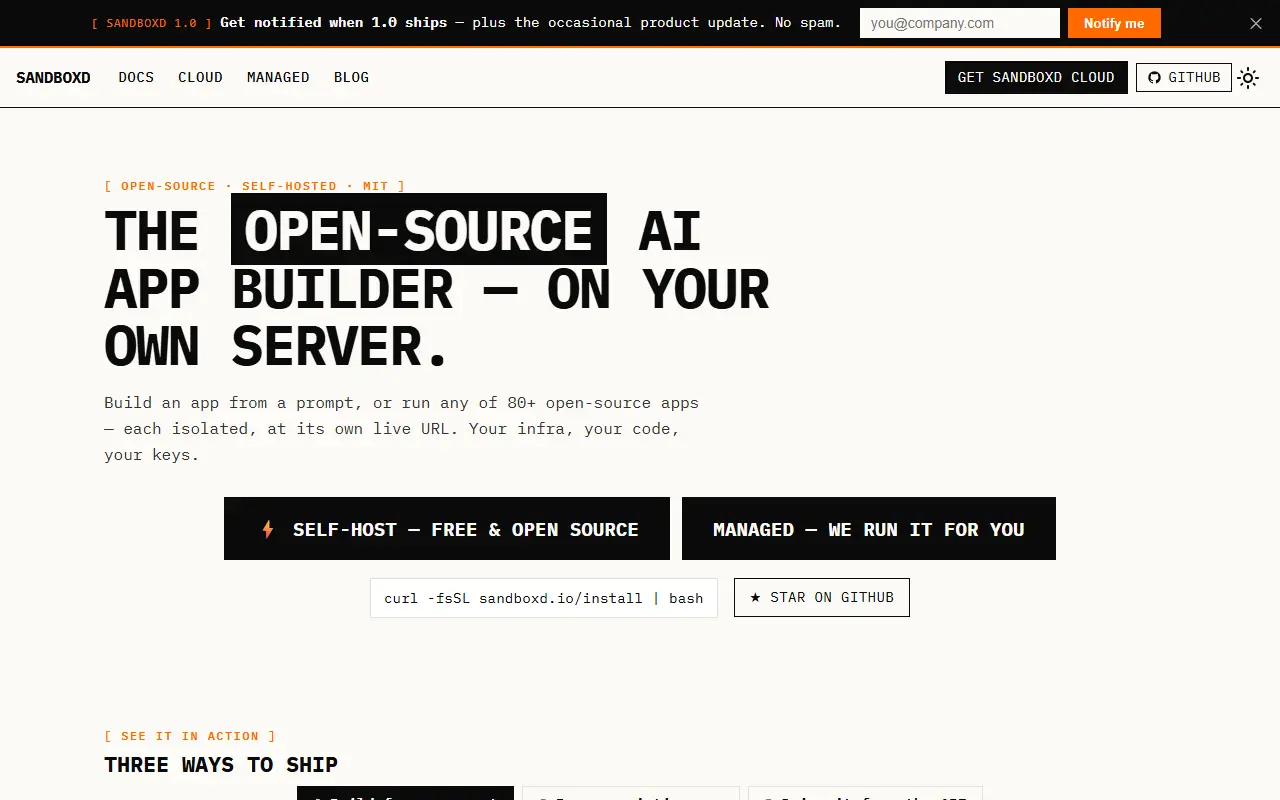
sandboxd.ioSandboxd homepage screenshot

Sandboxd is an open-source, self-hosted take on prompt-to-app builders like Lovable, Bolt, v0 and Replit. A single HTTP request creates a private, isolated container, runs an AI coding agent in it against your prompt, and returns a live preview URL for the resulting app, all on a server you own.

Beyond building from a prompt, it can also run existing apps from a curated catalog of more than 80 apps such as n8n, Ghost and Grafana, and every action is exposed as a /v1 API call for headless, scriptable use. Idle sandboxes go to sleep and wake on demand, so one ordinary server can hold many apps rather than a virtual machine each.

The design is intentionally small: a single Go program drives Docker, uses Traefik to route preview URLs and keeps state in SQLite, with no Kubernetes, separate database or queue. Self-hosting is free under the MIT license, and the maintainers also mention an optional managed cloud and a live demo console with sample data.

Key features

  • Prompt-to-app builds by a coding agent
  • Isolated Docker sandbox per app
  • Live preview URL for each app
  • One-click catalog of 80+ apps
  • Scriptable /v1 HTTP API
  • Idle sandboxes sleep and wake on demand

Pricing: Self-hosting is free and MIT licensed. The Managed option, where the team runs it on your server, is $79 per month, and a Cloud URL service for your own server is $4.99 per month.

Micracode

Open-source desktop AI app builder that generates web projects from a text description in a local editor, using your own OpenAI, Gemini or Anthropic key.

GitHub stars
289
Last commit
26 days ago
Latest release
v0.4.0
Licence
MIT
Self-hosted
Yes
micracode.comMicracode homepage screenshot

Micracode is an open-source AI web app builder presented as an alternative to tools like Lovable, v0, Bolt and Replit. You describe an app in natural language and it streams code into an in-browser workspace, where you can keep iterating by chat or edit files directly in a Monaco editor and preview the result live. It is aimed at developers and makers who want AI app generation to run on their own computer.

It ships as a desktop app, with a macOS build on the Releases page, and its core backend runs in-process, so there is no separate server to start. On first launch you paste an API key for OpenAI, Google Gemini or Anthropic, and the keys are stored in a local config file; the README says nothing is sent to a Micracode server. Projects are saved as plain folders on disk. There is no database and no sign-in, and cloud sharing happens only on request.

An optional feature publishes a temporary public static preview link through temp.md, which can be updated or revoked from the workspace. The codebase uses TypeScript, Electron and the pi coding agent SDK, and the project is licensed under MIT. Model usage is billed by whichever provider's key you use.

Key features

  • Generates web projects from natural language prompts
  • Monaco code editor with live preview
  • Bring your own OpenAI, Gemini or Anthropic key
  • Projects saved as plain local folders
  • No database or account required
  • Temporary public preview links on request

Pricing: Free and open source under MIT. You pay your chosen AI provider directly for model usage.

Replit alternatives: questions

What is the best open-source alternative to Replit?
code-server is the top-ranked open-source alternative to Replit on Enlisted: Runs Visual Studio Code on a remote machine and serves it in the browser, so you can code from any device that has a web browser. Other strong options are Onlook, Magic Cloud, Sandboxd and Micracode.
Are these Replit alternatives free?
All 5 are open source, so the code is free to use under its licence, and all of them can be self-hosted on your own server or computer. 2 also offer a paid or managed cloud version if you'd rather not host it yourself.
How is this list of Replit alternatives ranked?
By a score built from GitHub stars, star growth over the last 30 days and how recently the code changed. 4 of these projects shipped code in the last 30 days. Data is refreshed daily, and nobody can pay to move up.

People also look for alternatives to…

View all