7 open-source alternatives ranked by real activity

Open-source Qodo alternatives

A curated, ranked list of the 7 best open-source alternatives to Qodo.

The best open-source alternative to Qodo is Cline. If that doesn't suit you, other good options are Semgrep, Kilo Code, Continue and GitLab Community Edition.

Commercial alternatives to Qodo include Code Climate, SonarQube Cloud, Codacy and JetBrains AI Assistant. See all 25.

Qodo alternatives are mainly AI tools, but some are also security tools and CI/CD & DevOps tools. 6 of them shipped code in the last 30 days, 7 can be self-hosted, and 5 use a permissive licence.

Last updated November 12, 2026 · ranked by GitHub stars, growth and recent commits

Cline

An open-source autonomous coding agent available as a CLI, desktop app, VS Code extension, JetBrains plugin and SDK.

GitHub stars
72k
Last commit
yesterday
Latest release
v4.1.26
Licence
Apache-2.0
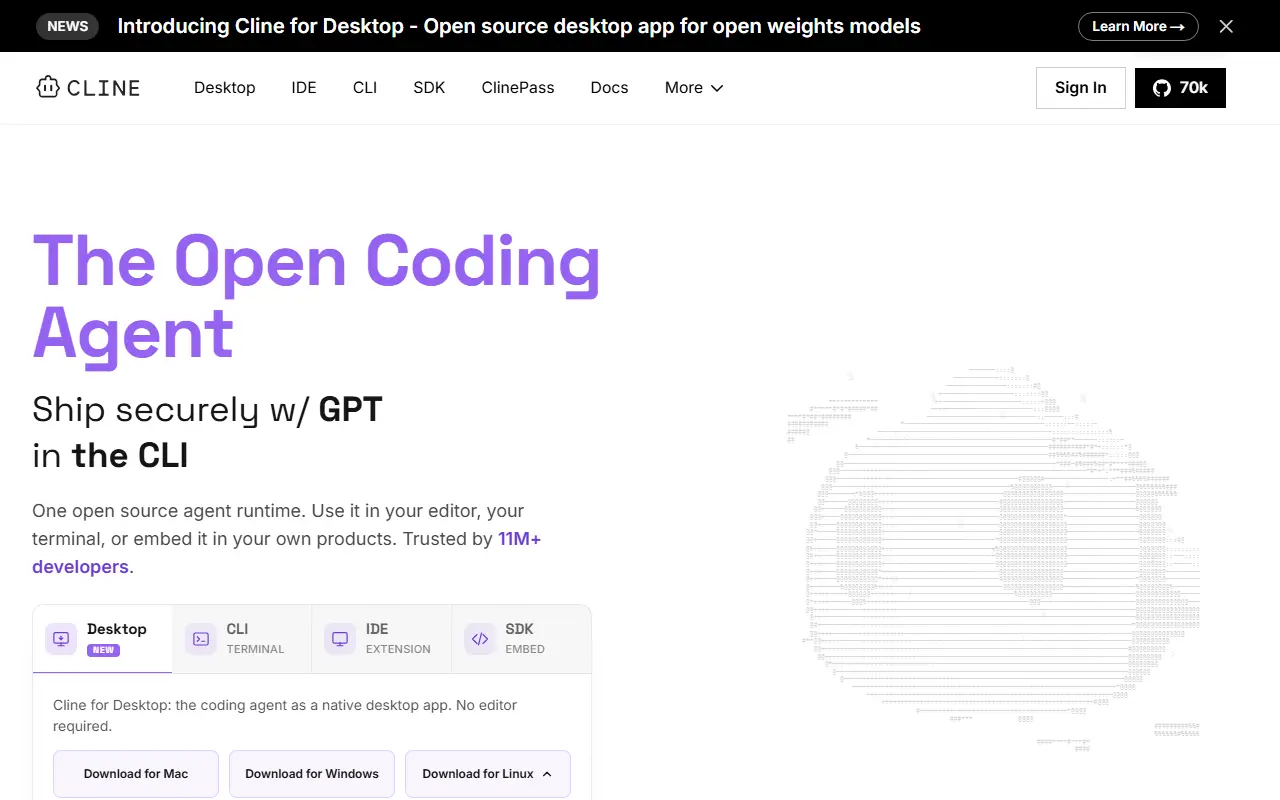
cline.botCline homepage screenshot

Cline is an open-source coding agent that works in your IDE, terminal and desktop. It can edit code across a project, create files, run commands and browse the web, with human-in-the-loop approval for tools in the editor. It is written in TypeScript and released under the Apache-2.0 license.

The same agent engine is offered in several forms: a CLI with an interactive mode and a headless mode for CI/CD and scripting, a native desktop app for macOS and Windows that works from any folder, schedules recurring routines and manages models, plugins and MCP servers, a VS Code extension, a JetBrains plugin for IntelliJ IDEA, PyCharm, WebStorm, GoLand and others, and an SDK.

The SDK is a Node.js programmatic API for building custom agents with custom tools, multi-agent teams, connectors and scheduled automations. The README notes that the JetBrains plugin is not open-sourced. Cline suits developers who want one coding agent across their editor, terminal and automation pipelines.

Key features

  • CLI with interactive and headless modes
  • VS Code extension with approval prompts
  • JetBrains plugin for the IntelliJ family
  • Desktop app for macOS and Windows
  • Node.js SDK for custom agents
  • Scheduled routines and MCP server management

Pricing: The open-source extension is free for individual developers, who pay only for AI inference or use their own API keys. Enterprise adds SSO, SLA and dedicated support at custom pricing.

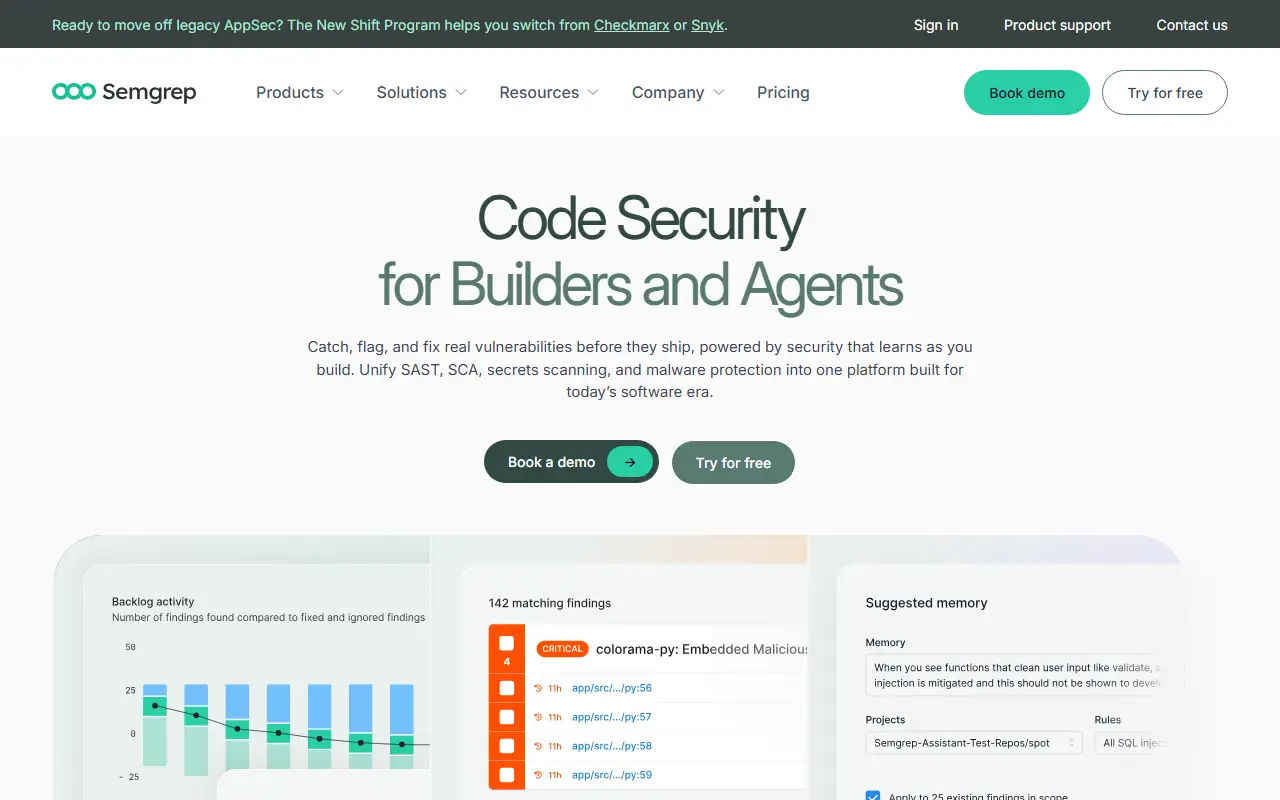
Semgrep

Semgrep is a fast, open-source static analysis tool that finds bugs and enforces security and coding standards across 30+ languages.

GitHub stars
18k
Last commit
2 days ago
Latest release
v1.185.0
Licence
LGPL-2.1
Self-hosted
Yes
Hosted version
Available
semgrep.devSemgrep homepage screenshot

Semgrep is a lightweight static analysis tool that searches code, finds bugs and enforces secure guardrails and coding standards. It supports more than 30 languages and can run in an IDE, as a pre-commit check or inside CI/CD workflows. The core engine is released under the LGPL-2.1 license.

It works like a semantic grep for code. Rules are written to look like the source code developers already write, so matching a pattern does not require abstract syntax trees, regular expressions or a separate query language, and a search for a value can match code that computes it. The aim is to find variants of a known bug quickly.

The Community Edition analyzes code within a single function or file, which the maintainers note means it will miss many true positives for security work. For SAST, software composition analysis and secrets scanning they recommend the commercial Semgrep AppSec Platform, which adds cross-file and data-flow analysis, AI-assisted triage and managed rule sets.

Key features

  • Pattern-based code search that looks like code
  • Support for 30+ programming languages
  • Runs in IDEs, pre-commit hooks and CI/CD
  • Custom rules without ASTs or regex
  • SAST, SCA and secrets scanning via AppSec Platform

Pricing: Free for up to 10 contributors. Teams starts at $30 per contributor per month (Secrets $15); Enterprise is custom.

Kilo Code

Kilo Code is an open-source AI coding agent for VS Code, JetBrains and the command line that works with hundreds of models.

GitHub stars
28k
Last commit
yesterday
Latest release
v7.8.27
Licence
MIT
Hosted version
Available
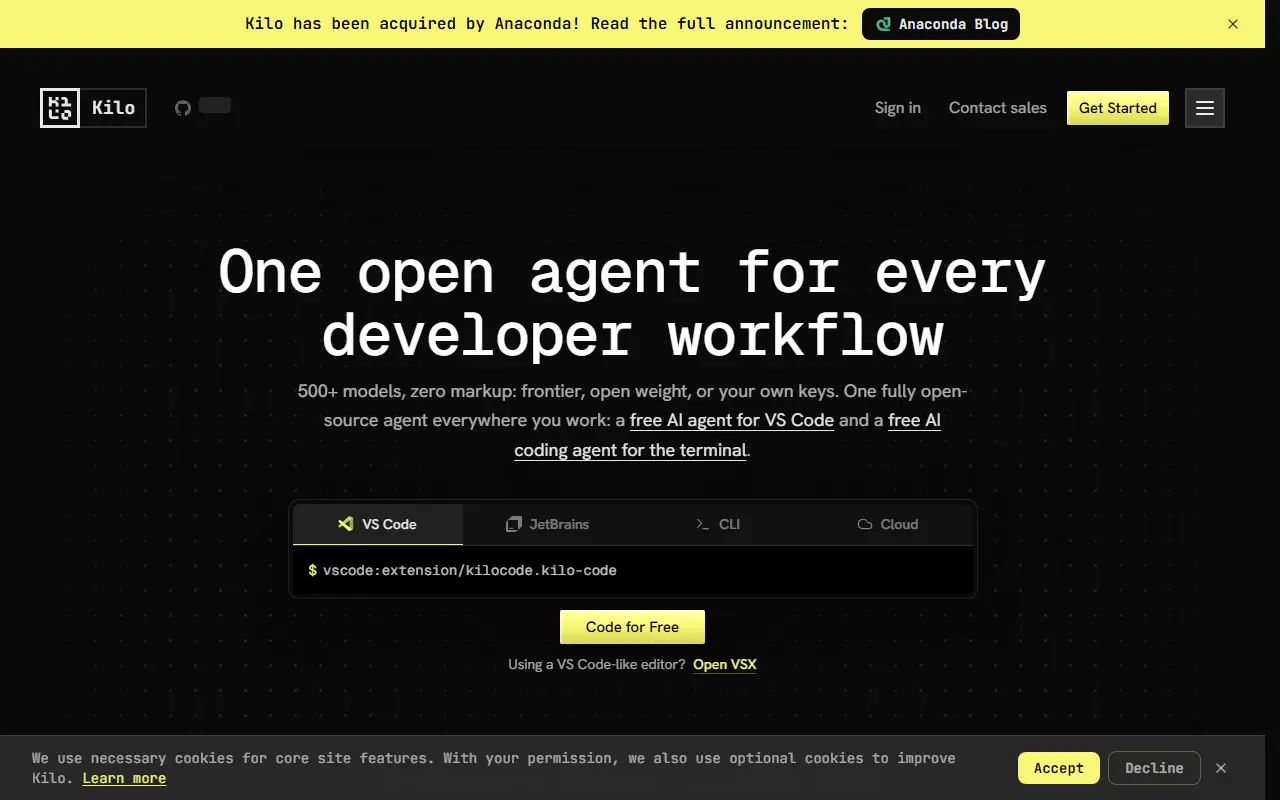
kilo.aiKilo Code homepage screenshot

Kilo Code is an AI coding agent that you can use in VS Code, in JetBrains IDEs or from the CLI. It is open source under the MIT license and written in TypeScript. According to the README, you can pick from more than 500 models and switch between them in the middle of a task, and you pay the model provider's rate with no markup. No API keys are needed to start.

Besides the local extensions, a Cloud Agent runs Kilo from the web without a local machine, and automated AI code reviews can be set up for pull requests. The CLI is started with the kilo command in a project directory and can be installed from release binaries for Windows, macOS on Apple Silicon and Intel, and Linux on x64 and ARM, with variants for older CPUs and Alpine-style images. The repository started in 2025 and its README is translated into many languages.

Key features

  • Agent for VS Code, JetBrains and CLI
  • Choice of hundreds of AI models
  • Switch models mid-task
  • Cloud Agent that runs from the web
  • Automated AI reviews for pull requests
  • CLI binaries for Windows, macOS and Linux

Pricing: The open-source extensions are free, with AI inference billed separately. Teams costs $15 per user per month with a 14-day trial; Enterprise is custom. Optional Kilo Pass credits start at $19 per month.

Continue

Continue is an open-source coding agent for the command line, VS Code and JetBrains; the repository is now read-only and no longer maintained.

GitHub stars
36k
Last commit
8 days ago
Latest release
v2.0.0-vscode
Licence
Apache-2.0
continue.devContinue homepage screenshot

Continue is an open-source coding agent that was offered as a command-line tool, a VS Code extension and a JetBrains plugin. It is written in TypeScript and released under the Apache-2.0 license. According to the README, the project's GitHub repository has stopped receiving active maintenance and is now read-only, so new features and fixes should not be expected from it.

The team shipped a final 2.0.0 release for the VS Code extension, the CLI and the JetBrains plugin. That release removed anonymous telemetry and authentication, and fixed a batch of bugs. The maintainers recommend the CLI over the JetBrains plugin, and they point to the documentation for configuration and customization. The project describes the codebase as a foundation that others can build on, which makes it relevant as reference code more than as an actively developed product.

Key features

  • Agent-style assistant usable from a terminal CLI
  • VS Code extension and JetBrains plugin
  • Configurable through project documentation
  • Final release removed telemetry and authentication
  • Apache-2.0 codebase open for reuse
  • Repository archived as read-only

Pricing: Free and open source under the Apache-2.0 license.

GitLab Community Edition

GitLab is a web platform for Git repositories, code review, CI/CD pipelines and issue tracking; this repository is its Community Edition mirror.

GitHub stars
25k
Last commit
21 days ago
Licence
MIT
Self-hosted
Yes
Hosted version
Available
about.gitlab.comGitLab Community Edition homepage screenshot

GitLab is a platform for collaborating on code. This GitHub repository is a mirror of the Community Edition, written in Ruby on Rails, while the canonical source and all development take place on GitLab.com. Issues should be opened on the GitLab.com tracker rather than here. The platform manages Git repositories with fine-grained access controls, merge requests for code review, and per-project issue trackers, boards and wikis.

GitLab includes continuous integration and delivery pipelines to build, test and deploy applications. It follows an open-core model: most of the code is MIT-licensed, while files in the ee directory are proprietary but source-available. Three editions exist: Community Edition, free under the MIT Expat license; Enterprise Edition, with extra features aimed at organizations with more than 100 users and sold by subscription; and JiHu Edition for the Chinese market. A free trial of the Ultimate tier is available.

Key features

  • Git repository hosting with access controls
  • Merge requests for code review
  • Built-in CI/CD pipelines
  • Issue tracker, boards and wiki per project
  • Community Edition under the MIT Expat license
  • Enterprise Edition with subscription support

Pricing: Free for personal projects with usage limits. Premium costs $29 per user per month billed annually; Ultimate and the single-tenant Dedicated offering are quoted. Free trials are offered for paid tiers.

SonarQube

Static code analysis platform that finds bugs, vulnerabilities and maintainability problems in code, in IDEs, pull requests and CI.

GitHub stars
11k
Last commit
yesterday
Latest release
26.11.0.134175
Licence
LGPL-3.0
Self-hosted
Yes
sonarqube.orgSonarQube homepage screenshot

SonarQube is a code quality and security platform. Its static analysis uses techniques such as symbolic execution and data and control flow analysis to inspect source code, find bugs and vulnerabilities, and explain what to fix and why. Results appear in the IDE, in pull requests and in CI pipelines.

This repository holds the source of the SonarQube Community Build, the free, open-source edition that shares the analysis used across the product line. It reports reliability bugs, security vulnerabilities and security hotspots, maintainability and structural issues, and coverage on new code. More than 40 programming languages and frameworks are covered, and the same code always produces the same findings.

The project positions itself as a verification step for code written by people or by AI agents before it merges. SonarQube is written in Java and licensed under LGPL-3.0. Commercial editions from SonarSource add further features, while the Community Build can be run on your own servers.

Key features

  • Static analysis for bugs and vulnerabilities
  • Security hotspot review guidance
  • Maintainability and structural issue detection
  • Coverage tracking on new code
  • Support for 40+ languages and frameworks
  • Feedback in IDE, pull requests and CI

Pricing: A free tier covers private projects up to 50k lines of code and an open-source Community Build is available. The Team plan starts at $34 a month for up to 100k lines of code; Enterprise is quoted.

Aider

Aider is an open-source command-line tool for pair programming with large language models, editing your codebase and committing changes through git.

GitHub stars
50k
Last commit
5 mo ago
Latest release
v0.86.0
Licence
Apache-2.0
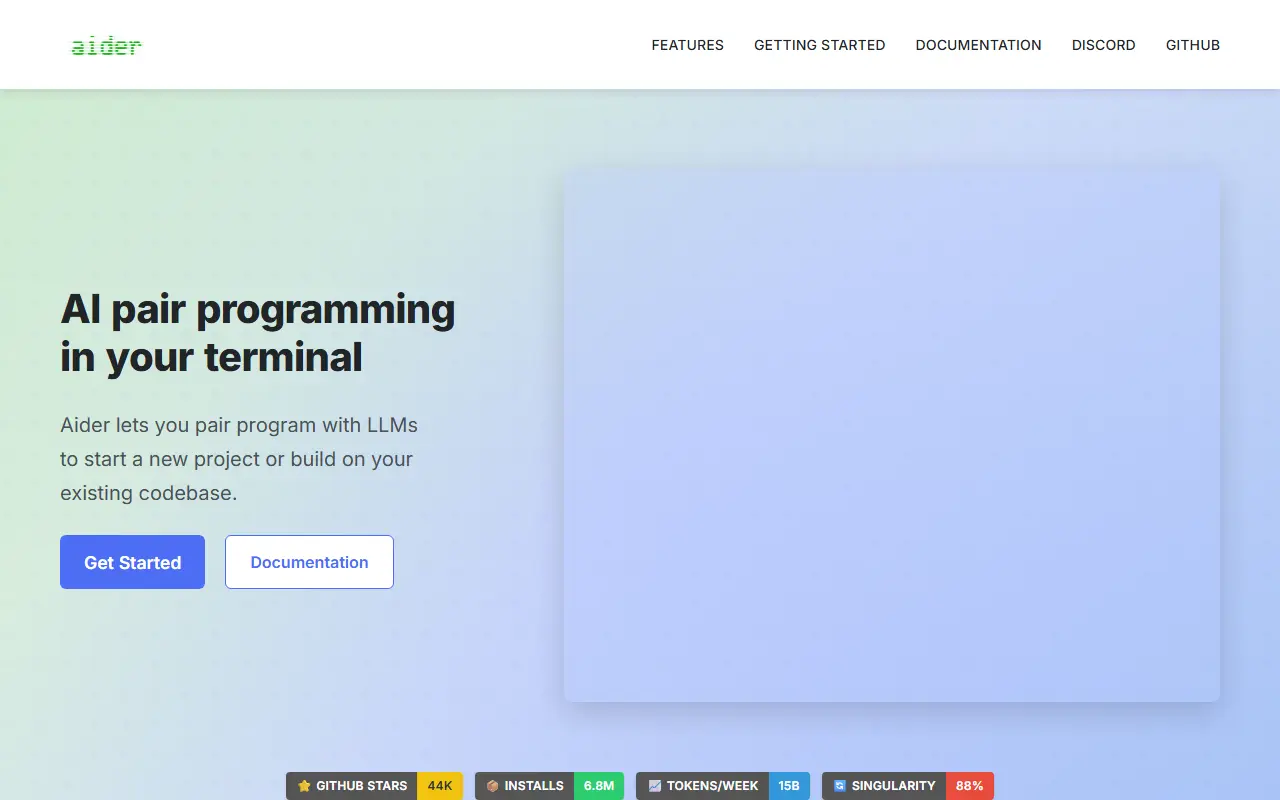
aider.chatAider homepage screenshot

Aider is AI pair programming in your terminal. It lets you work with large language models to start a new project or build on an existing codebase, asking for changes in plain language and letting the model edit the files in your repository.

It builds a map of the whole codebase to help in larger projects, supports more than 100 programming languages and commits changes to git with descriptive messages, so you can diff or undo AI edits with familiar tools. It can connect to cloud models and local models, accept images and web pages as context, take voice instructions, and run linters and tests after each change, attempting to fix problems they report. It can also be used from an IDE through code comments, or via copy and paste with a model's web chat.

Aider is written in Python and licensed under Apache-2.0. The README names a handful of commercial models it has been used with most, but says it can connect to almost any model, and installation and usage guides are available in the documentation.

Key features

  • Codebase map for larger projects
  • Works with cloud and local LLMs
  • Automatic git commits with clear messages
  • Support for 100+ programming languages
  • Image and web page context
  • Voice-to-code requests
  • Automatic linting and testing after edits

Pricing: Free and open source under the Apache-2.0 licence; model usage is billed by whichever LLM provider you connect.

Commercial Qodo alternatives

Hosted, closed-source products that compete with Qodo. Showing 12 of 25.

See every Qodo alternative on its tool page

Qodo alternatives: questions

What is the best open-source alternative to Qodo?
Cline is the top-ranked open-source alternative to Qodo on Enlisted: An open-source autonomous coding agent available as a CLI, desktop app, VS Code extension, JetBrains plugin and SDK. Other strong options are Semgrep, Kilo Code, Continue and GitLab Community Edition.
What are the best commercial alternatives to Qodo?
Code Climate, SonarQube Cloud, Codacy, JetBrains AI Assistant and Ontoly Cloud are among the hosted, closed-source alternatives to Qodo listed on Enlisted, which lists 25 in total. Compare their pricing and features on each tool page.
Are these Qodo alternatives free?
All 7 are open source, so the code is free to use under its licence, and all of them can be self-hosted on your own server or computer. 3 also offer a paid or managed cloud version if you'd rather not host it yourself.
How is this list of Qodo alternatives ranked?
By a score built from GitHub stars, star growth over the last 30 days and how recently the code changed. 6 of these projects shipped code in the last 30 days. Data is refreshed daily, and nobody can pay to move up.

People also look for alternatives to…

View all