7,363 open-source and SaaS tools, with GitHub stats refreshed every day.

18 alternatives ranked by real activity

Open-source Postman alternatives

A curated, ranked list of the 18 best open-source alternatives to Postman.

The best open-source alternative to Postman is Hoppscotch. If that doesn't suit you, other good options are Bruno, Insomnia, Yaak and Scalar.

Postman alternatives are mainly API tools, but some are also testing & QA tools. 14 of them shipped code in the last 30 days, 18 can be self-hosted, and 15 use a permissive licence.

Last updated October 2, 2026 · ranked by GitHub stars, growth and recent commits

Hoppscotch

An open-source API development tool for building and testing REST, GraphQL and WebSocket requests, on web, desktop and CLI, as a Postman alternative.

GitHub stars
81k
Last commit
2 days ago
Latest release
2026.9.0
Licence
MIT
Self-hosted
Yes
Hosted version
Available
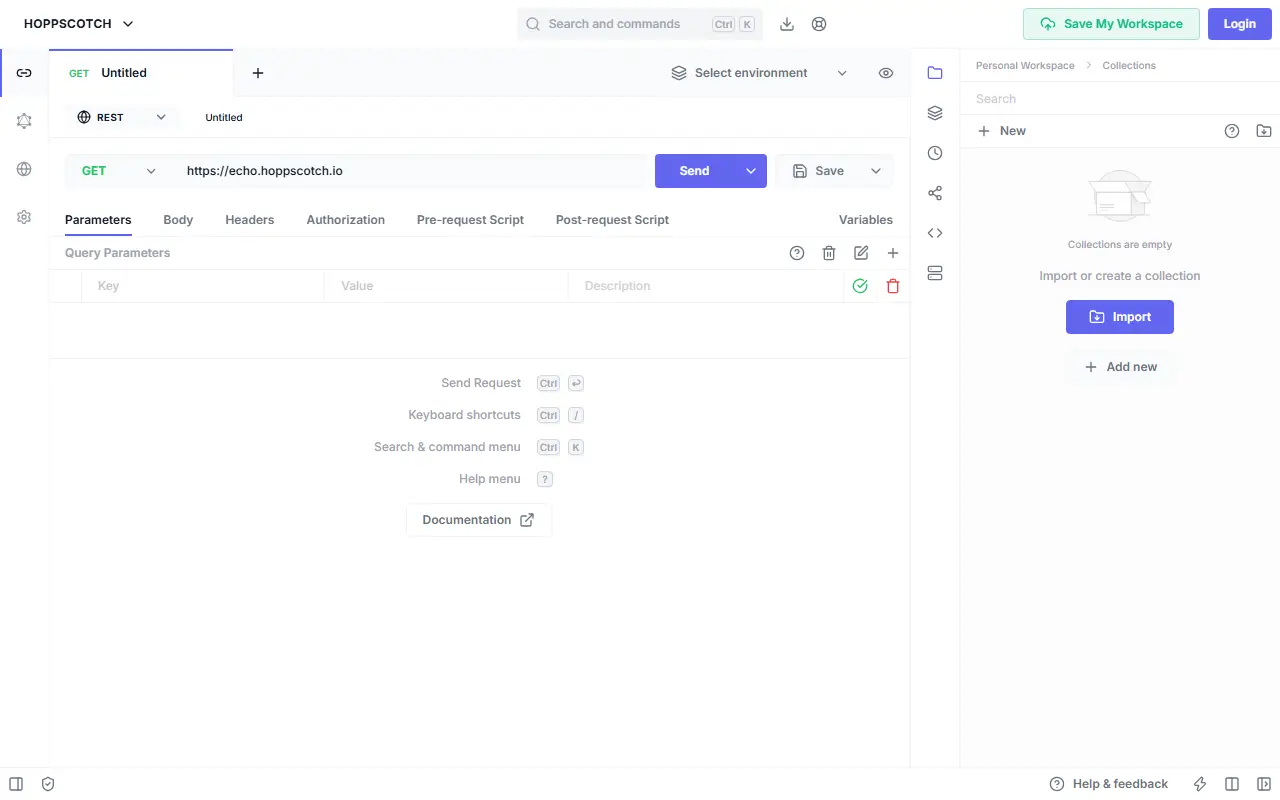
hoppscotch.ioHoppscotch homepage screenshot

Hoppscotch is an open-source API development ecosystem for sending requests, inspecting responses and organizing API work. It is positioned as an alternative to Postman and Insomnia and runs in the browser, as a desktop app and from a command line interface, with offline, on-premises and cloud options.

The request builder supports the standard HTTP methods plus custom ones, and the toolset extends to GraphQL and WebSocket testing. You can generate code snippets for more than ten languages and frameworks, share requests through public URLs, and install the web app as a progressive web app for offline use. The interface is lightweight, with light, dark and black themes, a choice of accent colors and a distraction-free Zen mode.

Hoppscotch is MIT licensed and written mainly in TypeScript with Vue. Teams that need to keep API traffic and collections inside their own network can self-host it, while the hosted service at hoppscotch.io suits individuals who just want to start sending requests.

Key features

  • REST, GraphQL and WebSocket request testing
  • Code snippet generation for 10+ languages
  • Installable offline-capable progressive web app
  • Shareable request URLs
  • Web, desktop and CLI clients
  • Custom themes and accent colors

Pricing: Free and open source under the MIT license; a hosted version is available at hoppscotch.io.

Bruno

A Git-friendly, offline-only API client for REST, GraphQL, gRPC and WebSocket that stores collections as plain text files, an open-source alternative to Postman.

GitHub stars
47k
Last commit
yesterday
Latest release
v4.2.1
Licence
MIT
Self-hosted
Yes
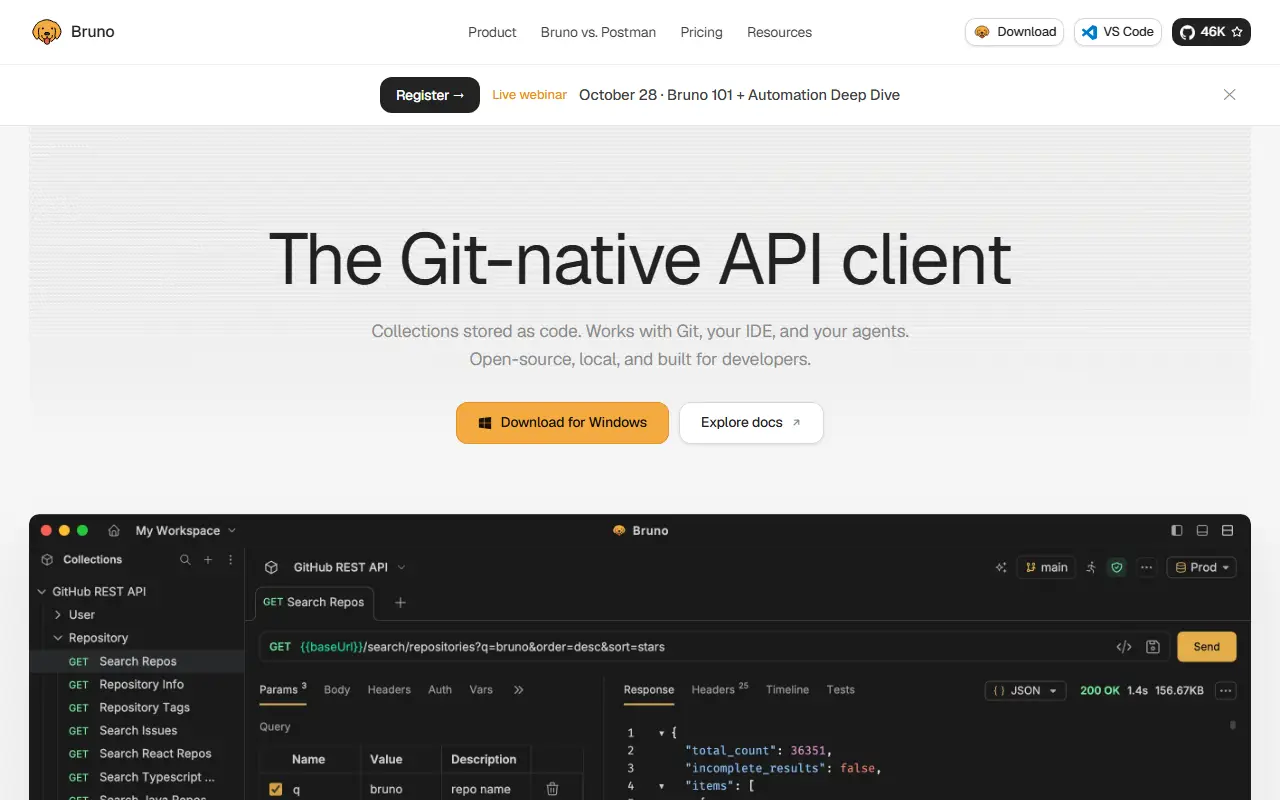
usebruno.comBruno homepage screenshot

Bruno is an open-source API client and testing environment, described as a lightweight alternative to Postman and Insomnia. It supports REST, GraphQL, gRPC and WebSocket requests, and runs on macOS, Windows and Linux.

Its distinguishing idea is that collections live directly in a folder on your filesystem, saved in a plain text markup language called Bru. That means you can version and share API collections with Git or any version control system you already use. Bruno is offline only, and the maintainers state they have no plans to add cloud sync, because they believe your data should stay on your device. A CLI runs collections from the command line for automated testing and CI/CD, and a Docker option is also documented.

The core is MIT licensed, and the project offers paid versions that add further features for teams that want them. Bruno can be installed from the website or through Homebrew, Chocolatey, Scoop, Snap, Flatpak and Apt. It suits developers who prefer keeping API definitions next to their code.

Key features

  • REST, GraphQL, gRPC and WebSocket requests
  • Collections stored as plain text Bru files
  • Git-based collaboration on API collections
  • Offline-only with no cloud sync
  • Bruno CLI for CI/CD test runs
  • Install via Homebrew, Chocolatey, Snap and more

Pricing: The open-source edition is free. Pro costs $6 and Ultimate $11 per user per month, billed annually, and Ultimate has a 14-day free trial.

Insomnia

A cross-platform API client from Kong for designing, debugging, testing and mocking REST, GraphQL, gRPC, WebSocket and SSE APIs, with local, Git or cloud storage.

GitHub stars
40k
Last commit
yesterday
Latest release
core@13.3.0
Licence
Apache-2.0
Self-hosted
Yes
Hosted version
Available
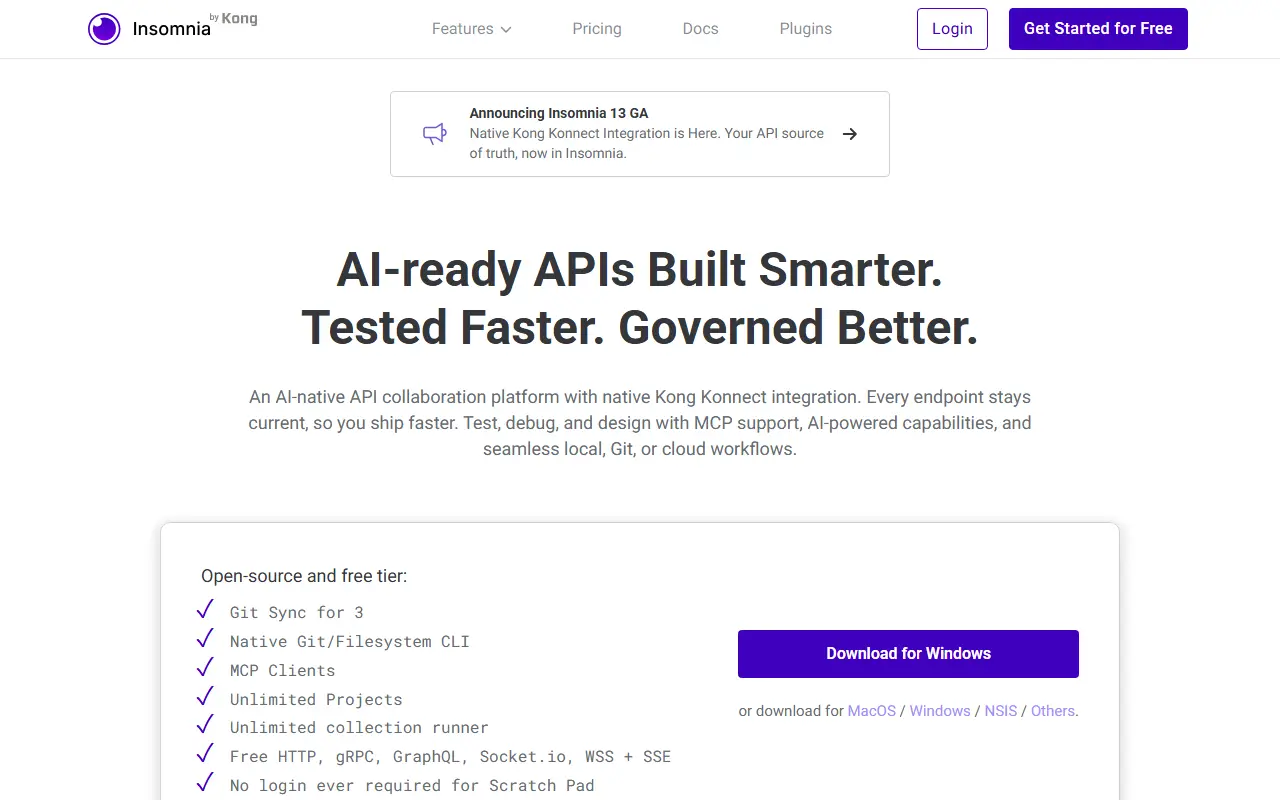
insomnia.restInsomnia homepage screenshot

Insomnia is an API client from Kong that is open source and runs on every major desktop platform. It handles GraphQL, REST, WebSockets, Server-Sent Events, gRPC and other HTTP-compatible protocols, so one desktop app can cover most of the API work a developer does day to day.

With it you can debug requests, design APIs in a native OpenAPI editor with visual preview, test them with native test suites and a collection runner, and mock them with a cloud or self-hosted mock server. A command line tool supports linting and testing in CI/CD pipelines, collaboration features help teams share work, and third-party plugins extend the app. Projects can be stored in a Local Vault for fully local use, synced through any Git repository, or kept in the cloud with optional end-to-end encryption.

Insomnia is Apache-2.0 licensed and written in TypeScript on Electron. It is free to get started with, and paid collaboration features are available from the vendor. It is a popular alternative to Postman for developers who want flexible storage options.

Key features

  • REST, GraphQL, gRPC, WebSocket and SSE support
  • OpenAPI design editor with visual preview
  • Test suites and collection runner
  • Mock servers, cloud or self-hosted
  • CLI for CI/CD linting and testing
  • Local Vault, Git Sync or Cloud Sync storage

Pricing: Essentials is free. Pro is $12 and Enterprise $45 per user per month (self-serve up to 50 users); there is a 14-day Enterprise trial and a free local-only Scratch Pad.

Yaak

Yaak is a fast, privacy-focused desktop API client for REST, GraphQL, gRPC, WebSocket and Server-Sent Events, built with Tauri.

GitHub stars
19k
Last commit
5 days ago
Latest release
v2026.8.1
Licence
MIT
Self-hosted
Yes
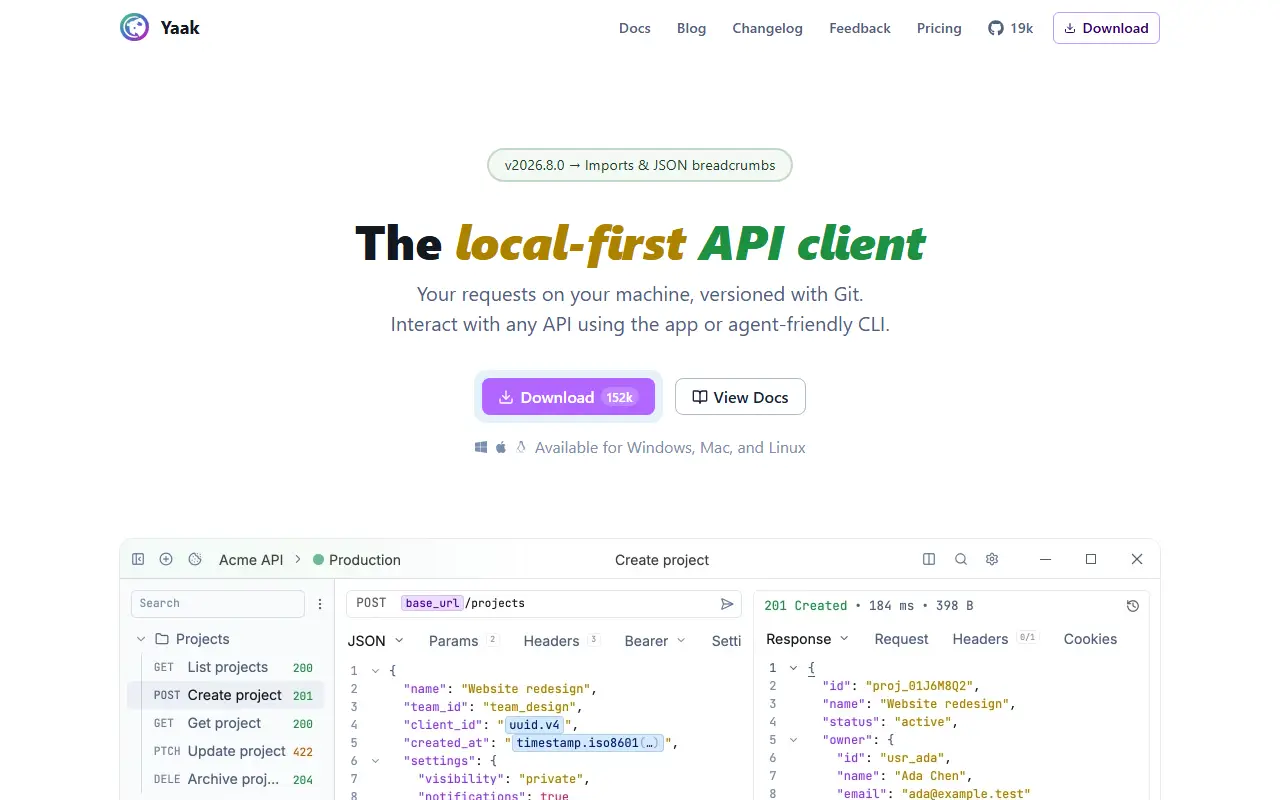
yaak.appYaak homepage screenshot

Yaak is a desktop API client for building, sending and inspecting requests to REST, GraphQL, gRPC, WebSocket and Server-Sent Events endpoints. It is built with Tauri, Rust and React and works offline-first, with no telemetry and no requirement to sync data to a cloud account.

Collections from Postman, Insomnia, OpenAPI, Swagger or curl can be imported. Responses can be filtered with JSONPath or XPath, and authentication supports OAuth 2.0, JWT and Basic Auth, with encrypted secrets that can be kept in the operating system keychain. Requests are grouped into workspaces and nested folders, and environment variables switch between dev, staging and production.

Workspaces can be mirrored to the filesystem so they can be versioned in Git or synced with a file-sync service. Template tags insert dynamic values such as UUIDs or timestamps, and themes and plugins allow customization. Yaak is MIT licensed, its repository topics position it as an alternative to Postman, Bruno and Insomnia, and development is funded by community-purchased licenses.

Key features

  • REST, GraphQL, gRPC, WebSocket and SSE requests
  • Import from Postman, Insomnia and OpenAPI
  • OAuth 2.0, JWT and Basic Auth support
  • Encrypted secrets with OS keychain storage
  • Workspaces mirrored to Git-friendly files
  • Environment variables and template tags
  • Plugins and custom themes

Pricing: Free for personal use. Commercial use needs a license: Individual is $79 a year or $399 once, Business is $149 per user per year, with a 30-day trial.

Scalar

An open-source API platform that renders interactive OpenAPI and Swagger references and includes an offline-first API client with desktop apps.

GitHub stars
16k
Last commit
today
Latest release
release-2026-10-02-0962afc
Licence
MIT
Self-hosted
Yes
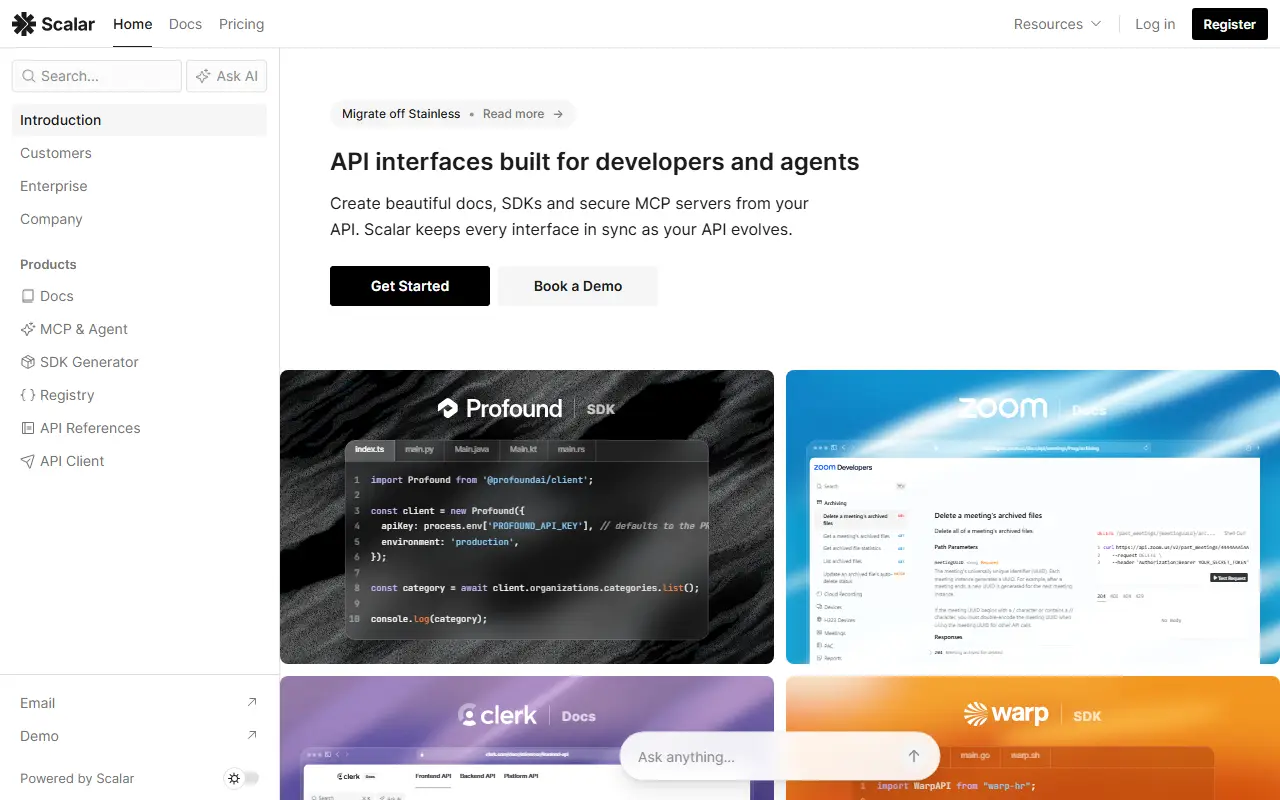
scalar.comScalar homepage screenshot

Scalar is an open-source API platform built around the OpenAPI standard. One part turns OpenAPI or Swagger documents into an interactive API reference with a built-in testing tool and generated code samples for many languages and frameworks, and it aims for a modern look rather than a dated one. Integrations exist for popular server frameworks, so docs can be mounted straight into an existing project.

The other part is an API client designed to work offline and built for OpenAPI. It is free and open source, treats OpenAPI and Swagger as first-class inputs, works with dozens of API frameworks such as Elysia, Hono and FastAPI, and can stay in sync with a running server through a watch mode. Environment variables, dynamic parameters and the other staples of a REST client are included. You can try it in the browser or download it for Windows, macOS or Linux.

The quickstart even offers a prompt you can hand to a coding agent to set up the reference in your project. Scalar is MIT licensed and written in TypeScript and Vue. It suits API teams that want better-looking documentation and a lighter alternative to Postman-style tools tied to their specs.

Key features

  • Interactive API reference from OpenAPI documents
  • Built-in request testing tool
  • Code samples in many languages
  • Offline-first API client for desktop
  • Watch mode that syncs with server frameworks
  • Integrations for Hono, FastAPI and Elysia

Pricing: Free plan for up to 3 APIs. Pro is $150 and Business $600 per month ($125 and $500 billed yearly); Enterprise is custom.

Karate

An open-source framework for test automation that brings API checks, mocks, performance tests and UI automation together under one readable syntax.

GitHub stars
9k
Last commit
yesterday
Latest release
v2.1.3
Licence
MIT
docs.karatelabs.ioKarate homepage screenshot

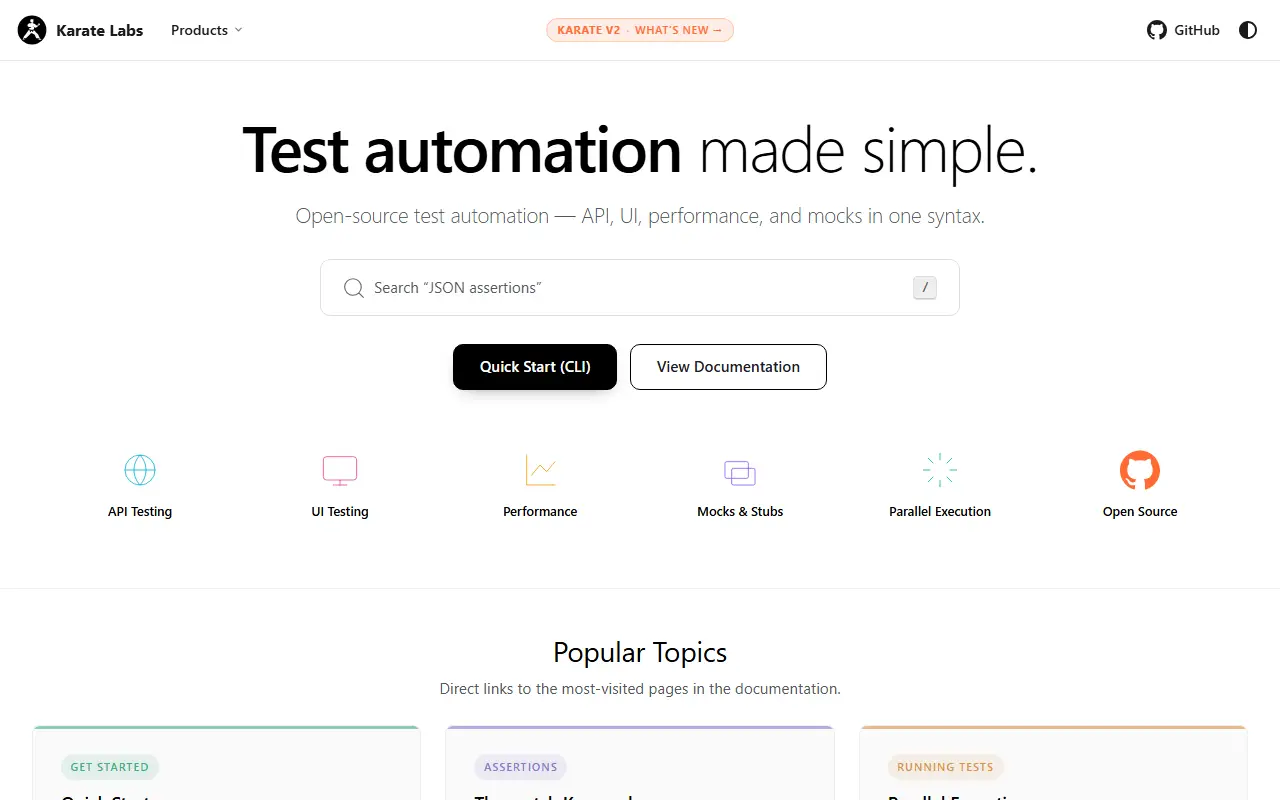
Karate is an open-source tool that unifies API testing, mocks, performance testing and UI automation in one framework with a single readable syntax. Tests are written as feature files, so people who are not Java developers can read and write them, and the project is written in Java.

Its documentation highlights the match keyword for validating complete responses, headers and arrays, parallel execution of features, scenarios and example rows, reusable flows by calling one feature from another, and test doubles that stand up HTTP, gRPC and message-queue mocks from a feature file. Karate v2 adds virtual threads, a single-binary CLI, JavaScript debugging and soft assertions. There are extensions for VS Code and IntelliJ, plus Karate Agent and Karate Xplorer products.

Tests can be run through JUnit, the command line or CI/CD pipelines. Karate is licensed under MIT, and topics mention BDD, Cucumber, contract testing, load testing and WebDriver. It suits QA engineers and developers who want one tool for API-level and UI-level checks.

Key features

  • API testing in readable feature files
  • Built-in HTTP, gRPC and queue mocks
  • Performance testing from the same tests
  • UI automation with a browser driver
  • Parallel test execution
  • JUnit, CLI and CI/CD runners
  • VS Code and IntelliJ extensions

Pricing: The open-source framework is free. Pro is $64 per user per month ($640 per user per year) and IDE Plus is $100 per user per year; Enterprise is custom. Everything runs self-hosted.

Mockoon

Mockoon is a free, open-source desktop app and CLI for designing and running mock REST APIs locally, with an optional cloud for teams.

GitHub stars
8.4k
Last commit
today
Latest release
v9.9.0
Licence
MIT
Self-hosted
Yes
Hosted version
Available
mockoon.comMockoon homepage screenshot

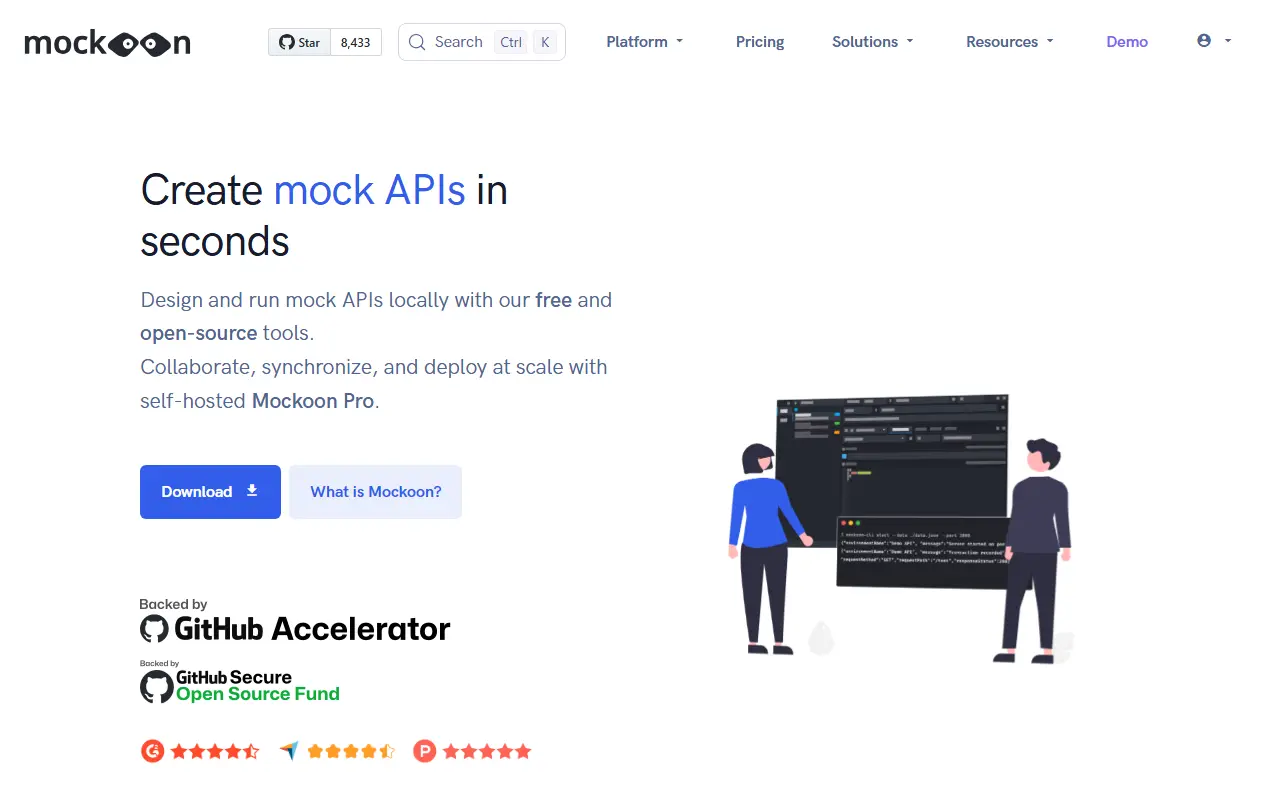
Mockoon is an open-source tool for designing and running mock APIs. It combines a desktop application for building mock servers locally with a command-line tool for running those mocks in headless environments, and it requires no remote deployment or account.

API mocking reduces dependence on external services and their limits such as rate limits, costs and availability. Mockoon lets you control routes in detail, including HTTP methods and statuses, regex paths, file serving and custom headers. It supports OpenAPI import, JSON templating, HTTPS, a proxy forwarding mode and logs of incoming and forwarded requests. Teams can simulate errors and latencies and onboard new members with a consistent test environment.

The desktop app is built with Electron and TypeScript under the MIT licence and installs through Homebrew, winget, Chocolatey, the Windows Store, Snap or AUR. The CLI is also available as a Docker image for self-hosting mock APIs, and a separate cloud offering supports team collaboration, data sync and deployment of mock APIs.

Key features

  • Unlimited local mock servers and routes
  • Control over methods, statuses and regex paths
  • OpenAPI compatibility
  • JSON templating and proxy forwarding
  • Request logs and HTTPS support
  • CLI and Docker image for CI

Pricing: Mockoon Pro Team costs €10 per license per month, billed annually and excluding tax, with a 14-day free trial. Enterprise is quoted on request.

Requestly

The community hub for Requestly's API client, a Git-native Postman alternative; note that the application itself is closed source and this repository tracks bugs and the roadmap.

GitHub stars
6.8k
Last commit
yesterday
Latest release
changelog-2026.03.23
Self-hosted
Yes
Hosted version
Available
requestly.comRequestly homepage screenshot

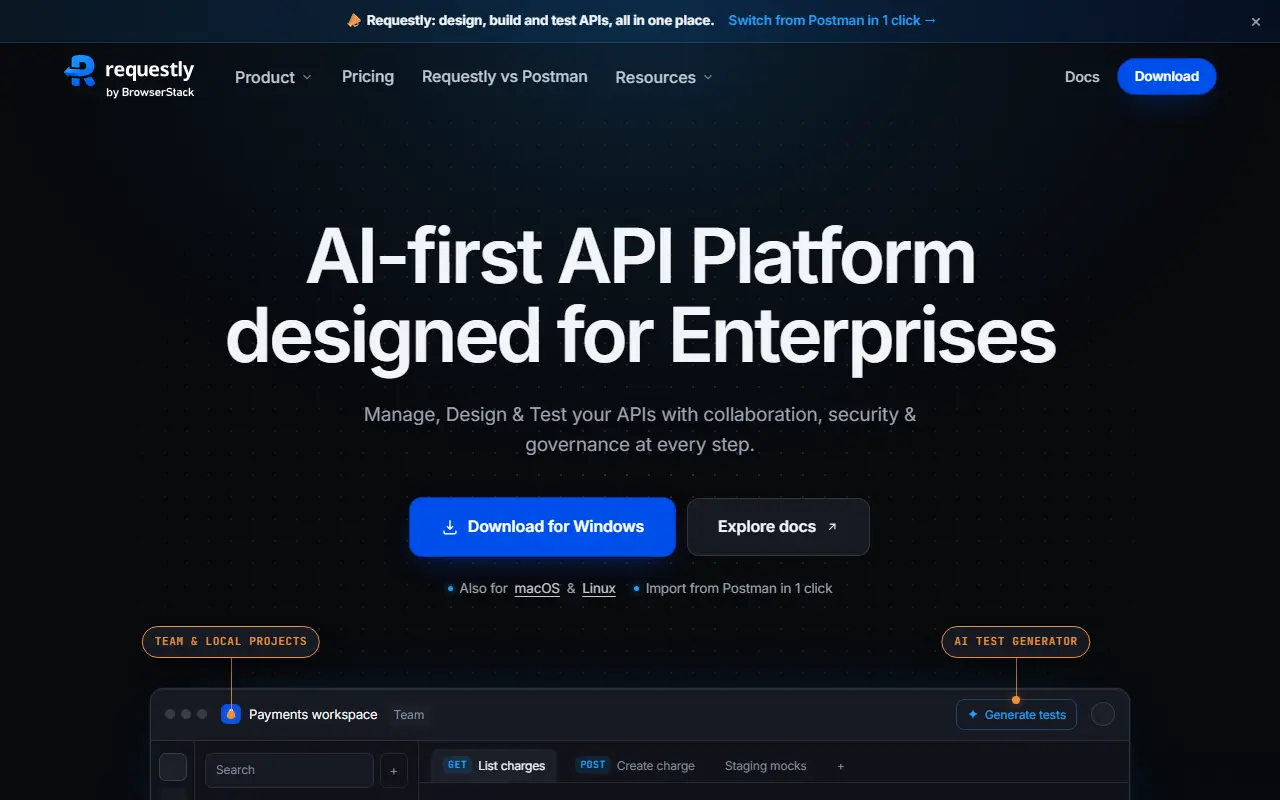
Requestly API Client is a tool for designing, building and testing APIs in one place, positioned as a privacy-first alternative to Postman. This GitHub repository is the community hub: it is where users report bugs, request features, ask questions and browse the roadmap, and the README states plainly that the application itself is closed source.

The client supports a REST API playground, pre and post scripts, import and export from cURL, Postman and OpenAPI, GraphQL with schema introspection and autocompletion, Git sync for keeping collections in a repository, and local workspaces stored as files with no cloud storage. Topics also mention gRPC and WebSocket. You can choose local, team sync or self-hosted setups to keep control of your data, and the project advertises flat pricing that is free for up to 10 collaborators.

Desktop downloads exist for macOS on Apple Silicon and Intel, Windows and Linux. Because the repository lists the license as Other and the app is closed source, readers looking for fully open-source software should not assume the client can be audited or modified.

Key features

  • REST API playground
  • Pre and post request scripts
  • Import from cURL, Postman and OpenAPI
  • GraphQL support with introspection
  • Git sync for API collections
  • Local workspaces with no cloud storage
  • Desktop apps for macOS, Windows and Linux

Pricing: No free plan is listed; a 30-day free start is offered. Team costs $10 and Team Pro $15 per user per month billed annually; Enterprise is by contract.

ATAC

ATAC is a terminal-based API client written in Rust, offering Postman-style request building without a graphical environment.

GitHub stars
3.7k
Last commit
29 days ago
Latest release
v0.23.1
Licence
MIT
Self-hosted
Yes

ATAC, short for Arguably a Terminal API Client, is a text user interface for building and sending API requests, similar in spirit to Postman, Insomnia and Bruno but running entirely in your terminal. No graphical environment is needed, which makes it handy over SSH and for keyboard-focused developers.

It is written in Rust using the ratatui library and offers Vim key-bindings, NeoVim integration and themes. The README covers several installation routes, including cargo, Homebrew, Scoop, Arch Linux, Fedora Copr, a Docker package, prebuilt binaries and compiling from source, and it documents features, planned work for the 1.0 and 2.0 releases, and the binary size and dependencies.

ATAC is MIT-licensed and runs locally on your machine, with no account or hosted service required. It suits developers who like terminal workflows and want a lightweight alternative to graphical API clients.

Key features

  • Terminal user interface for API requests
  • Postman-style request collections
  • Vim-style key bindings
  • Integration with NeoVim
  • Themes you can customize
  • Multiple install methods including Homebrew and Scoop

Pricing: Free and open source under the MIT license.

API Dash

Open-source, cross-platform API client built with Flutter for crafting HTTP and GraphQL requests, inspecting responses, and generating integration code.

GitHub stars
2.9k
Last commit
yesterday
Latest release
v0.3.0
Licence
Apache-2.0
Self-hosted
Yes
apidash.devAPI Dash homepage screenshot

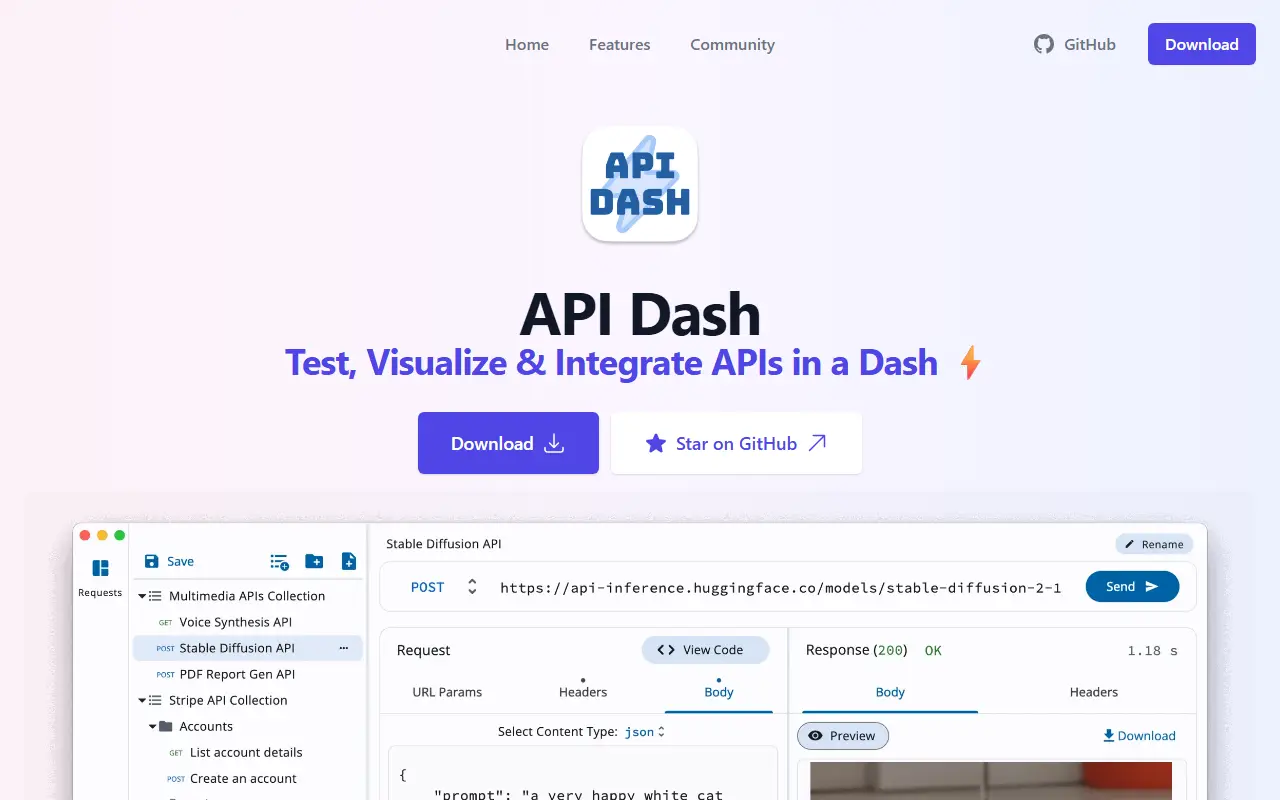
API Dash is an open-source API client for desktop and mobile, built with Flutter and described as a lightweight alternative to Postman and Insomnia. You can create and customize HTTP and GraphQL requests, visually inspect the responses, and generate code for integrating an API into your application. It is released under the Apache-2.0 license and includes AI-assisted features.

Requests can be built with different HTTP methods, headers, query parameters, and bodies, and the app handles Unicode and emoji content in both requests and previews. Requests are organized into collections and folders that you can rearrange, rename, and duplicate. Collections can be imported from Postman, cURL, Insomnia, OpenAPI, and HAR files, and the topics also mention server-sent events and WebSocket support.

Builds are provided for iOS, macOS, Windows, and Linux in several package formats. It suits developers who want a free, native-feeling alternative for exploring and testing APIs and who may want to contribute, since the project takes part in open-source programs and welcomes contributors.

Key features

  • HTTP and GraphQL request builder
  • Visual response inspection
  • API integration code generation
  • Collections and folders for organizing requests
  • Import from Postman, cURL, Insomnia, OpenAPI, and HAR
  • Desktop and mobile apps built with Flutter
  • AI-assisted features

Pricing: Free and open source under the Apache-2.0 license.

8 more Postman alternatives

Postman alternatives: questions

What is the best open-source alternative to Postman?
Hoppscotch is the top-ranked open-source alternative to Postman on Enlisted: An open-source API development tool for building and testing REST, GraphQL and WebSocket requests, on web, desktop and CLI, as a Postman alternative. Other strong options are Bruno, Insomnia, Yaak and Scalar.
Are these Postman alternatives free?
All 18 are open source, so the code is free to use under its licence, and all of them can be self-hosted on your own server or computer. 7 also offer a paid or managed cloud version if you'd rather not host it yourself.
How is this list of Postman alternatives ranked?
By a score built from GitHub stars, star growth over the last 30 days and how recently the code changed. 14 of these projects shipped code in the last 30 days. Data is refreshed daily, and nobody can pay to move up.

People also look for alternatives to…

View all