7 open-source alternatives ranked by real activity

Open-source Ona alternatives

A curated, ranked list of the 7 best open-source alternatives to Ona.

The best open-source alternative to Ona is OpenHands. If that doesn't suit you, other good options are code-server, Coder, Theia and Devbox.

Commercial alternatives to Ona include CodeSandbox, StackBlitz, GitHub Codespaces and Vibeongo. See all 9.

Ona alternatives are mainly developer tools, but some are also AI tools and infrastructure & container tools. 6 of them shipped code in the last 30 days, 7 can be self-hosted, and 4 use a permissive licence.

Last updated November 12, 2026 · ranked by GitHub stars, growth and recent commits

OpenHands

A self-hosted control center for running coding agents, including OpenHands, Claude Code and Codex, locally, in Docker or in the cloud, with automations.

GitHub stars
93k
Last commit
yesterday
Latest release
v1.39.0
Licence
MIT
Self-hosted
Yes
Hosted version
Available
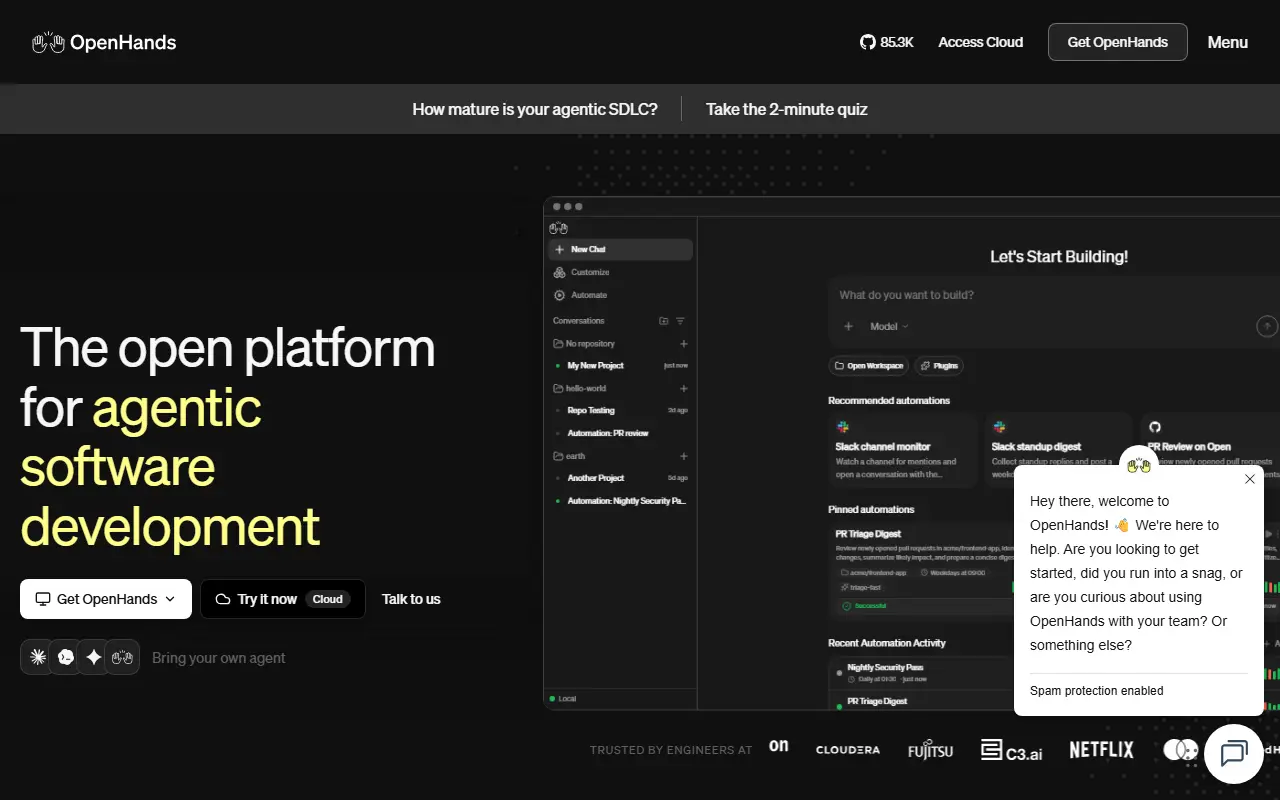
openhands.devOpenHands homepage screenshot

OpenHands is an open-source project for AI-driven software development. Its current README centers on Agent Canvas, a self-hosted developer control center for starting conversations with coding agents and automating everyday engineering tasks. It is written mainly in TypeScript and released under the MIT license.

By default Agent Canvas uses the open-source OpenHands agent, but it can also drive third-party agents such as Claude Code, Codex and Gemini, or any ACP-compatible agent. It runs locally by default and can connect to several agent backends, including Docker containers, virtual machines and company infrastructure, so agents can be moved between local, remote and cloud setups without interrupting your work.

Automations can be triggered on a timetable or by incoming webhook events and connect with tools such as Slack, GitHub, Linear and Notion, for example publishing reports to Slack or breaking GitHub issues into tasks. Agents can optionally run on OpenHands Cloud or OpenHands Enterprise. It suits engineering teams that want to coordinate several coding agents from one self-managed place.

Key features

  • Self-hosted control center for coding agents
  • Runs OpenHands, Claude Code, Codex and Gemini
  • Local, Docker, VM and cloud agent backends
  • Scheduled and webhook-triggered automations
  • Integrations with Slack, GitHub, Linear and Notion
  • Optional OpenHands Cloud and Enterprise hosting

Pricing: Local open-source use and the hosted Individual tier are free (model usage is passed through at cost). Enterprise, in the cloud or self-hosted in your VPC, has custom pricing.

code-server

Runs Visual Studio Code on a remote machine and serves it in the browser, so you can code from any device that has a web browser.

GitHub stars
80k
Last commit
yesterday
Latest release
v4.145.2
Licence
MIT
Self-hosted
Yes
coder.comcode-server homepage screenshot

code-server is an open-source project that runs VS Code on a server and makes the editor available in a web browser. It lets developers keep their development environment on a remote machine and reach it from any device with a browser. The project is maintained by Coder, is written in TypeScript and is released under the MIT license.

Because the editor runs remotely, heavy work such as builds and language tooling happens on the server rather than on a laptop or tablet. Its GitHub topics highlight remote work, VS Code Remote and browser-based IDE use. Coder, the company behind it, also sells a commercial platform for self-hosted cloud development environments, while code-server is the simpler open-source editor-in-a-browser project.

It suits individuals who want a consistent coding environment across devices, remote teams working on shared servers, and users who want a browser-based IDE on their own hardware or a cloud instance they control.

Key features

  • VS Code running in the browser
  • Development environment hosted on a remote machine
  • Access from any device with a browser
  • Remote workflows similar to VS Code Remote
  • Runs on your own server or cloud instance

Pricing: Free and open source under the MIT license.

Coder

Coder is a self-hosted platform for cloud development environments and AI coding agents, with workspaces defined in Terraform.

GitHub stars
17k
Last commit
yesterday
Latest release
v2.38.7
Licence
AGPL-3.0
Self-hosted
Yes
coder.comCoder homepage screenshot

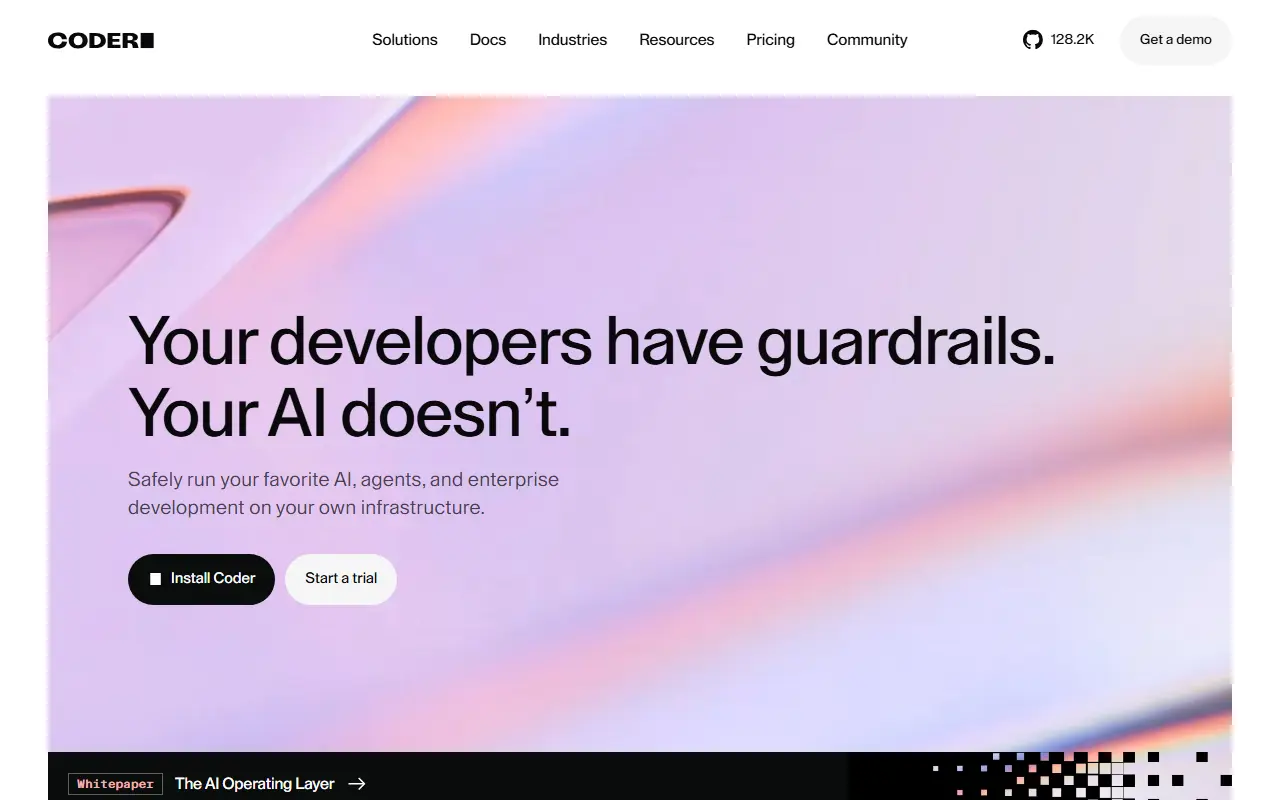
Coder is a self-hosted platform for running cloud development environments and AI coding agents on infrastructure you control. Workspaces are defined with Terraform and can be backed by EC2 VMs, Kubernetes pods, Docker containers and similar resources, so developers can start from a prepared environment instead of configuring a local machine.

Workspaces connect through a secure WireGuard tunnel and shut down automatically when idle to save on costs. Developers can use IDEs such as VS Code and JetBrains. Coder Agents runs an AI coding agent whose loop executes in the control plane on your infrastructure, works with models from Anthropic, OpenAI, Google, Bedrock or self-hosted options, and keeps LLM credentials out of workspaces while providing audit logging and cost tracking.

The server can be installed with a script on Linux and macOS or from a Windows binary, and it starts with a built-in database for evaluation. Production use calls for a PostgreSQL database and an external access URL. Coder is written in Go and released under AGPL-3.0, with a paid Premium tier referenced in its documentation.

Key features

  • Terraform-defined cloud development workspaces
  • Secure WireGuard connections
  • Automatic shutdown of idle workspaces
  • Works with VS Code and JetBrains
  • AI coding agents running on your infrastructure
  • Audit logging and model governance

Pricing: The Community edition is free and self-hosted. Premium is billed annually per user and AI Premium is custom; neither price is published.

Theia

Eclipse Theia is an AI-native, open-source IDE framework for cloud and desktop, supporting VS Code extensions and offering transparent AI assistance.

GitHub stars
22k
Last commit
yesterday
Latest release
v1.77.0
Licence
EPL-2.0
Self-hosted
Yes
Hosted version
Available
theia-ide.orgTheia homepage screenshot

Eclipse Theia is an AI-native, open-source IDE that runs on desktop and in the cloud. It is built on the Theia Platform, a framework for creating custom AI-native tools and IDEs. The IDE is designed with transparency and data ownership in mind, sending no telemetry on code, prompts, or AI usage.

Theia IDE supports the Language Server Protocol (LSP) and is fully compatible with VS Code extensions, with over 3000 extensions available via open-vsx.org. It allows users to bring their own API keys or subscriptions to connect to AI providers like OpenAI, Anthropic, Google, or self-hosted/local models, with no vendor lock-in.

Key features

  • AI-native IDE with transparent AI assistance and full control over data
  • Compatible with VS Code extensions, with over 3000 available
  • Supports Language Server Protocol (LSP)
  • No telemetry on code, prompts, or AI usage
  • Bring your own API key or subscription to connect to AI providers
  • Customizable AI interactions, prompts, and custom agents

Devbox

Devbox builds isolated, reproducible development shells from a devbox.json file, using the Nix package manager without requiring Nix code.

GitHub stars
12k
Last commit
yesterday
Latest release
0.20.0
Licence
Apache-2.0
Hosted version
Available
jetify.comDevbox homepage screenshot

Devbox creates a development environment from a list of packages and scripts defined in devbox.json. Running a devbox shell opens an isolated, ephemeral shell with those dependencies, so several runtime and package versions can sit on one machine without Docker or a virtual machine.

Under the hood it uses the Nix Package Manager, but the interface is designed so users do not write the Nix language or Dockerfiles. A searchable index lists over 400,000 versions of 80,000 packages. Environments are shared through Git, so teammates run the same packages and configuration on their own machines.

Devbox is an open-source project built by Jetify with community support. Jetify also sells Jetify Cloud, a service for deploying projects, synchronizing secrets and sharing binaries across an organization, with monthly plans and usage billed after plan credits are consumed.

Key features

  • Isolated shells without Docker or VMs
  • Environment defined in devbox.json
  • Searchable index of 400,000+ package versions
  • Share environments through Git
  • Nix package manager without the Nix language
  • Prebuilt cache on Jetify Cloud plans

Pricing: Jetify Cloud plans: Solo $5 per month (first month free), Starter $25 per month, Scale-Up $250 per month, Enterprise custom. Usage beyond plan credits is billed.

Gitpod

Gitpod Classic provided on-demand cloud development environments configured by a .gitpod.yml file; the product has since been renamed Ona.

GitHub stars
14k
Last commit
2 days ago
Latest release
2022.11.3
Licence
AGPL-3.0
Hosted version
Available
gitpod.ioGitpod homepage screenshot

Gitpod Classic is described as a developer platform that spins up pre-configured, secure workspaces in the cloud from a simple .gitpod.yml file, removing manual environment setup. Workspaces are ephemeral and Docker-based, with the same capabilities as a local Linux machine in a consistent, reproducible environment. It integrates with GitHub, GitLab, Bitbucket and Azure DevOps.

The README now states that Gitpod has been renamed to Ona, and that the Classic version is no longer recommended. Ona is presented as mission control for software projects and engineering agents, with background agents, automations, Dev Container based environments and runs in Ona Cloud or a customer's own VPC on AWS or GCP.

The repository is AGPL-3.0 and also points to related open-source projects, including ready-made workspace images, OpenVSCode Server for running VS Code in a browser on a remote machine, and a browser extension that adds a Gitpod button to GitHub, GitLab, Bitbucket and Azure DevOps.

Key features

  • Workspaces defined with a .gitpod.yml file
  • Ephemeral Docker-based workspaces
  • Integrates with four Git hosting services
  • Prebuilt environments and collaborative code review
  • OpenVSCode Server for VS Code in a browser
  • Ona adds background agents run on PR events or schedules

Pricing: The README says Gitpod Classic pay-as-you-go ended on October 15th 2025 and points to Ona's free tier or contacting sales for enterprise; the Ona docs say new customer signup is closed.

Nixpacks

Nixpacks builds container images from application source with a single command, supporting many languages; it is in maintenance mode.

GitHub stars
3.6k
Last commit
1 mo ago
Latest release
v1.41.0
Licence
MIT
nixpacks.comNixpacks homepage screenshot

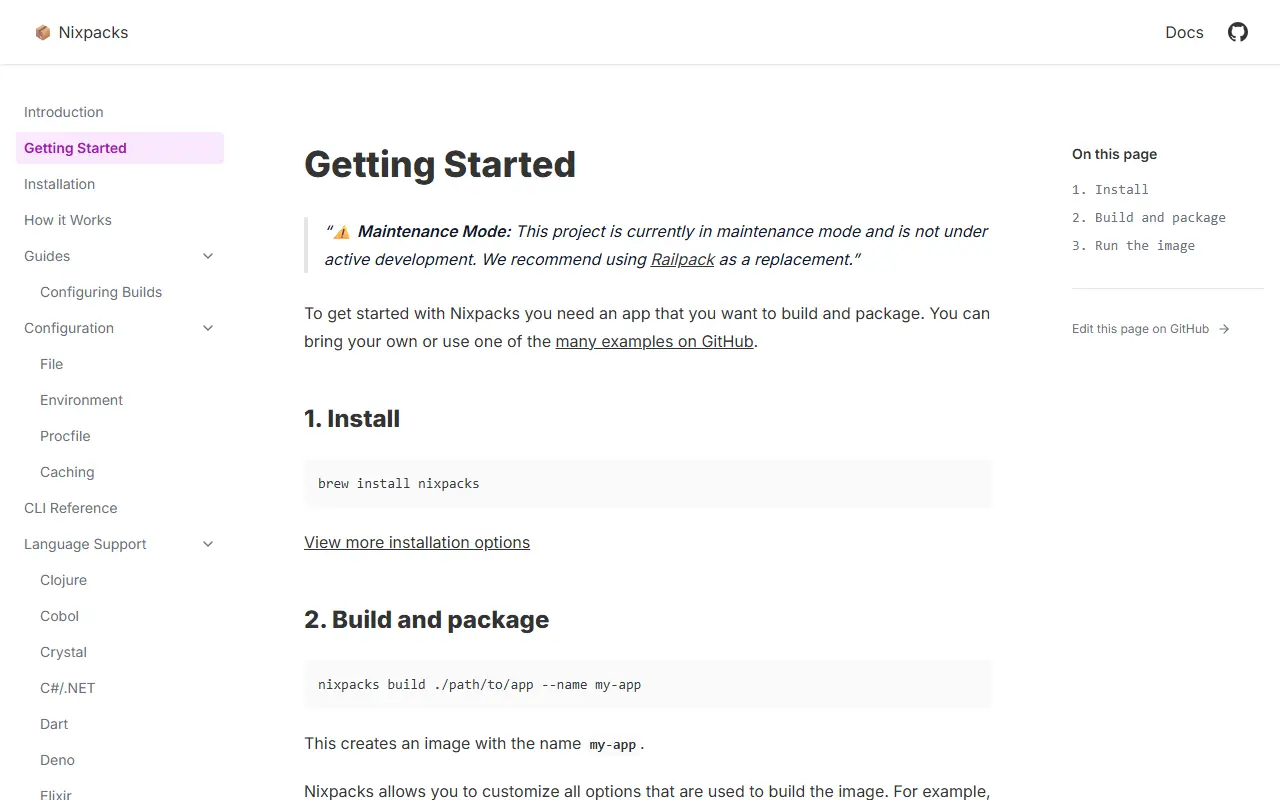
Nixpacks takes an application directory and packages it into an image. The getting-started flow is to install it, for example with Homebrew, run nixpacks build against the app path with a name, and then start the result with docker run.

Build options can be customised: the documentation shows adding system packages, a build command and a start command through command-line flags. Further guides cover a configuration file, environment variables, a Procfile and caching.

The docs list support for languages including Go, Node, Python, Ruby, Rust, PHP, Java, Elixir and many more, and deploy guides for Railway, Coolify, Dokku and others. The project states it is in maintenance mode, not under active development, and recommends Railpack as a replacement.

Key features

  • Build an image from an app with one command
  • Add system packages and custom build and start commands
  • Wide language support from Go to Zig
  • Configuration file, Procfile and caching guides
  • Deployment guides for self-hosted platforms

Commercial Ona alternatives

Hosted, closed-source products that compete with Ona.

Ona alternatives: questions

What is the best open-source alternative to Ona?
OpenHands is the top-ranked open-source alternative to Ona on Enlisted: A self-hosted control center for running coding agents, including OpenHands, Claude Code and Codex, locally, in Docker or in the cloud, with automations. Other strong options are code-server, Coder, Theia and Devbox.
What are the best commercial alternatives to Ona?
CodeSandbox, StackBlitz, GitHub Codespaces, Vibeongo and Factory are among the hosted, closed-source alternatives to Ona listed on Enlisted, which lists 9 in total. Compare their pricing and features on each tool page.
Are these Ona alternatives free?
All 7 are open source, so the code is free to use under its licence, and all of them can be self-hosted on your own server or computer. 4 also offer a paid or managed cloud version if you'd rather not host it yourself.
How is this list of Ona alternatives ranked?
By a score built from GitHub stars, star growth over the last 30 days and how recently the code changed. 6 of these projects shipped code in the last 30 days. Data is refreshed daily, and nobody can pay to move up.

People also look for alternatives to…

View all