7,363 open-source and SaaS tools, with GitHub stats refreshed every day.

11 alternatives ranked by real activity

Open-source Miro alternatives

A curated, ranked list of the 11 best open-source alternatives to Miro.

The best open-source alternative to Miro is Excalidraw. If that doesn't suit you, other good options are AFFiNE, tldraw, Drawnix and WBO.

Miro alternatives are mainly whiteboard tools, but some are also note-taking tools. 8 of them shipped code in the last 30 days, 11 can be self-hosted, and 3 use a permissive licence.

Last updated October 2, 2026 · ranked by GitHub stars, growth and recent commits

Excalidraw

An open-source virtual whiteboard for sketching diagrams and wireframes in a hand-drawn style, with real-time collaboration and end-to-end encryption.

GitHub stars
133k
Last commit
yesterday
Latest release
v0.18.1
Licence
MIT
Self-hosted
Yes
Hosted version
Available
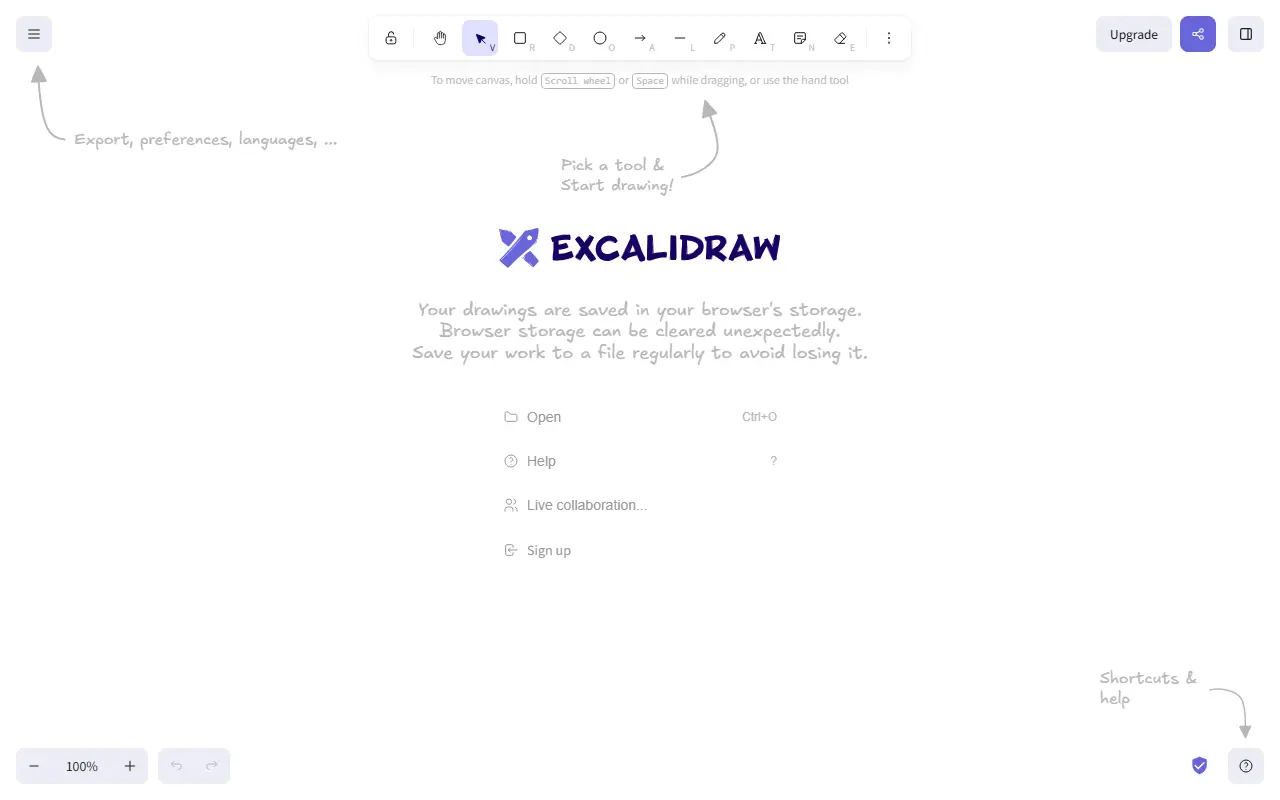
excalidraw.comExcalidraw homepage screenshot

Excalidraw is a browser-based whiteboard that renders shapes, arrows and text in a deliberately hand-drawn style, which makes diagrams feel like quick sketches rather than polished slides. It is used for architecture diagrams, wireframes, brainstorming and teaching, and works on an infinite canvas with zoom and pan.

The editor offers rectangles, circles, diamonds, arrows, lines, free-draw and an eraser, along with labeled arrows that stay bound to shapes, image support, shape libraries, dark mode and undo and redo. Drawings export to PNG, SVG or the clipboard, or to an open JSON-based .excalidraw file. The hosted app adds real-time collaboration with end-to-end encryption, offline use as a progressive web app, autosave in the browser and shareable read-only links.

The editor is also published as an npm package under the MIT license, so developers can embed it in their own products and customize it. A separate paid plan, Excalidraw+, is linked from the project for people who want a hosted workspace.

Key features

  • Infinite canvas with hand-drawn style shapes
  • Real-time collaboration with end-to-end encryption
  • Export to PNG, SVG or open .excalidraw files
  • Shape libraries and image support
  • Works offline as a progressive web app
  • Embeddable editor package on npm

Pricing: Free and open source under the MIT license; excalidraw.com is free to use, and a paid Excalidraw+ plan is also offered.

AFFiNE

A privacy-focused, local-first workspace that merges docs, whiteboards and tables on one canvas, positioned as an open-source alternative to Notion and Miro.

GitHub stars
73k
Last commit
2 days ago
Latest release
v0.27.4
Self-hosted
Yes
Hosted version
Available
affine.proAFFiNE homepage screenshot

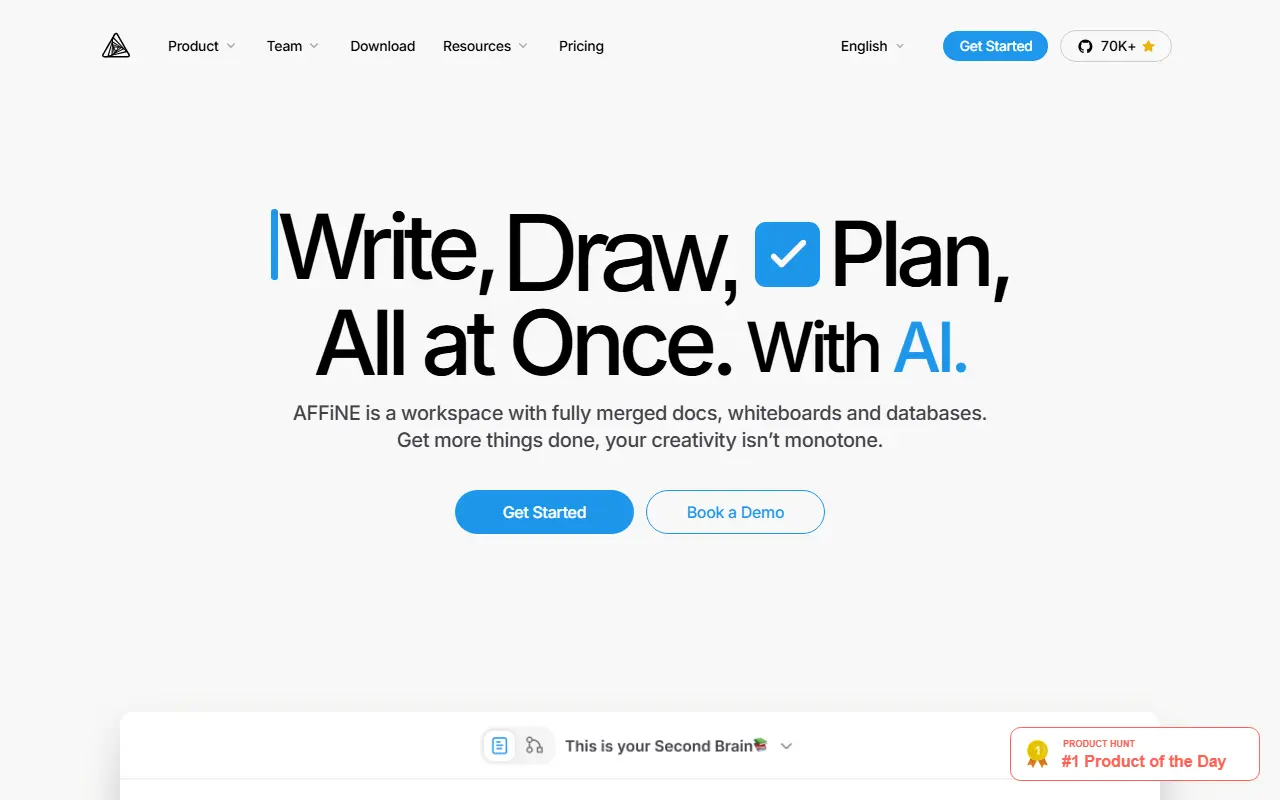
AFFiNE is an open-source workspace that combines writing, drawing and planning in a single app. Documents, an edgeless whiteboard and table views share the same blocks, so you can place rich text, sticky notes, embedded web pages, database views, linked pages, shapes and even slides anywhere on one canvas. It is presented as an alternative to Notion and Miro.

The project stresses local-first storage, meaning your data lives on your own device first, together with real-time collaboration. A multimodal AI assistant helps write reports, turn outlines into slides, summarize articles into mind maps and organize tasks. Under the hood it uses CRDTs for syncing and is built mostly in TypeScript and Rust, with Electron for the desktop app. It also supports Markdown, wiki and knowledge-base use, and presentations.

AFFiNE's license is listed as 'Other' on GitHub, so review it before commercial use. There is a live demo and documentation on the project site, a hosted version is available, and the app can also be self-hosted.

Key features

  • Docs, whiteboard and tables on one canvas
  • Local-first data storage on your device
  • Real-time multi-user collaboration
  • AI assistant for writing, slides and mind maps
  • Markdown editing and linked pages
  • Desktop app built on Electron

Pricing: Free plan with local use and 10 GB of cloud storage. Pro is $6.75 per month and Team $10 per seat per month; a $499.99 one-time Believer plan exists and Enterprise is custom-priced.

tldraw

A React SDK for building infinite canvas apps, with drawing and diagramming tools, an extensible editor API, AI integrations and self-hostable multiplayer sync.

GitHub stars
51k
Last commit
today
Latest release
v5.5.1
Self-hosted
Yes
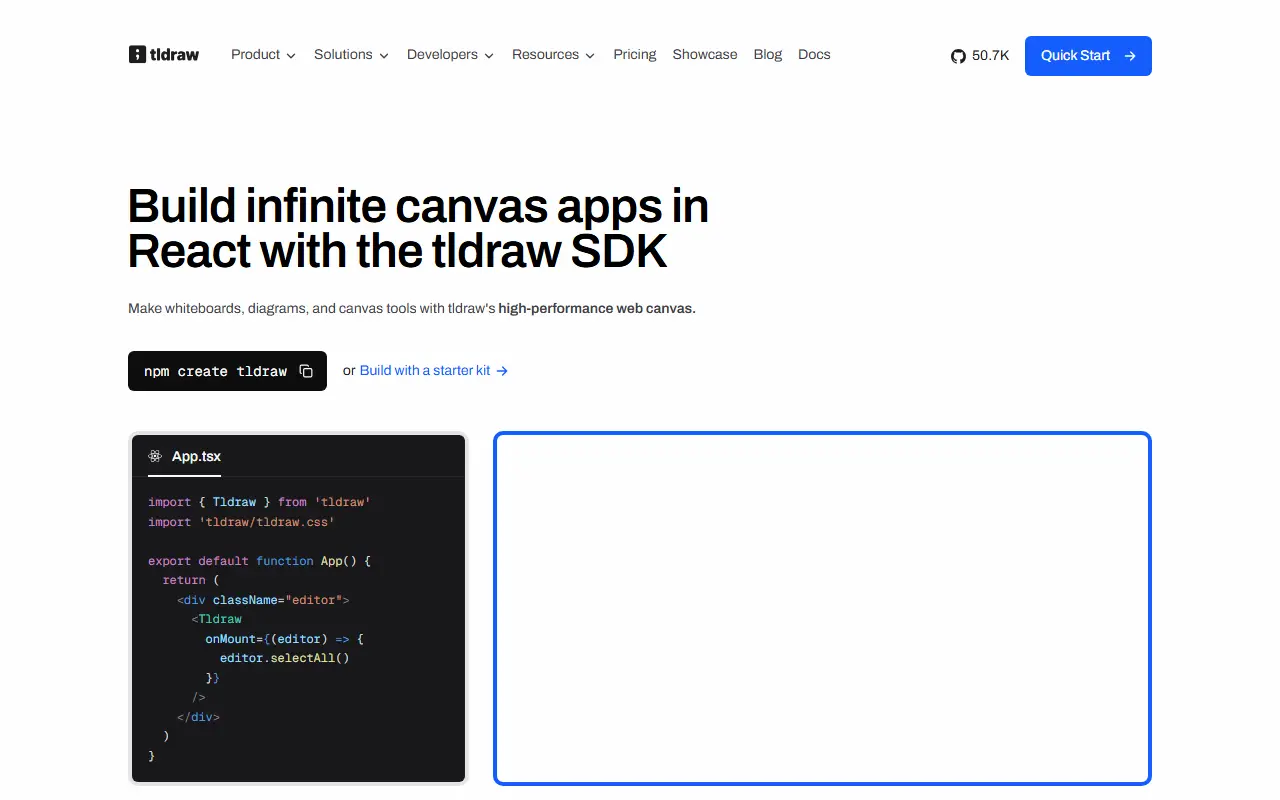
tldraw.devtldraw homepage screenshot

tldraw is an SDK for building infinite canvas applications in React. It supplies a complete canvas engine that serves as the foundation for whiteboards, diagramming tools, design editors and other canvas products, and it ships a default whiteboarding tool set that you can use as is or replace with your own primitives.

Out of the box it offers pressure-sensitive drawing, geometric shapes, rich text, arrows with snapping, image and video support and image export. Developers can extend it with their own shapes, tools, bindings, interface components, side effects and event hooks, and can drive the canvas at runtime through the Editor API. Multiplayer collaboration is available through a self-hostable sync package, there are canvas primitives for building with LLMs, and the DOM-based rendering can embed websites such as YouTube, Figma and GitHub. It works in desktop and touch browsers.

Starter kits provide the custom shapes, tools and interface for common application types, and each kit is MIT licensed. The SDK itself is under tldraw's own license rather than a standard open-source one, so review the terms before shipping it in a commercial product.

Key features

  • Infinite canvas engine for React apps
  • Custom shapes, tools and bindings
  • Editor API for runtime control
  • Self-hostable multiplayer sync
  • AI integration primitives for LLMs
  • Embeds web content on the canvas
  • Starter kits for common app types

Pricing: A free hobby license is available. The commercial SDK license uses value-based pricing arranged with sales, with a 100-day free trial and discounted pricing for early-stage startups.

Drawnix

An open-source, browser-based whiteboard that combines mind maps, flowcharts and freehand drawing on one infinite canvas, for people who sketch ideas visually.

GitHub stars
15k
Last commit
25 days ago
Latest release
v0.4.0
Licence
MIT
Self-hosted
Yes
Hosted version
Available
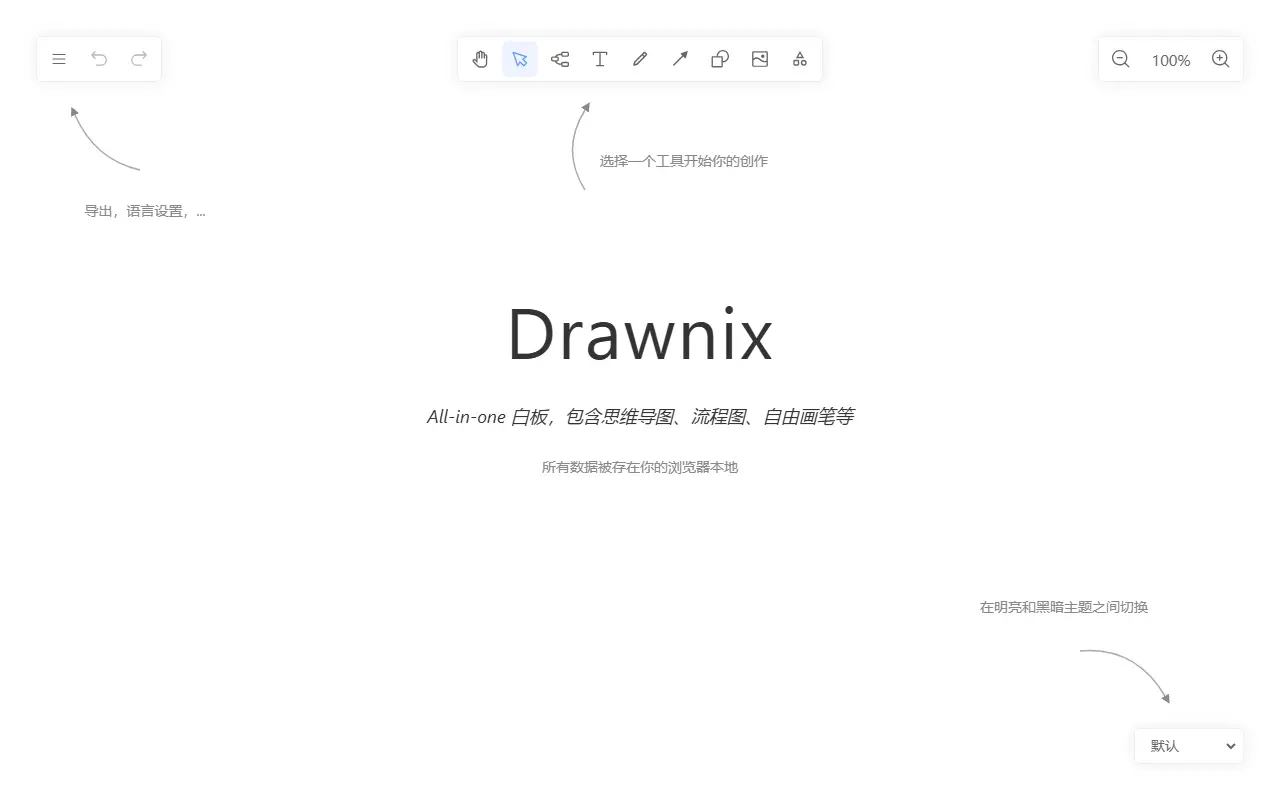
drawnix.comDrawnix homepage screenshot

Drawnix is a free, open-source whiteboard that brings mind maps, flowcharts and freehand drawing together in a single workspace. Instead of switching between separate diagramming apps, you can sketch ideas, structure them into diagrams and annotate everything on one infinite canvas that you can zoom and scroll freely.

The editor supports inserting images, undo and redo, copy and paste, light and dark themes, and a layout that adapts to mobile devices. Mermaid syntax can be converted into flowcharts and Markdown text into mind maps, while work is saved automatically in the browser and can be exported as PNG images or as .drawnix JSON files for later reuse.

Drawnix is released under the MIT licence and is built on Plait, an open-source drawing framework from the PingCode team, using a plugin architecture that can work with different UI frameworks. The hosted app at drawnix.com is a minimal version, and the repository includes Docker instructions for people who prefer to run their own copy.

Key features

  • Mind maps and flowcharts on one canvas
  • Freehand drawing with brush tools
  • Mermaid syntax converted into flowcharts
  • Markdown text converted into mind maps
  • Export to PNG or .drawnix JSON
  • Automatic saving in the browser
  • Infinite canvas with zoom and scrolling
  • Plugin architecture supporting multiple UI frameworks

Pricing: Free and open source under the MIT licence.

WBO

WBO is an open-source online whiteboard where many people can draw on one large shared board in real time.

GitHub stars
2.7k
Last commit
21 days ago
Licence
AGPL-3.0
Self-hosted
Yes
Hosted version
Available
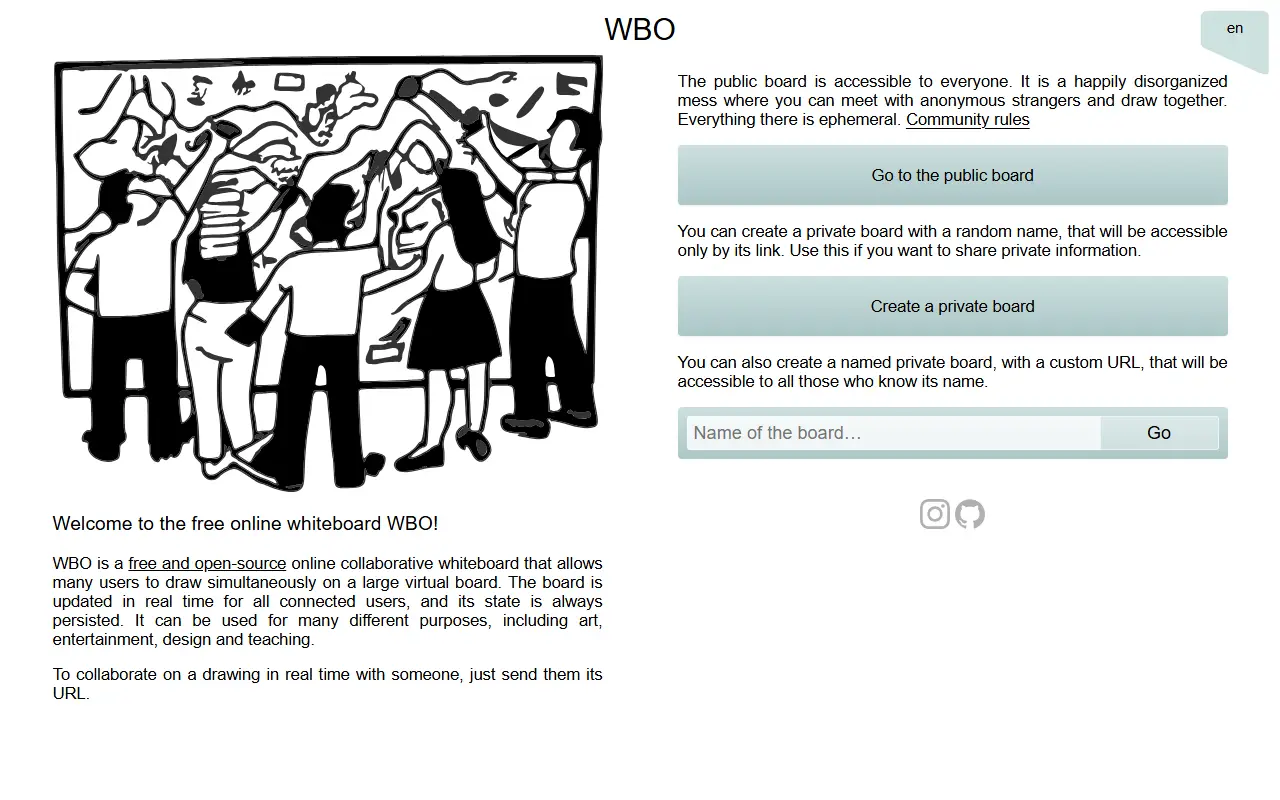
wbo.ophir.devWBO homepage screenshot

WBO, short for Whitebophir, is an online collaborative whiteboard that lets many users draw at the same time on a large virtual board. Every change appears in real time for everyone connected, and the state of each board is always saved, so you can return to a board later. A public demonstration server is available if you want to try it before installing.

The project suggests uses ranging from art and entertainment to design and teaching, and its screenshots show boards used for diagram editing, math lessons and drawing. Topics also tag it for education. Boards are reachable by name, including an anonymous board, so people can start collaborating without creating an account.

If you have your own web server you can run a private instance. The recommended route is the official Docker image, which listens on port 5001 and keeps boards outside the container. Running directly with Node.js 22 or later is also supported, although it offers less isolation. When behind a trusted proxy or CDN you should set the IP source setting explicitly. The software is licensed under AGPL-3.0.

Key features

  • Real-time multi-user drawing on shared boards
  • Boards saved automatically
  • Anonymous boards without sign-up
  • Official Docker image
  • Runs directly on Node.js
  • Configurable client IP source behind proxies

Pricing: Free and open source under AGPL-3.0; a public demonstration server is available.

Tldraw Offline

tldraw offline is a desktop app for the tldraw infinite canvas that works without accounts or servers and saves portable .tldraw files.

GitHub stars
628
Last commit
2 days ago
Latest release
v1.21.0
Self-hosted
Yes
offline.tldraw.comTldraw Offline homepage screenshot

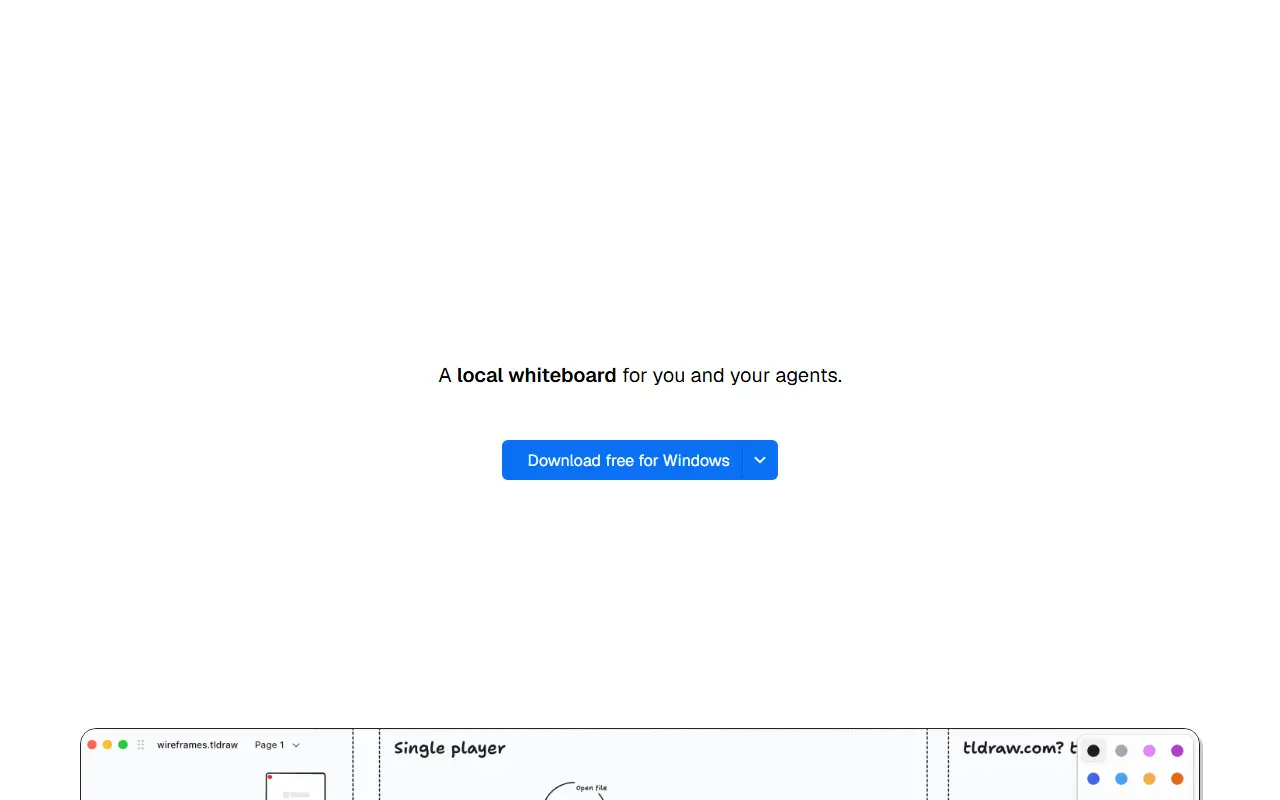
tldraw offline is a desktop application for drawing, diagramming and whiteboarding on tldraw's infinite canvas, described as a local whiteboard for you and your agents. There are no accounts or servers, and it works without an internet connection, with documents saved as portable .tldraw files you can keep private, back up or share.

Builds are available for macOS as a universal DMG for Apple silicon and Intel, for Windows as an installer for x64 or Arm64, and for Linux as an AppImage for x64 or Arm64 and a Debian package for x64, with a Homebrew option on macOS. Each document opens in its own window, the app keeps working copies of open documents and can restore unsaved work after an unexpected exit, and it checks for updates at startup. The .tldraw format holds the canvas, pages, stored media and any embedded document script, and legacy .tldr files can be opened and exported.

A user manual covers installation, file management, keyboard shortcuts, troubleshooting and agent setup. The repository metadata does not give a license, so check the project terms before use.

Key features

  • Infinite canvas whiteboard on the desktop
  • No account or server required
  • Portable .tldraw files
  • Automatic recovery of unsaved work
  • macOS, Windows and Linux builds
  • Support for agents working on documents

Ideon

Ideon is a self-hosted visual workspace where notes, files, repositories and to-dos live together on a shared infinite canvas.

GitHub stars
616
Last commit
yesterday
Latest release
v0.9.8
Licence
AGPL-3.0
Self-hosted
Yes
theideon.comIdeon homepage screenshot

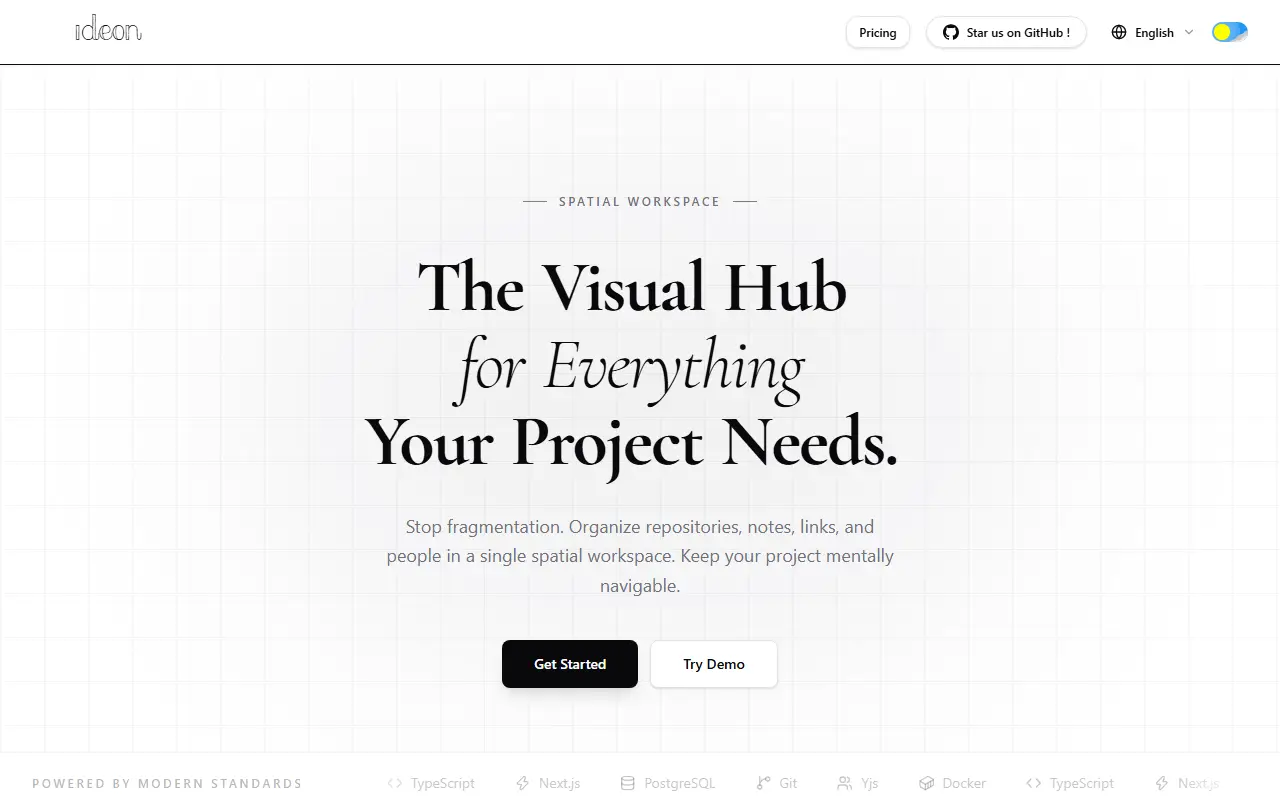
Ideon is a self-hosted visual workspace for projects. Instead of abstract folders and tabs, it uses spatial organization: you place blocks on a shared infinite canvas, and what sits close together is related, so a project's repositories, design notes and tasks can be seen on a single map.

Blocks can hold Markdown notes, images, links, files and to-dos, and live integrations embed repositories and issues from GitHub, GitLab, Gitea and Forgejo directly on the canvas. Teams can collaborate in real time, and a time travel feature shows historical snapshots of the workspace to trace past decisions. A hosted demo is available to try without setup.

Ideon runs with Docker and Docker Compose, using a PostgreSQL database and a persistent storage volume, and there is a one-click template for the Easypanel deployment platform. You set a secret key in an environment file before starting the stack and open the dashboard on port 3000. It is written in TypeScript and licensed under AGPL-3.0.

Key features

  • Infinite spatial canvas
  • Embedded repositories and issues
  • Markdown notes, images and files
  • Real-time multiplayer collaboration
  • Time travel snapshots
  • Docker Compose self-hosting

Pricing: The open source edition is free to self-host with Docker. The managed Cloud and Enterprise plans have no published prices and are handled by contacting sales.

InfiniPaint

Collaborative infinite-canvas drawing and note-taking app with no zoom limit, available as native desktop apps and in the browser, licensed under GPL-3.0.

GitHub stars
500
Last commit
yesterday
Latest release
v0.6.1
Licence
GPL-3.0
Hosted version
Available
infinipaint.comInfiniPaint homepage screenshot

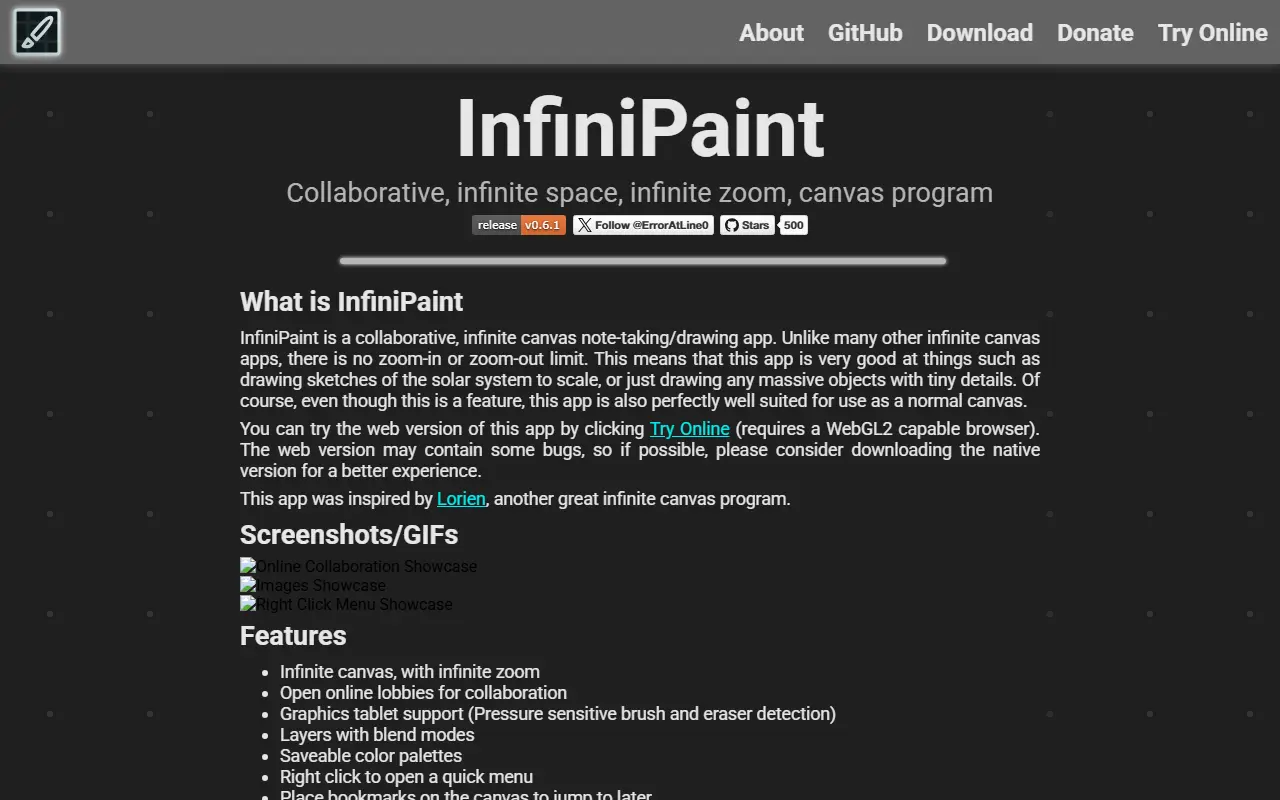
InfiniPaint is an open-source drawing and note-taking app built on an infinite canvas that you can zoom without a fixed limit, until your computer runs out of memory. That makes it handy for sketches that mix huge scale differences, such as a solar system drawn to scale, as well as for ordinary notes and doodles.

Collaboration is built in through online lobbies, which include text chat and the ability to jump to the position of other participants. The project is written in C++ and has a web version compiled with Emscripten that needs a WebGL2-capable browser, though the maintainer recommends the native build for a better experience. Drawing tablets are among the topics the project lists.

Native builds are offered for Windows (installer or portable zip), macOS on Apple Silicon, and Linux through Flathub or flatpak bundles. Files use the .infpnt extension. The author says it was inspired by the Lorien infinite canvas program, and the code is released under the GPL-3.0 licence.

Key features

  • Infinite canvas with unlimited zoom
  • Online lobbies for real-time collaboration
  • Text chat and jump-to-user navigation
  • Native apps for Windows, macOS and Linux
  • Browser version built with Emscripten
  • Tablet-friendly drawing and note-taking

Pricing: Free and open source under the GPL-3.0 licence.

Drafft.ink

Self-hostable infinite-canvas whiteboard built with Rust and WebGPU, with real-time collaboration, no account requirement and no telemetry.

GitHub stars
554
Last commit
2 mo ago
Licence
AGPL-3.0
Self-hosted
Yes
Hosted version
Available

Drafft.ink is a digital whiteboard with an infinite canvas, written in Rust and rendered with WebGPU. It runs on Linux, Windows, macOS, in the browser and on mobile, works without an account, and offers real-time collaboration through the Loro CRDT. The authors position it as a subscription-free tool, and the code is licensed under AGPL-3.0 so you can use, modify and host it as long as it stays open.

Drawing tools include rectangles, ellipses, lines, arrows and freehand paths with pressure sensitivity, plus smart guides for alignment, equal spacing and angle snapping. Text supports multiple fonts, per-character styling and inline LaTeX math, and images can be dropped or pasted into the document. A sketchy, hand-drawn style is available through the roughr library. Boards export to PNG or JSON, and JSON can be imported back. Touch gestures work on tablets, and the project states there is no telemetry.

For collaboration you run a single-binary server that listens on a WebSocket endpoint with no configuration files, or use the hosted site at drafft.ink. It is comparable to Excalidraw, which appears among its topics.

Key features

  • Infinite canvas whiteboard
  • Real-time collaboration via Loro CRDT
  • Shapes, arrows and pressure-sensitive freehand
  • Smart guides and snapping
  • Text with LaTeX math and image paste
  • PNG and JSON export and import
  • Single-binary self-hosted server

Pricing: Free and open source under AGPL-3.0, described as having no subscription, paywall or account requirement.

Revezone

Revezone is a free, AGPL-licensed, local-first productivity app combining Excalidraw and Tldraw whiteboards with a Notion-like note editor, for building a personal second brain.

GitHub stars
2.7k
Last commit
2 yr ago
Latest release
1.0.0-alpha.18
Licence
AGPL-3.0
Self-hosted
Yes
Hosted version
Available

Revezone is a lightweight, graphic-centric productivity tool aimed at people building a personal knowledge base, often described as a second brain. It is local-first, meaning notes and boards are stored in the browser or on the local machine rather than requiring a cloud account, and it is currently in public beta.

It combines whiteboard functions based on both Excalidraw and Tldraw with a WYSIWYG, Notion-like note editor that supports slash commands and Markdown syntax. Notes and boards can be organized into folders in a left sidebar, with flexible layout allowing users to sort directories and split the screen by dragging and dropping. The Excalidraw-based board also supports custom fonts and double-link connections to notes within the desktop app.

Revezone can be used online, with data stored in the browser, or as a downloadable desktop app with data stored locally. It is written in TypeScript and released under the AGPL-3.0 license. This repository contains only the basic functionality of the project, according to its README.

Key features

  • Excalidraw and Tldraw whiteboard support
  • Notion-like WYSIWYG note editor with Markdown
  • Local-first data storage
  • Folder-based organization of notes and boards
  • Custom fonts and note linking on whiteboards
  • Desktop app with local data storage

Pricing: Free and open source under the AGPL-3.0 license; an online version and a downloadable desktop app are both available.

1 more Miro alternative

Miro alternatives: questions

What is the best open-source alternative to Miro?
Excalidraw is the top-ranked open-source alternative to Miro on Enlisted: An open-source virtual whiteboard for sketching diagrams and wireframes in a hand-drawn style, with real-time collaboration and end-to-end encryption. Other strong options are AFFiNE, tldraw, Drawnix and WBO.
Are these Miro alternatives free?
All 11 are open source, so the code is free to use under its licence, and all of them can be self-hosted on your own server or computer. 8 also offer a paid or managed cloud version if you'd rather not host it yourself.
How is this list of Miro alternatives ranked?
By a score built from GitHub stars, star growth over the last 30 days and how recently the code changed. 8 of these projects shipped code in the last 30 days. Data is refreshed daily, and nobody can pay to move up.

People also look for alternatives to…

View all