7,363 open-source and SaaS tools, with GitHub stats refreshed every day.

7 alternatives ranked by real activity

Open-source Microsoft Power Apps alternatives

A curated, ranked list of the 7 best open-source alternatives to Microsoft Power Apps.

The best open-source alternative to Microsoft Power Apps is ToolJet. If that doesn't suit you, other good options are Budibase, NocoBase, Corteza and Steedos.

Microsoft Power Apps alternatives are mainly low-code & internal tools. 5 of them shipped code in the last 30 days, 7 can be self-hosted, and 1 uses a permissive licence.

Last updated October 2, 2026 · ranked by GitHub stars, growth and recent commits

ToolJet

An open-source platform for building internal tools, dashboards and workflows visually or from prompts, with an MCP server so coding agents can build apps.

GitHub stars
41k
Last commit
yesterday
Latest release
v3.20.237-lts
Licence
AGPL-3.0
Self-hosted
Yes
Hosted version
Available
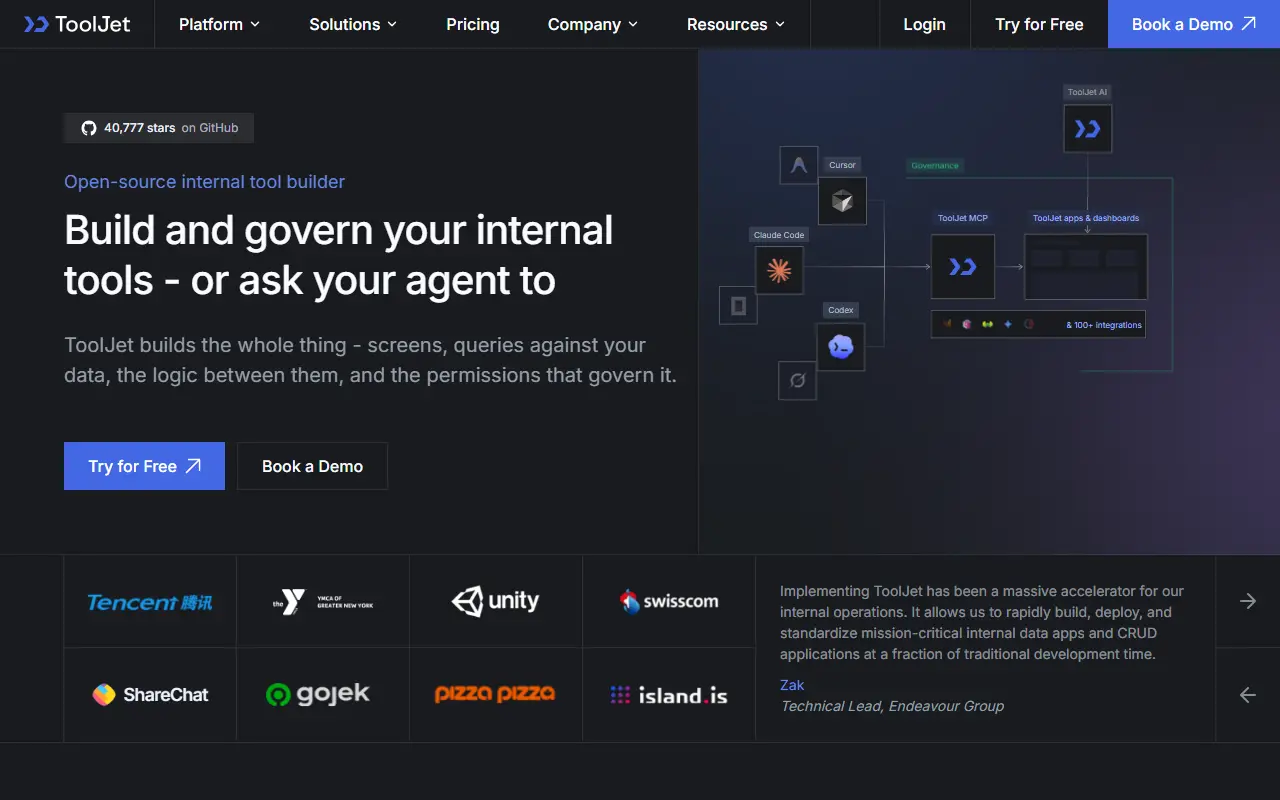
tooljet.comToolJet homepage screenshot

ToolJet is an open-source platform for creating internal software, including admin panels, dashboards and operational apps that sit on top of your existing databases, APIs and SaaS systems. Apps are assembled visually in a builder, so teams can ship tools without writing a full front end.

AI plays a large role. ToolJet AI turns a text description into pages, queries and components, and a Model Context Protocol server lets coding agents such as Claude Code and Codex build and modify ToolJet apps directly. Agents work against the platform's real component and data contracts, so the output is an ordinary ToolJet app that the team can keep editing in the visual builder with the same permissions, environments and version history. Workflows and AI agents are part of the offering.

You can self-host ToolJet or use ToolJet Cloud, and the open-source foundation is AGPL-3.0 licensed with a JavaScript and TypeScript codebase. It targets teams that need internal software quickly and want an open-source option with a managed alternative.

Key features

  • Visual builder for internal tools and dashboards
  • AI generation of pages, queries and components
  • MCP server for coding agents
  • Permissions, environments and version history
  • Workflows and AI agents
  • Self-hosted or ToolJet Cloud

Pricing: A free plan covers 2 builders. Paid plans are priced per builder per month: Basic $29, Pro $99 and Team $249 on monthly billing, with 20% off annually; Enterprise is custom.

Read more about ToolJetWebsite GitHub

Budibase

An open-source, model-agnostic operations platform for building AI agents, automations and internal apps that connect to your business systems.

GitHub stars
28k
Last commit
yesterday
Latest release
v3.47.0
Self-hosted
Yes
Hosted version
Available
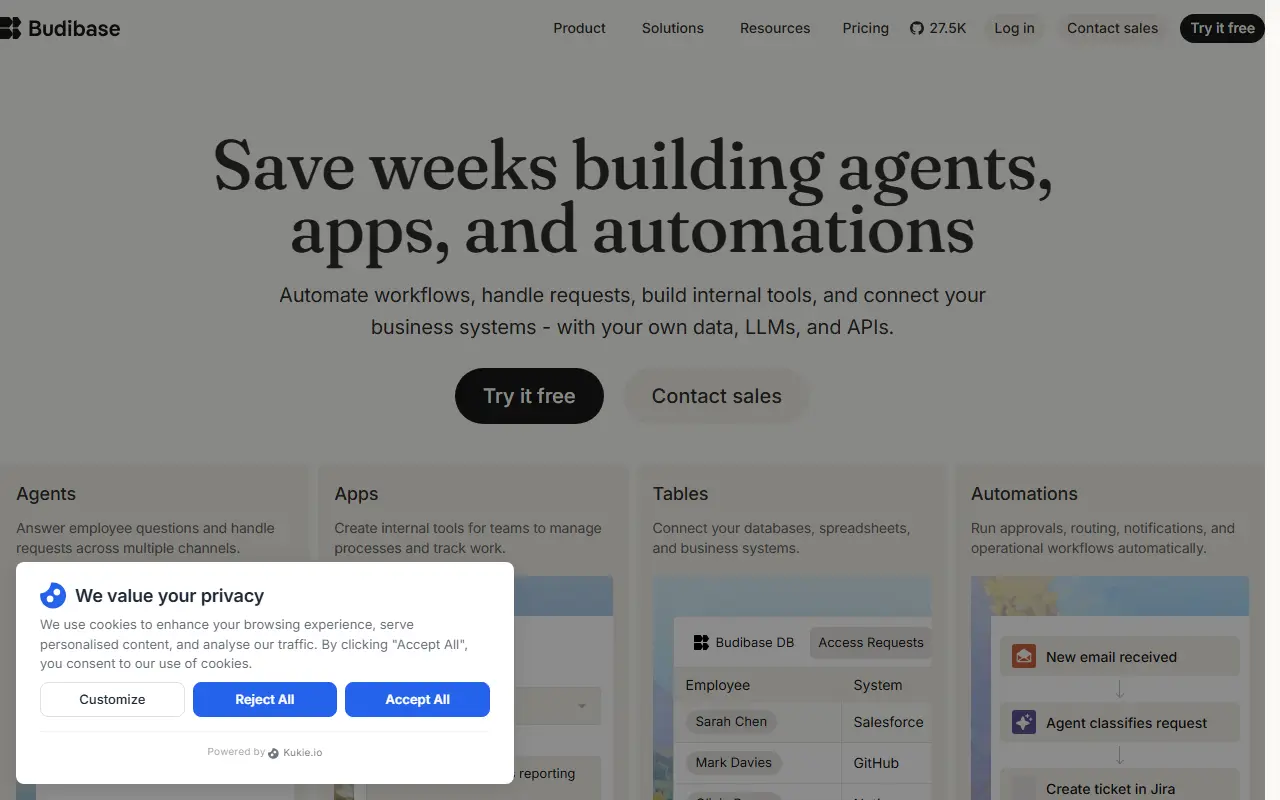
budibase.comBudibase homepage screenshot

Budibase is an open-source operations platform for building AI agents, automations and apps that run internal processes. It is model agnostic and describes itself as saving engineers many hours when building these tools, while handling security concerns. Topics place it in the low-code and no-code internal tools space, with CRUD apps and an SQL GUI.

The idea is to run requests, approvals and workflows on one platform instead of stitching several tools together. Staff constantly ask questions, request sign-offs and flag problems, and Budibase agents interpret those requests and carry out the work: creating records, sending approvals to the right people, updating apps and alerting teams. You connect the business systems your operations already rely on, and the platform also supports building data applications over databases and REST APIs.

You can use Budibase Cloud, where the vendor hosts it, or host it yourself with Docker, Kubernetes or DigitalOcean. The repository is written in TypeScript, and its license is listed as 'Other' on GitHub, so check the terms for enterprise features. It suits operations and engineering teams that want internal tools and AI automation without building everything from scratch.

Key features

  • AI agents that run workflows
  • Internal app builder for CRUD tools
  • Automations connecting business systems
  • Works with any AI model
  • Self-host with Docker or Kubernetes
  • Budibase Cloud hosting

Pricing: The open-source edition is free to self-host. Cloud plans are Pro $19, Premium $49 and Business $299 per month, each with a 14-day trial; Enterprise is custom and quoted through sales.

Read more about BudibaseWebsite GitHub

NocoBase

An open-source AI and no-code platform for building business systems such as CRMs, internal tools and workflows, where people and coding agents build together.

GitHub stars
24k
Last commit
2 days ago
Latest release
v2.2.20
Self-hosted
Yes
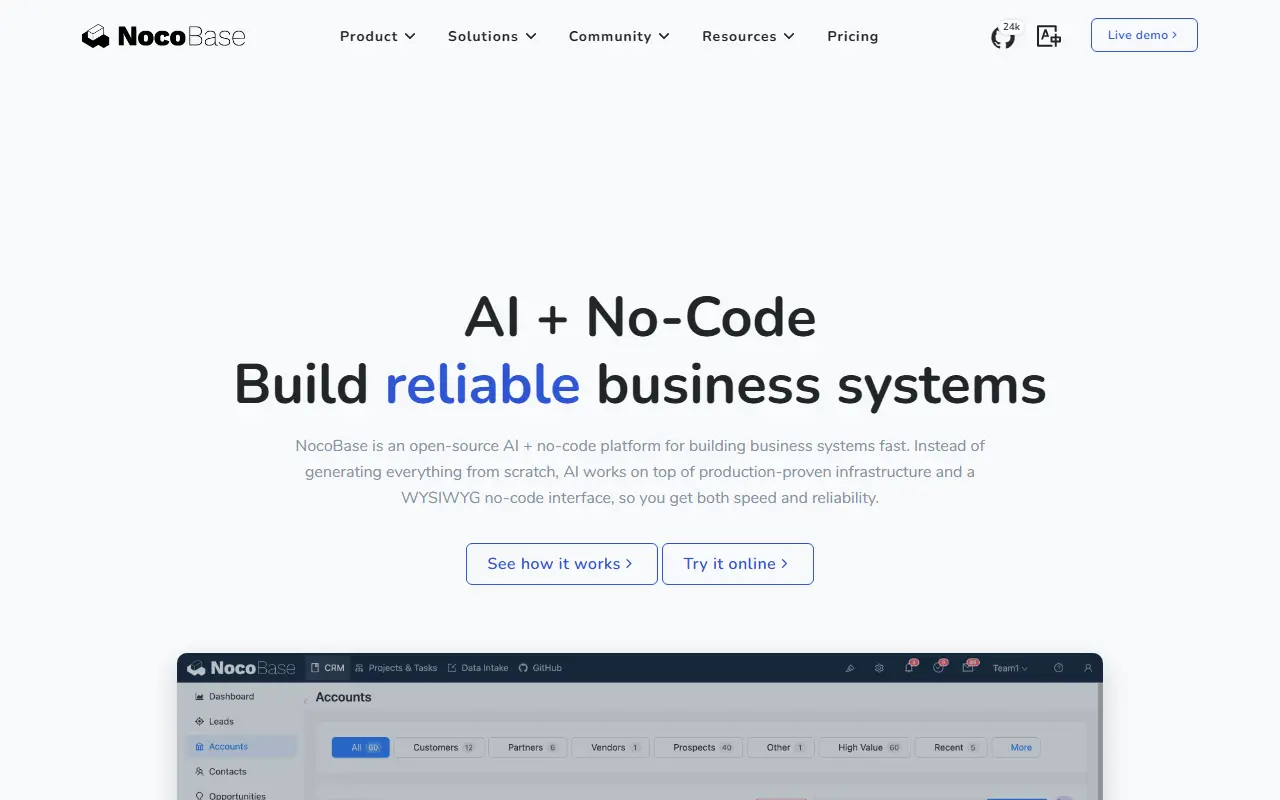
nocobase.comNocoBase homepage screenshot

NocoBase is an open-source platform that combines AI with no-code tooling to build business systems quickly. Rather than having AI generate everything from scratch, it has AI build on infrastructure already proven in production and on a visual WYSIWYG no-code editor, which the project says delivers both speed and reliability.

Its approach is collaborative: coding agents are given a complete CLI plus skills, and people use a visual interface, so both can contribute to the same system. Topics show typical uses such as internal tools, admin dashboards, CRUD apps, CRM, ERP and project management, with workflows included. An online demo, documentation, a forum and customer stories are available, and release notes are published on the blog with weekly summaries. It is written in TypeScript.

NocoBase can be installed on your own infrastructure, and its license is listed as 'Other' on GitHub, so review the terms for commercial or enterprise use. It suits teams that want flexible internal systems without maintaining a large custom codebase, and who want to use AI assistance on a stable foundation.

Key features

  • WYSIWYG no-code interface
  • CLI and skills for coding agents
  • Workflows and CRUD apps
  • Suitable for CRM, ERP and project management
  • Online demo and documentation
  • Install on your own infrastructure

Pricing: The Community Edition is free and open source. Standard is a one-time $800 lifetime license and Professional a one-time $8,000 license, each with one year of upgrades; Enterprise is by contact.

Read more about NocoBaseWebsite GitHub

Corteza

Open-source low-code platform for building CRM, business process, and structured data apps, with workflows, RBAC, privacy features, and data integrations.

GitHub stars
2.2k
Last commit
yesterday
Latest release
2024.9.10
Licence
Apache-2.0
Self-hosted
Yes
Hosted version
Available
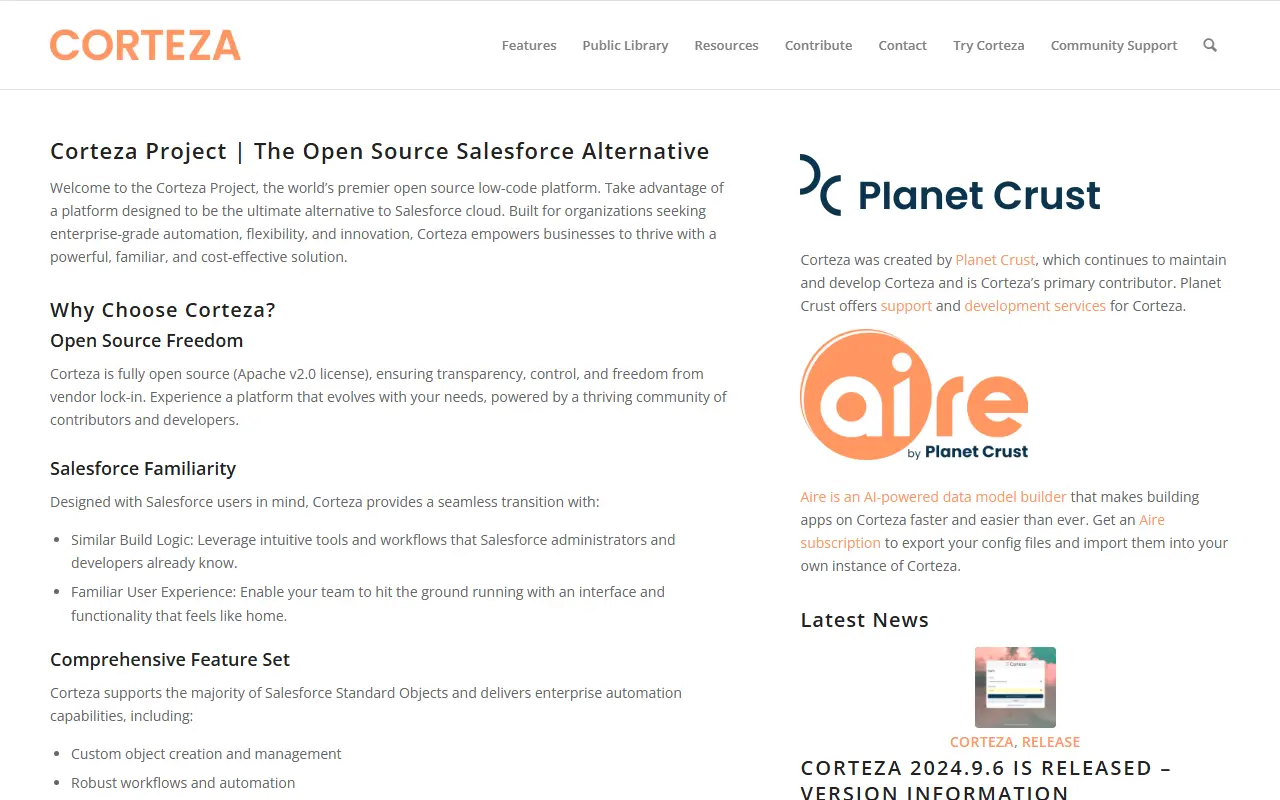
cortezaproject.orgCorteza homepage screenshot

Corteza is a low-code platform that lets teams build and iterate on CRM, business process, and other structured data applications quickly. It also supports intelligent business process workflows and connects to almost any data source. It is written in Go, with a Vue front end, and released under the Apache-2.0 license. It is maintained by Planet Crust, its founder.

Key characteristics include a standards-oriented approach using established data formats, flat role-based access control that supports complex internal security policies, privacy features that help comply with data protection regulations, accessibility following WCAG 2.1, and an API-centric design that makes integration with external services and other Corteza instances straightforward. Applications can be customized from translations and terminology up to entirely new low-code apps.

Planet Crust offers hosted Corteza cloud instances as the easiest way to start, and a DevOps guide covers self-hosting along with backup, restore, and email relay topics. Corteza suits organizations that want an open-source alternative to proprietary low-code CRM platforms and need control over their data.

Key features

  • Low-code builder for CRM and data apps
  • Workflow automation for business processes
  • Role-based access control
  • Privacy and data protection features
  • API-centric integration with data sources
  • WCAG 2.1 accessibility

Pricing: Free and open source under the Apache-2.0 license; Planet Crust offers hosted instances.

Read more about CortezaWebsite GitHub

Steedos

A metadata-driven low-code platform for building enterprise apps, evolving into the AI-native ObjectStack architecture for generating software from prompts.

GitHub stars
1.6k
Last commit
8 days ago
Latest release
v2.7.32
Licence
AGPL-3.0
Self-hosted
Yes
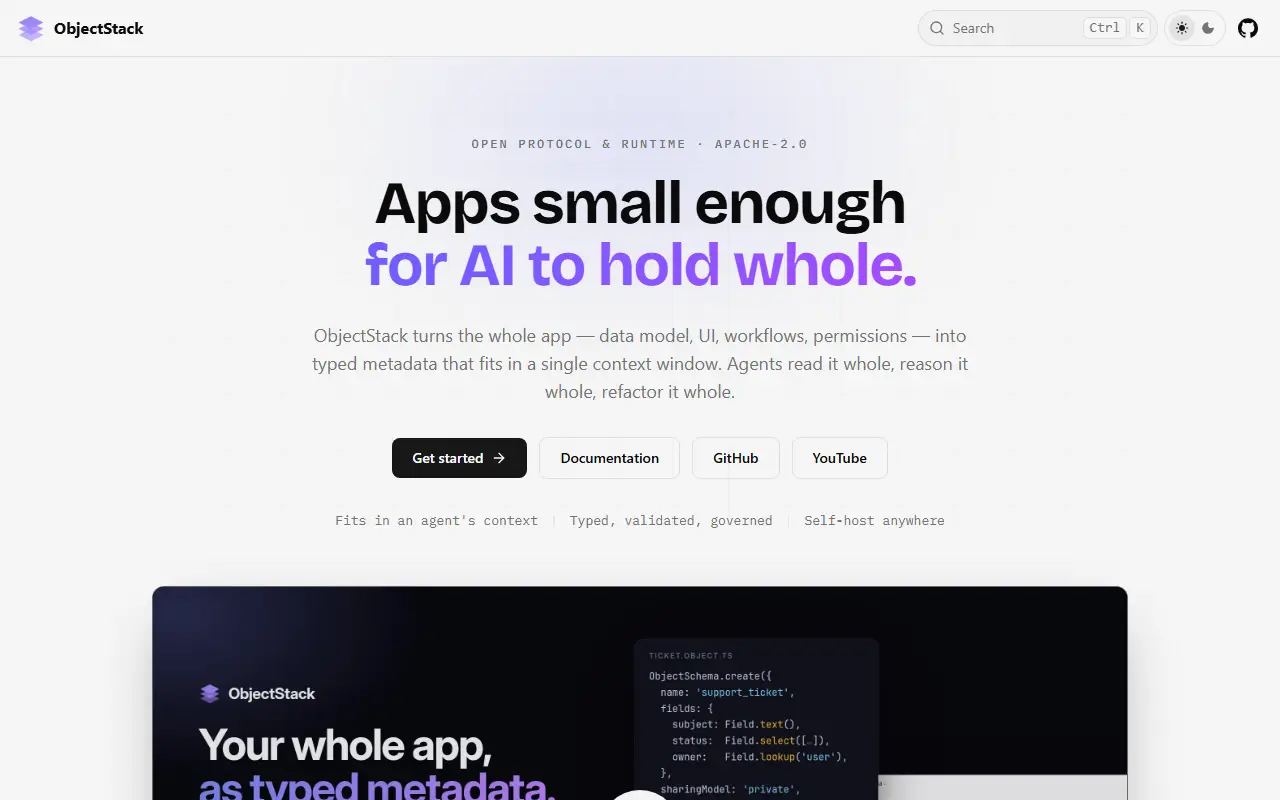
objectstack.aiSteedos homepage screenshot

Steedos Platform is an open-source low-code and no-code platform for building enterprise applications. It follows a metadata-driven architecture similar to Salesforce, where objects, fields, permissions and workflows are described as configuration instead of hand-written code, which speeds up building business apps such as CRM and ERP-style tools.

The project is evolving into ObjectStack, a modular headless stack made of ObjectQL as a protocol for data, logic and UI, ObjectOS as a runtime providing APIs, authentication, permissions and workflow automation, and Object UI as a schema-driven renderer based on React and Tailwind. The README says Steedos v2.x remains supported while future development focuses on ObjectStack and AI-generated applications.

Steedos is written in TypeScript and licensed under AGPL-3.0, with documentation, examples and a community linked from the repository. It is a self-hosted platform and its topics reference tools such as Salesforce, Appsmith, Budibase and Airtable, indicating the space it competes in. It suits development teams and agencies that want to build internal business software on a configurable, open foundation.

Key features

  • Metadata-driven object and field definitions
  • Headless runtime with APIs and permissions
  • Workflow and BPM automation
  • Schema-driven React user interface renderer
  • Prompt-to-app direction through ObjectStack
  • OpenAPI support
Read more about SteedosWebsite GitHub

Joget

Open-source no-code and low-code platform for building business apps, workflows and process automation visually, with community and commercial editions.

GitHub stars
618
Last commit
1 mo ago
Self-hosted
Yes
Hosted version
Available
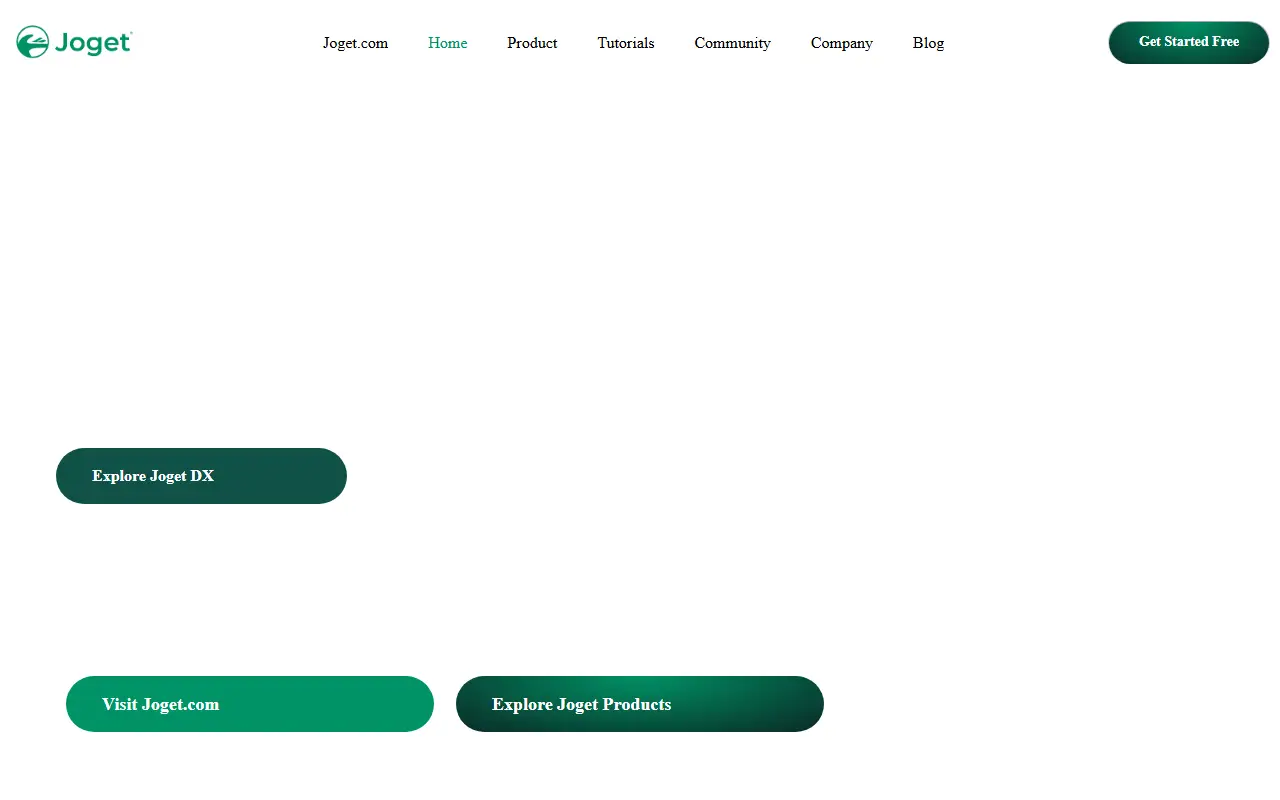
joget.orgJoget homepage screenshot

Joget is an application platform that combines rapid application development, business process automation and workflow management in a visual, web-based builder. Business and technical teams can use it together to build full enterprise applications without much hand coding, aiming to shorten delivery from months to weeks or days. Apps built on it are mobile ready and cloud ready, and the platform offers APIs for integration and a plugin architecture for extension.

The README describes a marketplace where ready-made apps, plugins and templates can be downloaded, along with a community Q&A forum, a knowledge base, video tutorials, an online academy and translations in more than twenty languages. Deployment is flexible: on-premise, on-demand cloud, Docker, Kubernetes, Cloud Foundry, OpenShift and several cloud marketplaces are listed.

Licensing is split. Joget Community Edition is released under GPL version 3, while the Professional, Enterprise and Large Enterprise editions are covered by a commercial end-user license agreement. The core is written in Java. It suits organizations that want to digitize processes such as approvals and forms with a platform they can run themselves.

Key features

  • Visual no-code and low-code app builder
  • Workflow and business process automation
  • APIs and plugin architecture
  • Marketplace of ready-made apps and plugins
  • Docker, Kubernetes and on-premise deployment
  • Mobile-ready apps

Pricing: Community Edition is free under GPL-3.0. Professional, Enterprise and Large Enterprise editions are commercial; see the vendor for pricing.

Read more about JogetWebsite GitHub

Openblocks

Openblocks is an AGPL-licensed, open-source internal tools builder positioned as an alternative to Retool, with a visual UI builder and native database connections.

GitHub stars
6.2k
Last commit
2 yr ago
Latest release
v1.1.8
Licence
AGPL-3.0
Self-hosted
Yes
Hosted version
Available

Openblocks is an open-source platform for building internal and customer-facing applications, positioned as an alternative to Retool. It targets teams that need to connect to data sources and assemble working apps quickly without designing a custom interface and wiring together multiple languages and frameworks from scratch.

It provides a visual UI builder with more than 50 components, a module and query library for reusable pieces, and native connections to PostgreSQL, MongoDB, MySQL, Redis, Elasticsearch, REST APIs and SMTP, with JavaScript usable throughout for transforming data and controlling components. Custom components can be shared through React and the Openblocks SDK, or whole Openblocks pages can be embedded as a React component. Team features include role-based access control, autosaved and restorable version history, DIY app theming, and audit logs for compliance tracking.

Openblocks is written in TypeScript and React and is released under the AGPL-3.0 license, so it can be self-hosted. A cloud-hosted version is also available at cloud.openblocks.dev. The README includes direct feature comparisons against other low-code tools in its space.

Key features

  • Visual UI builder with 50-plus components
  • Native connections to Postgres, MongoDB, MySQL and more
  • Reusable module and query library
  • Role-based access control
  • Version history with autosave
  • Audit logs for compliance

Pricing: Free and open source under the AGPL-3.0 license, self-hostable; a cloud-hosted version is also available.

Read more about OpenblocksWebsite GitHub

Microsoft Power Apps alternatives: questions

What is the best open-source alternative to Microsoft Power Apps?
ToolJet is the top-ranked open-source alternative to Microsoft Power Apps on Enlisted: An open-source platform for building internal tools, dashboards and workflows visually or from prompts, with an MCP server so coding agents can build apps. Other strong options are Budibase, NocoBase, Corteza and Steedos.
Are these Microsoft Power Apps alternatives free?
All 7 are open source, so the code is free to use under its licence, and all of them can be self-hosted on your own server or computer. 5 also offer a paid or managed cloud version if you'd rather not host it yourself.
How is this list of Microsoft Power Apps alternatives ranked?
By a score built from GitHub stars, star growth over the last 30 days and how recently the code changed. 5 of these projects shipped code in the last 30 days. Data is refreshed daily, and nobody can pay to move up.

People also look for alternatives to…

View all