7 open-source alternatives ranked by real activity

Open-source Liveblocks alternatives

A curated, ranked list of the 7 best open-source alternatives to Liveblocks.

The best open-source alternative to Liveblocks is Mattermost. If that doesn't suit you, other good options are Nakama, Centrifugo, MiroTalk and Supabase Auth.

Commercial alternatives to Liveblocks include Pusher, PubNub, Ably and Stream. See all 10.

Liveblocks alternatives are mainly gaming & emulation tools, but some are also backend-as-a-service tools and team chat tools. 5 of them shipped code in the last 30 days, 7 can be self-hosted, and 5 use a permissive licence.

Last updated November 13, 2026 · ranked by GitHub stars, growth and recent commits

Mattermost

A self-hosted, open-core collaboration platform combining team chat, automated workflows, voice calls, screen sharing and AI integrations.

GitHub stars
40k
Last commit
yesterday
Latest release
v12.0.2
Self-hosted
Yes
Hosted version
Available
mattermost.comMattermost homepage screenshot

Mattermost is an open-core collaboration platform you host yourself, covering team chat, workflow automation, voice calls, screen sharing and AI integrations. This repository is the primary source for core development of the platform. The server is built with Go and React, ships as one Linux binary and depends on PostgreSQL. GitHub lists the license as 'Other'.

Each month, on the 16th, a newly compiled release is published under the MIT license. You can deploy Mattermost on-premises or try it in the cloud. The project highlights use cases such as DevSecOps, incident resolution and IT service desk, and it offers native clients for Android, iOS, Windows, macOS and Linux in addition to the web interface.

Installation options include Docker, Ubuntu, a tar archive, Kubernetes, Helm and an Omnibus package. Developers can build integrations through APIs, webhooks, slash commands, Apps and plugins, and the repository links product and developer documentation, security bulletins and contribution guides. It suits engineering, security and operations teams that want controlled, self-managed team messaging.

Key features

  • Team chat with channels and threads
  • Built-in workflow automation
  • Voice calling and screen sharing
  • Integration with AI tools
  • Single Linux binary with PostgreSQL
  • Native mobile and desktop apps
  • APIs, webhooks, slash commands and plugins

Pricing: Mattermost does not publish prices. Professional, Enterprise and Enterprise Advanced are quoted through sales; a limited-use edition and a 1-hour trial environment are offered for evaluation.

Nakama

Open-source game backend for online and social games, scriptable in JavaScript, Go and Lua and available as a managed service on Heroic Cloud.

GitHub stars
14k
Last commit
2 days ago
Latest release
v3.42.0
Licence
Apache-2.0
Self-hosted
Yes
Hosted version
Available
heroiclabs.comNakama homepage screenshot

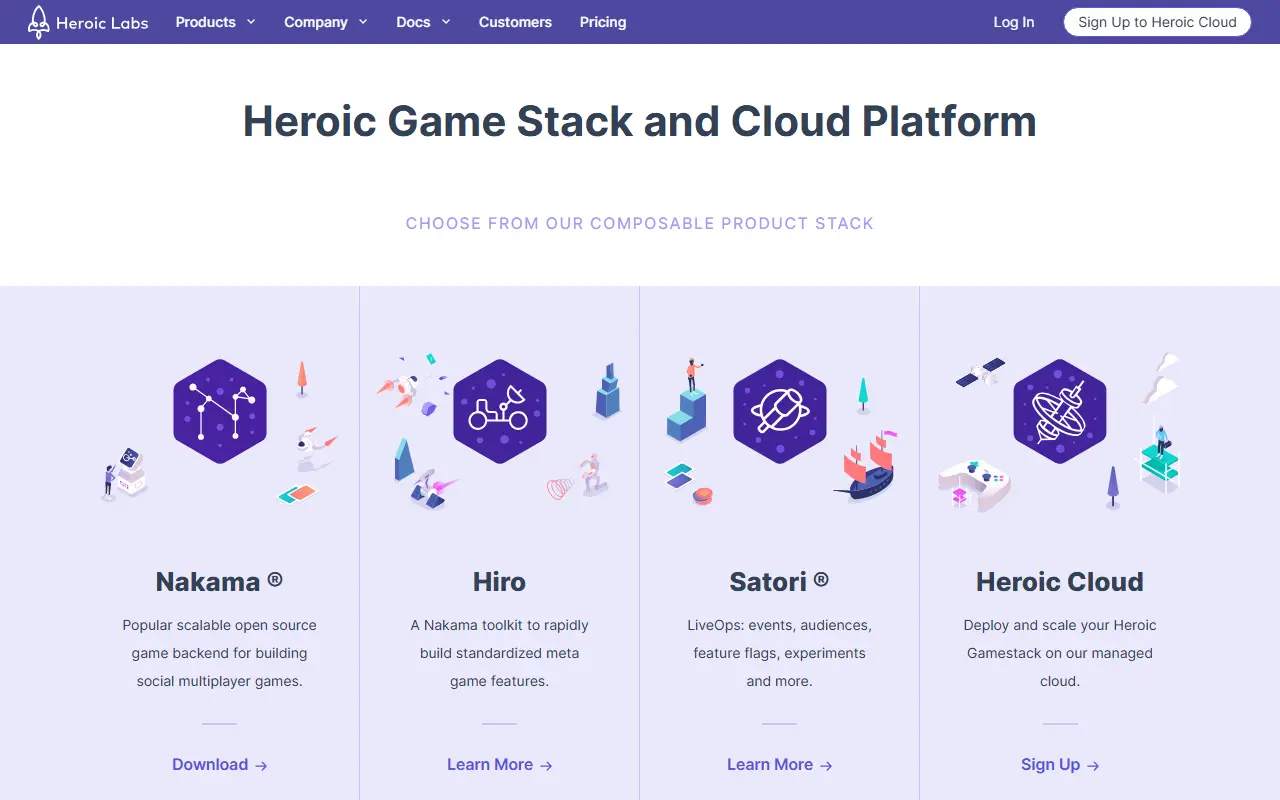
Nakama is a scalable open-source game backend from Heroic Labs for online and social games, with competitive, social and multiplayer features. The company pitches it as a way to take back control of your game backend and own your data.

Nakama can be customised with JavaScript, Go and Lua, and the site lists adding social gameplay, building multiplayer experiences and growing competitive communities as its focus. It sits in a wider Heroic stack: Hiro, a toolkit for meta game features such as economy models with soft and hard currencies and energy accumulators, and Satori, for LiveOps like events, audiences, feature flags and experiments.

Nakama OSS can be downloaded and started by following the documentation, which promises a start in five minutes, or run on Heroic Cloud, a managed or private cloud where Nakama and Satori are hosted with automated scale out. Heroic Labs publishes a case study with Kwalee and highlights Loom Games' Pixel Flow, which it says has passed 10M players.

Key features

  • Social and multiplayer features, scripted in JavaScript, Go or Lua
  • Hiro toolkit for economy, energy and ad-reward features
  • Satori adds LiveOps such as events and feature flags
  • Managed hosting on Heroic Cloud
  • Client libraries, tutorials and guides in the docs
Read more about NakamaWebsiteGitHub#2 Liveblocks alternative

Centrifugo

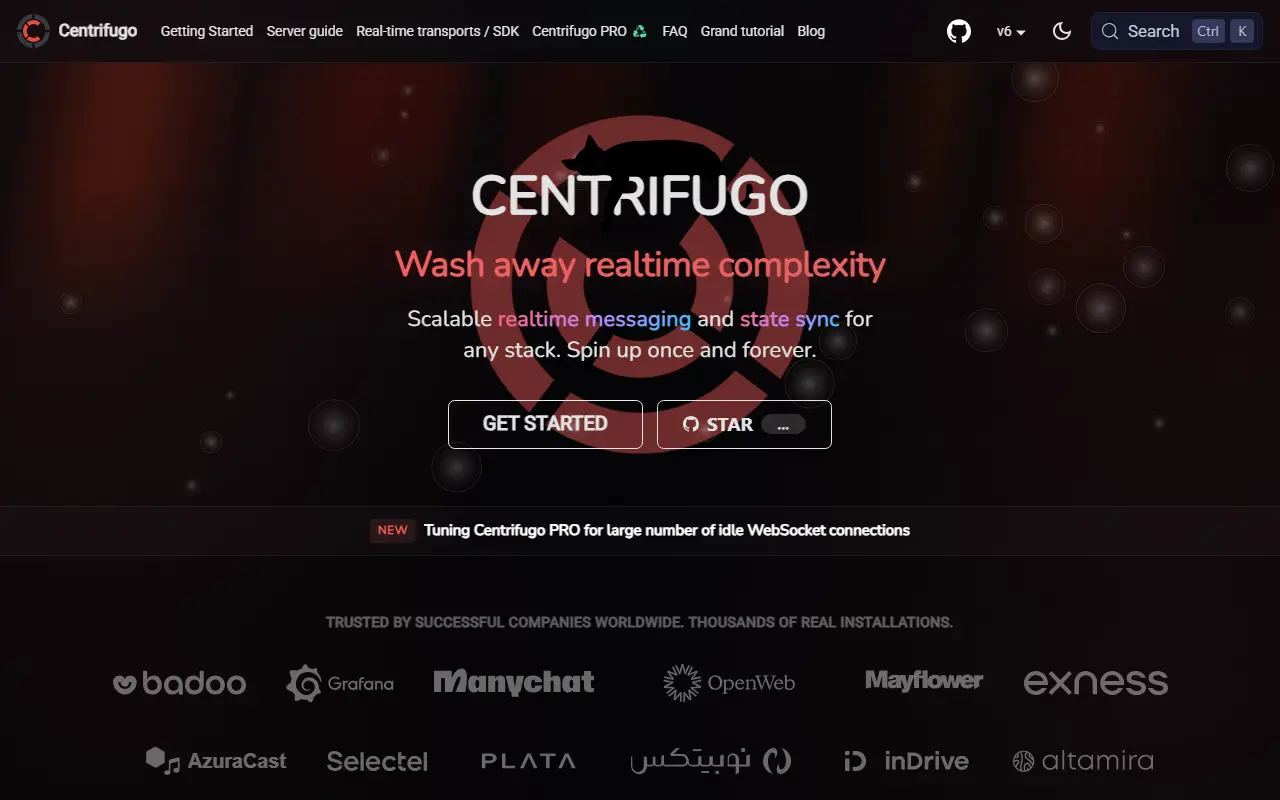
Centrifugo is a self-hosted, language-agnostic real-time messaging server that pushes messages to browsers and apps over WebSocket and other transports, an alternative to Pusher and Ably.

GitHub stars
11k
Last commit
2 days ago
Latest release
v6.10.3
Licence
Apache-2.0
Self-hosted
Yes
centrifugal.devCentrifugo homepage screenshot

This entry covers Centrifugo, the real-time messaging server from the Centrifugal project. It is an open-source PUB/SUB server for user-facing messaging: your backend publishes into channels through a simple HTTP or gRPC API, and clients subscribe to those channels using official SDKs, or a unidirectional approach that needs no SDK.

Messages reach online users over WebSocket, HTTP streaming, Server-Sent Events, gRPC and WebTransport. Because it is language-agnostic, it can sit beside any backend and separates the business logic from the real-time transport. It is used for chat apps, live comments, multiplayer games, data visualizations, collaborative tools and streaming AI responses. An embedded admin UI shows live connections and lets you publish test messages, and Redis support allows scaling out.

Centrifugo is written in Go and licensed under Apache-2.0. It is pitched as a self-run replacement for hosted services like Pusher, Ably and PubNub and for libraries such as socket.io, Phoenix.PubSub and SignalR, and a Docker command starts it in a minute for local trials. The README warns that the insecure flags used in the quick start must never be used in production.

Key features

  • Channel-based PUB/SUB messaging
  • WebSocket, SSE, HTTP streaming and gRPC transports
  • WebTransport support for browsers
  • HTTP and gRPC publish API
  • Official client SDKs
  • Embedded admin UI
  • Scaling out with Redis

Pricing: Free and open source under the Apache-2.0 licence.

MiroTalk

MiroTalk P2P is a self-hosted, open-source WebRTC video conferencing app with browser-based rooms, screen sharing, chat, whiteboard and recording.

GitHub stars
4.8k
Last commit
yesterday
Licence
AGPL-3.0
Self-hosted
Yes
p2p.mirotalk.comMiroTalk homepage screenshot

MiroTalk P2P is an open-source video conferencing platform that uses direct peer-to-peer WebRTC connections between participants. You host it on your own server, and people join meeting rooms from a browser with no downloads and no time limits. It is meant for teams and communities that want private real-time communication they control.

Features include unlimited rooms, screen sharing, text chat, a collaborative whiteboard, recording and general collaboration tools. It works across common browsers and platforms, can be deployed with a Docker image in minutes, and has a live demo, documentation and a Discord community. The software is JavaScript based.

MiroTalk P2P is licensed under AGPL-3.0. Because media flows peer to peer, it keeps traffic off a central media server, which suits small groups. It fits small teams, schools and communities who want a self-hosted alternative to commercial meeting tools.

Key features

  • Peer-to-peer WebRTC video calls
  • Browser-based rooms without downloads
  • Screen sharing and text chat
  • Shared collaborative whiteboard
  • Recording of meetings
  • Docker image for quick deployment

Pricing: Free and open source under AGPL-3.0.

Read more about MiroTalkWebsiteGitHub#4 Liveblocks alternative

Supabase Auth

Go-based user management and authentication server from Supabase that issues JWTs and supports email, passwordless, phone, and social sign-in.

GitHub stars
2.6k
Last commit
yesterday
Latest release
v2.197.0
Licence
MIT
Self-hosted
Yes
Hosted version
Available
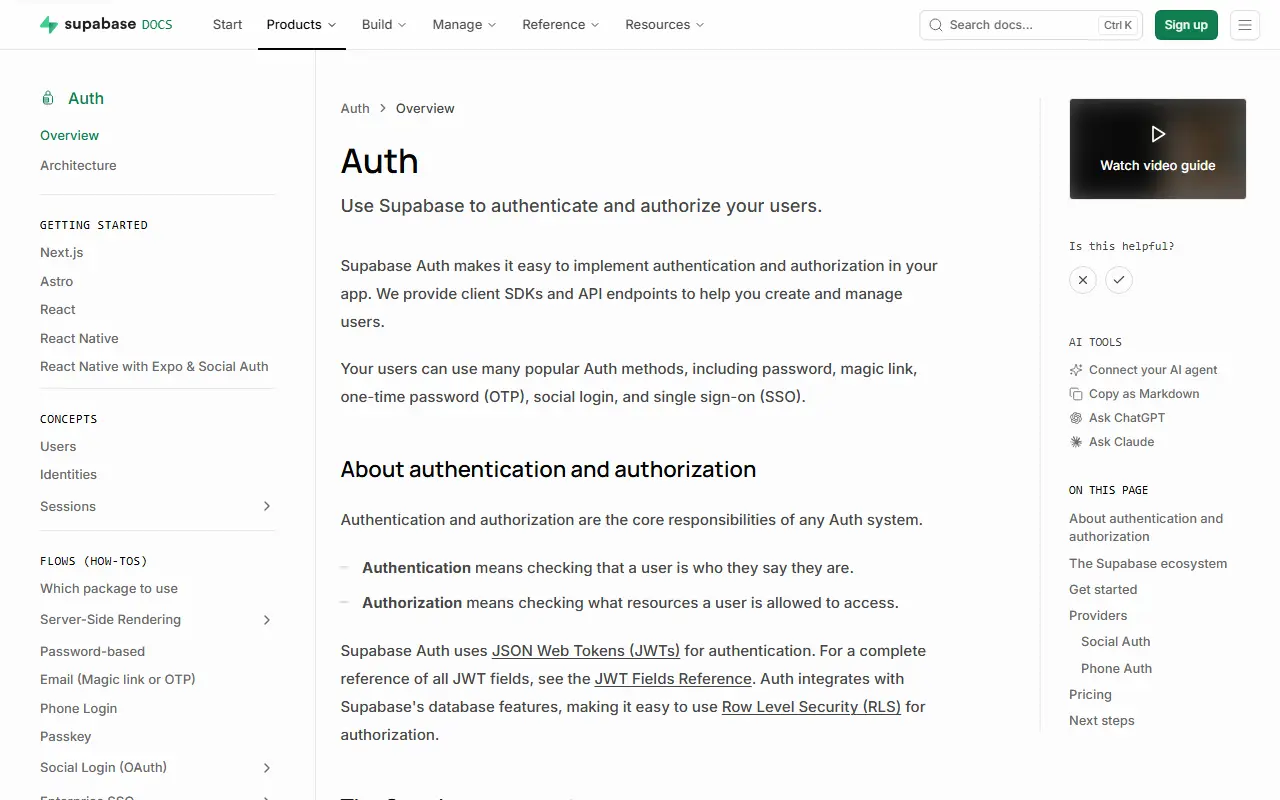
supabase.comSupabase Auth homepage screenshot

Supabase Auth is an authentication and user management server written in Go. It powers Supabase's sign-in features by issuing JSON Web Tokens that downstream services, such as PostgREST with Row Level Security, can trust. It started from Netlify's GoTrue codebase, but both projects have diverged significantly. It is released under the MIT license.

Supported sign-in methods include email and password, magic links, phone numbers, and external providers such as Google, Apple, Facebook, and Discord. The server exposes an HTTP API for managing users and sessions, and its configuration is handled through environment variables in a .env file, with an example file provided.

The README walks through a quick start using a local Postgres database and has sections on running in production, configuration, and endpoints. The service can be used as part of the Supabase hosted platform or run on its own, which suits teams that want an open-source JWT-based identity service they can host themselves.

Key features

  • JWT issuing for application sessions
  • Email and password sign-in
  • Magic link and phone number login
  • OAuth providers such as Google and Apple
  • User management API
  • Row Level Security integration with PostgREST

Pricing: Free and open source under the MIT license; it is also available through the hosted Supabase platform.

Deepstream.io

An open realtime server for syncing data, publishing events and making remote procedure calls at scale, with built-in authentication and a permission language.

GitHub stars
7.2k
Last commit
1 mo ago
Latest release
v10.2.4
Licence
MIT
Self-hosted
Yes
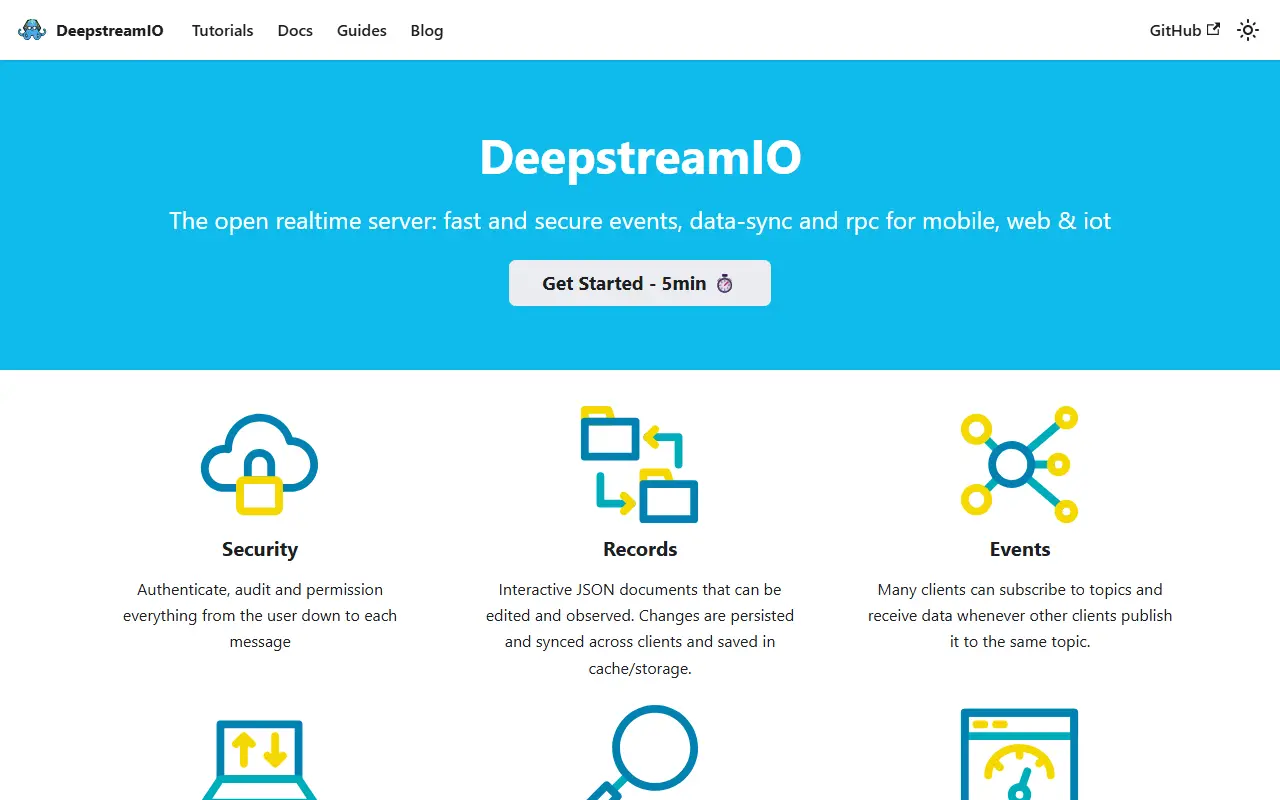
deepstreamio.github.ioDeepstream.io homepage screenshot

deepstream is an open-source realtime server inspired by ideas from financial trading technology. It lets clients and backend services sync data, exchange messages and make remote procedure calls at high speed and scale, and it is written in TypeScript for Node.js.

It is built on three core concepts. Records are schema-less, persistent documents that clients can edit and observe, with changes synchronized to all connected clients and backend processes in milliseconds and links between records to model relational data. Events provide publish-subscribe messaging with topic-based routing and subscription listening. RPCs offer request-response workflows with load balancing, failover and message routing handled by the server.

Security combines several authentication mechanisms with a permission language called Valve that specifies which user can do which action on which data. deepstream is licensed under MIT and hosted by you, with tutorials, a quickstart and documentation, plus community support on Stack Overflow and GitHub Discussions. It suits developers building collaborative or live-updating applications.

Key features

  • Realtime synced records
  • Publish-subscribe events with topic routing
  • RPCs with load balancing and failover
  • Pluggable authentication mechanisms
  • Valve permission language
  • WebSocket-based realtime transport

Pricing: Free and open source under the MIT licence.

PartyKit

JavaScript platform for adding real-time multiplayer features to apps, running on edge networks; its hosted service is being shut down.

GitHub stars
5.7k
Last commit
1 mo ago
Latest release
y-partykit@0.0.33
Licence
MIT
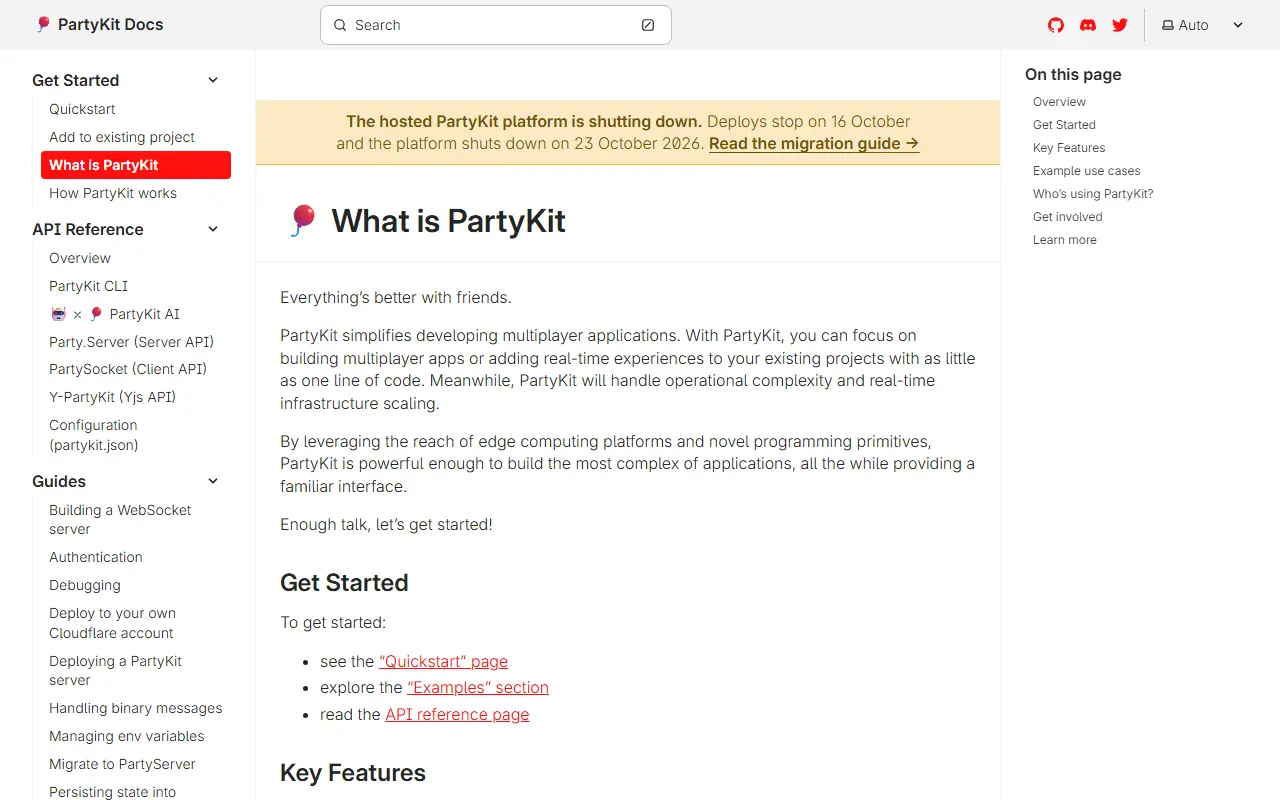
docs.partykit.ioPartyKit homepage screenshot

PartyKit is a toolkit for building multiplayer and real-time applications. The idea is to add shared experiences to a new or existing project with very little code, while the platform deals with the real-time infrastructure and scaling behind it.

Server logic is written in JavaScript, or optionally Wasm, and runs on edge computing networks that route users to nearby servers. The documentation covers WebSocket servers, authentication, storage, alarms for scheduled tasks, rate limiting, hibernation for scaling, and a Yjs API for collaborative editing.

The docs include example apps such as live polls, a multiplayer text editor, cursors, a falling sand game and a YouTube watch party, along with starter kits for Next.js, Remix, Replicache and TinyBase. A banner states that the hosted PartyKit platform is closing, with a migration guide to PartyServer and a guide for deploying to your own Cloudflare account.

Key features

  • Add multiplayer to existing projects with minimal code
  • Edge network scaling for users worldwide
  • Server code written in plain JavaScript
  • Choose your own libraries and abstractions
  • Guides for hibernation, alarms and static assets
  • Sample apps including polls, editors and games
Read more about PartyKitWebsiteGitHub#7 Liveblocks alternative

Commercial Liveblocks alternatives

Hosted, closed-source products that compete with Liveblocks.

Liveblocks alternatives: questions

What is the best open-source alternative to Liveblocks?
Mattermost is the top-ranked open-source alternative to Liveblocks on Enlisted: A self-hosted, open-core collaboration platform combining team chat, automated workflows, voice calls, screen sharing and AI integrations. Other strong options are Nakama, Centrifugo, MiroTalk and Supabase Auth.
What are the best commercial alternatives to Liveblocks?
Pusher, PubNub, Ably, Stream and AWS AppSync are among the hosted, closed-source alternatives to Liveblocks listed on Enlisted, which lists 10 in total. Compare their pricing and features on each tool page.
Are these Liveblocks alternatives free?
All 7 are open source, so the code is free to use under its licence, and all of them can be self-hosted on your own server or computer. 3 also offer a paid or managed cloud version if you'd rather not host it yourself.
How is this list of Liveblocks alternatives ranked?
By a score built from GitHub stars, star growth over the last 30 days and how recently the code changed. 5 of these projects shipped code in the last 30 days. Data is refreshed daily, and nobody can pay to move up.

People also look for alternatives to…

View all