#1
A self-hosted file sync, sharing and collaboration platform that stores files, contacts and calendars on a server you choose, extensible with hundreds of apps.
- GitHub stars
- 37k
- Last commit
- yesterday
- Latest release
- v33.0.11
- Licence
- AGPL-3.0
- Self-hosted
- Yes
- Hosted version
- Available
nextcloud.com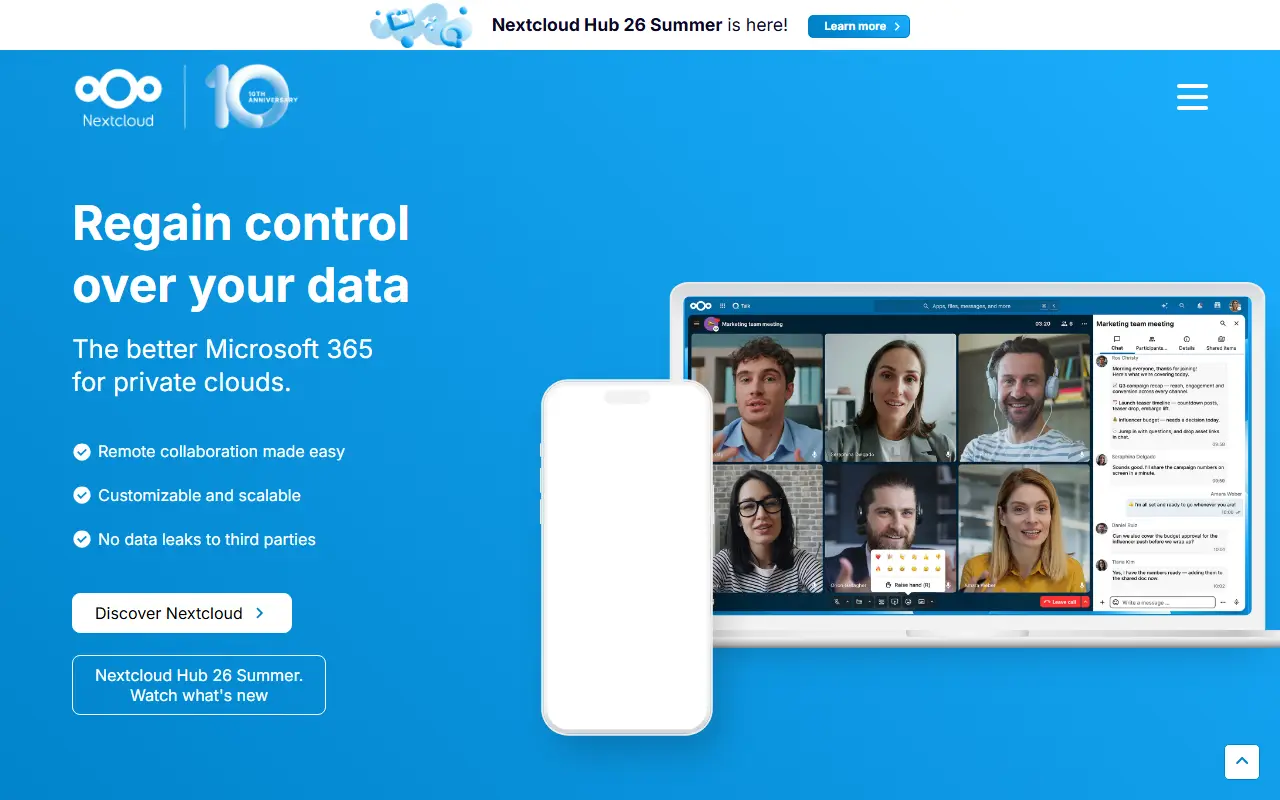
Nextcloud Server is a platform for keeping your files, contacts, calendars and other data on a server of your choosing. Content is synchronized across your devices, can be shared with other people for viewing or collaboration, and stays under your control rather than with a large cloud provider. It grew out of the ownCloud lineage.
Functionality can be expanded through hundreds of apps in its App Store, including Calendar, Contacts, Mail and Video Chat. Security measures include encryption mechanisms, a public bug bounty program and two-factor authentication. There are several ways to get a Nextcloud: sign up with a provider, install the server yourself on your own hardware or with a ready-to-use appliance, buy a device that comes with it preinstalled, or find a service provider to host it for you.
The server is written in PHP and JavaScript under the AGPL-3.0 license. Nextcloud GmbH also offers an Enterprise edition aimed at public sector, education and company users. It suits households, schools and organizations that want to replace commercial cloud storage and office suites with something they run themselves.
Key features
- File storage and sync across devices
- Contacts and calendar hosting
- Sharing and collaboration controls
- App Store with hundreds of apps
- Two-factor authentication and encryption
- Self-install, appliance or provider-hosted options
Pricing: Nextcloud Enterprise Standard starts at 42€ per user per year, with subscriptions from 100 users and 31.50€ from 250 users. Nextcloud One managed hosting is offered for smaller teams.
#2
1Panel is an open-source Linux server management panel with a web interface for apps, websites, databases and containers, plus AI management.
- GitHub stars
- 37k
- Last commit
- yesterday
- Latest release
- v2.5.1
- Licence
- GPL-3.0
- Self-hosted
- Yes
1panel.pro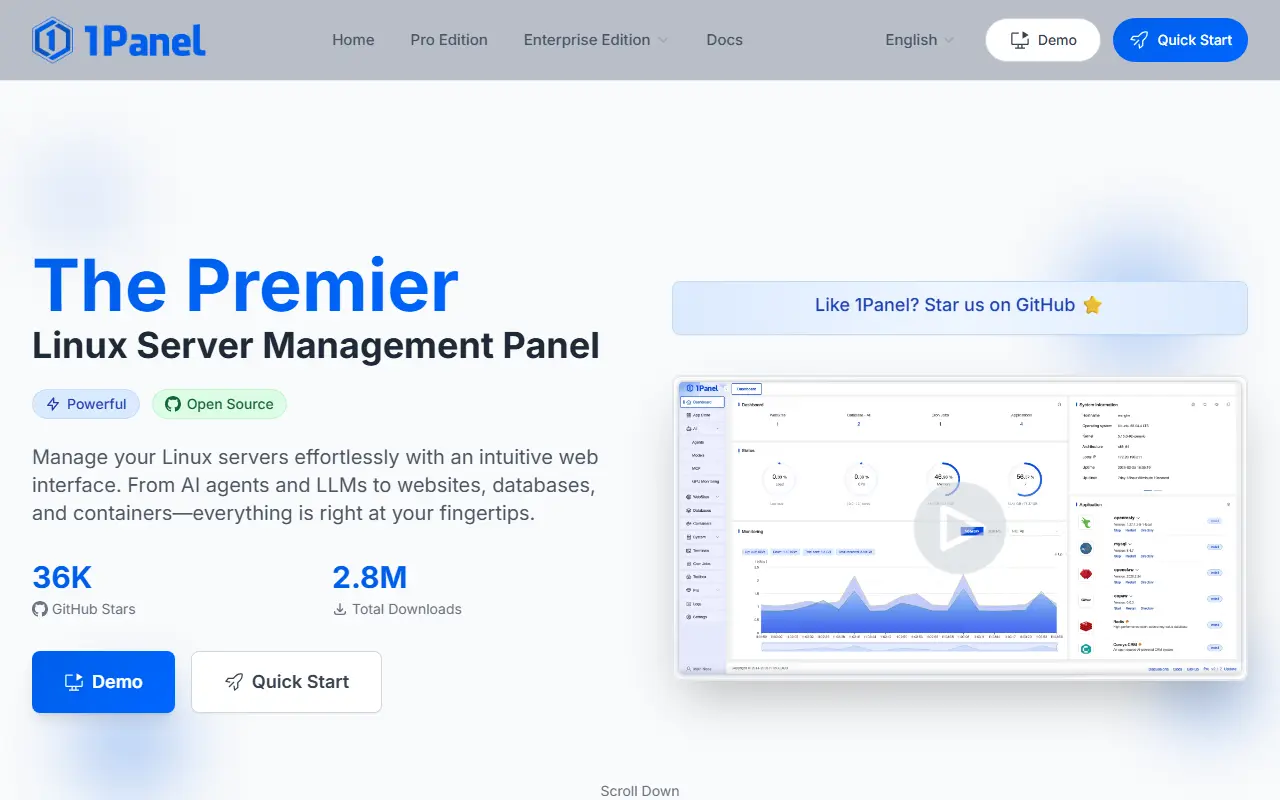
1Panel is an open-source Linux server management panel that also positions itself as a lightweight AI management platform. Through a web interface it covers monitoring of the host, files, databases and containers, so common server chores can be done without working only in a terminal. It is written in Go, uses Docker for app deployment and is released under the GPL-3.0 license.
A built-in app store offers one-click installation and upgrades of open-source applications, and website tooling integrates with builders such as WordPress and Halo, including domain binding and SSL certificate setup. Security features include a web application firewall and log auditing, and applications are deployed in containers to limit exposure. Backups and restores can be triggered in one click and sent to various cloud storage services. The project compares itself with panels such as cPanel, Plesk, aaPanel and Webmin.
Key features
- Web GUI for Linux server management
- One-click app store with installs and upgrades
- Website deployment with domain and SSL setup
- Docker container and database management
- Backup and restore to cloud storage
- AI gateway and agent management tools
Pricing: The open-source edition is free forever. The Pro Edition costs $80 per year as a subscription or $200 as a one-time perpetual license.
#3
Tuta Mail is an encrypted email, contacts and calendar service with open-source clients for web, desktop and mobile devices, focused on privacy.
- GitHub stars
- 8.2k
- Last commit
- 2 days ago
- Latest release
- tutanota-release-368.261110.0
- Licence
- GPL-3.0
- Self-hosted
- No
- Hosted version
- Available
tuta.com
Tuta, formerly known as Tutanota, is an email service built around security and privacy. It uses built-in end-to-end encryption to protect emails, contacts and calendar entries across devices, and it lets users communicate securely with other people regardless of what provider they use.
The open-source repository contains the client applications, which include a web client, an iOS app and a desktop client, along with separate calendar releases for mobile platforms. The code is written in TypeScript and JavaScript on top of the Mithril framework and is licensed under GPL-3.0. Build, translation and development instructions are provided in dedicated files, and the roadmap and feature requests are handled through Reddit and the vendor website.
Tuta is a hosted service operated by the vendor rather than a product you install on your own server. The repository states that it does not accept contributions or bug reports produced with the help of large language models, and maintainers close such submissions without explanation.
Key features
- End-to-end encrypted email
- Encrypted contacts and calendar entries
- Web, desktop and iOS clients
- Open-source client code
- Community translations
Pricing: Free plan with 1 GB of storage, plus paid Revolutionary (20 GB) and Legend (500 GB) plans. Plan prices were not visible on the page, so check the vendor site.
#4
An open-source cloud platform that turns bare-metal Linux servers into an AWS-style cloud with compute, storage, networking, managed Postgres, Kubernetes and AI inference.
- GitHub stars
- 12k
- Last commit
- today
- Licence
- AGPL-3.0
- Self-hosted
- Yes
- Hosted version
- Available
ubicloud.com
Ubicloud is an open-source cloud platform designed to run on any infrastructure, described by its authors as an open alternative to cloud providers in the way Linux is to proprietary operating systems. It delivers infrastructure-as-a-service capabilities on top of bare-metal hosts, for example Hetzner, Leaseweb and AWS Bare Metal.
Its services include elastic compute, non-replicated block storage, firewalls and load balancers, managed Postgres, Kubernetes, AI inference and IAM. A control plane takes leased bare-metal Linux machines, prepares them for cloud use, and then lets you provision and manage resources through a cloud console. The project is written in Ruby and topics also mention GitHub Actions runners.
You can use the managed platform at console.ubicloud.com without installing anything, where the underlying provider's price and location benefits are passed on to you, or build your own cloud by leasing servers and running the control plane yourself. Ubicloud is licensed under AGPL-3.0. The quick-start flow is currently described for Hetzner machines running Ubuntu 24.04.
Key features
- Elastic compute on bare-metal servers
- Block storage, firewalls and load balancers
- Managed PostgreSQL databases
- Managed Kubernetes clusters
- AI inference services
- IAM and cloud console
Pricing: Pay-as-you-go, billed per minute: runners from $0.00125 a minute, burstable VMs from $10.47 a month, managed PostgreSQL from $19.54 and Kubernetes from $71.82 a month. You can also self-host.
#5
The server core of ownCloud Classic, a self-hosted platform for file storage, sync and sharing with WebDAV, CalDAV and CardDAV support.
- GitHub stars
- 8.8k
- Last commit
- 4 days ago
- Latest release
- v11.1.0
- Licence
- AGPL-3.0
- Self-hosted
- Yes
owncloud.com
ownCloud Core is the server component of ownCloud Classic, a self-hosted platform for file storage, synchronization and sharing. It is the foundation on which apps such as Activity, Calendar and Contacts are built, and is written in PHP and JavaScript.
It ships with servers for WebDAV, CalDAV and CardDAV, an app plugin architecture, backends for external storage, support for encryption, user and group management, and a REST API. The server runs on PHP with MySQL, MariaDB, PostgreSQL or SQLite, and is also available as a Docker image on Docker Hub. Its topics point to federated sharing and enterprise use.
ownCloud Classic is licensed under AGPL-3.0, and installation is covered by the official manual. For the next-generation platform, the project points to ownCloud Infinite Scale. Contributors follow a rebase workflow with signed commits and DCO sign-off, and enterprise support is available from the vendor. It suits organizations and individuals who want to keep files on their own servers instead of a public cloud.
Key features
- File storage, sync and sharing
- WebDAV, CalDAV and CardDAV servers
- Plugin architecture for apps
- User and group management
- Encryption and external storage support
- REST API for integrations
- Docker image available
Pricing: Free and open source under AGPL-3.0; enterprise support is available from the vendor.
#6
A web and command-line control panel for Linux servers that manages websites, mail, DNS and databases from one dashboard.
- GitHub stars
- 4.6k
- Last commit
- yesterday
- Latest release
- 1.10.6
- Licence
- GPL-3.0
- Self-hosted
- Yes
hestiacp.com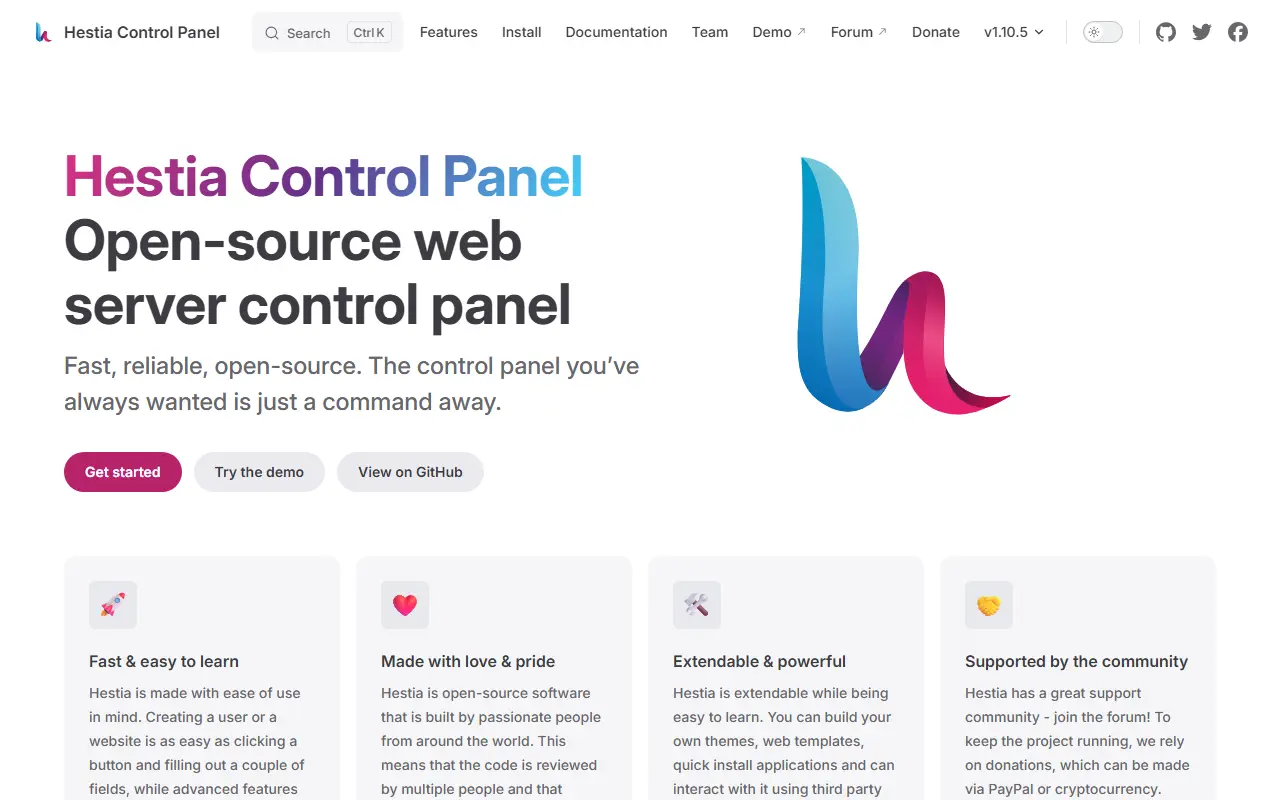
Hestia Control Panel gives server administrators a web and command-line interface for deploying and managing web domains, mail accounts, DNS zones and databases from a single dashboard. It spares them from installing and configuring each underlying service by hand.
The stack it sets up includes Apache2 and NGINX with PHP-FPM and multiple PHP versions, a Bind DNS server with clustering, POP, IMAP and SMTP mail services with ClamAV, SpamAssassin, Sieve and Roundcube, MariaDB, MySQL or PostgreSQL databases, Let's Encrypt SSL with wildcard certificates, and a firewall with brute-force detection using iptables, fail2ban and ipset.
Hestia targets 64-bit Debian and Ubuntu LTS releases and should be installed on a fresh operating system. The project warns that OpenVZ 7 or lower can cause DNS and firewall issues, recommending KVM or LXC virtual servers. It is written in Shell and PHP, licensed under GPL-3.0, and offers documentation and a forum.
Key features
- Web and command-line administration
- Apache2 and NGINX with PHP-FPM
- Multiple PHP versions
- DNS server with clustering
- Mail services with antivirus, antispam and webmail
- MariaDB, MySQL and PostgreSQL databases
- Let's Encrypt SSL with wildcard certificates
- Firewall with brute-force detection
Pricing: Free and open source under the GPL-3.0 licence.
Infomaniak alternatives: questions
- What is the best open-source alternative to Infomaniak?
- Nextcloud is the top-ranked open-source alternative to Infomaniak on Enlisted: A self-hosted file sync, sharing and collaboration platform that stores files, contacts and calendars on a server you choose, extensible with hundreds of apps. Other strong options are 1Panel, Tuta, Ubicloud and ownCloud.
- What are the best commercial alternatives to Infomaniak?
- Gandi, IONOS, OVHcloud, Hostinger and Bluehost are among the hosted, closed-source alternatives to Infomaniak listed on Enlisted, which lists 16 in total. Compare their pricing and features on each tool page.
- Are these Infomaniak alternatives free?
- All 6 are open source, so the code is free to use under its licence, and 5 of them can be self-hosted on your own server or computer. 3 also offer a paid or managed cloud version if you'd rather not host it yourself.
- How is this list of Infomaniak alternatives ranked?
- By a score built from GitHub stars, star growth over the last 30 days and how recently the code changed. 6 of these projects shipped code in the last 30 days. Data is refreshed daily, and nobody can pay to move up.
 TrackMedia
 TrackRev