5 open-source alternatives ranked by real activity

Open-source Feathery alternatives

A curated, ranked list of the 5 best open-source alternatives to Feathery.

The best open-source alternative to Feathery is NocoDB. If that doesn't suit you, other good options are Appsmith, Budibase, Baserow and Form.io.

Commercial alternatives to Feathery include Fillout, Typeform, FormAssembly and Tally. See all 22.

Feathery alternatives are mainly database tools, but some are also low-code & internal tools and form & survey tools. 5 of them shipped code in the last 30 days, 5 can be self-hosted, and 1 uses a permissive licence.

Last updated November 13, 2026 · ranked by GitHub stars, growth and recent commits

NocoDB

A self-hostable no-code database platform that puts a spreadsheet-style interface and auto-generated APIs on top of SQL databases, positioned as an Airtable alternative.

GitHub stars
66k
Last commit
yesterday
Latest release
2026.10.1
Self-hosted
Yes
Hosted version
Available
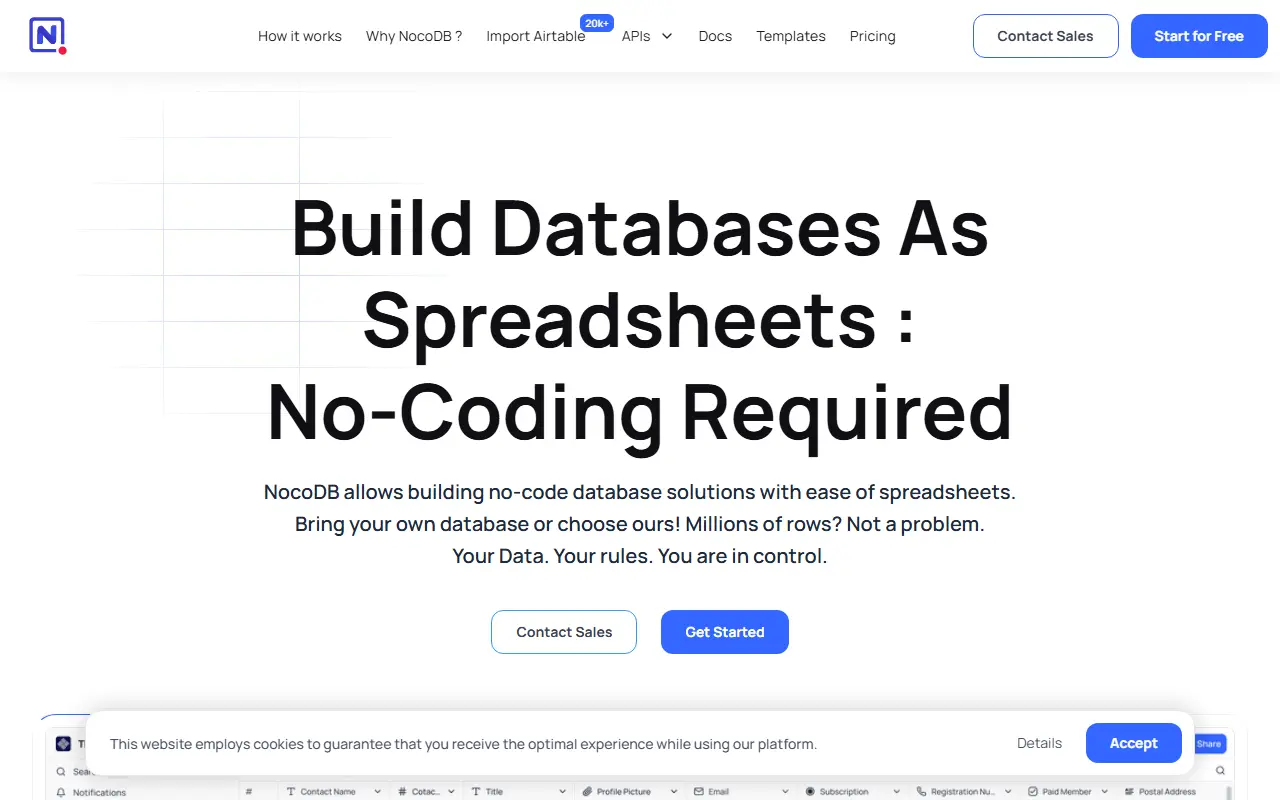
nocodb.comNocoDB homepage screenshot

NocoDB is a no-code database platform presented as a free, self-hostable alternative to Airtable. It gives relational databases a spreadsheet-like interface, so people who do not write SQL can create tables, add records and build views, while developers keep a real database underneath.

Its topics point to automatically generated REST APIs documented with Swagger, with PostgreSQL and SQLite among the supported databases. Installation is flexible: you can run it with Docker backed by SQLite or PostgreSQL, or use the auto-upstall script, which sets up a production-style stack with PostgreSQL, Redis and a Traefik gateway through Docker Compose, handles SSL certificates and renewal, and upgrades the install when you run it again. Prebuilt binaries for macOS and Linux are meant only for quick local testing.

The license is listed as 'Other', so check the repository terms before commercial redistribution. NocoDB also runs a hosted service for teams that would rather not manage a server, and it suits groups who want Airtable-style workflows while keeping data in their own database.

Key features

  • Spreadsheet-style interface over SQL databases
  • Auto-generated REST APIs with Swagger docs
  • Works with PostgreSQL and SQLite
  • Docker and Docker Compose installation
  • One-command production installer with SSL
  • Prebuilt binaries for quick local testing

Pricing: Cloud Free covers up to 3 users. Paid plans start at $12 per seat per month billed annually (Plus), then Business $24 and Scale $45. Self-hosted Community is free; Enterprise is custom.

Appsmith

An open-source low-code platform for building admin panels, internal tools and dashboards that connect to more than 25 databases and any API.

GitHub stars
41k
Last commit
today
Latest release
v2.7.0
Licence
Apache-2.0
Self-hosted
Yes
Hosted version
Available
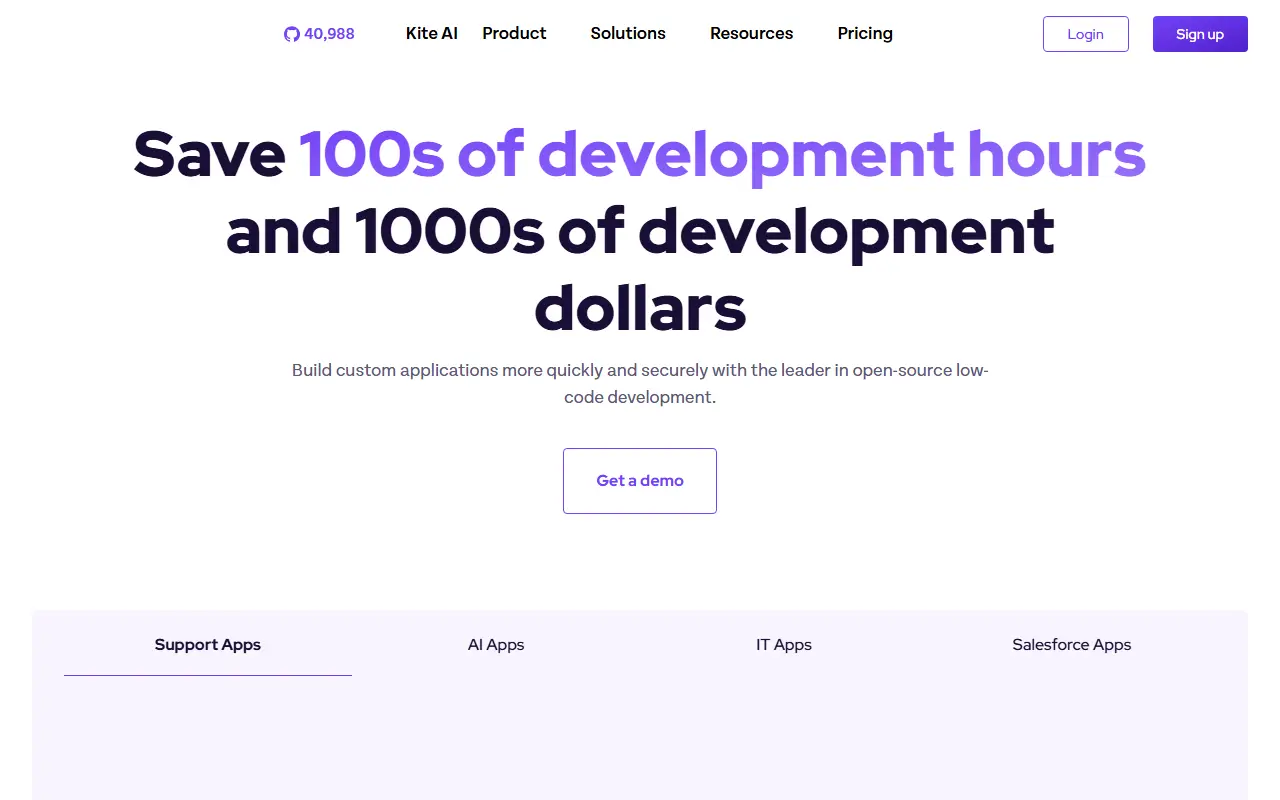
appsmith.comAppsmith homepage screenshot

Appsmith is an open-source low-code platform for building custom internal applications such as dashboards, admin panels, customer 360 views, IT automation and service management tools. It aims to simplify building, deploying and maintaining these apps, which otherwise tend to be tedious to code from scratch.

You assemble interfaces visually and connect them to data through integrations with more than 25 databases and any REST or GraphQL API, with JavaScript available where you need custom logic. Topics also point to CRUD generation, workflows and automation. The front end is built with React and TypeScript, and the server side is mostly Java.

You can sign up for Appsmith Cloud or install it on your own machine, with Docker as the recommended method, plus Kubernetes and an AWS AMI. The code is Apache-2.0 licensed. It is a common choice for engineering teams that want to ship internal tools quickly without maintaining a bespoke front-end codebase.

Key features

  • Visual builder for internal tools
  • Integrates with 25+ databases and any API
  • JavaScript for custom logic
  • Admin panels, dashboards and CRUD apps
  • Docker, Kubernetes and AWS AMI installation
  • Cloud or self-hosted deployment

Pricing: Free for up to 5 cloud users. Business is $15 per user per month with a 15-day trial; Enterprise is listed at $2,500 per month for 100 users. The open-source Community edition is free.

Budibase

An open-source, model-agnostic operations platform for building AI agents, automations and internal apps that connect to your business systems.

GitHub stars
28k
Last commit
yesterday
Latest release
v4.0.0
Self-hosted
Yes
Hosted version
Available
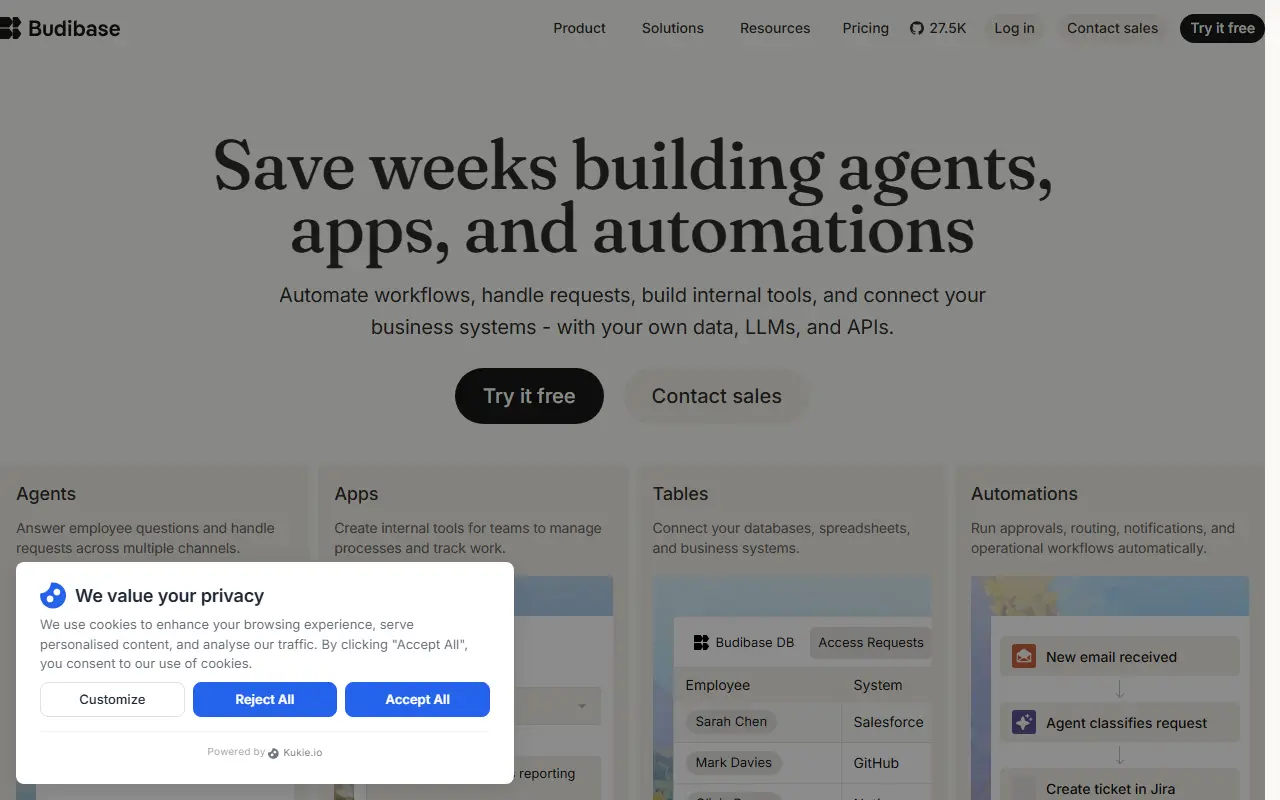
budibase.comBudibase homepage screenshot

Budibase is an open-source operations platform for building AI agents, automations and apps that run internal processes. It is model agnostic and describes itself as saving engineers many hours when building these tools, while handling security concerns. Topics place it in the low-code and no-code internal tools space, with CRUD apps and an SQL GUI.

The idea is to run requests, approvals and workflows on one platform instead of stitching several tools together. Staff constantly ask questions, request sign-offs and flag problems, and Budibase agents interpret those requests and carry out the work: creating records, sending approvals to the right people, updating apps and alerting teams. You connect the business systems your operations already rely on, and the platform also supports building data applications over databases and REST APIs.

You can use Budibase Cloud, where the vendor hosts it, or host it yourself with Docker, Kubernetes or DigitalOcean. The repository is written in TypeScript, and its license is listed as 'Other' on GitHub, so check the terms for enterprise features. It suits operations and engineering teams that want internal tools and AI automation without building everything from scratch.

Key features

  • AI agents that run workflows
  • Internal app builder for CRUD tools
  • Automations connecting business systems
  • Works with any AI model
  • Self-host with Docker or Kubernetes
  • Budibase Cloud hosting

Pricing: The open-source edition is free to self-host. Cloud plans are Pro $19, Premium $49 and Business $299 per month, each with a 14-day trial; Enterprise is custom and quoted through sales.

Baserow

Baserow is a no-code platform for building databases, automations, apps and AI agents, positioned as an open-source Airtable alternative.

GitHub stars
6.3k
Last commit
today
Latest release
2.4.2
Self-hosted
Yes
Hosted version
Available
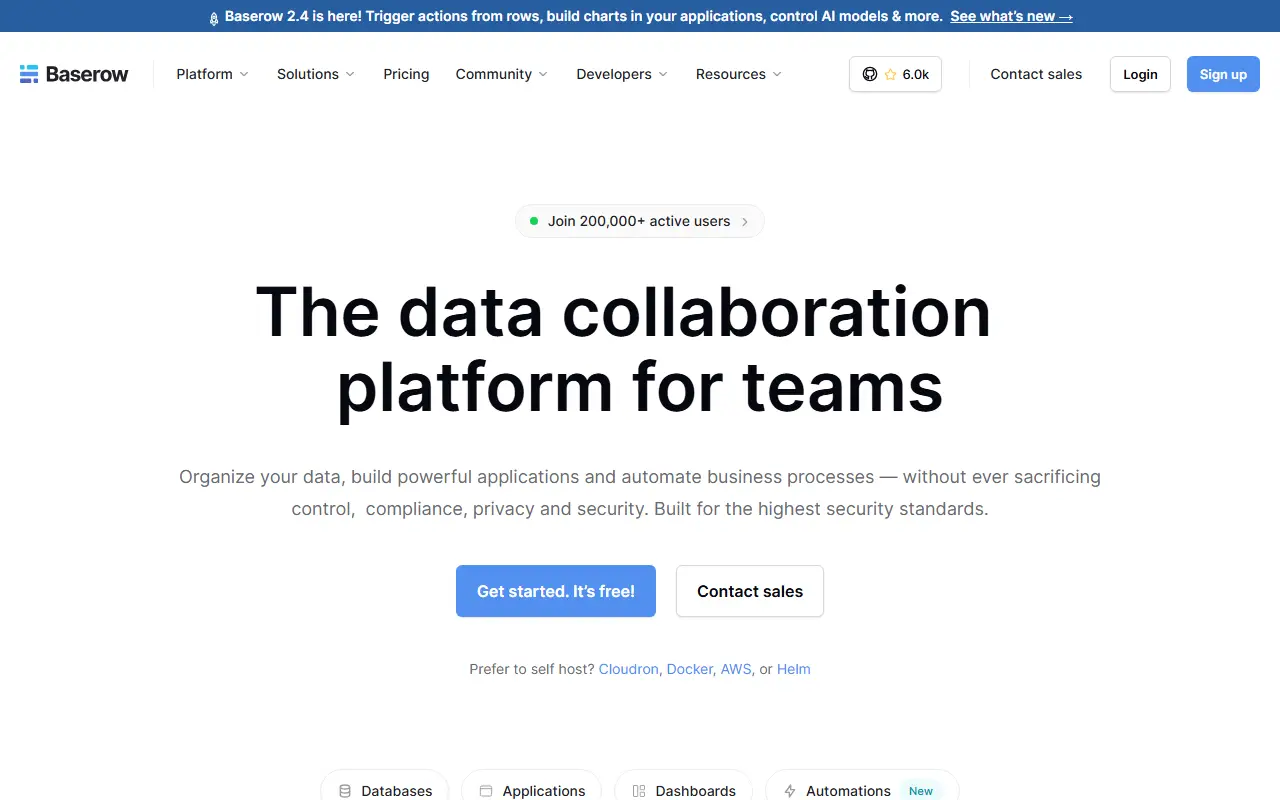
baserow.ioBaserow homepage screenshot

Baserow is an open-source, no-code platform that combines a spreadsheet-style database with automations, application building, dashboards and AI agents. It targets teams that want to structure data and build internal tools without writing code, and its repository is tagged as an Airtable alternative.

Capabilities include an AI Assistant that creates databases and workflows from natural-language instructions, an API-first design with a REST API, and extensibility for connecting to existing tools. The README states that the cloud service meets GDPR, HIPAA and SOC 2 Type II compliance requirements. The backend is written in Python and uses PostgreSQL for storage.

Baserow is available as a managed cloud service and as a self-hosted installation, which suits organizations that need to keep data on their own servers. The repository license is listed as 'Other' on GitHub, reflecting the open-source core alongside separately licensed premium and enterprise features, so check the terms for the features you need.

Key features

  • Spreadsheet-style online database
  • No-code app and automation builder
  • AI Assistant for natural-language setup
  • REST API with API-first design
  • Dashboards over table data
  • Cloud and self-hosted deployment

Pricing: Free plan with 3,000 rows per workspace. Premium costs $12 and Advanced $22 per user per month, or $10 and $18 billed yearly; Enterprise is on request.

Form.io

Form.io is the open source core of a form and API platform that builds data-management apps from a drag-and-drop form builder.

GitHub stars
2.3k
Last commit
4 days ago
Licence
OSL-3.0
Self-hosted
Yes

This repository is the core form and API engine behind form.io. It lets people build serverless data-management applications from a drag-and-drop form builder, and the resulting forms can be embedded in Angular.js and React applications.

The server runs on Node.js with MongoDB. The README offers two routes: Docker Compose, which serves the application on localhost port 3001 with a default admin account whose password should then be changed, or a manual install of Node.js and MongoDB followed by yarn build and yarn start.

Logging is built on Pino, with an application logger and an HTTP request logger that redact tokens, authorization headers and cookies before writing. The log level is set through the LOG_LEVEL environment variable, and structured output sits behind a feature flag that is off by default.

Key features

  • Drag-and-drop form builder
  • Embeds forms in Angular.js and React apps
  • Runs locally with Docker Compose
  • Manual install on Node.js and MongoDB
  • Structured logging built on Pino
  • Redacts tokens and cookies in request logs

Commercial Feathery alternatives

Hosted, closed-source products that compete with Feathery. Showing 12 of 22.

See every Feathery alternative on its tool page

Feathery alternatives: questions

What is the best open-source alternative to Feathery?
NocoDB is the top-ranked open-source alternative to Feathery on Enlisted: A self-hostable no-code database platform that puts a spreadsheet-style interface and auto-generated APIs on top of SQL databases, positioned as an Airtable alternative. Other strong options are Appsmith, Budibase, Baserow and Form.io.
What are the best commercial alternatives to Feathery?
Fillout, Typeform, FormAssembly, Tally and Google Forms are among the hosted, closed-source alternatives to Feathery listed on Enlisted, which lists 22 in total. Compare their pricing and features on each tool page.
Are these Feathery alternatives free?
All 5 are open source, so the code is free to use under its licence, and all of them can be self-hosted on your own server or computer. 4 also offer a paid or managed cloud version if you'd rather not host it yourself.
How is this list of Feathery alternatives ranked?
By a score built from GitHub stars, star growth over the last 30 days and how recently the code changed. 5 of these projects shipped code in the last 30 days. Data is refreshed daily, and nobody can pay to move up.

People also look for alternatives to…

View all