4 open-source alternatives ranked by real activity

Open-source Caspio alternatives

A curated, ranked list of the 4 best open-source alternatives to Caspio.

The best open-source alternative to Caspio is NocoBase. If that doesn't suit you, other good options are Budibase, REI3 and Totum.

Commercial alternatives to Caspio include Tadabase, Knack, Quickbase and Zoho Creator. See all 30.

Caspio alternatives are mainly low-code & internal tools. 3 of them shipped code in the last 30 days, 4 can be self-hosted, and 1 uses a permissive licence.

Last updated November 12, 2026 · ranked by GitHub stars, growth and recent commits

NocoBase

An open-source AI and no-code platform for building business systems such as CRMs, internal tools and workflows, where people and coding agents build together.

GitHub stars
25k
Last commit
yesterday
Latest release
v2.2.46
Self-hosted
Yes
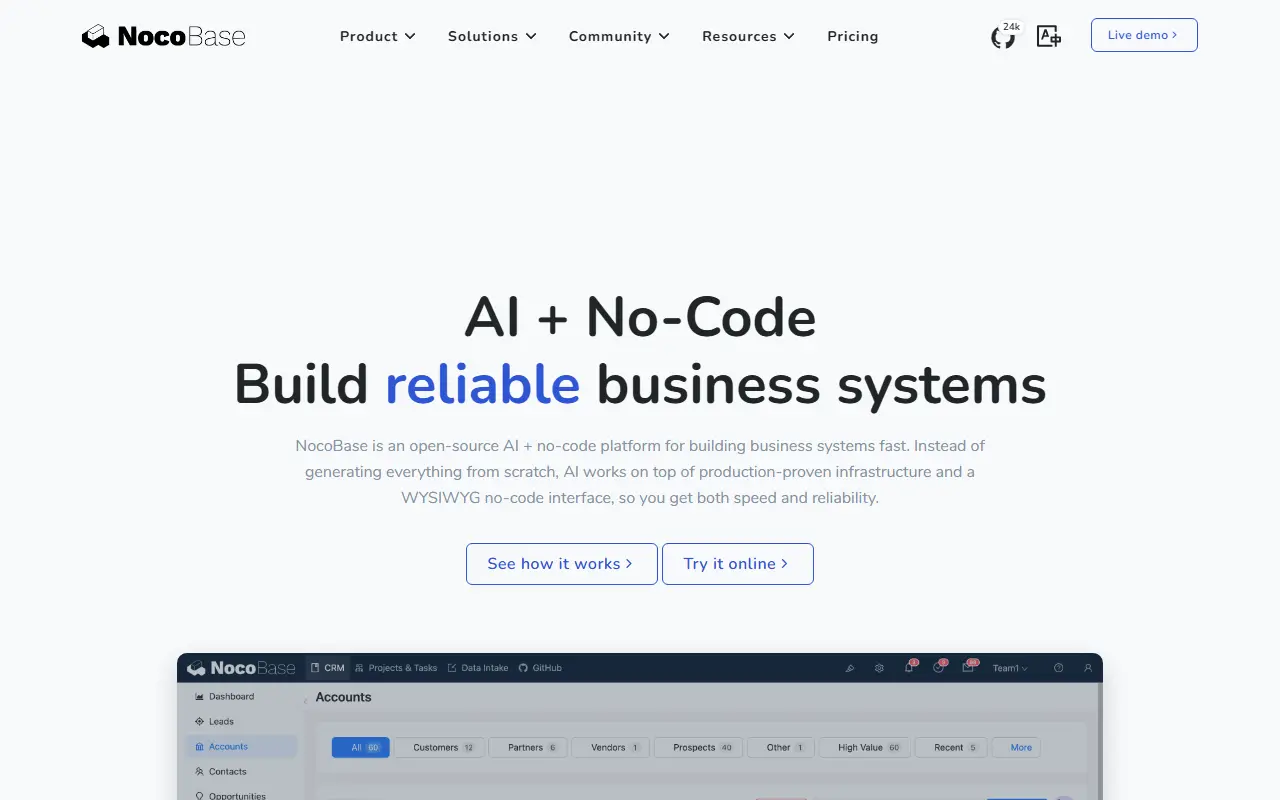
nocobase.comNocoBase homepage screenshot

NocoBase is an open-source platform that combines AI with no-code tooling to build business systems quickly. Rather than having AI generate everything from scratch, it has AI build on infrastructure already proven in production and on a visual WYSIWYG no-code editor, which the project says delivers both speed and reliability.

Its approach is collaborative: coding agents are given a complete CLI plus skills, and people use a visual interface, so both can contribute to the same system. Topics show typical uses such as internal tools, admin dashboards, CRUD apps, CRM, ERP and project management, with workflows included. An online demo, documentation, a forum and customer stories are available, and release notes are published on the blog with weekly summaries. It is written in TypeScript.

NocoBase can be installed on your own infrastructure, and its license is listed as 'Other' on GitHub, so review the terms for commercial or enterprise use. It suits teams that want flexible internal systems without maintaining a large custom codebase, and who want to use AI assistance on a stable foundation.

Key features

  • WYSIWYG no-code interface
  • CLI and skills for coding agents
  • Workflows and CRUD apps
  • Suitable for CRM, ERP and project management
  • Online demo and documentation
  • Install on your own infrastructure

Pricing: The Community Edition is free and open source. Standard is a one-time $800 lifetime license and Professional a one-time $8,000 license, each with one year of upgrades; Enterprise is by contact.

Budibase

An open-source, model-agnostic operations platform for building AI agents, automations and internal apps that connect to your business systems.

GitHub stars
28k
Last commit
yesterday
Latest release
v4.0.0
Self-hosted
Yes
Hosted version
Available
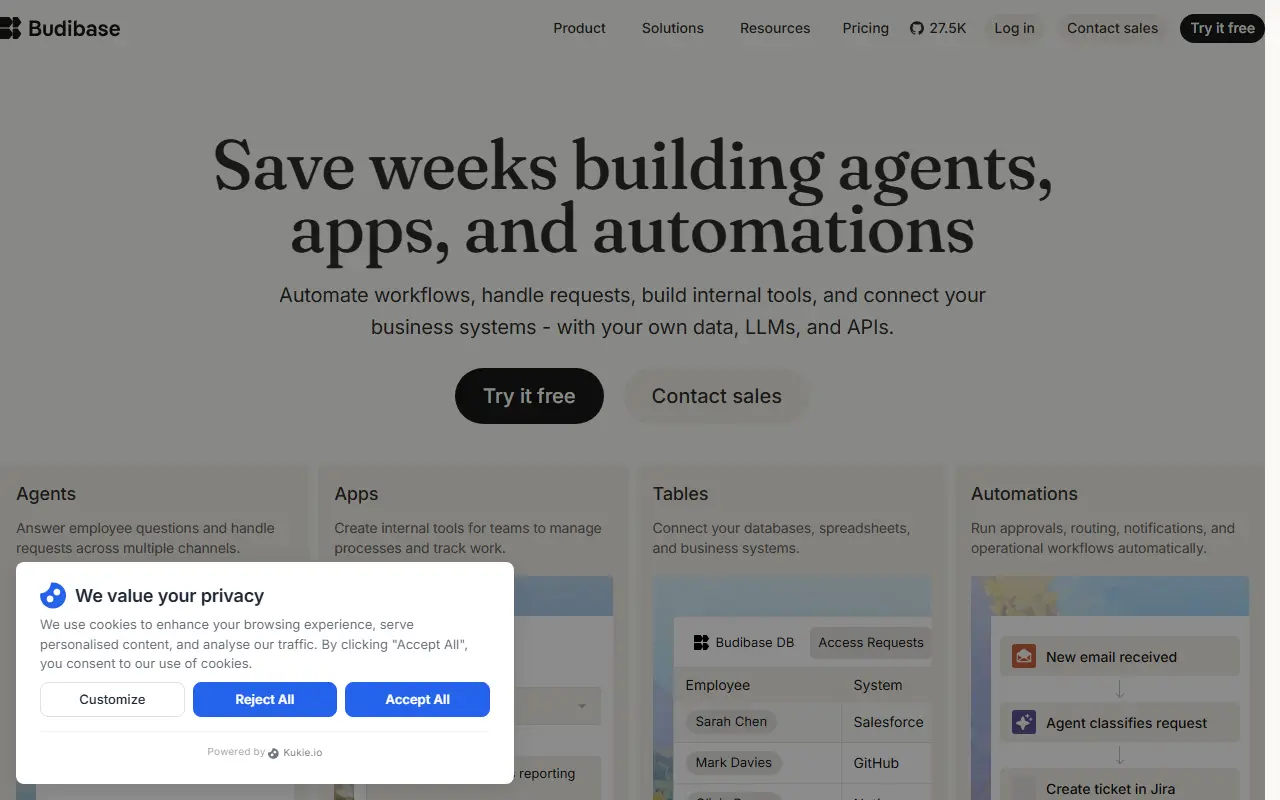
budibase.comBudibase homepage screenshot

Budibase is an open-source operations platform for building AI agents, automations and apps that run internal processes. It is model agnostic and describes itself as saving engineers many hours when building these tools, while handling security concerns. Topics place it in the low-code and no-code internal tools space, with CRUD apps and an SQL GUI.

The idea is to run requests, approvals and workflows on one platform instead of stitching several tools together. Staff constantly ask questions, request sign-offs and flag problems, and Budibase agents interpret those requests and carry out the work: creating records, sending approvals to the right people, updating apps and alerting teams. You connect the business systems your operations already rely on, and the platform also supports building data applications over databases and REST APIs.

You can use Budibase Cloud, where the vendor hosts it, or host it yourself with Docker, Kubernetes or DigitalOcean. The repository is written in TypeScript, and its license is listed as 'Other' on GitHub, so check the terms for enterprise features. It suits operations and engineering teams that want internal tools and AI automation without building everything from scratch.

Key features

  • AI agents that run workflows
  • Internal app builder for CRUD tools
  • Automations connecting business systems
  • Works with any AI model
  • Self-host with Docker or Kubernetes
  • Budibase Cloud hosting

Pricing: The open-source edition is free to self-host. Cloud plans are Pro $19, Premium $49 and Business $299 per month, each with a 14-day trial; Enterprise is custom and quoted through sales.

REI3

REI3 is a free, self-hostable low-code platform for building multi-user business applications with workflows, access policies, encryption and mobile support.

GitHub stars
588
Last commit
yesterday
Latest release
v3.13.2
Self-hosted
Yes
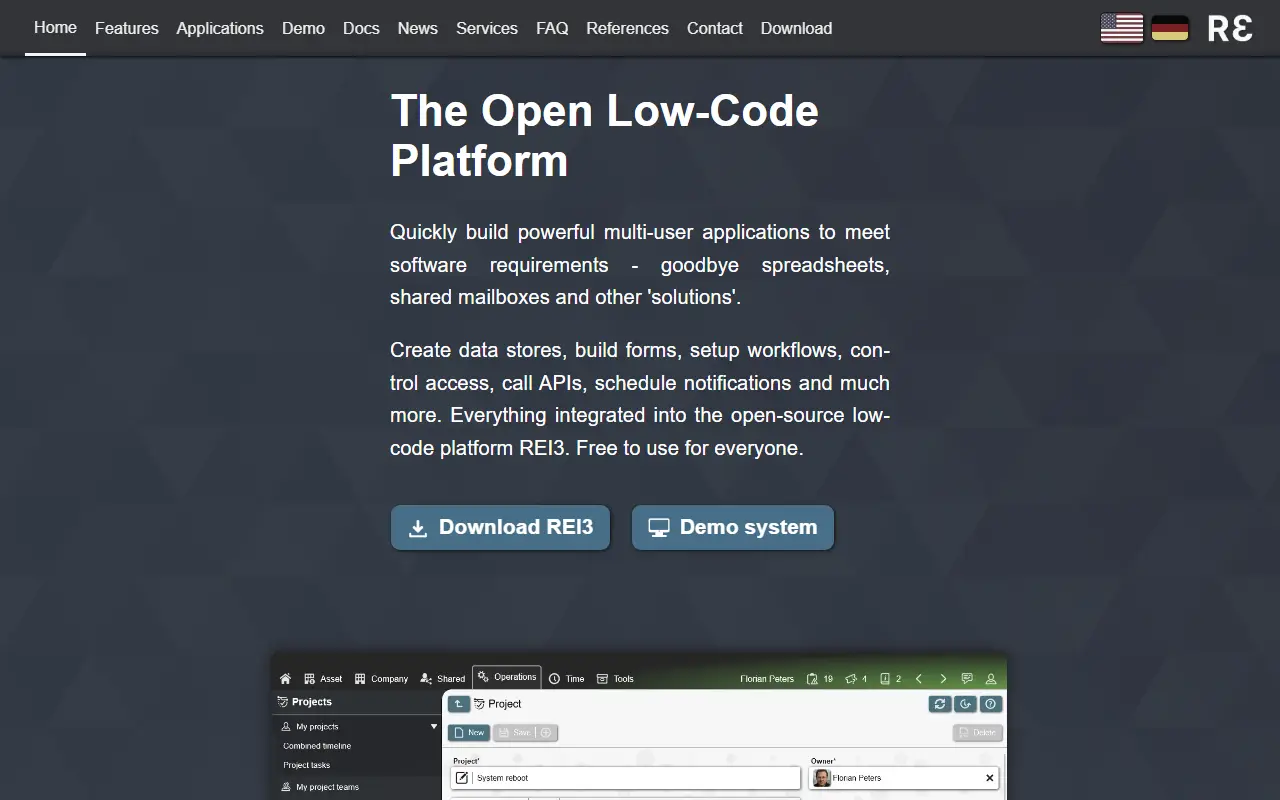
rei3.deREI3 homepage screenshot

REI3 is a free and open low-code platform for building and hosting business applications with full control and ownership. It targets organizations that want to replace spreadsheet-based solutions with proper multi-user apps, run them in the cloud or on-premise, and avoid walled gardens and cloud-only SaaS. Created applications can be used, shared or even sold.

Applications can summarize records, do date calculations and apply business rules, show tasks on Gantt charts, diagrams and dense lists, and include workflows such as forms that change with a record's state, PDF export and notifications. Roles and access policies restrict access globally or per record, and built-in end-to-end encryption comes with key management. Integration options include serving and calling REST endpoints, CSV import and export and ICS calendar access. The platform also covers mobile use with PWA features, full-text search, input types such as signatures and bar or QR code scanning, password policies and brute-force protection.

REI3 is written in Go and JavaScript, uses multi-core processing and bi-directional data channels for speed, and has downloads, documentation, a live demo and a catalog of applications. Its license is listed as Other.

Key features

  • Low-code builder for multi-user business apps
  • Roles and record-level access policies
  • Built-in end-to-end encryption
  • REST, CSV and ICS integration options
  • Gantt charts and diagrams
  • PWA support for mobile use

Pricing: The platform is free and open source for private or commercial use. Enterprise features and support services are available on request, with no prices shown.

Totum

Self-hosted database and spreadsheet hybrid with its own small scripting language for building internal business tools without heavy programming.

GitHub stars
981
Last commit
5 mo ago
Latest release
7.17.63.0
Licence
MIT
Self-hosted
Yes

Totum is a self-hosted platform that combines a database with spreadsheet-like tables. The repository holds the free MIT-licensed community edition of Totum PRO. It comes with a ready-made front end for desktop and mobile, so tables, fields and their settings are created in a browser with the mouse.

Logic is written in Totum code, a small language that lets non-programmers build solutions without knowing SQL. Most codes run to five or ten lines. Some calculate a field value like an Excel formula, others react to changes and run actions, and a third kind controls appearance depending on conditions. Actions are grouped into chains, so an error cancels the whole chain, and concurrent edits to the same table restart the later action.

The README lists example solutions such as production management, cadastre and financial accounting, order management, stocks, CRM and equipment inventory. Access is two-level, split between developer and user, with logging and access rules. Data can be exchanged over an API using JSON via POST, and code can call third-party servers; the API is flagged as PRO only.

Key features

  • Database and spreadsheet hybrid with ready front end
  • Own scripting language called totum code
  • Developers need not know SQL
  • Tables and fields built in the browser with the mouse
  • Actions run in chains that cancel as a whole on error
  • Field types including strings, numbers, dates, trees and charts
  • JSON over POST for data exchange with other systems
  • One-command install on Ubuntu 24.04

Pricing: The Community version of Totum is distributed under an MIT licence and is free for any type of use; the PRO version works without a licence with only the Admin user, and a free PRO licence covers 2 additional users.

Commercial Caspio alternatives

Hosted, closed-source products that compete with Caspio. Showing 12 of 30.

See every Caspio alternative on its tool page

Caspio alternatives: questions

What is the best open-source alternative to Caspio?
NocoBase is the top-ranked open-source alternative to Caspio on Enlisted: An open-source AI and no-code platform for building business systems such as CRMs, internal tools and workflows, where people and coding agents build together. Other strong options are Budibase, REI3 and Totum.
What are the best commercial alternatives to Caspio?
Tadabase, Knack, Quickbase, Zoho Creator and Claris FileMaker are among the hosted, closed-source alternatives to Caspio listed on Enlisted, which lists 30 in total. Compare their pricing and features on each tool page.
Are these Caspio alternatives free?
All 4 are open source, so the code is free to use under its licence, and all of them can be self-hosted on your own server or computer. 1 also offers a paid or managed cloud version if you'd rather not host it yourself.
How is this list of Caspio alternatives ranked?
By a score built from GitHub stars, star growth over the last 30 days and how recently the code changed. 3 of these projects shipped code in the last 30 days. Data is refreshed daily, and nobody can pay to move up.

People also look for alternatives to…

View all