#1
A developer-focused platform for error tracking and performance monitoring that helps teams detect, trace and fix issues, with SDKs for most programming languages.
- GitHub stars
- 46k
- Last commit
- today
- Latest release
- 26.10.1
- Self-hosted
- Yes
- Hosted version
- Available
sentry.io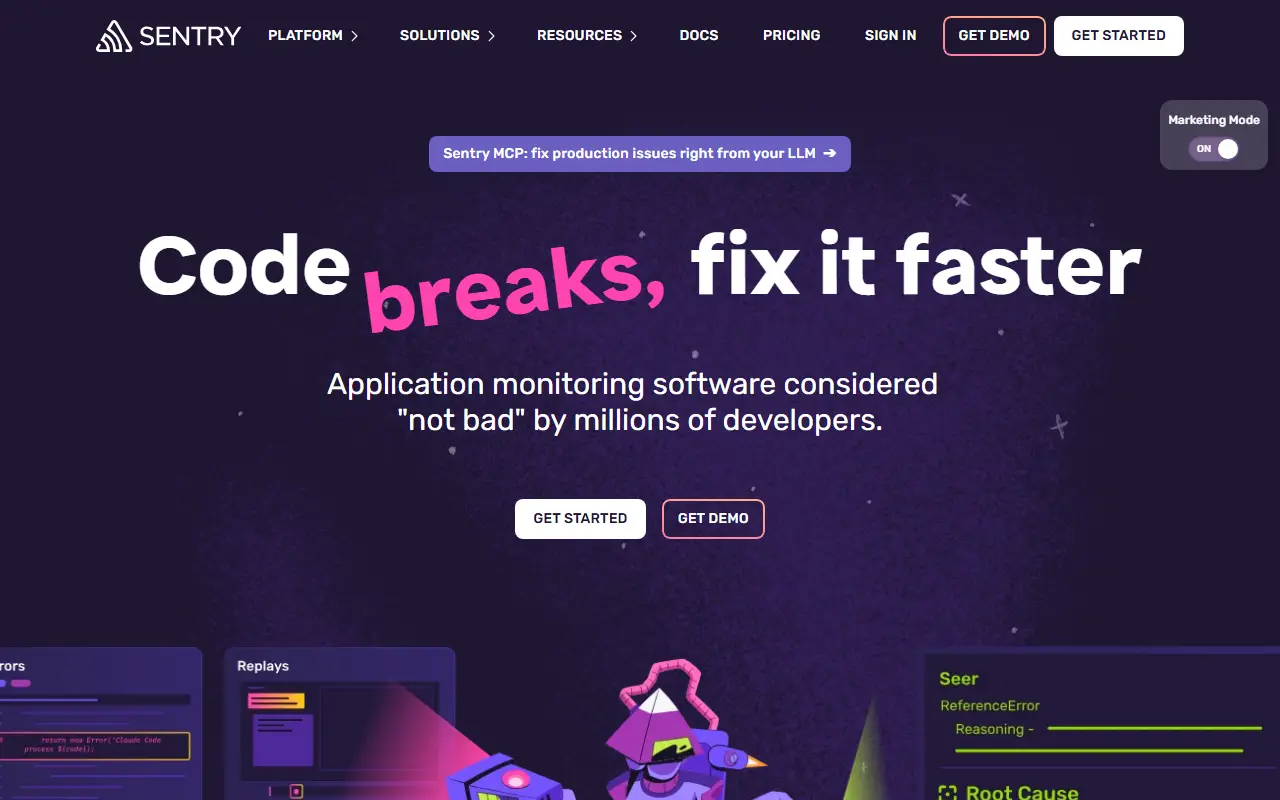
Sentry is a debugging platform that helps developers detect, trace and fix problems in their applications. It collects crash reports and errors from running software, groups them into issues, and adds the context needed to understand what happened, alongside performance monitoring for slow requests and transactions.
Integration happens through official SDKs covering web, mobile, desktop, server and game platforms, from JavaScript, Python and PHP to Go, Rust, Java, Kotlin, Swift, Flutter, Unity, Unreal Engine and Godot. The server itself is a Python application built on Django, and topics also mention CSP report collection and application performance monitoring.
Sentry is source available, and its license is listed as 'Other' on GitHub rather than a standard open-source license. It can be run on your own infrastructure, and the company also operates the hosted service at sentry.io. It is used by engineering teams of all sizes as a first stop when something breaks in production.
Key features
- Error and crash tracking
- Application performance monitoring
- Official SDKs for many languages and frameworks
- Issue grouping with debugging context
- CSP report collection
- Self-hosted or hosted deployment
Pricing: Free Developer plan for one user. Team is $26 per month and Business $80 per month when billed annually, with unlimited users; Enterprise is custom. Usage above the included quota is billed pay-as-you-go.
#2
A self-hosted session replay, cobrowsing and product analytics platform that keeps user session data inside your own infrastructure.
- GitHub stars
- 13k
- Last commit
- yesterday
- Latest release
- v1.28.0
- Self-hosted
- Yes
openreplay.com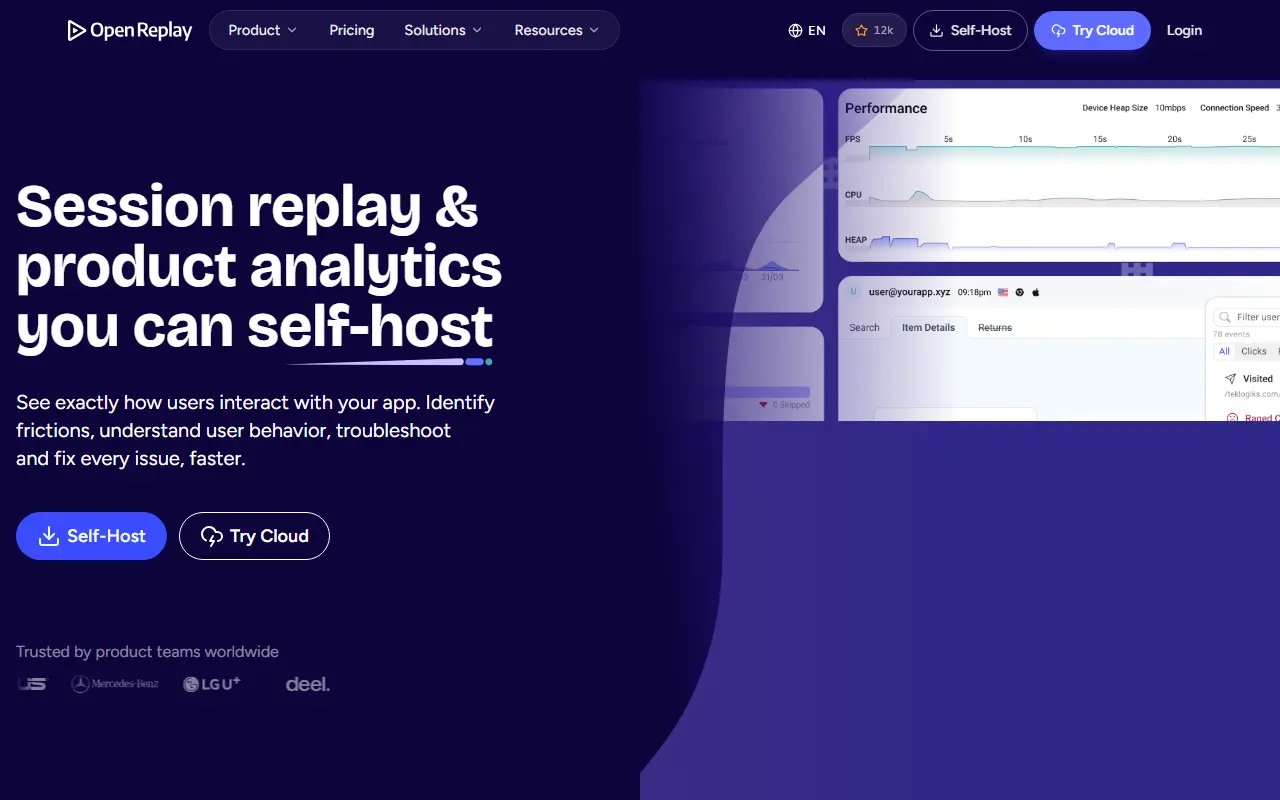
OpenReplay is an open-source experience platform that you host on your own infrastructure. It combines session replay, DevTools-level debugging context, product analytics and live cobrowsing, so teams can see how real users navigate, where they struggle and what errors they hit without sending sessions to a third party.
Because everything stays in your own cloud, it is pitched at teams that cannot hand customer data to an external vendor. Data can be masked, obscured or skipped at capture time before it reaches your servers, and a private mode redacts everything by default. A lightweight tracker sends data asynchronously to limit the impact on page performance, and SDKs cover frameworks such as React, Angular, Vue, Svelte, Next.js and React Native.
The README states it can be self-hosted for free on AWS, GCP, Azure and other platforms. The repository lists its licence as Other and its topics also reference feature flags, web vitals and real-user monitoring, so it spans debugging, product and support use cases.
Key features
- Session replay with search and filtering
- DevTools context for debugging sessions
- Product analytics for usage insights
- Live cobrowsing with users
- Masking and private mode at capture time
- Lightweight asynchronous tracker
- Web and mobile framework SDKs
Pricing: Self-hosting is free. Managed Dedicated instances start from $199 a month (billed hourly) with a 7-day trial; Serverless is usage-based and Enterprise is custom.
#3
An open-source full-stack monitoring platform that combines session replay, error monitoring, logging and distributed tracing, offered hosted or self-hosted.
- GitHub stars
- 9.4k
- Last commit
- 20 days ago
- Latest release
- docker-v0.5.6
- Self-hosted
- Yes
- Hosted version
- Available
app.highlight.io
Highlight, at highlight.io, is an open-source monitoring platform for developers. Its aim is to give teams one cohesive tool covering the front end and back end, instead of separate products for errors, logs and user sessions.
The core features are session replay, error monitoring and logging, with tracing and metrics also in scope. Console logs from the front end can be analyzed, and errors are embedded alongside the session in which they happened, so you can see what the user was doing beforehand. Session comments let teams discuss user frustration or bugs, there are integrations with other tools, and client SDKs install with a few lines of code.
You can sign up for the free-to-start hosted version at app.highlight.io, or deploy a hobby instance on Linux with Docker, sized at roughly 8 GB of memory, four CPUs and 64 GB of storage. The code is written in TypeScript and Go, and the repository lists the license as Other, so check the licence file for terms.
Key features
- Session replay for user interactions
- Error monitoring tied to sessions
- Logging and console log analysis
- Distributed tracing and metrics
- Session comments for team discussion
- Client SDKs for several platforms
- Docker hobby self-hosting
Pricing: A hosted version is free to start; a hobby self-hosted instance is available. The repository lists the license as Other.
Bugsee alternatives: questions
- What is the best open-source alternative to Bugsee?
- Sentry is the top-ranked open-source alternative to Bugsee on Enlisted: A developer-focused platform for error tracking and performance monitoring that helps teams detect, trace and fix issues, with SDKs for most programming languages. Other strong options are OpenReplay and Highlight.io.
- What are the best commercial alternatives to Bugsee?
- Firebase Crashlytics, Marker.io, Raygun, Rollbar and Airbrake are among the hosted, closed-source alternatives to Bugsee listed on Enlisted, which lists 21 in total. Compare their pricing and features on each tool page.
- Are these Bugsee alternatives free?
- All 3 are open source, so the code is free to use under its licence, and all of them can be self-hosted on your own server or computer. 2 also offer a paid or managed cloud version if you'd rather not host it yourself.
- How is this list of Bugsee alternatives ranked?
- By a score built from GitHub stars, star growth over the last 30 days and how recently the code changed. 3 of these projects shipped code in the last 30 days. Data is refreshed daily, and nobody can pay to move up.
 TrackMedia
 TrackRev