7,363 open-source and SaaS tools, with GitHub stats refreshed every day.

4 alternatives ranked by real activity

Open-source Bubble alternatives

A curated, ranked list of the 4 best open-source alternatives to Bubble.

The best open-source alternative to Bubble is NocoBase. If that doesn't suit you, other good options are Magic Cloud, Structr and Noodl.

Bubble alternatives are mainly low-code & internal tools, but some are also AI tools. 3 of them shipped code in the last 30 days, 4 can be self-hosted, and 1 uses a permissive licence.

Last updated October 2, 2026 · ranked by GitHub stars, growth and recent commits

NocoBase

An open-source AI and no-code platform for building business systems such as CRMs, internal tools and workflows, where people and coding agents build together.

GitHub stars
24k
Last commit
2 days ago
Latest release
v2.2.20
Self-hosted
Yes
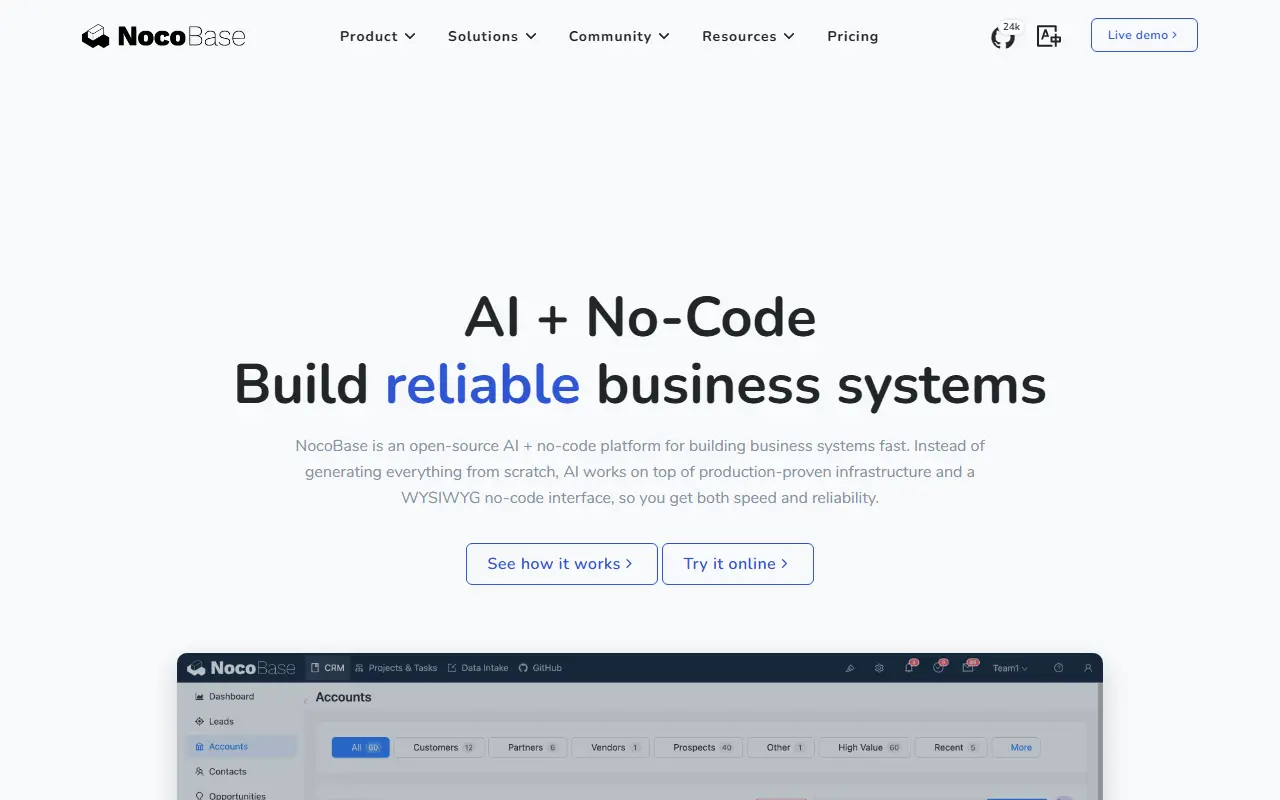
nocobase.comNocoBase homepage screenshot

NocoBase is an open-source platform that combines AI with no-code tooling to build business systems quickly. Rather than having AI generate everything from scratch, it has AI build on infrastructure already proven in production and on a visual WYSIWYG no-code editor, which the project says delivers both speed and reliability.

Its approach is collaborative: coding agents are given a complete CLI plus skills, and people use a visual interface, so both can contribute to the same system. Topics show typical uses such as internal tools, admin dashboards, CRUD apps, CRM, ERP and project management, with workflows included. An online demo, documentation, a forum and customer stories are available, and release notes are published on the blog with weekly summaries. It is written in TypeScript.

NocoBase can be installed on your own infrastructure, and its license is listed as 'Other' on GitHub, so review the terms for commercial or enterprise use. It suits teams that want flexible internal systems without maintaining a large custom codebase, and who want to use AI assistance on a stable foundation.

Key features

  • WYSIWYG no-code interface
  • CLI and skills for coding agents
  • Workflows and CRUD apps
  • Suitable for CRM, ERP and project management
  • Online demo and documentation
  • Install on your own infrastructure

Pricing: The Community Edition is free and open source. Standard is a one-time $800 lifetime license and Professional a one-time $8,000 license, each with one year of upgrades; Enterprise is by contact.

Magic Cloud

Magic turns plain-English descriptions into full-stack apps and AI agents with a database, secure API and MCP server, running on your own hardware.

GitHub stars
1.2k
Last commit
3 days ago
Latest release
v24.0.3
Licence
MIT
Self-hosted
Yes
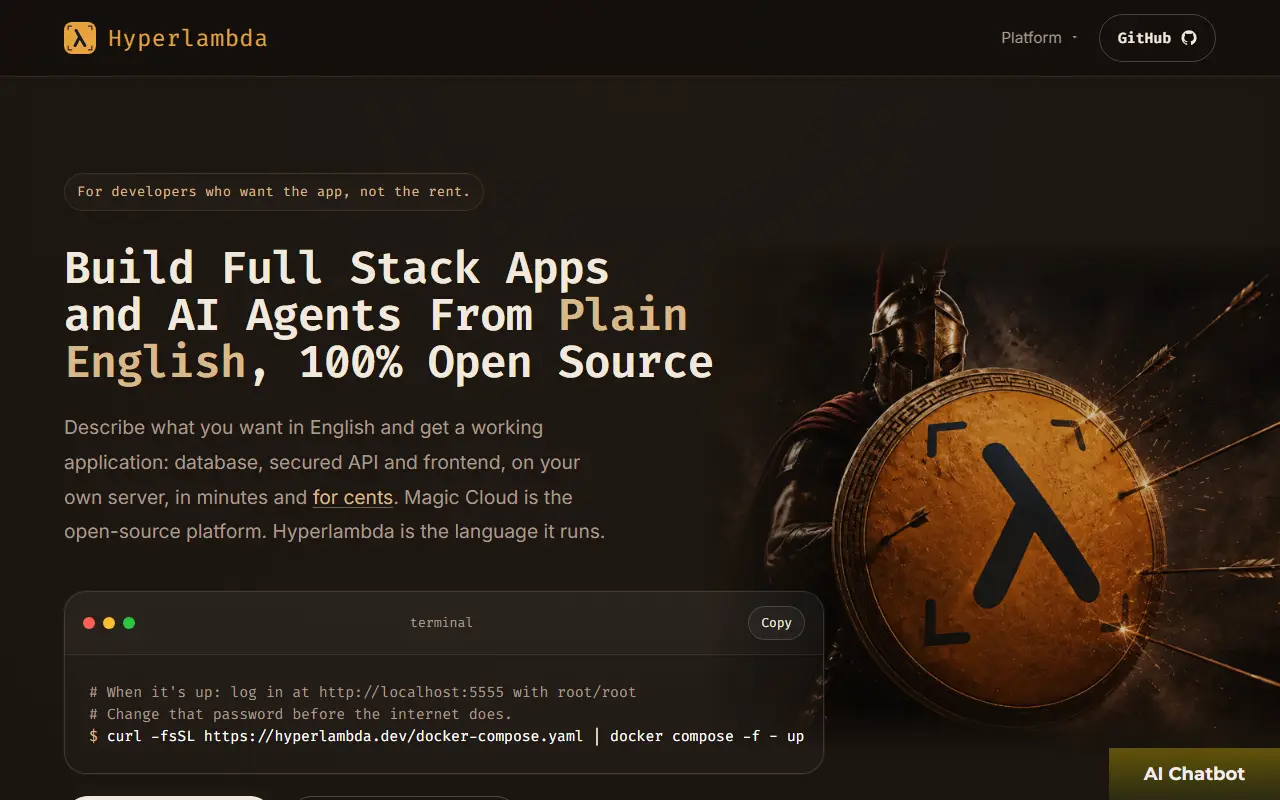
hyperlambda.devMagic Cloud homepage screenshot

Magic is an open-source platform for generating full-stack applications and AI agents from natural language. It produces the database layer, a secured API, business logic and a frontend, and positions itself as an alternative to Lovable, Bolt and Replit that gives you the whole backend on your own hardware without lock-in.

An API wizard can point at an existing MySQL, PostgreSQL, SQL Server or MariaDB database and generate a complete secured REST API, which you can then extend in plain English without a build or deploy step. It can wrap third-party APIs from an OpenAPI or Swagger URL, build database-driven agents behind role-based access control, create embeddable chatbots grounded in crawled website content, run scheduled jobs and serve static sites and single-page apps. An MCP server exposes every endpoint as a tool for Claude, Cursor or Codex.

Magic is built on .NET with the Hyperlambda language and is licensed under MIT. It runs locally in about a minute using Docker, and its stated use cases include CRM systems, admin panels, booking systems and internal tools. It suits developers who want AI-generated apps with a self-hosted, auditable backend.

Key features

  • Natural-language app and API generation
  • API wizard for existing SQL databases
  • MCP server exposing endpoints as tools
  • Database-driven AI agents with RBAC
  • Wrappers for OpenAPI and Swagger APIs
  • Scheduled background jobs

Pricing: The software is free to self-host. Managed cloudlets cost $100 (Professional) or $300 (Enterprise) per month with unlimited users and a 14-day trial; a Managed Services add-on is $3,000 per month.

Structr

Structr is an open-source low-code development and runtime platform built on the Neo4j graph database for custom web apps, backends and integrations.

GitHub stars
828
Last commit
4 days ago
Self-hosted
Yes
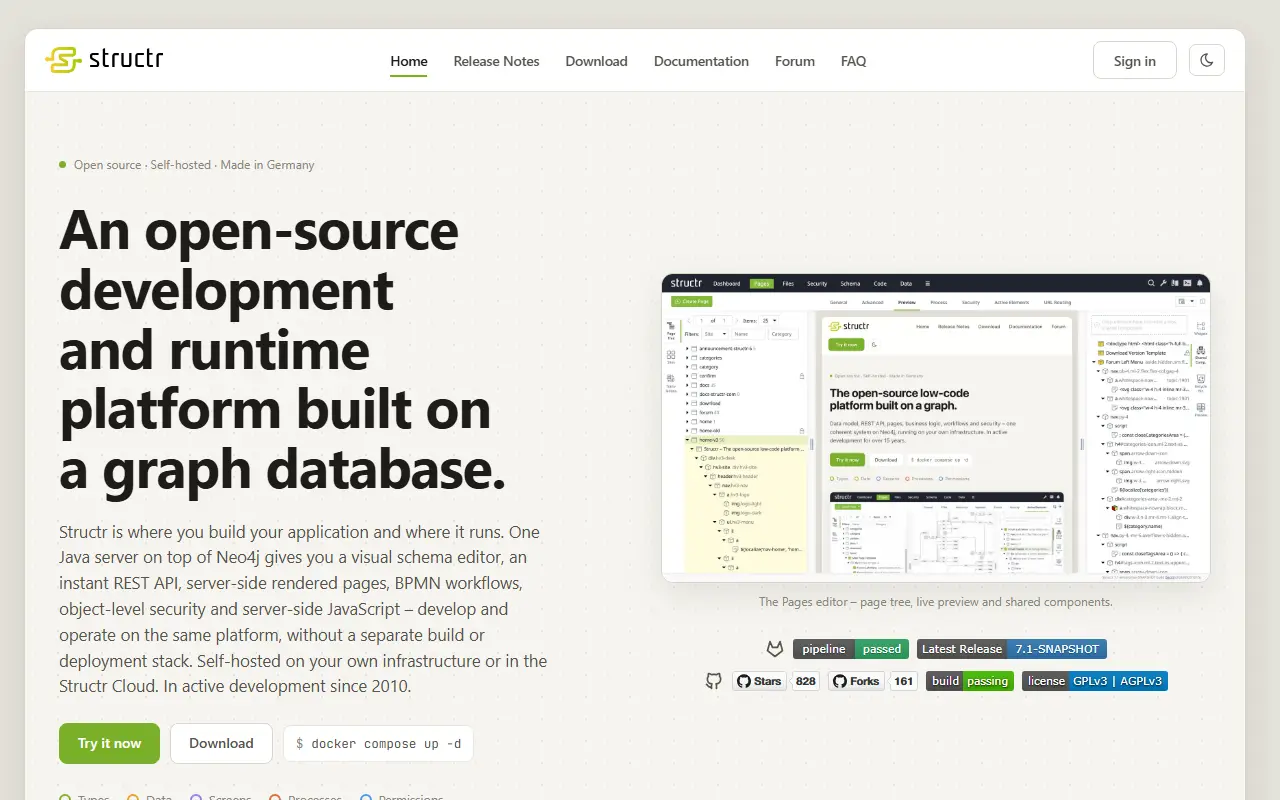
structr.orgStructr homepage screenshot

Structr is a generic low-code development and runtime platform built on graph technology. It is not tied to one use case and is meant for building fully custom applications, including web applications, graph-database-backed back ends, data-centric systems, middleware and integration components.

At its core Structr keeps both application components, such as schema, UI definitions, templates, scripts and workflows, and the application data in a graph database (Neo4j). That gives schema flexibility and expressive data modeling without join-heavy queries, and the schema can be represented as JSON Schema with import and export. A virtual file system manages files with custom metadata and can store binary content on external providers such as S3. Development happens in a web-based developer and admin UI that works as an integrated IDE.

The README is explicit about what Structr is not: it is not a prebuilt CMS, CRM or ERP, a website builder, or an industry template collection, but a set of building blocks for your own applications. The GitHub repository is a clone, and development and issue tracking have moved to gitlab.structr.com. The license is listed as Other, and the topics mention GraalVM polyglot programming.

Key features

  • Graph database storage with Neo4j
  • Web-based developer and admin IDE
  • Schema export and import as JSON Schema
  • Virtual file system with S3 support
  • Low-code builder for backends and web apps
  • Polyglot scripting with GraalVM

Noodl

Noodl is a visual low-code platform where designers and developers build full-stack web applications, with a GPL-licensed editor and MIT runtime.

GitHub stars
552
Last commit
2 yr ago
Latest release
v1.0.1
Licence
GPL-3.0
Self-hosted
Yes
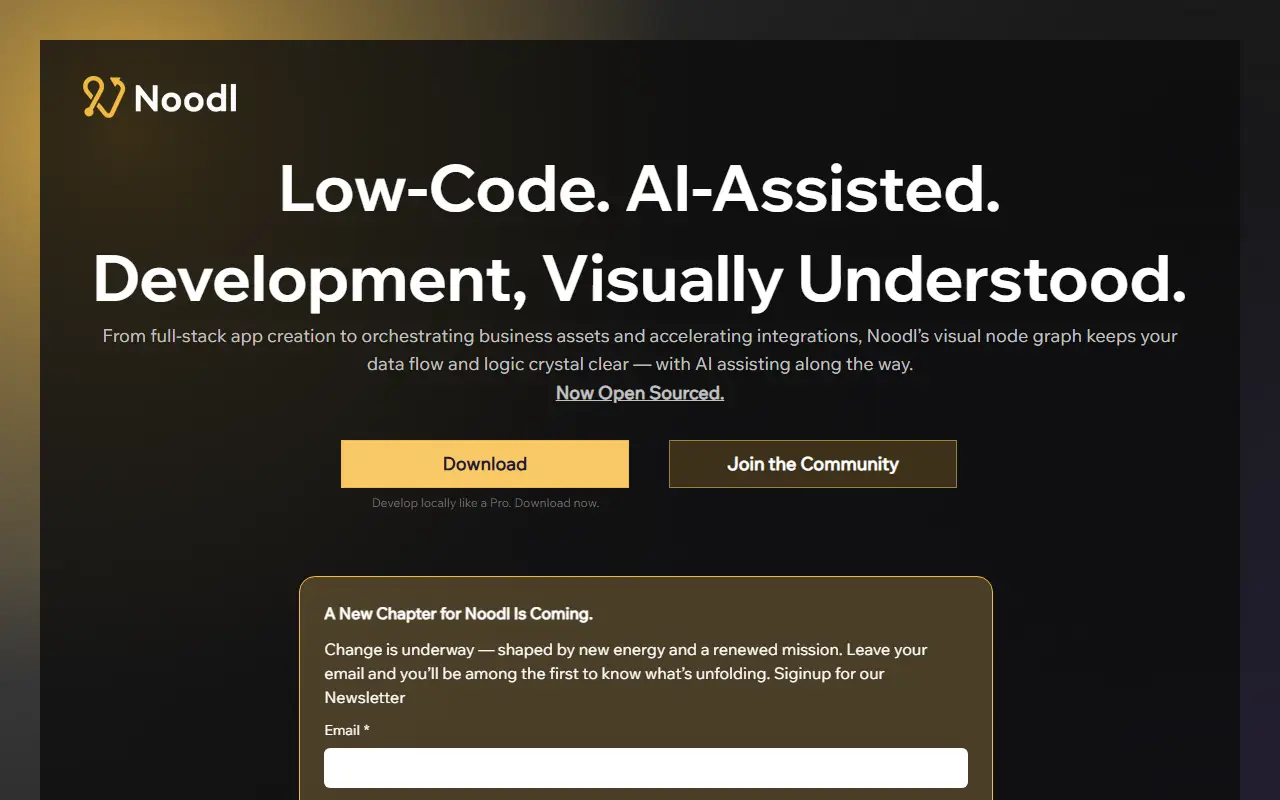
noodl.netNoodl homepage screenshot

Noodl is a low-code platform for creating custom applications and experiences, built as a visual programming environment. It aims to speed up development and lets designers and developers produce apps with minimal coding knowledge.

The repository is the open-source continuation of the formerly closed-source product, with pre-built binaries on GitHub and guidance for migrating projects to a Git provider, moving the backend and database, and self-hosting the frontend. Documentation is available on a docs site and the main support channel is Discord. The editor is built with TypeScript, React and JavaScript.

Licensing is split: editor components are under GPLv3, while the runtime packages used by deployed applications (noodl-runtime, noodl-viewer-cloud and noodl-viewer-react) are under MIT. Source code of applications you create is MIT, so project-specific runtime changes need not be redistributed.

Key features

  • Visual programming environment
  • Full-stack web app building
  • React-based runtime
  • Visual workflows for app logic
  • Self-hostable frontend
  • Pre-built desktop releases

Pricing: Free and open source: editor under GPLv3, runtime packages under MIT.

Bubble alternatives: questions

What is the best open-source alternative to Bubble?
NocoBase is the top-ranked open-source alternative to Bubble on Enlisted: An open-source AI and no-code platform for building business systems such as CRMs, internal tools and workflows, where people and coding agents build together. Other strong options are Magic Cloud, Structr and Noodl.
Are these Bubble alternatives free?
All 4 are open source, so the code is free to use under its licence, and all of them can be self-hosted on your own server or computer.
How is this list of Bubble alternatives ranked?
By a score built from GitHub stars, star growth over the last 30 days and how recently the code changed. 3 of these projects shipped code in the last 30 days. Data is refreshed daily, and nobody can pay to move up.

People also look for alternatives to…

View all