7,363 open-source and SaaS tools, with GitHub stats refreshed every day.

9 alternatives ranked by real activity

Open-source Basedash alternatives

A curated, ranked list of the 9 best open-source alternatives to Basedash.

The best open-source alternative to Basedash is Appsmith. If that doesn't suit you, other good options are ToolJet, Refine, Budibase and Windmill.

Basedash alternatives are mainly low-code & internal tools, but some are also workflow automation tools. 6 of them shipped code in the last 30 days, 9 can be self-hosted, and 4 use a permissive licence.

Last updated October 3, 2026 · ranked by GitHub stars, growth and recent commits

Appsmith

An open-source low-code platform for building admin panels, internal tools and dashboards that connect to more than 25 databases and any API.

GitHub stars
41k
Last commit
yesterday
Latest release
v2.4.3
Licence
Apache-2.0
Self-hosted
Yes
Hosted version
Available
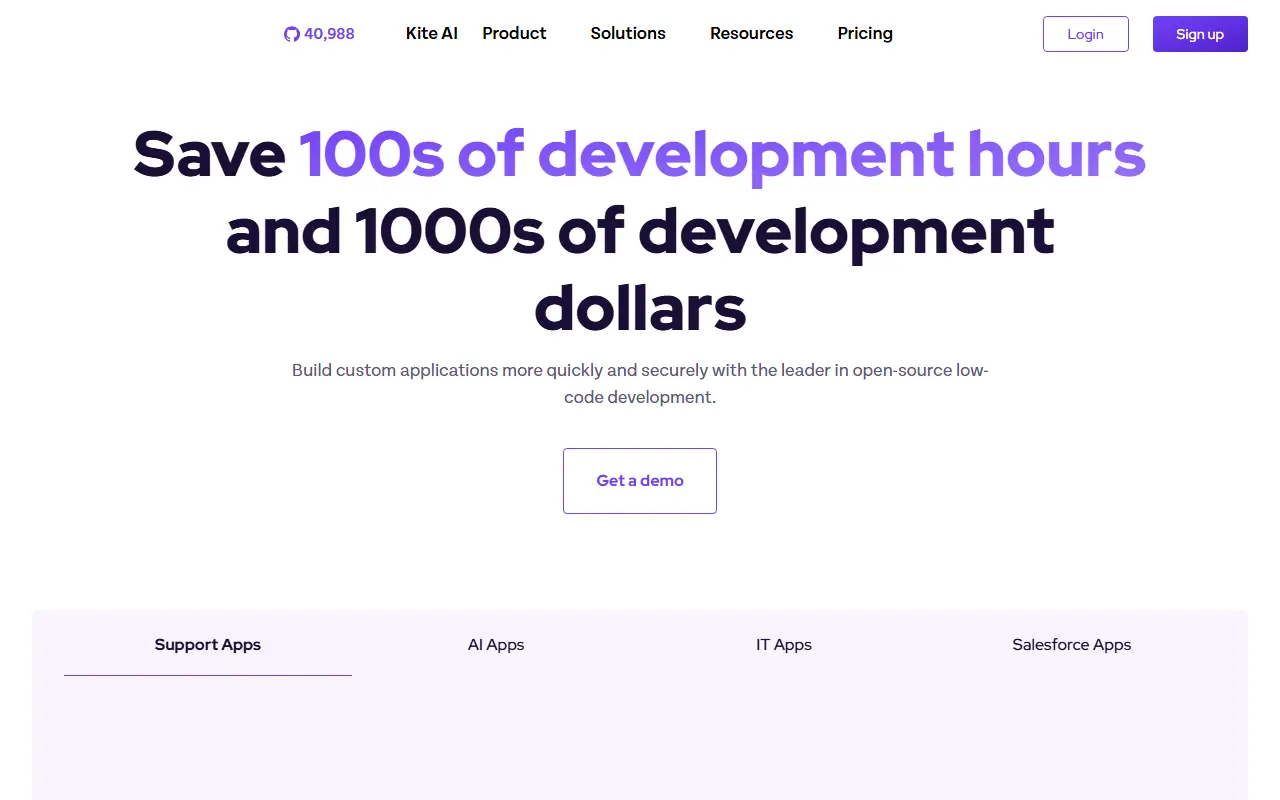
appsmith.comAppsmith homepage screenshot

Appsmith is an open-source low-code platform for building custom internal applications such as dashboards, admin panels, customer 360 views, IT automation and service management tools. It aims to simplify building, deploying and maintaining these apps, which otherwise tend to be tedious to code from scratch.

You assemble interfaces visually and connect them to data through integrations with more than 25 databases and any REST or GraphQL API, with JavaScript available where you need custom logic. Topics also point to CRUD generation, workflows and automation. The front end is built with React and TypeScript, and the server side is mostly Java.

You can sign up for Appsmith Cloud or install it on your own machine, with Docker as the recommended method, plus Kubernetes and an AWS AMI. The code is Apache-2.0 licensed. It is a common choice for engineering teams that want to ship internal tools quickly without maintaining a bespoke front-end codebase.

Key features

  • Visual builder for internal tools
  • Integrates with 25+ databases and any API
  • JavaScript for custom logic
  • Admin panels, dashboards and CRUD apps
  • Docker, Kubernetes and AWS AMI installation
  • Cloud or self-hosted deployment

Pricing: Free for up to 5 cloud users. Business is $15 per user per month with a 15-day trial; Enterprise is listed at $2,500 per month for 100 users. The open-source Community edition is free.

ToolJet

An open-source platform for building internal tools, dashboards and workflows visually or from prompts, with an MCP server so coding agents can build apps.

GitHub stars
41k
Last commit
yesterday
Latest release
v3.20.237-lts
Licence
AGPL-3.0
Self-hosted
Yes
Hosted version
Available
tooljet.comToolJet homepage screenshot

ToolJet is an open-source platform for creating internal software, including admin panels, dashboards and operational apps that sit on top of your existing databases, APIs and SaaS systems. Apps are assembled visually in a builder, so teams can ship tools without writing a full front end.

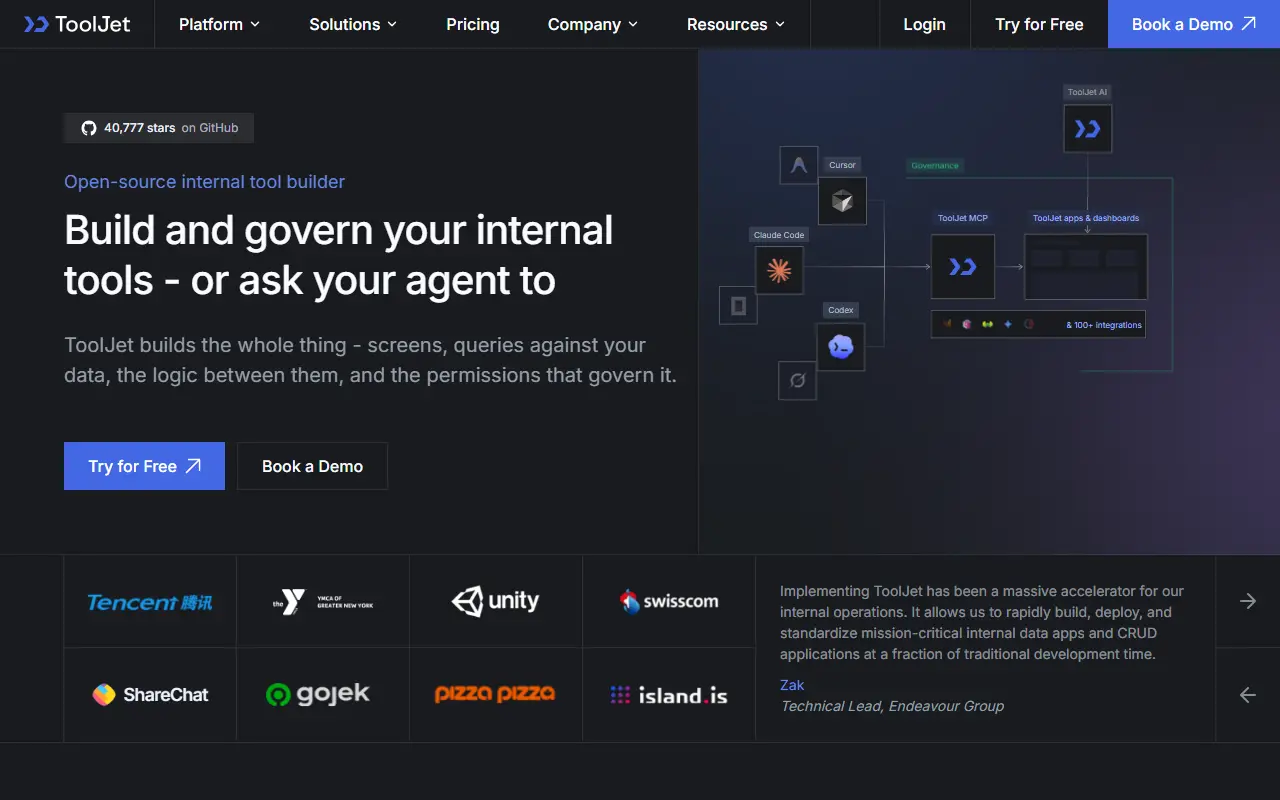
AI plays a large role. ToolJet AI turns a text description into pages, queries and components, and a Model Context Protocol server lets coding agents such as Claude Code and Codex build and modify ToolJet apps directly. Agents work against the platform's real component and data contracts, so the output is an ordinary ToolJet app that the team can keep editing in the visual builder with the same permissions, environments and version history. Workflows and AI agents are part of the offering.

You can self-host ToolJet or use ToolJet Cloud, and the open-source foundation is AGPL-3.0 licensed with a JavaScript and TypeScript codebase. It targets teams that need internal software quickly and want an open-source option with a managed alternative.

Key features

  • Visual builder for internal tools and dashboards
  • AI generation of pages, queries and components
  • MCP server for coding agents
  • Permissions, environments and version history
  • Workflows and AI agents
  • Self-hosted or ToolJet Cloud

Pricing: A free plan covers 2 builders. Paid plans are priced per builder per month: Basic $29, Pro $99 and Team $249 on monthly billing, with 20% off annually; Enterprise is custom.

Refine

A headless React framework for creating internal tools, back-office admin panels, dashboards and B2B apps, with pluggable data, auth and UI integrations.

GitHub stars
36k
Last commit
23 days ago
Latest release
@refinedev/core@5.0.12
Licence
MIT
Self-hosted
Yes
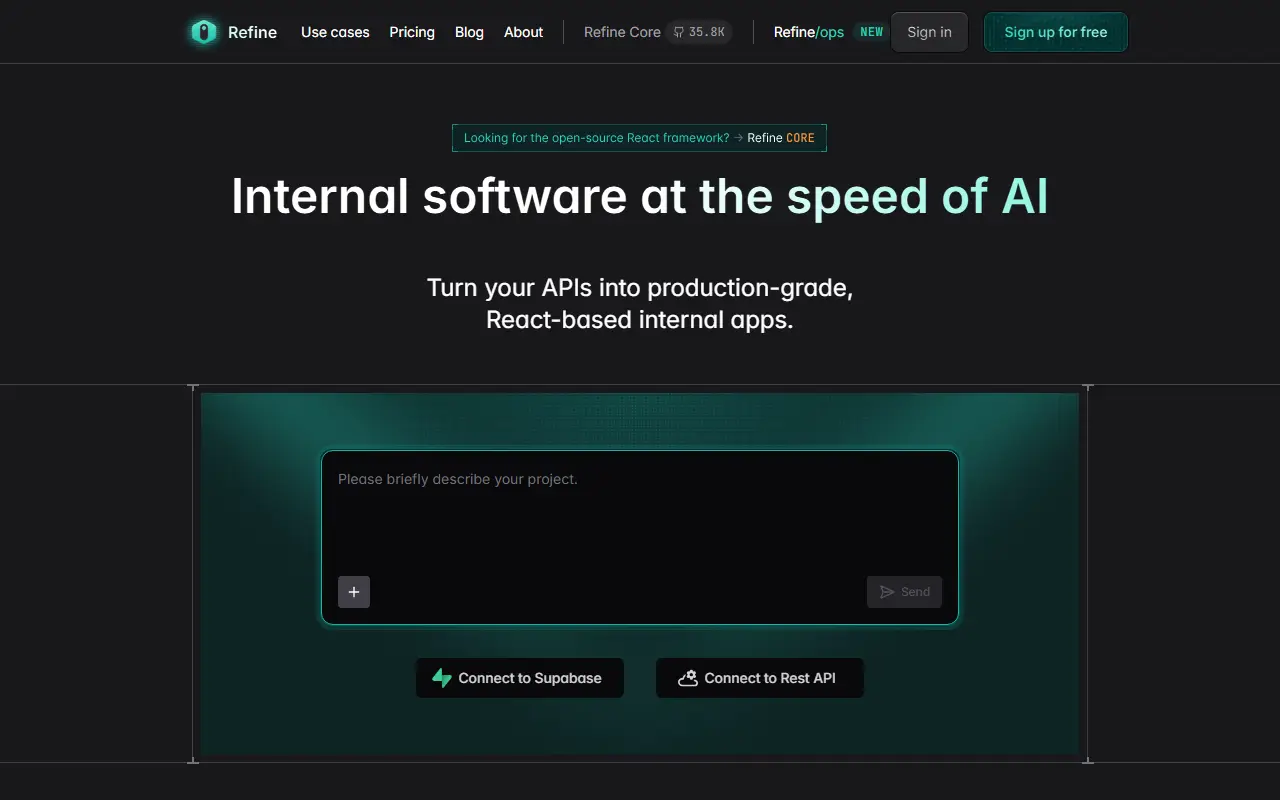
refine.devRefine homepage screenshot

Refine is a React-based framework aimed at internal tools, admin panels, dashboards and business-to-business applications. It is described as headless, meaning it provides the logic for data fetching, routing, authentication and other CRUD concerns through hooks and components while leaving the visual layer to the UI library you prefer.

Its topics reference Ant Design, GraphQL, NestJS and Next.js, which reflects the range of UI kits, data sources and runtimes it can be paired with. Because it builds on plain React, teams can use it as a low-code accelerator for common admin screens while still writing normal TypeScript where they need custom behavior.

Refine is MIT licensed and distributed as npm packages, with the core published as @refinedev/core. It runs inside your own project, so there is nothing to host separately. It suits front-end teams who are tired of hand-building the same tables, forms and permissions in every back-office project.

Key features

  • Headless React hooks for CRUD operations
  • Data provider abstraction for APIs and GraphQL
  • Authentication and access control hooks
  • Works with Ant Design and other UI libraries
  • Integration with Next.js apps
  • Written in TypeScript

Pricing: Refine's credit-based AI plans: Starter is $0.99 a month for 300 credits and Pro is $20 a month for 1,500 credits; Enterprise is quoted on request.

Budibase

An open-source, model-agnostic operations platform for building AI agents, automations and internal apps that connect to your business systems.

GitHub stars
28k
Last commit
yesterday
Latest release
v3.47.0
Self-hosted
Yes
Hosted version
Available
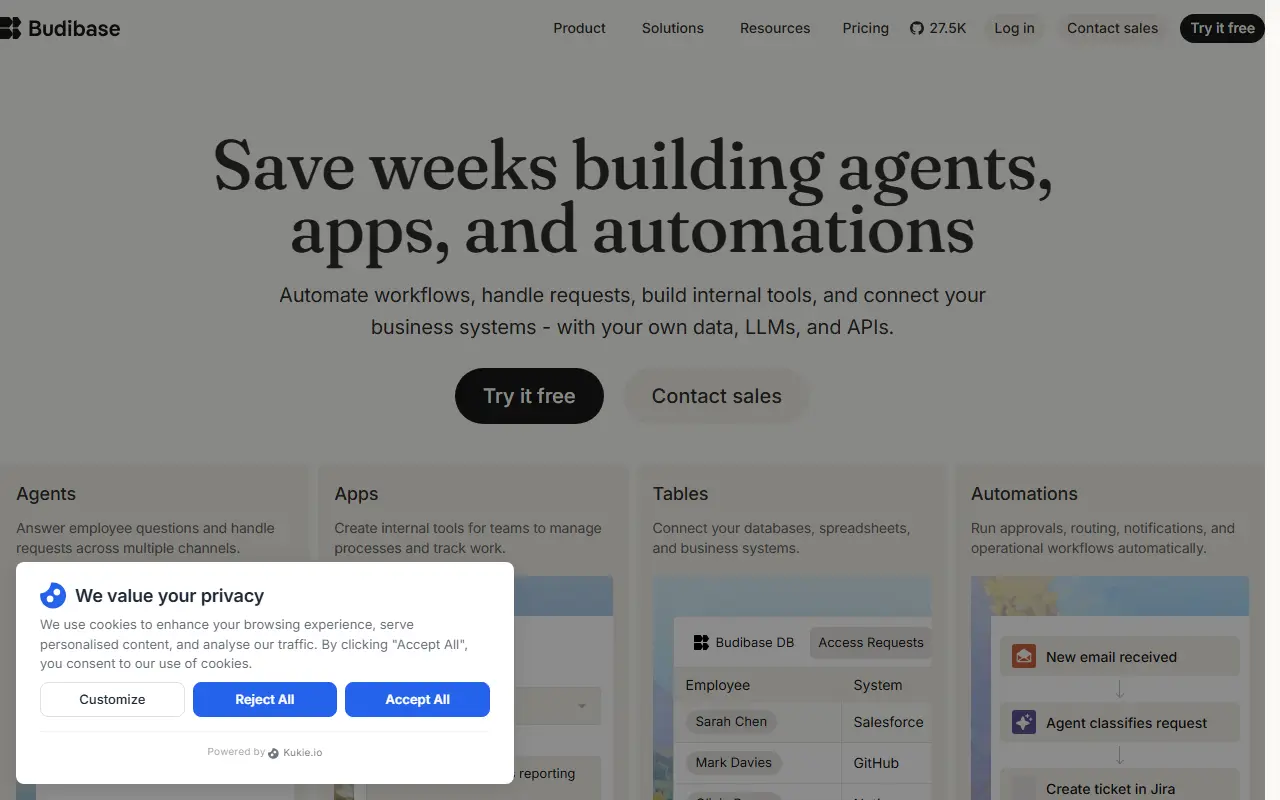
budibase.comBudibase homepage screenshot

Budibase is an open-source operations platform for building AI agents, automations and apps that run internal processes. It is model agnostic and describes itself as saving engineers many hours when building these tools, while handling security concerns. Topics place it in the low-code and no-code internal tools space, with CRUD apps and an SQL GUI.

The idea is to run requests, approvals and workflows on one platform instead of stitching several tools together. Staff constantly ask questions, request sign-offs and flag problems, and Budibase agents interpret those requests and carry out the work: creating records, sending approvals to the right people, updating apps and alerting teams. You connect the business systems your operations already rely on, and the platform also supports building data applications over databases and REST APIs.

You can use Budibase Cloud, where the vendor hosts it, or host it yourself with Docker, Kubernetes or DigitalOcean. The repository is written in TypeScript, and its license is listed as 'Other' on GitHub, so check the terms for enterprise features. It suits operations and engineering teams that want internal tools and AI automation without building everything from scratch.

Key features

  • AI agents that run workflows
  • Internal app builder for CRUD tools
  • Automations connecting business systems
  • Works with any AI model
  • Self-host with Docker or Kubernetes
  • Budibase Cloud hosting

Pricing: The open-source edition is free to self-host. Cloud plans are Pro $19, Premium $49 and Business $299 per month, each with a 14-day trial; Enterprise is custom and quoted through sales.

Windmill

An open-source developer platform that turns scripts into APIs, background jobs, workflows and auto-generated UIs, positioned against Retool, Pipedream and Temporal.

GitHub stars
18k
Last commit
yesterday
Latest release
v1.821.0
Self-hosted
Yes
Hosted version
Available
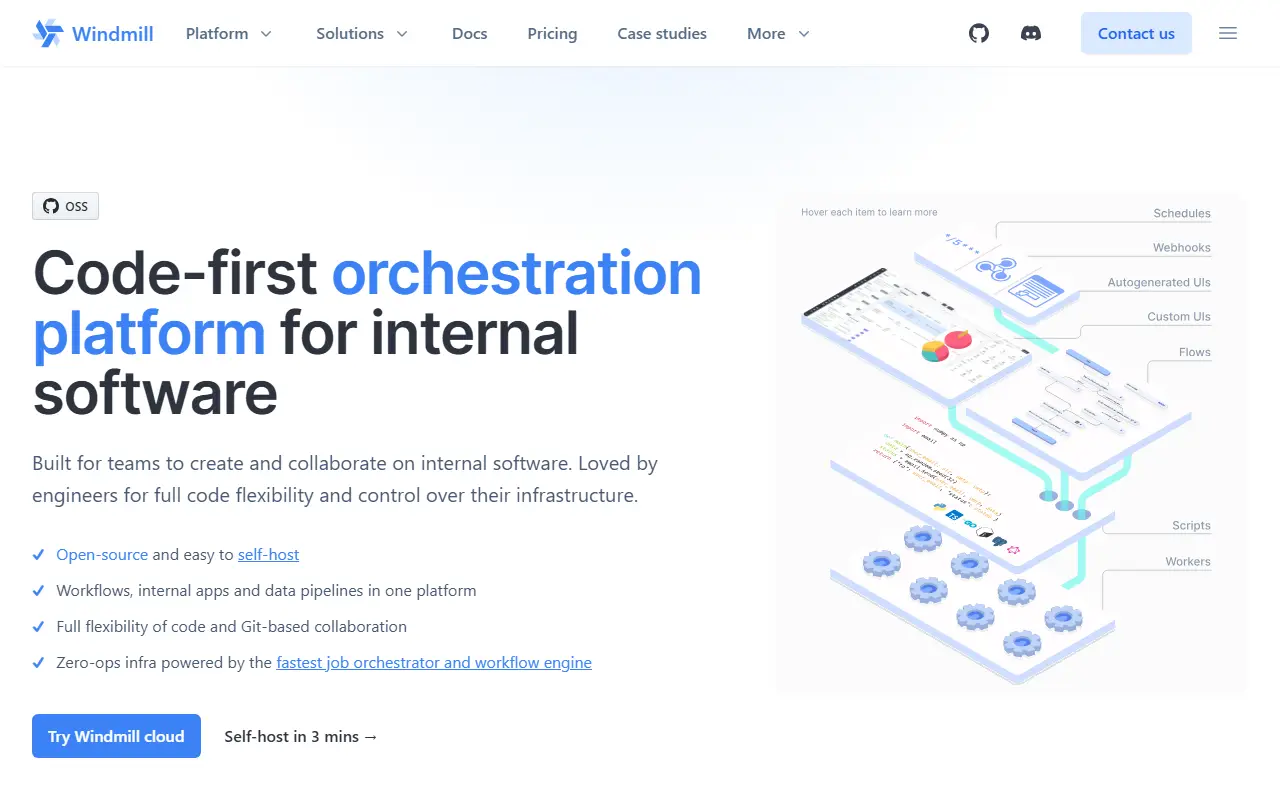
windmill.devWindmill homepage screenshot

Windmill is an open-source platform for developers to run internal code as APIs, background jobs, workflows and user interfaces. It is pitched as a self-hostable alternative to Retool, Pipedream and Superblocks and as a simplified version of Temporal, and it automatically generates UIs so a script can be shared and triggered as an internal app.

Scripts can be written in languages including Python, TypeScript, Go, Bash, SQL, PowerShell, Rust and GraphQL. They can be composed into flows or used within richer apps built with its low-code builder. The backend is written in Rust on PostgreSQL, and the README describes it as a very fast self-hosted workflow engine, citing a comparison with Airflow. Sections of its documentation cover main concepts, local development, architecture, security, performance and self-hosting with Docker Compose.

Windmill is open source under AGPLv3, and Windmill Labs sells dedicated instances, commercial support and licenses, so the repository license is listed as 'Other' on GitHub. It suits engineering teams that want to turn existing scripts into reliable internal tools and automations without building each interface by hand.

Key features

  • Scripts turned into APIs and auto-generated UIs
  • Multi-language support including Python and TypeScript
  • Workflows composed from scripts
  • Low-code builder for internal apps
  • Rust workflow engine on PostgreSQL
  • Self-hosting with Docker Compose

Pricing: The Community Edition is free to self-host. Team is $10 per seat per month; Enterprise is $20 per developer and $10 per operator per month, with a one-month trial.

Lowdefy

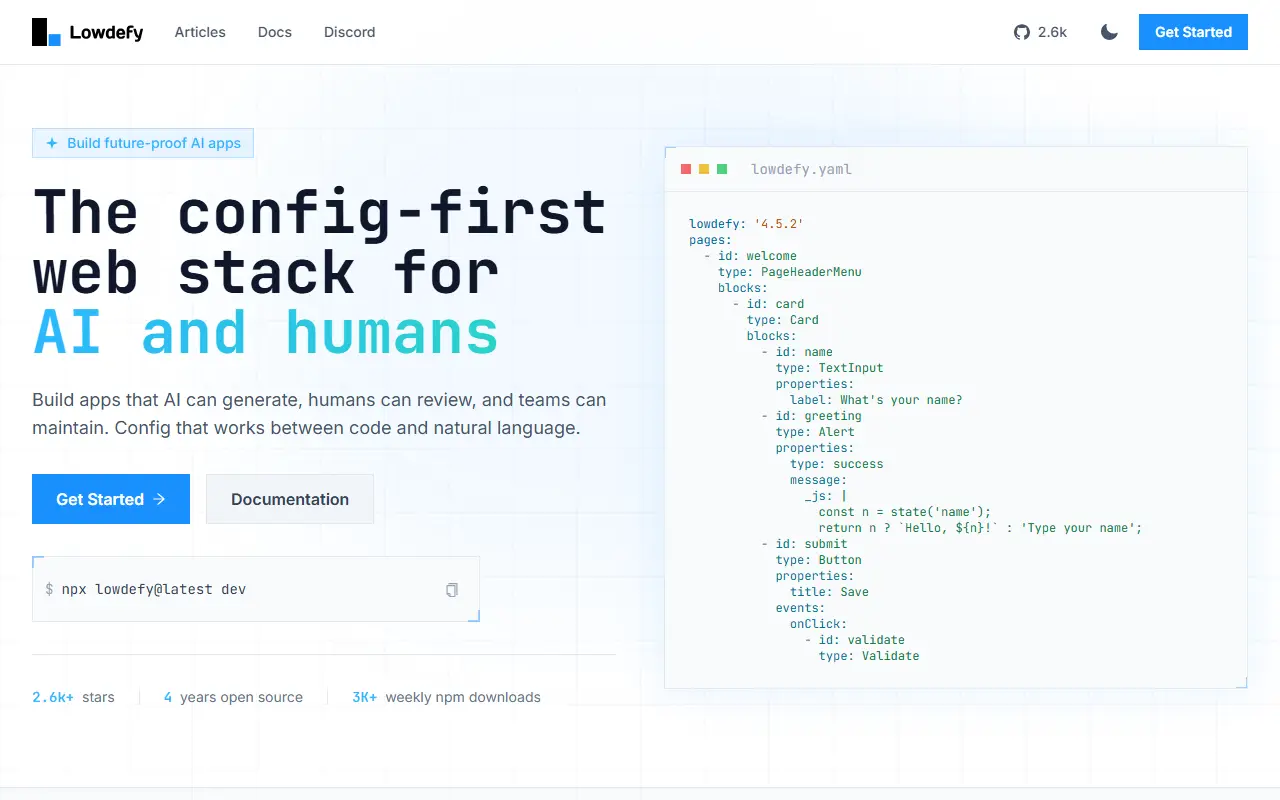
Config-first web stack for building internal tools, admin panels, and dashboards from YAML configuration instead of hand-written front-end code.

GitHub stars
3k
Last commit
yesterday
Latest release
v6.1.0
Licence
Apache-2.0
Self-hosted
Yes
lowdefy.comLowdefy homepage screenshot

Lowdefy is an open-source framework for building web apps from configuration files rather than code. Its pitch is that concise, schema-validated config is easier for both people and AI tools to generate, review, and maintain than thousands of lines of generated React. It is released under the Apache-2.0 license.

Apps are described in YAML, and the runtime interprets the config instead of executing arbitrary code, with authentication, permissions, and data validation built in. The framework includes over 70 UI components such as forms, tables, charts, and markdown, more than 50 logic operators for dynamic behavior, and over 10 data connectors including MongoDB, PostgreSQL, MySQL, REST APIs, Google Sheets, and S3.

It is built on Hono, Vite, and Auth.js and can be deployed anywhere Node.js runs. A framework update upgrades every app at once, which the authors present as a maintenance benefit. It suits teams building CRUD apps, admin panels, dashboards, and workflow tools who want something between a low-code platform and a custom codebase.

Key features

  • YAML configuration instead of front-end code
  • 70+ built-in UI components
  • 50+ logic operators for dynamic pages
  • Connectors for MongoDB, PostgreSQL, MySQL, and REST
  • Built-in authentication and permissions
  • Deployable anywhere Node.js runs

Pricing: Free and open source under the Apache-2.0 license.

Motor Admin

Rails engine that adds a low-code admin panel and SQL-based business intelligence, configured from a settings UI rather than code.

GitHub stars
839
Last commit
8 mo ago
Latest release
0.4.27
Licence
MIT
Self-hosted
Yes

Motor Admin is a Rails engine that provides a low-code admin panel and business intelligence tools for a Rails application. Everything can be configured from a settings interface with no DSL, and it is presented as a modern alternative to Rails Admin, Active Admin and Blazer. It is aimed at Rails teams who want internal tools and dashboards quickly without hand-coding screens.

Features include customizable CRUD, custom actions through Active Record method calls or API endpoints, virtual attributes, a forms builder, SQL queries with embedded variables, data visualization and dashboards, email alerts, authorization, Active Storage support, search, internationalization, a mobile-friendly layout, configuration sync between environments, authentication, multiple databases, audit logs, collaboration notes and personalized report alerts via Slack. Resource pages can show data from SQL queries and attached dashboards.

The engine is installed by adding a gem and running a migration. The core is MIT licensed, and a Pro edition adds white-label styling and logos, multi-factor authentication and SSO or SAML. A demo app is available for trying it out.

Key features

  • Admin panel configured from a settings UI
  • SQL queries, charts and dashboards
  • Custom actions and virtual attributes
  • Forms builder
  • Email and Slack alerts
  • Audit log and authorization
  • Pro: white label, MFA and SSO

Pricing: Core engine is free under MIT. A Pro edition adds white labeling, multi-factor authentication and SSO or SAML; see the vendor for pricing.

Openblocks

Openblocks is an AGPL-licensed, open-source internal tools builder positioned as an alternative to Retool, with a visual UI builder and native database connections.

GitHub stars
6.2k
Last commit
2 yr ago
Latest release
v1.1.8
Licence
AGPL-3.0
Self-hosted
Yes
Hosted version
Available

Openblocks is an open-source platform for building internal and customer-facing applications, positioned as an alternative to Retool. It targets teams that need to connect to data sources and assemble working apps quickly without designing a custom interface and wiring together multiple languages and frameworks from scratch.

It provides a visual UI builder with more than 50 components, a module and query library for reusable pieces, and native connections to PostgreSQL, MongoDB, MySQL, Redis, Elasticsearch, REST APIs and SMTP, with JavaScript usable throughout for transforming data and controlling components. Custom components can be shared through React and the Openblocks SDK, or whole Openblocks pages can be embedded as a React component. Team features include role-based access control, autosaved and restorable version history, DIY app theming, and audit logs for compliance tracking.

Openblocks is written in TypeScript and React and is released under the AGPL-3.0 license, so it can be self-hosted. A cloud-hosted version is also available at cloud.openblocks.dev. The README includes direct feature comparisons against other low-code tools in its space.

Key features

  • Visual UI builder with 50-plus components
  • Native connections to Postgres, MongoDB, MySQL and more
  • Reusable module and query library
  • Role-based access control
  • Version history with autosave
  • Audit logs for compliance

Pricing: Free and open source under the AGPL-3.0 license, self-hostable; a cloud-hosted version is also available.

DashPress

DashPress is a free, AGPL-licensed, open-source admin app generator that turns an existing database schema into a customizable admin dashboard without writing code.

GitHub stars
1.9k
Last commit
1 yr ago
Licence
AGPL-3.0
Self-hosted
Yes

DashPress is an admin app generator aimed at developers who want to produce a working admin dashboard from an existing database schema quickly, without hand-coding CRUD screens for every table. It transforms the schema directly into a sleek, customizable and performant admin interface.

It can be run instantly with a single npx dashpress command, pointing it at an existing database to generate the admin app, with a Docker-based setup also available through an example Dockerfile in the repository. A public demo at demo.dashpress.io shows an example admin app generated this way without writing a line of code.

DashPress is written in TypeScript with Node.js and React, and is released under the GNU Affero General Public License v3.0, so self-hosted deployments remain subject to that copyleft license. The README states the project follows good security practices but offers no warranty, and provides a community Discord, Twitter and GitHub Discussions for support.

Key features

  • Generates an admin dashboard from a database schema
  • No-code setup via a single CLI command
  • Docker deployment option
  • Customizable, performant admin UI
  • React and Node.js based architecture

Pricing: Free and open source under the AGPL-3.0 license.

Basedash alternatives: questions

What is the best open-source alternative to Basedash?
Appsmith is the top-ranked open-source alternative to Basedash on Enlisted: An open-source low-code platform for building admin panels, internal tools and dashboards that connect to more than 25 databases and any API. Other strong options are ToolJet, Refine, Budibase and Windmill.
Are these Basedash alternatives free?
All 9 are open source, so the code is free to use under its licence, and all of them can be self-hosted on your own server or computer. 5 also offer a paid or managed cloud version if you'd rather not host it yourself.
How is this list of Basedash alternatives ranked?
By a score built from GitHub stars, star growth over the last 30 days and how recently the code changed. 6 of these projects shipped code in the last 30 days. Data is refreshed daily, and nobody can pay to move up.

People also look for alternatives to…

View all