#1
A self-hosted photo and video library with mobile auto-backup, face and object search, shared albums and multi-user support, often used in place of Google Photos.
- GitHub stars
- 119k
- Last commit
- today
- Latest release
- v3.4.1
- Licence
- AGPL-3.0
- Self-hosted
- Yes
immich.app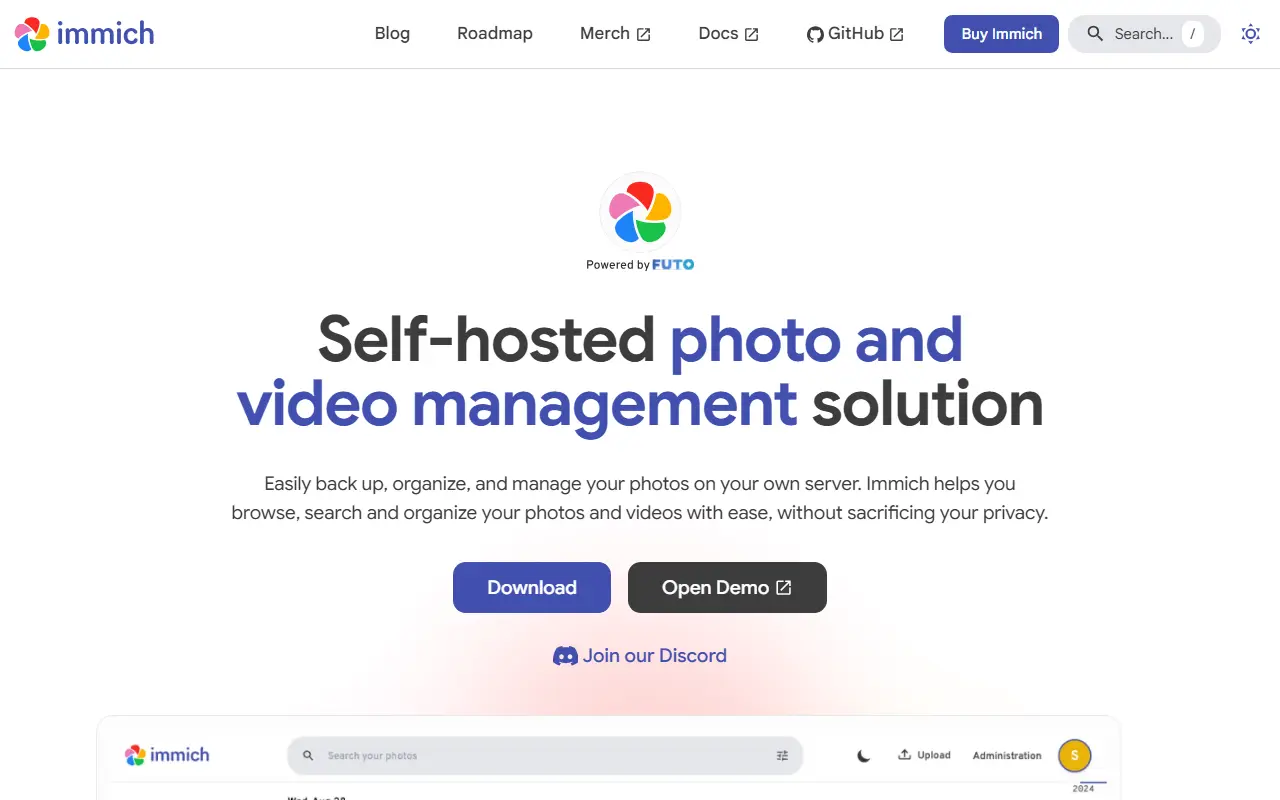
Immich is a self-hosted photo and video management server with companion mobile apps and a web interface. Your media stays on hardware you control while you still get automatic phone backup, a timeline view, albums and sharing, which is the role many people otherwise hand to Google Photos.
Search works on metadata, recognized objects, faces and CLIP-based natural language queries, and face recognition groups people into clusters. Other features include shared albums and partner sharing, a global map, memories, archive and favorites, RAW format support, LivePhoto and MotionPhoto handling, duplicate prevention, OAuth login, API keys and a user-defined storage structure. Background backup and selective album backup keep the mobile app flexible.
Immich is released under AGPL-3.0, and its documentation includes installation guides, a roadmap and a public demo. The maintainers stress following a 3-2-1 backup plan, since a self-hosted library is only as safe as the backups behind it. It suits households and small groups who want private, searchable photo storage.
Key features
- Automatic photo and video backup from mobile
- Face recognition and people clustering
- Search by metadata, objects and CLIP
- Shared albums and partner sharing
- Multi-user support with OAuth login
- RAW, LivePhoto and MotionPhoto support
- Global map and memories views
Pricing: Free and open source under AGPL-3.0; you run it on your own hardware.
#2
Ente is an open-source, end-to-end encrypted cloud for photos, 2FA codes and documents, with apps for mobile, web and desktop.
- GitHub stars
- 30k
- Last commit
- yesterday
- Latest release
- ente-cli-v0.4.4
- Licence
- AGPL-3.0
- Self-hosted
- Yes
- Hosted version
- Available
ente.com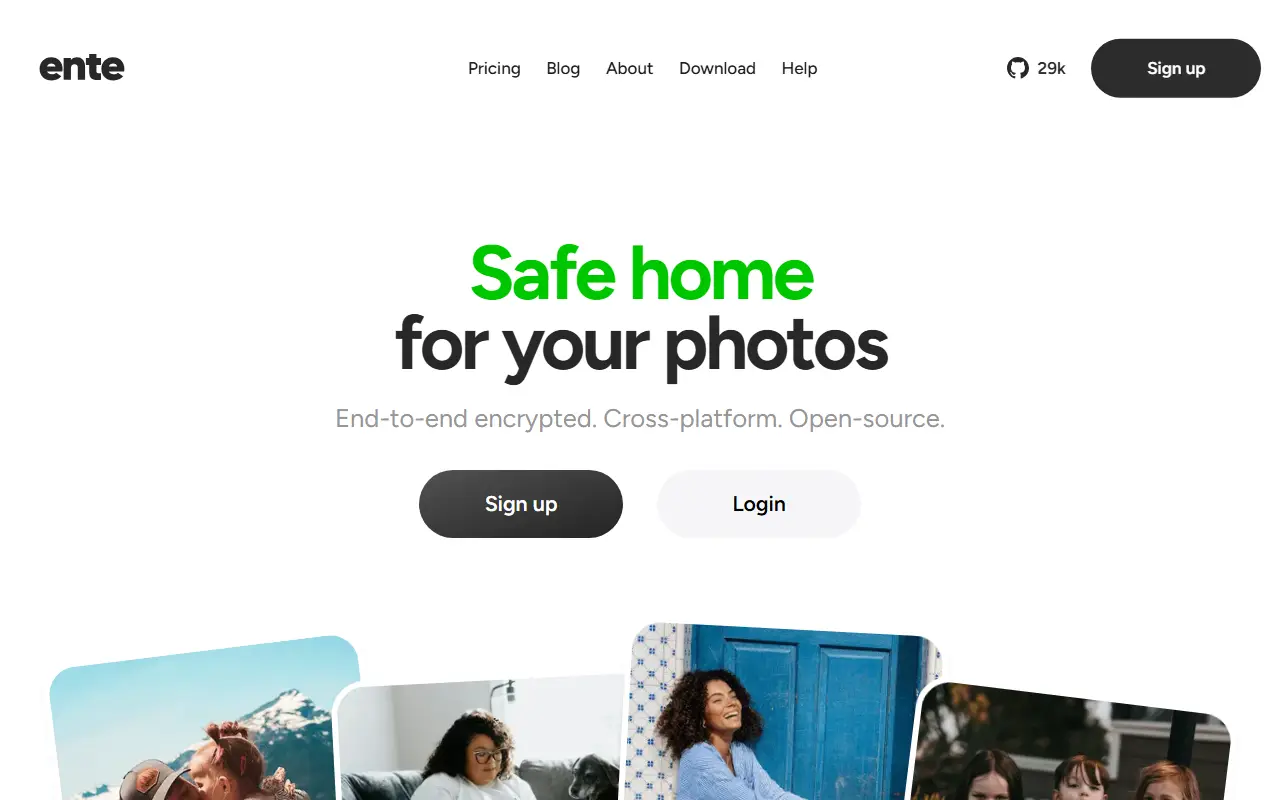
Ente is a service built on an open-source, end-to-end encrypted platform that lets you keep data in the cloud without having to trust the provider. Three apps run on it: Ente Photos, an alternative to Google Photos and Apple Photos; Ente Locker, for important documents and credentials; and Ente Auth, a two-factor authentication app positioned as a replacement for Authy. The monorepo contains the clients and the server.
Ente Photos includes triple data replication, face detection, semantic search, private sharing, collaborative albums, family plans, background uploads and straightforward import and export, all encrypted across platforms. Clients exist for iOS, Android, F-Droid, web, Linux, macOS and Windows, built with Flutter, Go and TypeScript. The README says the source code and cryptography have had external audits. The server can be self-hosted, and the code is under the AGPL-3.0 license.
Key features
- End-to-end encrypted photo storage and backup
- Authenticator app for two-factor codes
- Locker for documents and credentials
- Face detection and semantic photo search
- Private sharing and collaborative albums
- Apps for mobile, web and desktop
Pricing: A free plan includes 10 GB. Paid storage plans cost $4.99 per month for 200 GB, $9.99 for 1000 GB and $19.99 for 2000 GB, with a smaller 50 GB Starter tier and annual billing also offered.
#3
An AI-powered, privacy-first photo app for browsing, organizing and sharing pictures and videos, running self-hosted or in the cloud with a PWA interface.
- GitHub stars
- 40k
- Last commit
- yesterday
- Latest release
- 261029-963b58c50
- Self-hosted
- Yes
- Hosted version
- Available
photoprism.app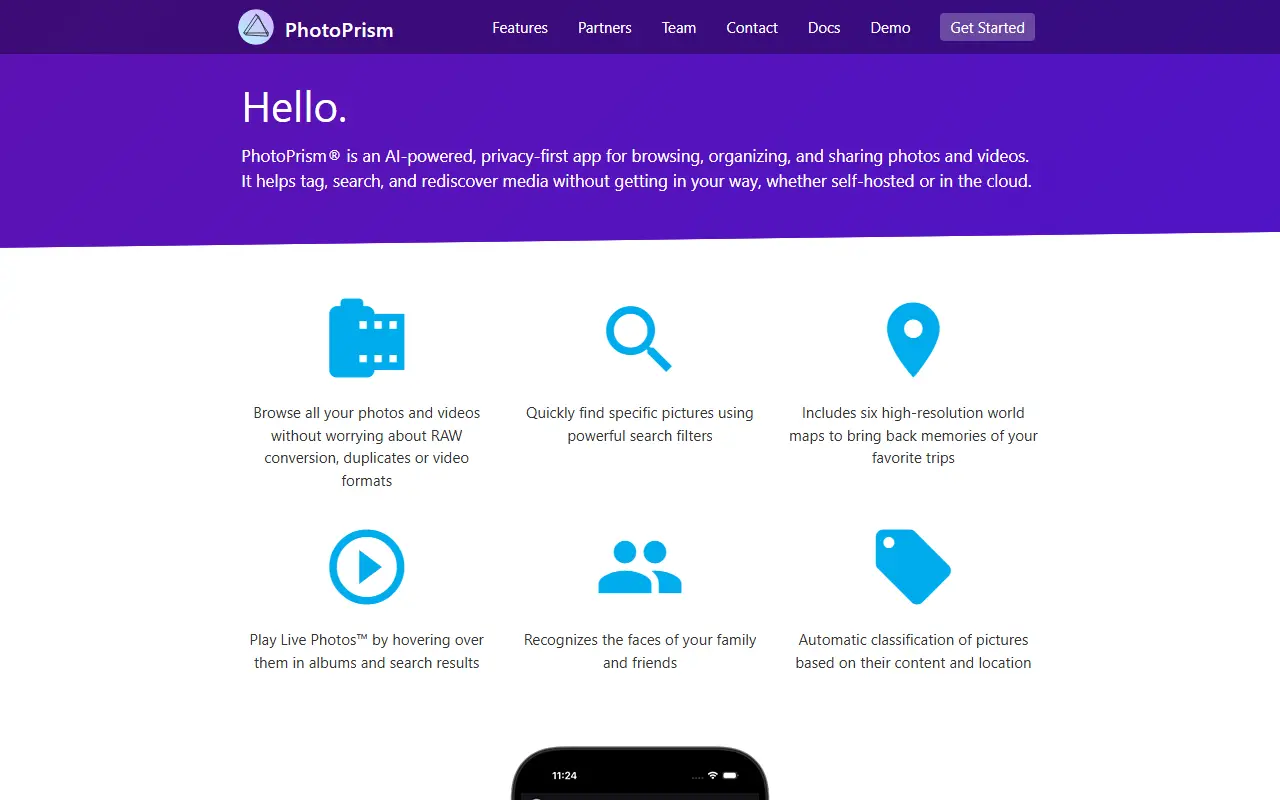
PhotoPrism is a photo management application that uses machine learning to help you browse, organize and share photos and videos. It tags and classifies media automatically, so you can search and rediscover pictures without sorting them by hand. The project says it was built to run wherever you need it without compromising privacy, and its topics place it as a Google Photos alternative.
The web interface is a progressive web app that can be installed on a phone, tablet or desktop home screen and feels like a native app. It handles RAW images and many video formats, and offers search filters that can be combined across many properties. A public demo lets you try it first, with a warning not to upload private material. PhotoPrism is written in Go and uses TensorFlow for image analysis.
You can self-host PhotoPrism or use a cloud-hosted setup. Its license is listed as 'Other' on GitHub, so check the terms if you plan to redistribute it. It suits photographers and families who want a private, searchable photo library on hardware they own.
Key features
- AI-based tagging and classification
- Support for RAW photos and video formats
- Combinable search filters
- Installable progressive web app
- Albums, sharing and browsing by place
- Self-hosted or cloud-hosted

Free digital painting application for illustrators, concept artists and comic creators, built on the KDE and Qt frameworks.
- GitHub stars
- 11k
- Last commit
- yesterday
- Licence
- GPL-3.0
invent.kde.org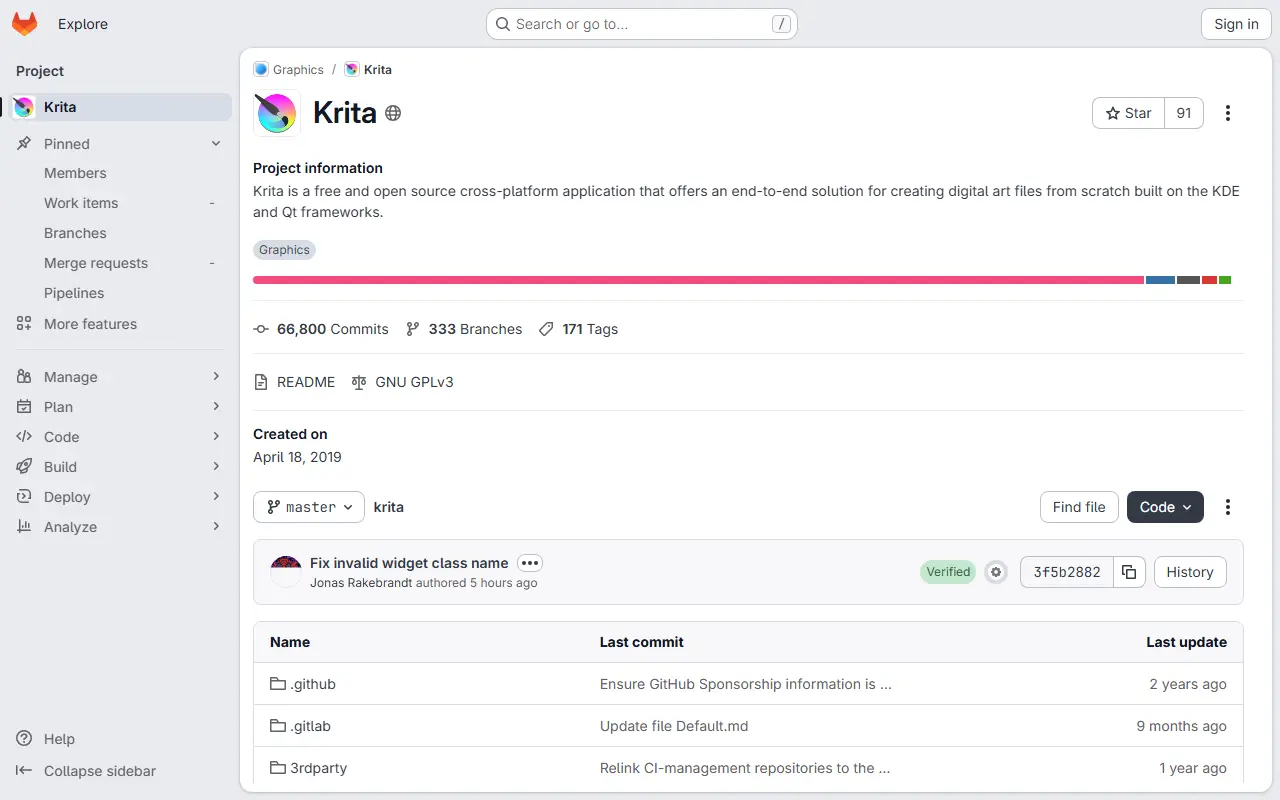
Krita is a free and open-source cross-platform application for creating digital art from scratch. It is a digital painting program meant for artists who want to produce professional work from start to finish, and it is used by comic book artists, illustrators, concept artists, matte and texture painters, and the digital VFX industry.
It is built on the KDE and Qt frameworks. The GitHub repository is only a mirror, since the real code lives on KDE's invent.kde.org. The project offers a user manual at docs.krita.org, API documentation, a bug tracker, a community forum at krita-artists.org and an IRC channel where most developers can be found. Nightly builds for both unstable and stable branches are available from KDE's CI server.
Krita is written in C++ and licensed under GPL-3.0. The README includes a repository status table with feature and string freeze information for the current branch, and developer builds for Linux with debug symbols can be fetched from the CI system.
Key features
- Digital painting for illustration and concept art
- Cross-platform on KDE and Qt
- Nightly and stable builds from KDE CI
- Online user manual and API docs
- Community forum and IRC support
Pricing: Free and open source under the GPL-3.0 license.
#5
Open-source photography workflow application and non-destructive raw developer for managing, editing and exporting digital negatives.
- GitHub stars
- 13k
- Last commit
- yesterday
- Latest release
- release-5.6.2
- Licence
- GPL-3.0
darktable.org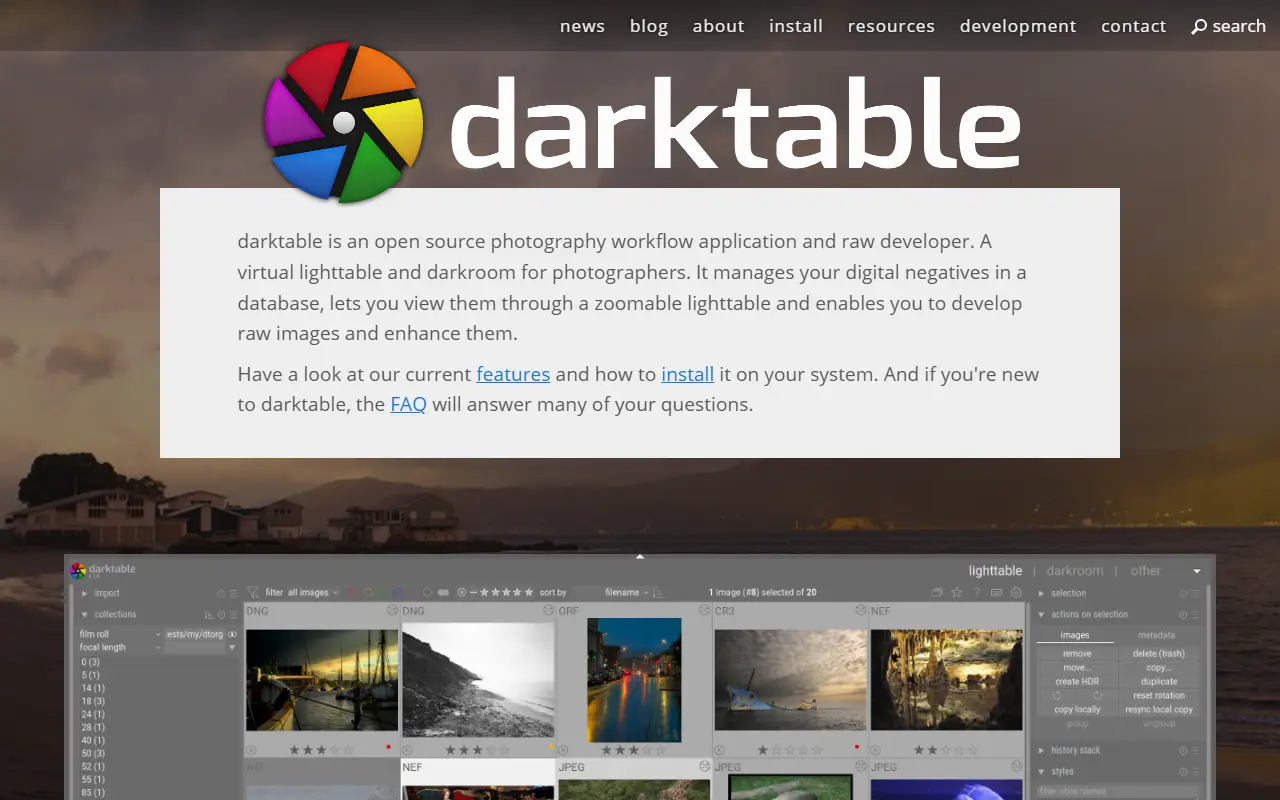
darktable is an open-source photography application that works as a virtual lighttable and darkroom. It keeps digital negatives in a database, lets you browse them in a zoomable lighttable view, and provides a darkroom where raw images are developed and enhanced without altering the original files.
Edited images can be exported to local or remote storage. The project runs on Linux, FreeBSD, NetBSD, OpenBSD, Windows 10 and later, and Apple Silicon Macs on macOS 14 and later, and it includes optional AI features. A Lua API is documented separately, and extensions can be obtained from the community. The README is explicit that darktable is not meant to be a free copy of Adobe Lightroom.
The software is written in C and licensed under GPL-3.0. The user manual, Lua documentation and website each live in their own repositories, and the main README covers requirements, building from source, using test or stable versions, and common questions such as camera and lens detection.
Key features
- Non-destructive raw image development
- Lighttable view for managing digital negatives
- Darkroom module for editing and enhancing photos
- Export to local or remote storage
- Lua API for scripting and extensions
- Optional AI-assisted features
Pricing: Free and open source under the GPL-3.0 license.
#6
GIMP, the GNU Image Manipulation Program, is a free, open-source raster image editor; this repository is a read-only mirror of the official GNOME source.
- GitHub stars
- 6.6k
- Last commit
- 2 days ago
GIMP is the GNU Image Manipulation Program, a free and open-source image editor developed within the GNOME project. This GitHub repository is a read-only mirror of the official source hosted on GNOME's GitLab, where development, releases and issue tracking take place.
GIMP is widely known as a general-purpose raster graphics editor used for photo retouching, image composition and image authoring, and it can be extended with plug-ins and scripts. The input available for this entry was limited to the project metadata, which shows the code is written in C and released under the GNU General Public License version 3 or later. For downloads and documentation, use the official project resources rather than this mirror.
Key features
- Raster image editing
- Photo retouching and image composition
- Extensible with plug-ins and scripts
- Open source under GPL v3 or later
- Developed in C within the GNOME project
Pricing: Free and open source under the GNU GPL v3 or later.
#7
LibrePhotos is a self-hosted, open-source photo manager with face recognition, object detection, semantic search and timeline views for personal libraries.
- GitHub stars
- 8.2k
- Last commit
- today
- Latest release
- 1.6.0
- Licence
- MIT
- Self-hosted
- Yes
docs.librephotos.com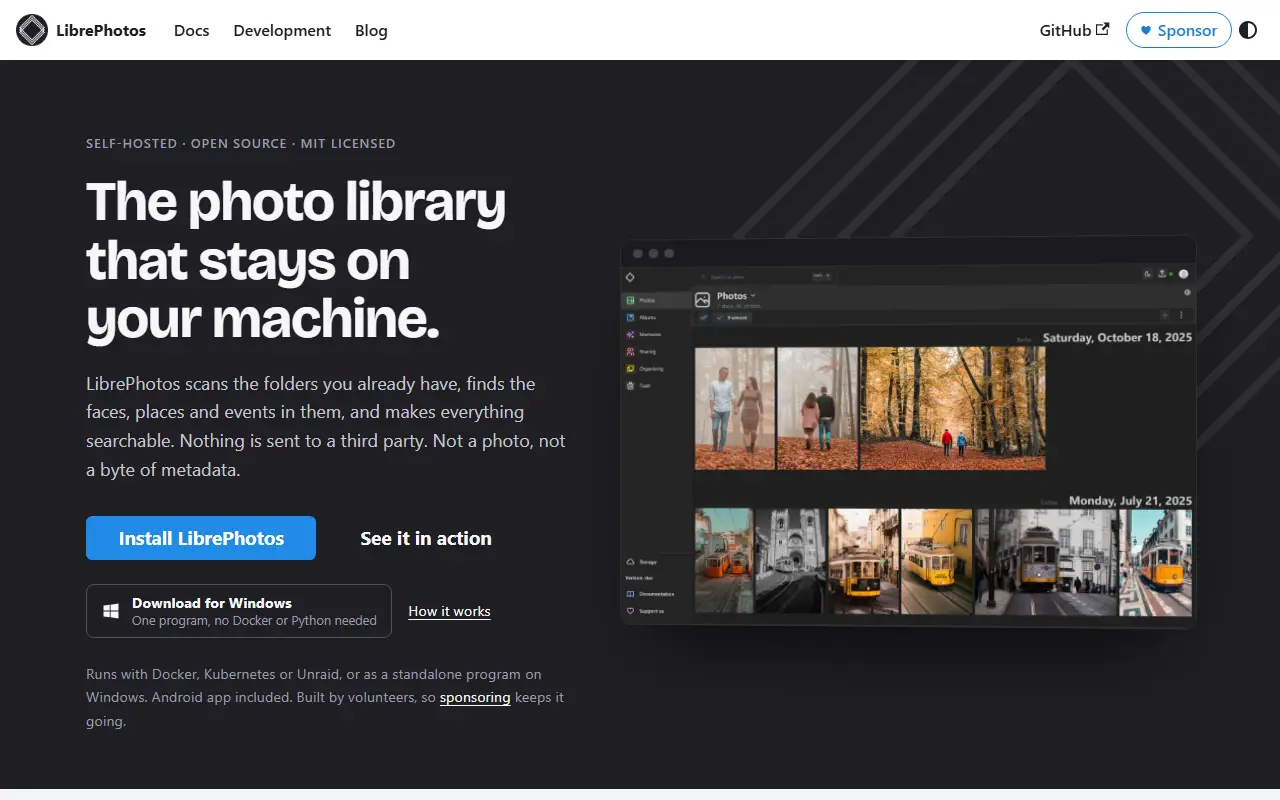
LibrePhotos is a self-hosted photo management service for people who want to organize a personal library on their own server. It scans pictures on the file system and adds machine-learning features such as automatic face recognition, object and scene detection and semantic image search.
It supports all kinds of photos, including raw files, as well as videos, and offers a timeline view, multiuser support, reverse geocoding and search by metadata. Albums can be generated automatically from events, for example a day spent in a particular city. The README warns that the machine-learning features use a lot of memory: it lists 4 GB of RAM as a minimum and recommends 8 GB or more.
The project is a monorepo containing a Django 5 backend, a React and Vite web client, an Expo mobile app for Android and iOS, a Docusaurus documentation site and deployment files for Docker Compose and Kubernetes. It is released under the MIT licence and runs on any Docker-compatible system, with Linux recommended.
Key features
- Automatic face recognition and classification
- Object and scene detection
- Semantic image search
- Support for raw photos and videos
- Timeline view and event-based albums
- Multiuser support
- Reverse geocoding of photo locations
Pricing: Free and open source under the MIT licence.
#8
A cross-platform raw photo processing program with detailed control over demosaicing and development, aimed at enthusiasts and semi-professional photographers.
- GitHub stars
- 4.3k
- Last commit
- 4 days ago
- Latest release
- 5.13
- Licence
- GPL-3.0
- Self-hosted
- Yes
rawtherapee.com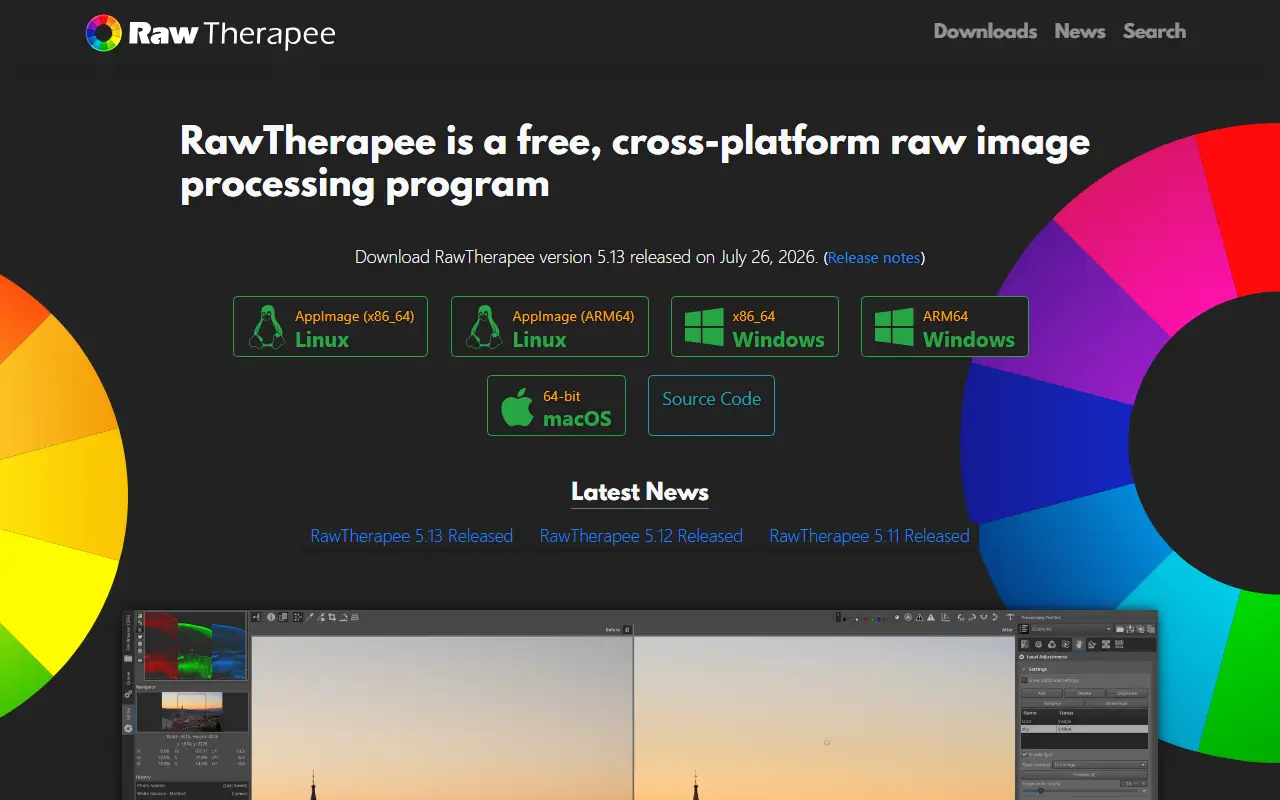
RawTherapee is a cross-platform program for processing raw photos, released as free software under GPL version 3. It is written mostly in C++ with a GTK+ front end and gives users detailed control over the demosaicing and development process.
Raw files are read with a patched dcraw plus an in-house solution that adds support for certain camera models dcraw does not handle and improves accuracy for some it does. The program develops raw files from a wide range of digital cameras, along with HDR DNG files and non-raw formats: JPEG, TIFF and PNG.
The target audience runs from enthusiasts wanting to understand digital imaging to semi-professional photographers, and some knowledge of color science helps. The README notes that professionals may miss peripheral features like digital asset management, printing or uploading, which are left to other specialized software. Documentation is provided in RawPedia, and a user forum is on pixls.us.
Key features
- Raw file development and demosaicing control
- Support for many camera models
- HDR DNG file support
- JPEG, TIFF and PNG editing
- RawPedia documentation
Pricing: Free software under the GPL-3.0 licence.
#9
Photoview is a self-hosted photo gallery for photographers that scans folders on your server and builds fast, thumbnail-based browsing of large libraries.
- GitHub stars
- 6.6k
- Last commit
- 6 days ago
- Latest release
- v2.4.0
- Licence
- AGPL-3.0
- Self-hosted
- Yes
photoview.github.io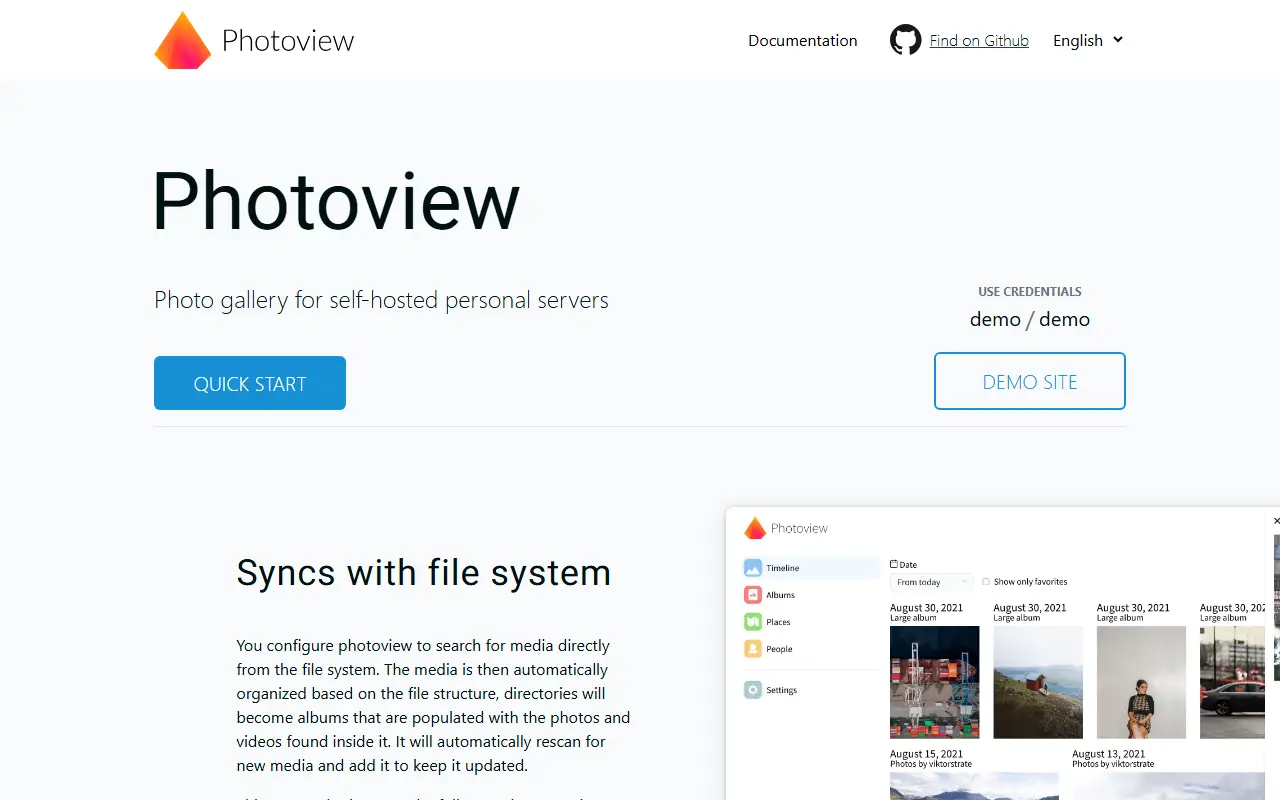
Photoview is a photo gallery for self-hosted personal servers, made for photographers who need to navigate directories containing thousands of high-resolution images. You configure it to look for photos and videos in a folder on the file system, and it takes care of the rest.
A scanner picks up the media automatically and generates thumbnails so browsing stays fast. Once scanning finishes, the media appear on the website organized the same way they are on disk. Repository topics point to support for RAW files and EXIF metadata, and the project is distributed as a Docker image that is commonly deployed on NAS devices. The README gives migration notes about a new Docker registry and a move to PostgreSQL 18 on the master branch.
Photoview is written in Go and licensed under AGPL-3.0. It is meant to be run on your own hardware, there is a Discord server for setup and development questions, and its approach of mirroring the folder structure suits people who already keep photos neatly organized on disk.
Key features
- Scans folders for photos and videos
- Automatic thumbnail generation
- Gallery mirrors the filesystem layout
- RAW and EXIF handling
- Docker deployment with PostgreSQL
Pricing: Free and open source under the AGPL-3.0 licence.
#10
The desktop sync client for Nextcloud, which keeps files on a Nextcloud server in sync with a Windows, macOS or Linux computer.
- GitHub stars
- 4k
- Last commit
- yesterday
- Latest release
- v35.0.3
- Licence
- GPL-2.0
nextcloud.com
The Nextcloud Desktop Client is an app that synchronizes files from a Nextcloud server with your computer. It is available for Windows, macOS and Linux and is the companion to a Nextcloud server that you run or use.
Official downloads, daily builds and release lists are available from the Nextcloud site, and user, administration and developer manuals are on the central documentation site. Contributors can follow the repository's guidelines and code of conduct, help with testing by installing daily builds, and report bugs in the issue tracker.
The client is written mostly in C++ with Qt6 since version 3.14, with Swift components on macOS, and builds with CMake and compilers such as clang or gcc. Windows 10 and 11, macOS 13 Ventura or newer and Linux are supported, and the build instructions use KDE Craft. The code is licensed under GPL-2.0.
Key features
- File synchronization with Nextcloud servers
- Windows, macOS and Linux clients
- Daily builds for testing
- Qt6-based C++ codebase
- User and admin manuals online
Pricing: Standard plan starts at 42€ per user per year for 100+ users; pricing decreases at higher user volumes.
5 more Apple Photos alternatives
Apple Photos alternatives: questions
- What is the best open-source alternative to Apple Photos?
- Immich is the top-ranked open-source alternative to Apple Photos on Enlisted: A self-hosted photo and video library with mobile auto-backup, face and object search, shared albums and multi-user support, often used in place of Google Photos. Other strong options are Ente, PhotoPrism, Krita and Darktable.
- What are the best commercial alternatives to Apple Photos?
- Mylio Photos, Google Photos, Photomator, ON1 Photo RAW and Capture One are among the hosted, closed-source alternatives to Apple Photos listed on Enlisted, which lists 17 in total. Compare their pricing and features on each tool page.
- Are these Apple Photos alternatives free?
- All 15 are open source, so the code is free to use under its licence, and all of them can be self-hosted on your own server or computer. 3 also offer a paid or managed cloud version if you'd rather not host it yourself.
- How is this list of Apple Photos alternatives ranked?
- By a score built from GitHub stars, star growth over the last 30 days and how recently the code changed. 15 of these projects shipped code in the last 30 days. Data is refreshed daily, and nobody can pay to move up.
 TrackMedia
 TrackRev