#1
A fair-code workflow automation platform that mixes a visual canvas with custom code and AI agent features, for teams connecting apps and automating processes.
- GitHub stars
- 210k
- Last commit
- today
- Latest release
- n8n@2.47.5
- Self-hosted
- Yes
- Hosted version
- Available
n8n.io
n8n is a workflow automation platform for connecting apps, moving data between them and triggering actions without writing a full integration from scratch. Workflows are built on a visual canvas, and when a step needs more logic you can drop in JavaScript or Python and use npm packages. It is often compared with Zapier and Make, but the source is public and it can run on your own infrastructure.
Recent versions put a lot of weight on AI. You can build multi-step agents and LLM workflows that call OpenAI, Anthropic, Google or open-source models, add human approval steps, and inspect what happened afterward. The project advertises over a thousand integrations and a large library of ready-made workflow templates, and you can extend it with your own nodes.
n8n is distributed under a fair-code model: the Sustainable Use License, plus a separate enterprise license for additional features. The code is always visible and can be self-hosted, for example with Docker, but it is not an OSI-approved open-source license, so commercial redistribution is restricted. A managed cloud edition is available if you would rather not run it yourself.
Key features
- Visual workflow canvas with branching logic
- JavaScript and Python code steps with npm packages
- Multi-step AI agents with human approval
- Over 1,500 integrations plus reusable templates
- Connects to OpenAI, Anthropic, Google or local models
- Role-based access and audit trails
- Self-hosting with Docker or managed cloud
Pricing: Free self-hosted Community Edition. Hosted plans cost 20€ (Starter), 50€ (Pro) and 667€ (Business) per month billed annually, scaled by workflow executions; Enterprise is custom. Free trial available.
#2
An LLM application platform for building AI workflows, RAG pipelines and agents on one canvas, deployable in the cloud, a private VPC or self-hosted.
- GitHub stars
- 161k
- Last commit
- today
- Latest release
- 1.19.0
- Self-hosted
- Yes
- Hosted version
- Available
dify.ai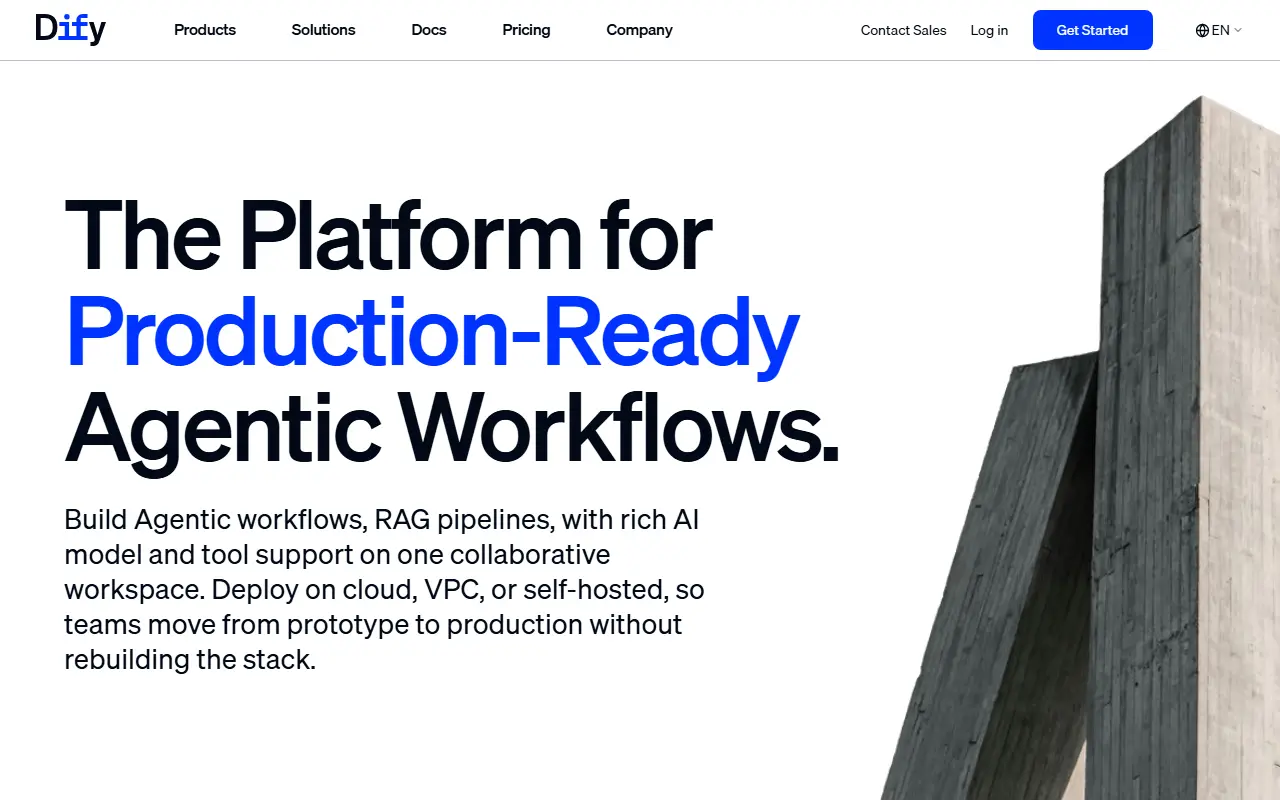
Dify is a platform for building applications on top of large language models. Instead of wiring together prompts, retrieval code and model APIs by hand, teams assemble AI workflows, knowledge pipelines and agents in a shared visual workspace, then move them from prototype to production without changing stacks.
The product covers a workflow studio for agentic flows, a knowledge pipeline that prepares searchable knowledge bases for retrieval-augmented generation, model management across many providers, and a marketplace of tools, models and integrations. Observability integrations such as Opik, Langfuse and Arize Phoenix help trace and debug runs once an app is live.
Dify comes in a few editions: a community edition you deploy yourself with Docker, a hosted cloud service, and an enterprise edition for private deployments. The repository carries a custom license rather than a standard one, so check its terms before offering Dify as a service to others.
Key features
- Visual workflow studio for agentic apps
- Knowledge pipelines for retrieval-augmented generation
- Model management across many LLM providers
- Marketplace of tools, models and integrations
- Observability integrations such as Langfuse
- Deploy on cloud, VPC or Docker
Pricing: Free Sandbox on Dify Cloud and a free self-hosted Community edition. Cloud Professional costs $590 and Team $1590 per workspace per year; Enterprise is custom.
#3
Temporal is a durable execution platform whose server runs application workflows resiliently, retrying failed operations automatically.
- GitHub stars
- 24k
- Last commit
- yesterday
- Latest release
- v1.32.2
- Licence
- MIT
- Self-hosted
- Yes
- Hosted version
- Available
docs.temporal.io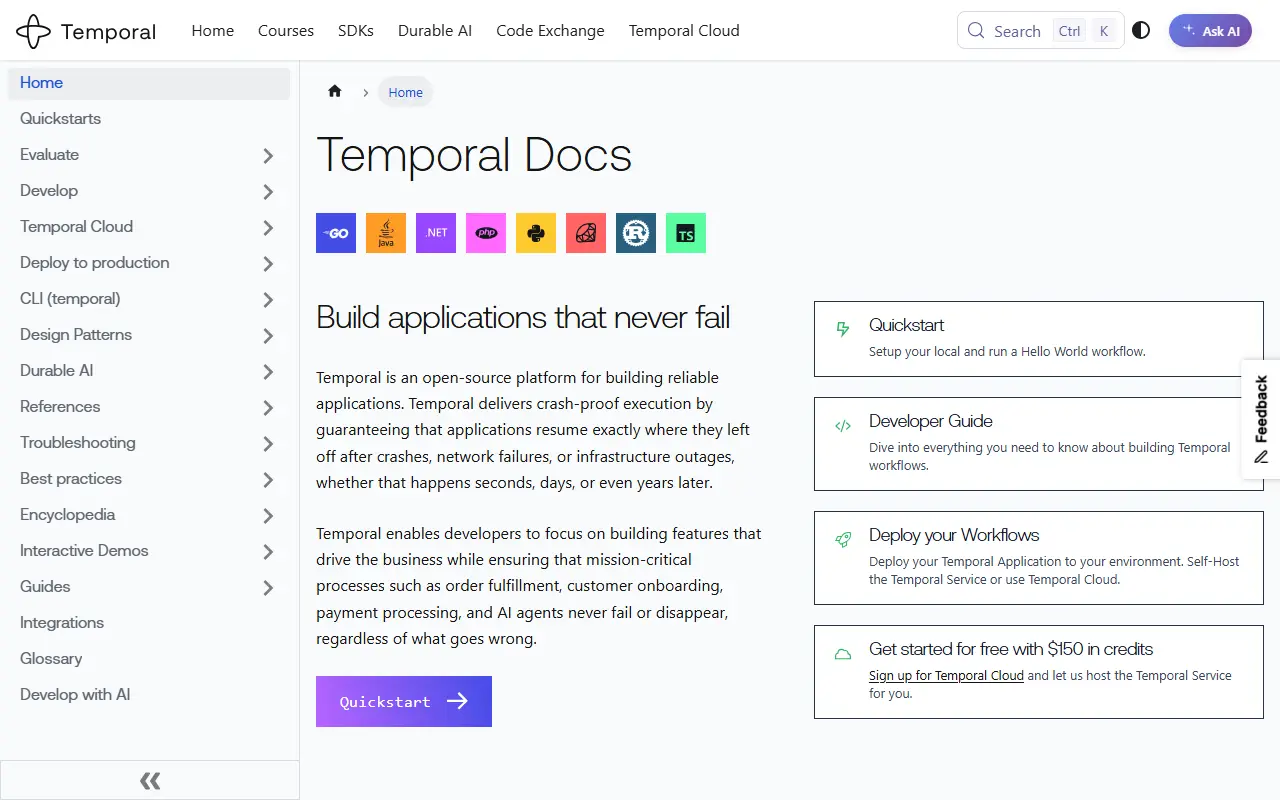
Temporal is a durable execution platform that helps developers create scalable applications while keeping both productivity and reliability. The Temporal server runs units of application logic called Workflows, handling intermittent failures and retrying failed operations automatically. It started as a fork of Uber's Cadence and is developed by Temporal Technologies, a company founded by Cadence's creators. The server is written in Go and released under the MIT license.
This repository contains the source of the server only. To implement Workflows, Activities and Workers you use one of the supported language SDKs. The getting started guide shows how to download and run a pre-built image with its dependencies locally, try samples written for Go or Java, interact with the server through the Temporal CLI, and watch workflows in the Web UI at port 8233. Repository topics cover workflow engines, distributed cron, microservice orchestration and durable execution.
Key features
- Durable execution of long-running workflows
- Automatic retries for failed operations
- SDKs for writing Workflows and Activities
- Temporal CLI for interacting with the server
- Web UI for viewing running workflows
- Distributed cron-style scheduling
Pricing: Server is free and open source under the MIT license; a managed cloud service is also offered by Temporal Technologies.
#4
An open-source, event-driven orchestration and scheduling platform where data, AI and infrastructure workflows are defined declaratively in YAML and managed from a UI.
- GitHub stars
- 30k
- Last commit
- today
- Latest release
- v2.0.10
- Licence
- Apache-2.0
- Self-hosted
- Yes
go.kestra.io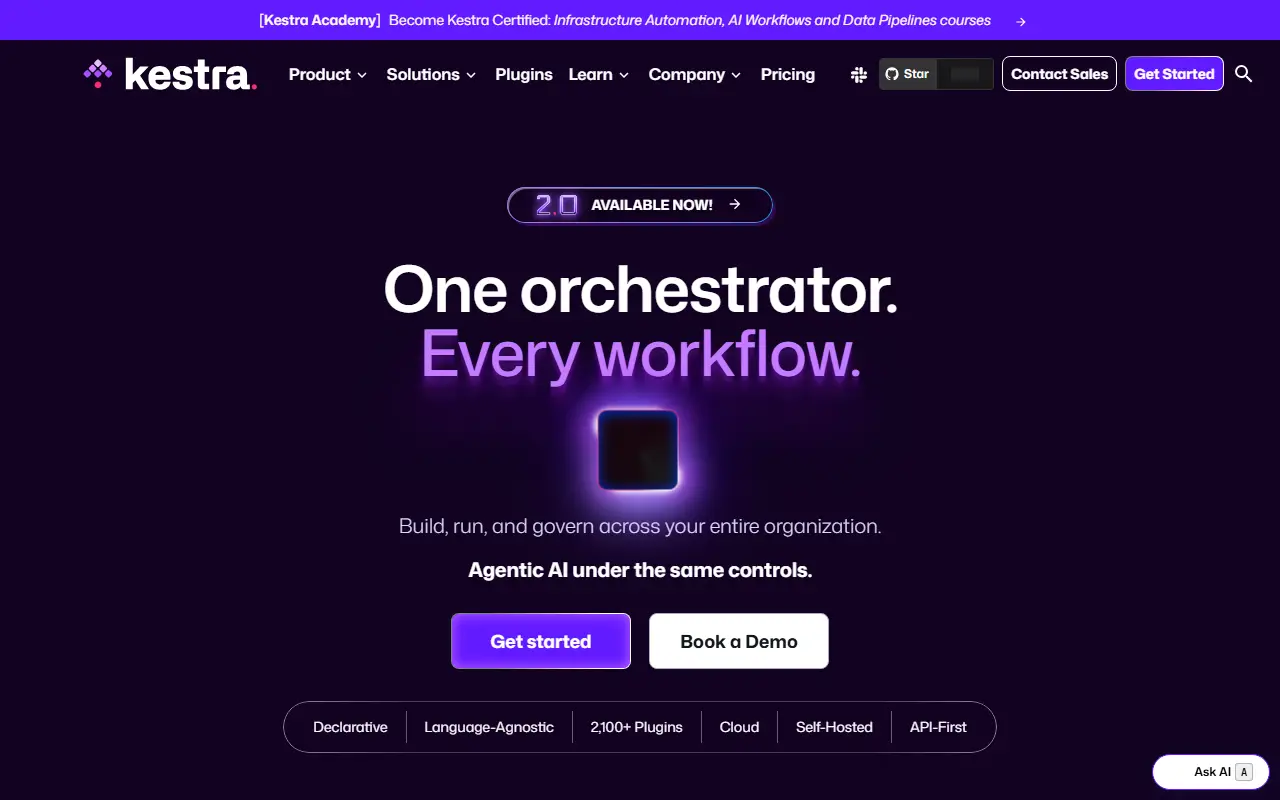
Kestra is an orchestration platform, open source, for data pipelines, AI workflows and infrastructure automation. It brings scheduled and event-triggered automation together under one declarative interface that does not depend on a programming language, applying infrastructure-as-code practices to pipelines so that reliable workflows can be defined in a few lines of YAML.
Workflows can be built in the UI, written by a built-in AI Copilot, or generated from coding agents such as Claude Code and Cursor using agent skills, and everything can be kept as code with Git integration even when it was authored visually. A large plugin ecosystem connects it to external systems, and key concepts cover tasks, triggers and flows. The project is written in Java, with topics covering orchestration, high availability, pipeline-as-code and DevOps, and the 2.0 release adds new capabilities.
Kestra is Apache-2.0 licensed and can be self-hosted, with a quick start that gets a first workflow running in minutes. It targets data engineers, platform teams and automation developers who want an alternative to schedulers such as Airflow with a more declarative style.
Key features
- Declarative YAML workflow definitions
- Scheduled and event-driven triggers
- Visual editor and AI Copilot
- Git version control integration
- Large plugin ecosystem
- Agent skills for coding agents
Pricing: Free and open source under the Apache-2.0 license.
#5
Huginn is an MIT-licensed Ruby system for building agents that watch the web, react to events and act for you, on your own server.
- GitHub stars
- 51k
- Last commit
- 4 days ago
- Latest release
- v2026.11.09
- Licence
- MIT
- Self-hosted
- Yes
Huginn lets you build agents that perform automated tasks online. They read the web, watch for events and take actions on your behalf. Agents create and consume events, passing them along a directed graph. The README calls it a hackable version of IFTTT or Zapier on your own server, where you know who holds your data.
Typical jobs listed include scraping a website and emailing when it changes, watching RSS feeds, IMAP mailboxes, webhooks and MQTT topics, tracking weather or travel and shopping deals, sending digest emails and detecting peaks in an event stream. Agents can post to Slack, Telegram and other services, call OpenAI-compatible APIs, and store files on Dropbox, S3, FTP or disk.
Custom logic can be written in JavaScript, Liquid templates or jq, and collected events can be published as feeds or JSON endpoints. The quickest trial is the official Docker image on port 3000. Production use runs a web process plus a background worker on MySQL or PostgreSQL, with Docker Compose recommended.
Key features
- Agents create and consume events along a directed graph
- Website scraping with change alerts by email
- Watches RSS feeds, IMAP mailboxes, webhooks and MQTT
- Posts to chat and messaging services
- Summarise, classify and translate text with OpenAI-compatible APIs
- Custom logic in JavaScript, Liquid or jq
- File storage on Dropbox, S3, FTP and local disk
- Publish your own feeds and JSON endpoints

An Apache workflow orchestration platform where data teams author, schedule and monitor pipelines as Python code, widely used for data engineering and ELT jobs.
- GitHub stars
- 47k
- Last commit
- today
- Latest release
- 3.4.0
- Licence
- Apache-2.0
- Self-hosted
- Yes
airflow.apache.org
Apache Airflow is a workflow platform where you write, schedule and watch over pipelines in code. Workflows are defined as Python code in the form of directed acyclic graphs, or DAGs, where each task and its dependencies are explicit, so pipelines can be versioned, tested and reviewed like any other software.
A scheduler runs tasks on a defined cadence and workers execute them, while a web interface shows the status of each run, lets you inspect logs and retry failures. Airflow is used heavily in data engineering, including data integration, ELT and ETL pipelines, data orchestration and machine learning workflows, and its topics cover data science and automation. It has a large ecosystem of providers and operators for connecting to databases, cloud services and other systems, and the 3.x line is the current series.
Airflow is an Apache Software Foundation project under the Apache-2.0 license and runs on your own infrastructure, from a single machine to Kubernetes. Several vendors offer managed Airflow services, but the project itself is self-hosted software. It suits data engineers who prefer code-first orchestration over drag-and-drop tools.
Key features
- Workflows defined as Python DAGs
- Scheduler for recurring and dependent tasks
- Web UI for monitoring runs and logs
- Retries and task dependency management
- Large provider ecosystem of integrations
- Runs on single machines or Kubernetes
Pricing: Free and open source under the Apache-2.0 license.
#7
Activepieces is an open-source, self-hostable no-code automation platform with AI agents and integrations written as TypeScript pieces.
- GitHub stars
- 25k
- Last commit
- yesterday
- Latest release
- 0.93.0
- Self-hosted
- Yes
- Hosted version
- Available
activepieces.com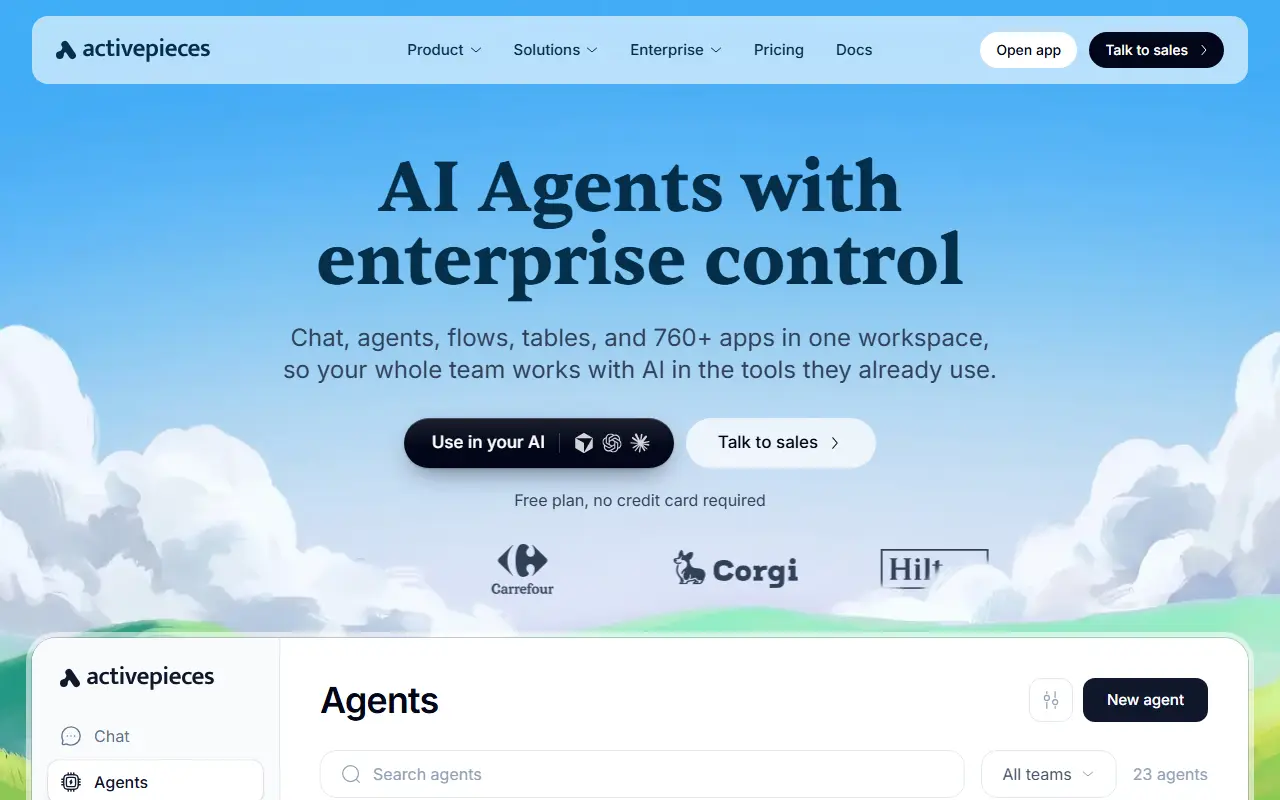
Activepieces is an open-source replacement for Zapier, positioned as an all-in-one AI automation tool. Automations are built from pieces, which are type-safe TypeScript npm packages, and the interface is meant to work for both technical and non-technical users. The topics also describe it as an alternative to n8n. The repository metadata lists the license as Other.
Pieces that are contributed to the project automatically become available as MCP servers, so LLM clients such as Claude Desktop, Cursor and Windsurf can use them. The platform includes native AI pieces for working with different providers, an AI SDK for building agents inside the builder, and human-in-the-loop steps that delay execution or require approval. Developers can set up tools, then others in the organization use the no-code builder. It can be self-hosted, including in network-gapped environments, and supports branding customization.
Key features
- No-code workflow builder
- Integrations written as TypeScript npm packages
- Pieces exposed as MCP servers for LLM clients
- Native AI pieces and AI SDK
- Human-in-the-loop delays and approvals
- Self-hosting with branding customization
Pricing: A free plan includes 1,000 credits a month. Plus is $20 and Team $200 per month on monthly billing, with overage at $0.007 per credit; Ultimate and self-run Enterprise are custom, and Embed starts from $36k a year.
#8
An open-source developer platform that turns scripts into APIs, background jobs, workflows and auto-generated UIs, positioned against Retool, Pipedream and Temporal.
- GitHub stars
- 19k
- Last commit
- today
- Latest release
- v1.871.1
- Self-hosted
- Yes
- Hosted version
- Available
windmill.dev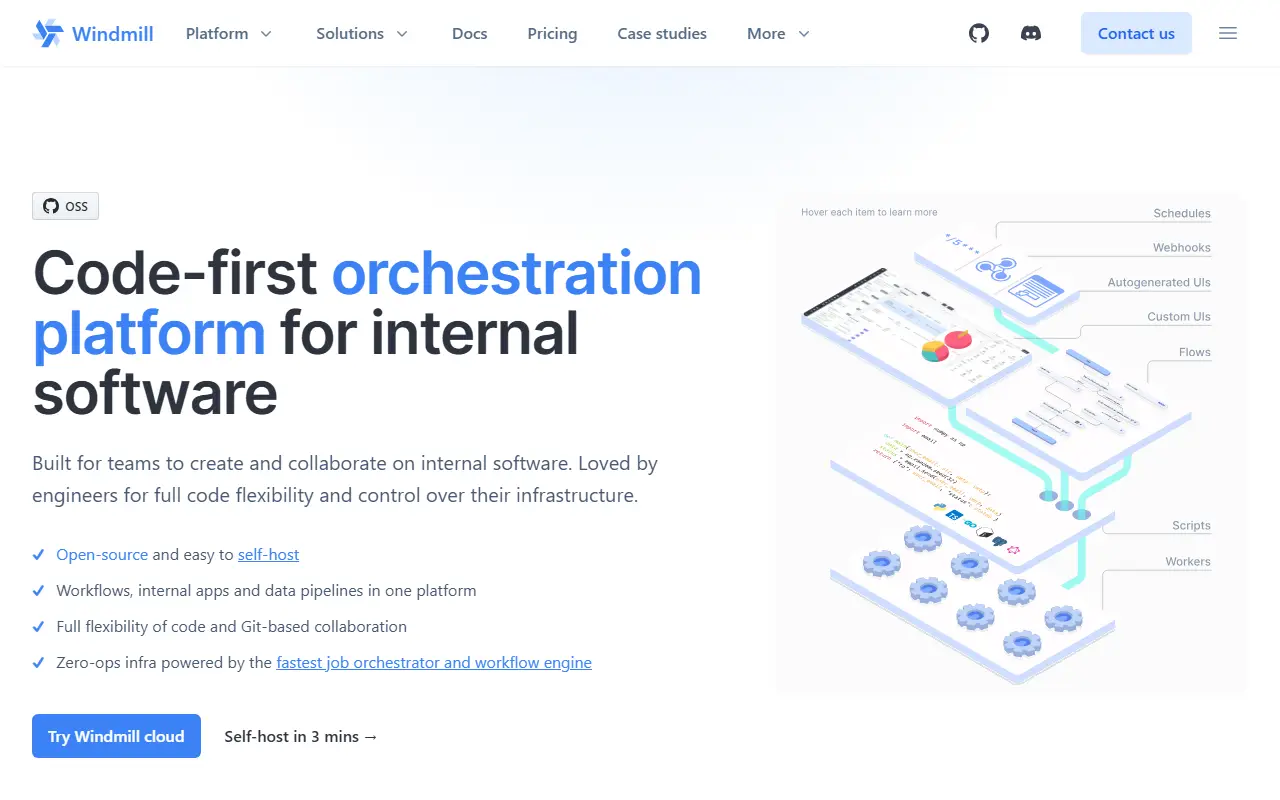
Windmill is an open-source platform for developers to run internal code as APIs, background jobs, workflows and user interfaces. It is pitched as a self-hostable alternative to Retool, Pipedream and Superblocks and as a simplified version of Temporal, and it automatically generates UIs so a script can be shared and triggered as an internal app.
Scripts can be written in languages including Python, TypeScript, Go, Bash, SQL, PowerShell, Rust and GraphQL. They can be composed into flows or used within richer apps built with its low-code builder. The backend is written in Rust on PostgreSQL, and the README describes it as a very fast self-hosted workflow engine, citing a comparison with Airflow. Sections of its documentation cover main concepts, local development, architecture, security, performance and self-hosting with Docker Compose.
Windmill is open source under AGPLv3, and Windmill Labs sells dedicated instances, commercial support and licenses, so the repository license is listed as 'Other' on GitHub. It suits engineering teams that want to turn existing scripts into reliable internal tools and automations without building each interface by hand.
Key features
- Scripts turned into APIs and auto-generated UIs
- Multi-language support including Python and TypeScript
- Workflows composed from scripts
- Low-code builder for internal apps
- Rust workflow engine on PostgreSQL
- Self-hosting with Docker Compose
Pricing: The Community Edition is free to self-host. Team is $10 per seat per month; Enterprise is $20 per developer and $10 per operator per month, with a one-month trial.
#9
A Python workflow orchestration framework for turning scripts into resilient, observable data pipelines with scheduling, retries, caching and event-driven automation.
- GitHub stars
- 24k
- Last commit
- today
- Latest release
- 3.9.2
- Licence
- Apache-2.0
- Self-hosted
- Yes
- Hosted version
- Available
prefect.io
Prefect is a Python framework for orchestrating workflows and building data pipelines. It aims to be the simplest way to lift an ordinary script into a production workflow: you add flow and task decorators, and Prefect adds the machinery that makes pipelines dependable and visible.
That machinery includes scheduling, caching, retries and event-based automations, and flows can express dependencies and complex branching logic. The goal is dynamic pipelines that react to changes in the world and recover from unexpected failures. Run activity is tracked, and you can monitor it from a self-hosted Prefect server or from the managed Prefect Cloud dashboard. Prefect requires Python 3.10 or newer, and the documentation covers installation, quickstart, building and deploying workflows and agent setup.
Prefect is licensed under Apache-2.0. Topics list data engineering, ML ops and observability among its uses. It is aimed at data teams who prefer to write workflows as plain Python code, and who want a choice between running the orchestrator themselves or using a hosted control plane.
Key features
- Flows and tasks defined with Python decorators
- Scheduling and event-based automations
- Automatic retries and caching
- Complex branching and dependencies
- Self-hosted server or Prefect Cloud monitoring
- Deployment of workflows to infrastructure
Pricing: Prefect Cloud's Hobby tier is free. Starter is $100 per month and Team $100 per user per month, both billed monthly; Enterprise is custom and billed annually.
#10
A low-code, flow-based programming tool for event-driven applications, where you wire together devices, APIs and services in a browser-based editor.
- GitHub stars
- 24k
- Last commit
- yesterday
- Latest release
- 5.0.9
- Licence
- Apache-2.0
- Self-hosted
- Yes
nodered.org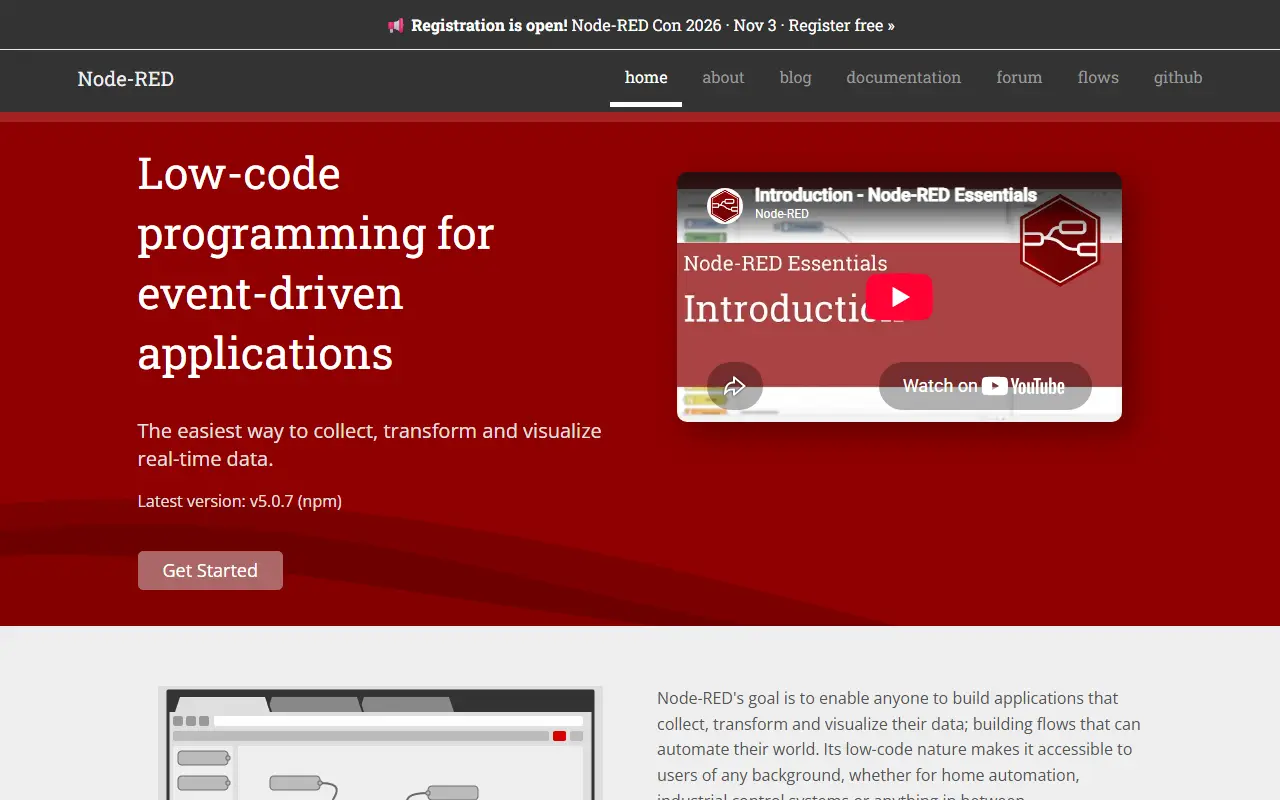
Node-RED is a low-code programming tool for event-driven applications built on flow-based, visual programming. Instead of writing everything as code, you connect nodes that represent inputs, processing steps and outputs, which makes it popular for IoT projects, home automation and wiring together APIs and online services. It is a project of the OpenJS Foundation.
Getting started takes a couple of commands: install it globally with npm, start it with the node-red command, and open it in your browser. A large ecosystem sits around it, with a library of custom nodes and integrations, shared flows and node collections, plus documentation, a forum and a Slack community. Developers can also run the latest code from git by cloning the repository, installing dependencies and building it.
Node-RED is written in JavaScript on Node.js and licensed under Apache-2.0. You run it on your own computer, a Raspberry Pi, a server or in a container, so there is no hosted service to depend on. It suits makers, integrators and engineers who want to prototype and automate event-driven logic quickly.
Key features
- Flow-based visual programming
- Browser-based visual editor
- Large library of community nodes
- Shareable flows and node collections
- Install with npm in one command
- Runs on small devices and servers
Pricing: Free and open source under the Apache-2.0 license.
3 more Albato alternatives
Albato alternatives: questions
- What is the best open-source alternative to Albato?
- n8n is the top-ranked open-source alternative to Albato on Enlisted: A fair-code workflow automation platform that mixes a visual canvas with custom code and AI agent features, for teams connecting apps and automating processes. Other strong options are Dify, Temporal, Kestra and Huginn.
- What are the best commercial alternatives to Albato?
- Pabbly Connect, Zapier, Integrately, IFTTT and Latenode are among the hosted, closed-source alternatives to Albato listed on Enlisted, which lists 16 in total. Compare their pricing and features on each tool page.
- Are these Albato alternatives free?
- All 13 are open source, so the code is free to use under its licence, and all of them can be self-hosted on your own server or computer. 7 also offer a paid or managed cloud version if you'd rather not host it yourself.
- How is this list of Albato alternatives ranked?
- By a score built from GitHub stars, star growth over the last 30 days and how recently the code changed. 12 of these projects shipped code in the last 30 days. Data is refreshed daily, and nobody can pay to move up.
 TrackMedia
 TrackRev