#1
An open-source Postgres development platform bundling a database, auth, auto-generated APIs, realtime, storage and vector tools, often chosen as a Firebase alternative.
- GitHub stars
- 115k
- Last commit
- today
- Latest release
- v1.26.08
- Licence
- Apache-2.0
- Self-hosted
- Yes
- Hosted version
- Available
supabase.com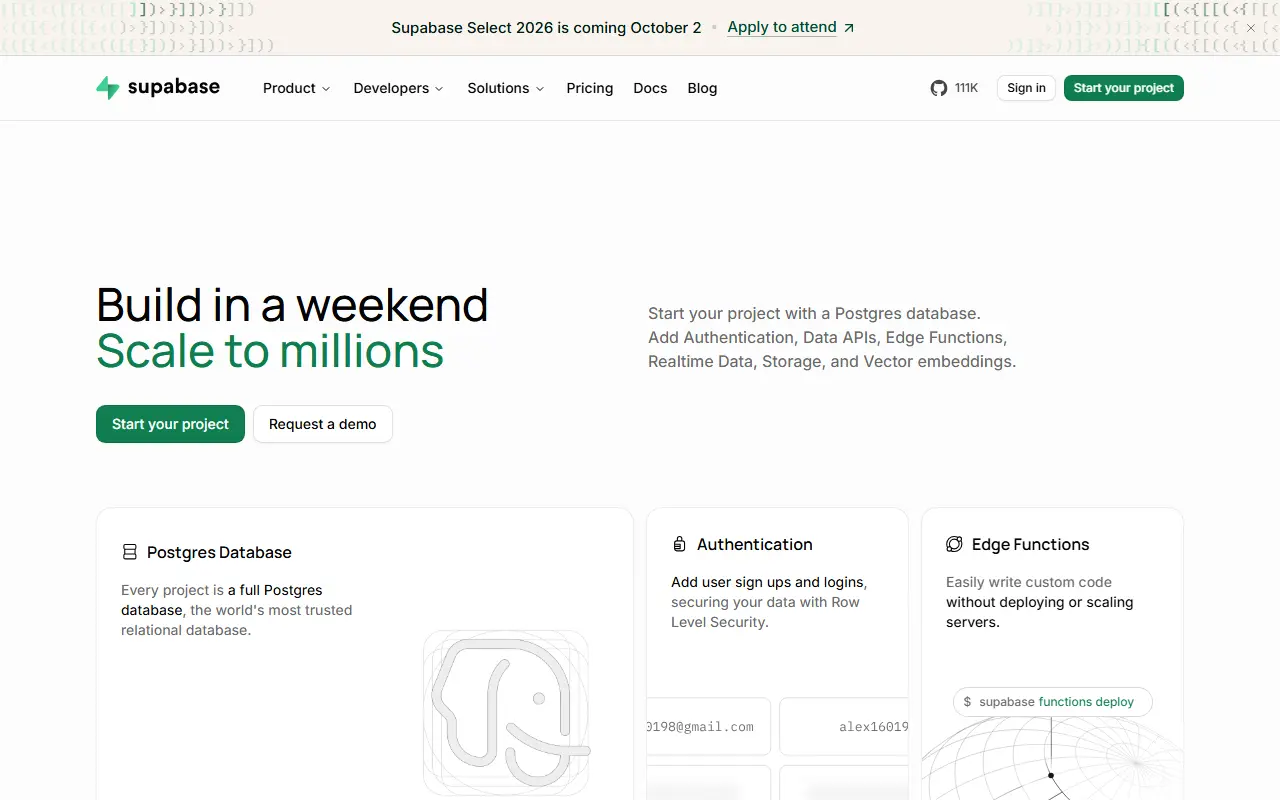
Supabase is a backend platform built around a dedicated Postgres database. It packages the pieces most web, mobile and AI apps need, including authentication and authorization, auto-generated APIs, file storage, serverless functions and a dashboard, so developers can start without assembling separate services. Its stated aim is a developer experience similar to Firebase, built from open-source components.
APIs are generated from your schema as REST and GraphQL, with realtime subscriptions over websockets. Logic can live in database functions or in Edge Functions that run on Deno. For AI work there is a toolkit for vectors and embeddings built on pgvector, and Postgres extensions such as PostGIS are available. Supabase combines existing open tools with ones it builds itself when nothing suitable exists.
The code is Apache-2.0 licensed. Supabase is offered as a hosted platform you can sign up for without installing anything, and the same stack can be self-hosted or run locally for development. It suits teams that want Postgres at the core of their app but prefer not to build the surrounding backend themselves.
Key features
- Hosted Postgres database with a dashboard
- Authentication and authorization
- Auto-generated REST and GraphQL APIs
- Realtime subscriptions over websockets
- Edge Functions and database functions
- File storage for user uploads
- Vector and embeddings toolkit with pgvector
Pricing: Free plan with 50,000 monthly active users. Pro starts at $25 and Team at $599 per month, with usage and extra compute billed on top; Enterprise is custom.
#2
An open-source backend platform offering auth, databases, storage, functions, messaging, realtime and hosting, available as a managed cloud or self-hosted with Docker.
- GitHub stars
- 58k
- Last commit
- today
- Latest release
- 2.7.2
- Licence
- BSD-3-Clause
- Self-hosted
- Yes
- Hosted version
- Available
appwrite.io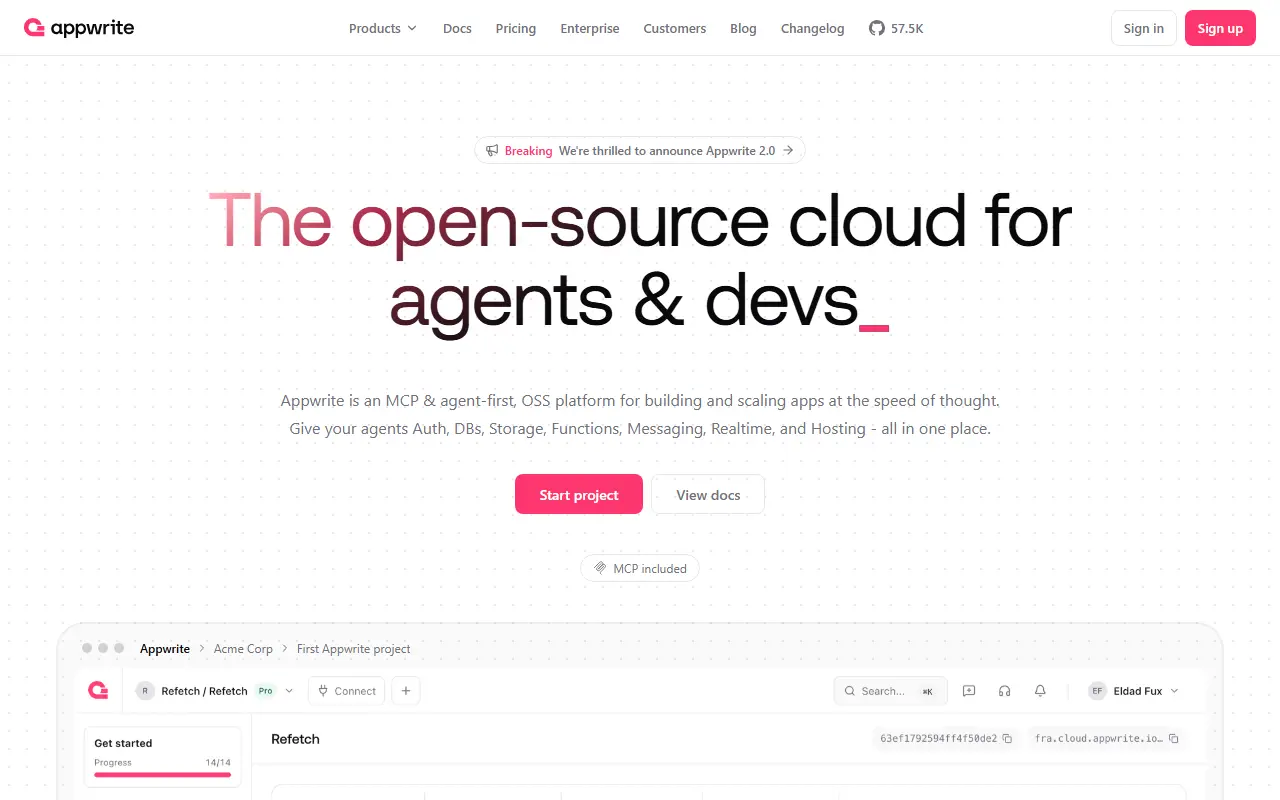
Appwrite is an open-source platform for building and scaling web, mobile and AI apps. It bundles the backend services most apps need, namely auth, databases, storage, functions, messaging, realtime and hosting, and presents them as an agent-friendly cloud with MCP support. It can run as a managed cloud platform or be self-hosted on infrastructure you control.
Auth supports email, SMS, OAuth, anonymous sessions and magic URLs. Databases can be modeled and queried through Appwrite itself or backed by managed PostgreSQL and MySQL. Storage keeps files with compression, encryption, image transformations and permission controls, and Functions run serverless code in isolated runtimes triggered by events. Sites deploys static, SSR and CSR frontends from Git with previews, and Messaging sends email, SMS and push notifications.
Developers integrate through client and server SDKs, including Flutter, Swift, React Native and JavaScript, or let coding agents such as Cursor, Claude Code and Codex operate a live project through a hosted MCP server. Appwrite is BSD-3-Clause licensed and written mainly in PHP, with Docker-based self-hosting for Unix and Windows.
Key features
- Auth with email, SMS, OAuth and magic URLs
- Databases including managed PostgreSQL and MySQL
- File storage with encryption and image transformations
- Serverless functions in isolated runtimes
- Messaging via email, SMS and push
- Realtime updates and static or SSR site hosting
- Hosted MCP server and client and server SDKs
Pricing: A free plan and a Pro plan exist, but the captured page does not show their prices. Dedicated databases start at $10 a month each and go up to $960 a month; serverless databases have no fixed fee.
#3
An open-source headless CMS written in JavaScript and TypeScript that generates REST and GraphQL APIs from content models you design.
- GitHub stars
- 73k
- Last commit
- today
- Latest release
- v5.62.0
- Self-hosted
- Yes
- Hosted version
- Available
strapi.io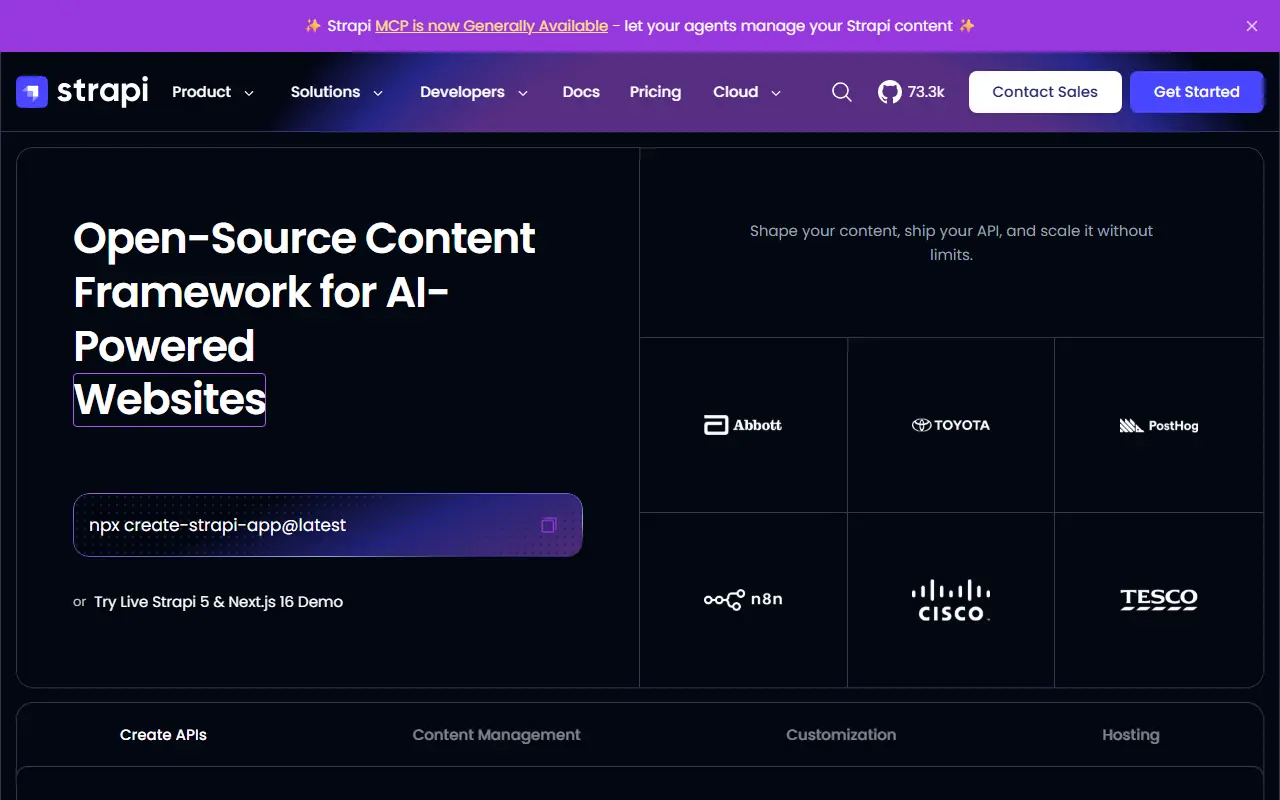
Strapi is a headless content management system. Developers define content models, and Strapi generates a complete API that a website, mobile app or other client can consume, while editors get a friendly admin interface for writing and managing content. It is written entirely in JavaScript and TypeScript on Node.js.
A visual Content-Type Builder lets you design structures without code, and every content type gets REST and GraphQL endpoints automatically. Granular roles and permissions, a media library, internationalization and draft and publish workflows are built in. It works with SQLite, PostgreSQL, MySQL and MariaDB, and offers a plugin system and a customizable admin dashboard. Requests pass through routes, middlewares, controllers and services, which is where backend customization happens. Strapi AI adds help with content modeling, media alt text and translations.
You can self-host Strapi on your own infrastructure or use Strapi Cloud, the managed service. Its license is listed as 'Other' in the repository metadata, so confirm the terms for any enterprise features. It suits teams building Jamstack or multi-channel sites that want a flexible, developer-first backend.
Key features
- Visual Content-Type Builder
- Auto-generated REST and GraphQL APIs
- Granular roles and permissions
- Media library with internationalization
- Draft and publish workflow
- Plugin system and customizable admin panel
- SQLite, PostgreSQL, MySQL and MariaDB support
Pricing: Strapi Cloud has no free tier on this page: Starter is $35, Pro $90 and Business $450 per project per month. Custom limits go through sales.
#4
An open-source backend packaged as a single Go executable, with an embedded SQLite database, realtime subscriptions, user and file management and an admin dashboard.
- GitHub stars
- 62k
- Last commit
- 18 days ago
- Latest release
- v0.40.6
- Licence
- MIT
- Self-hosted
- Yes
pocketbase.io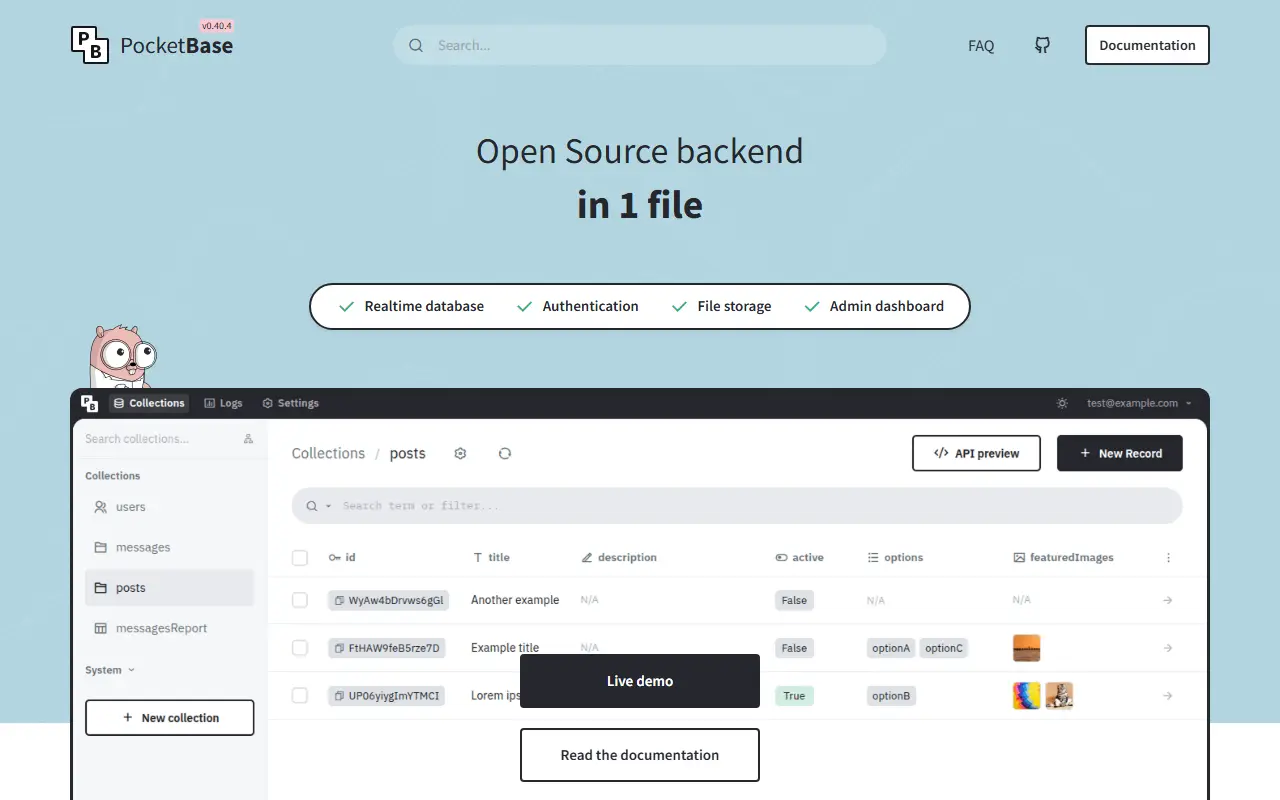
PocketBase is an open-source backend written in Go that ships as one file. It bundles an embedded SQLite database with realtime subscriptions, built-in management of users and files, a convenient admin dashboard and a simple REST-style API, which makes it quick to stand up a backend for a small web or mobile project.
You can use it as a standalone application by downloading the prebuilt executable for your platform and running its serve command, or you can extend it as a Go library to add custom routes and logic. The prebuilt binaries come with a JavaScript VM plugin enabled for scripting. Official SDK clients exist for JavaScript, covering browsers, Node.js and React Native, and for Dart, covering web, mobile, desktop and CLI.
PocketBase is MIT licensed. The maintainers warn that it is still under active development and that backward compatibility is not guaranteed before version 1.0.0, so upgrades deserve some care. It suits solo developers and small teams who want a simple, self-contained backend without managing a database server separately.
Key features
- Embedded SQLite database with realtime subscriptions
- Built-in user authentication and file management
- Admin dashboard for managing data
- REST-style API for client access
- Official JavaScript and Dart SDKs
- Single executable that can also extend as a Go library
Pricing: Free and open source under the MIT license.
#5
A self-hostable data platform that wraps any SQL database with instant REST and GraphQL APIs, a no-code admin app, authentication and an MCP server.
- GitHub stars
- 39k
- Last commit
- today
- Latest release
- v12.6.1
- Self-hosted
- Yes
- Hosted version
- Available
directus.com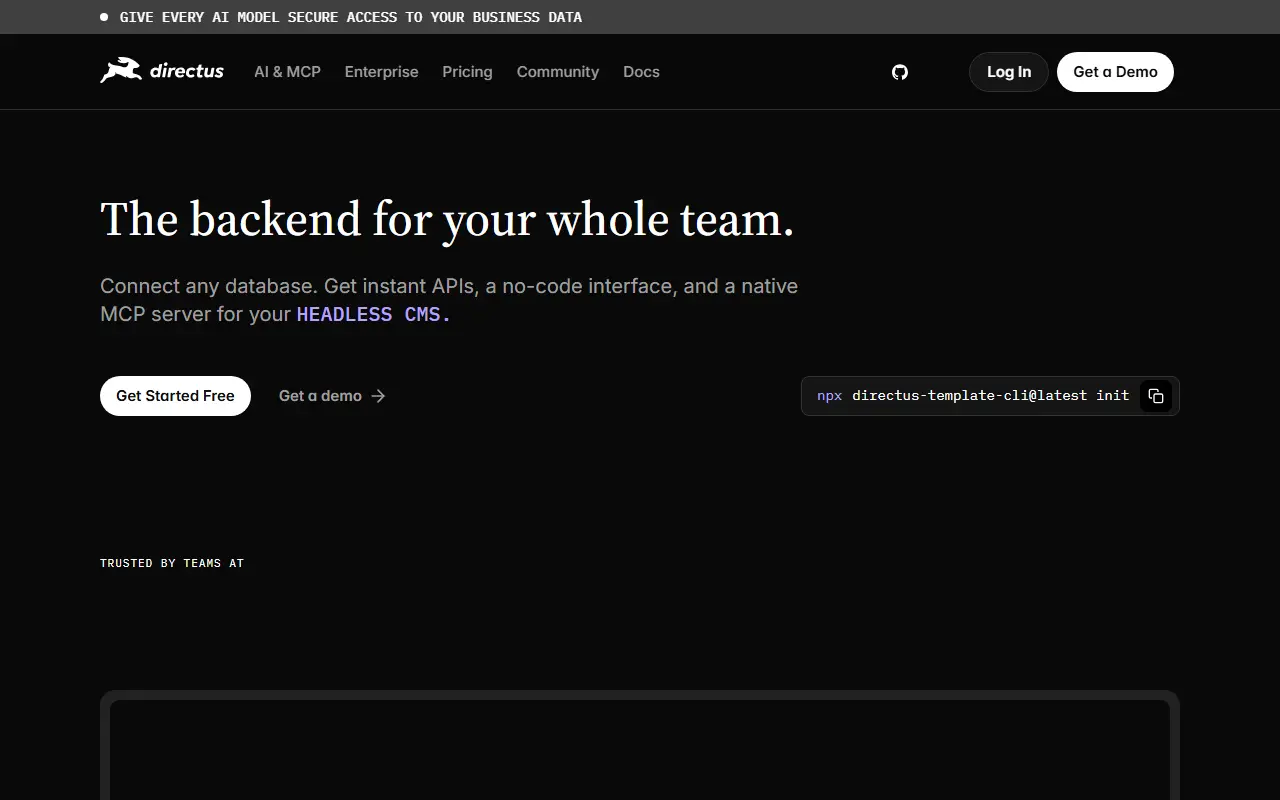
Directus is a collaborative backend and headless CMS that sits on top of an existing SQL database. You connect a database, and it generates production-ready REST and GraphQL APIs, leaving your schema exactly as built, along with a no-code interface where non-developers can manage content and data.
Beyond content management it provides authentication and access control, so the same install can power websites, apps, admin panels and internal tools. A native Model Context Protocol server gives AI assistants such as Claude, ChatGPT and Cursor secure access to business data. Supported databases include SQLite, MySQL, PostgreSQL and SQL Server, and the app is built with TypeScript and Vue. A template CLI, run through npx, can initialize a project quickly.
Directus can be self-hosted on servers you control, or run on the vendor's Directus Cloud. The repository license is listed as 'Other', so review the terms to see which uses are free. It suits teams that want an API and admin layer over data they already have, without writing a custom backend.
Key features
- Instant REST and GraphQL APIs over any SQL database
- No-code data and content interface
- Authentication and role-based access
- Native MCP server for AI assistants
- Works with SQLite, MySQL, PostgreSQL and SQL Server
- Project templates via npx CLI
Pricing: Core is free with 3 seats. Team is $599 per month billed monthly or $499 per month on an annual commitment; Enterprise is custom. Directus Cloud hosting is a $99 per month add-on, with a 14-day cloud trial.
#6
Open-source SDK for TypeScript and Go that provisions databases, Pub/Sub and more from code, plus an optional managed platform for deploying to AWS or GCP.
- GitHub stars
- 13k
- Last commit
- today
- Latest release
- v1.58.9
- Licence
- MPL-2.0
- Self-hosted
- Yes
- Hosted version
- Available
encore.dev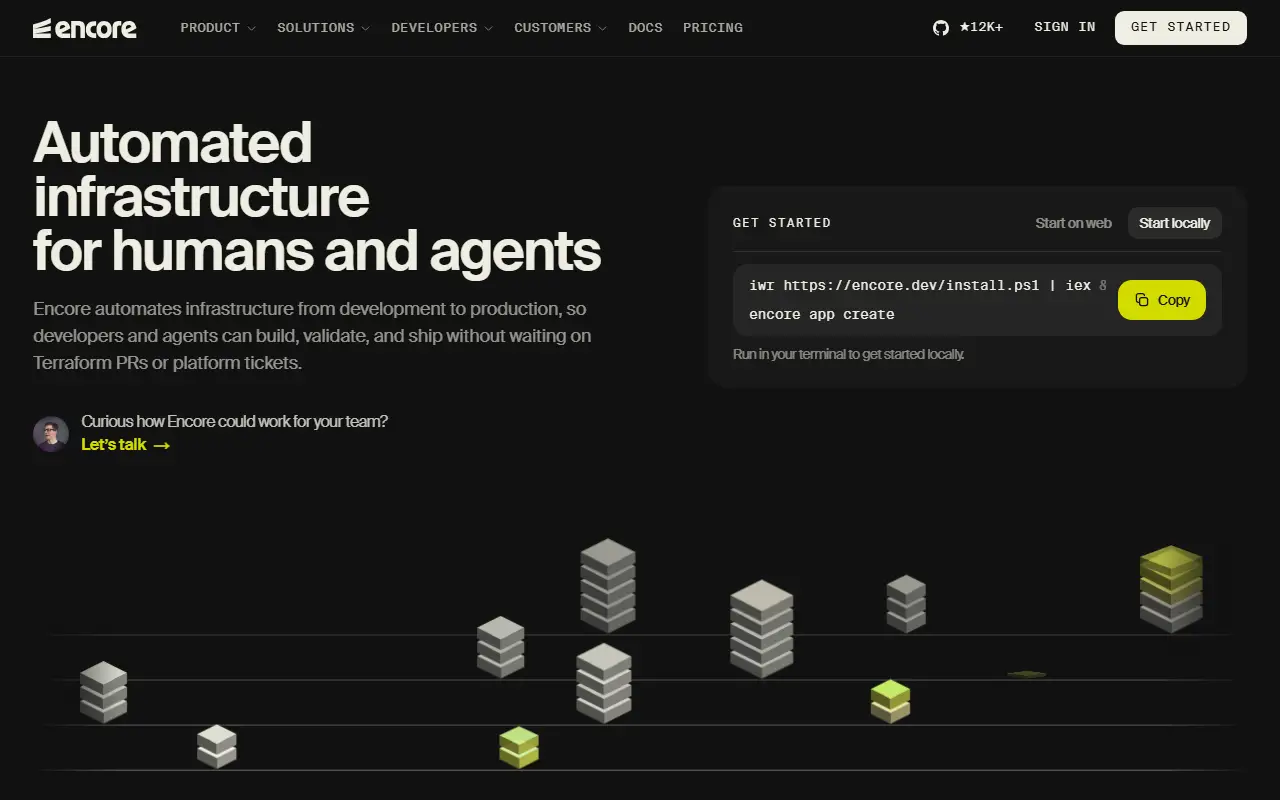
Encore is an infrastructure platform with two parts. The first is an open-source SDK for TypeScript and Go in which you declare the resources your application needs, such as databases, Pub/Sub, object storage, caches, cron jobs and secrets, directly in code. Running encore run then starts the whole system locally with real Postgres, Pub/Sub semantics and distributed tracing.
Each declaration becomes a node in the application graph, which maps to local equivalents during development and to cloud services at deployment, such as RDS or Cloud SQL, SNS plus SQS or Cloud Pub/Sub, and S3 or GCS. The second part is the Encore platform, an optional managed service that orchestrates cloud infrastructure, from preview environments for testing pull requests to provisioning resources in your own AWS or GCP account.
The SDK can also be used alone for local development, with infrastructure provisioned by Terraform or another tool of your choice. Encore is written in Go and licensed under MPL-2.0, and its pitch is that both engineers and AI agents can build production systems without waiting on infrastructure work.
Key features
- Declare databases and queues in application code
- Local run with real Postgres and tracing
- TypeScript and Go SDKs
- Preview environments for pull requests
- Deploys to your own AWS or GCP account
- Optional managed orchestration platform
Pricing: Free Starter plan. Pro costs $49 per member per month plus $99 per environment and $2.50 per resource, with a 14-day trial; Enterprise is custom.
#7
Hasura GraphQL Engine gives applications a single, secure API over databases such as PostgreSQL, MongoDB, ClickHouse and SQL Server.
- GitHub stars
- 32k
- Last commit
- 2 days ago
- Latest release
- v2.51.6
- Licence
- Apache-2.0
- Self-hosted
- Yes
- Hosted version
- Available
hasura.io
Hasura GraphQL Engine is an open-source project for building applications on top of existing data through a single, composable and secure API endpoint. It creates GraphQL APIs automatically, adds fine-grained access control, and can trigger webhooks on database events. The repository holds two generations: V2, the current stable engine, and the V3 engine that powers Hasura DDN. It is released under the Apache-2.0 license.
V3 supports PostgreSQL and its flavors, MongoDB, ClickHouse and Microsoft SQL Server, and lets you write custom business logic with TypeScript, Python and Go connector SDKs. Data connectors link sources to the engine, and the connectors are available as open source from the Connector Hub. The repository's topics also mention BigQuery, REST APIs and subgraph support. The repository is a large mono-repo, so shallow clones are recommended.
Key features
- Automatic GraphQL APIs over your data
- Fine-grained access control rules
- Webhooks triggered by database events
- Support for PostgreSQL, MongoDB, ClickHouse and SQL Server
- Connector SDKs for TypeScript, Python and Go
- V2 stable engine and V3 engine in one repository
Pricing: DDN Free costs nothing. DDN Advanced starts at $30 per active model per month, with a free trial; DDN Base also has a trial but its price is not shown. Private DDN and Enterprise support are by sales.
#8
Pulumi is an infrastructure as code platform that lets teams define cloud infrastructure in Node.js, Python, Go, .NET, Java or YAML.
- GitHub stars
- 26k
- Last commit
- yesterday
- Latest release
- v3.275.0
- Licence
- Apache-2.0
- Self-hosted
- Yes
- Hosted version
- Available
pulumi.com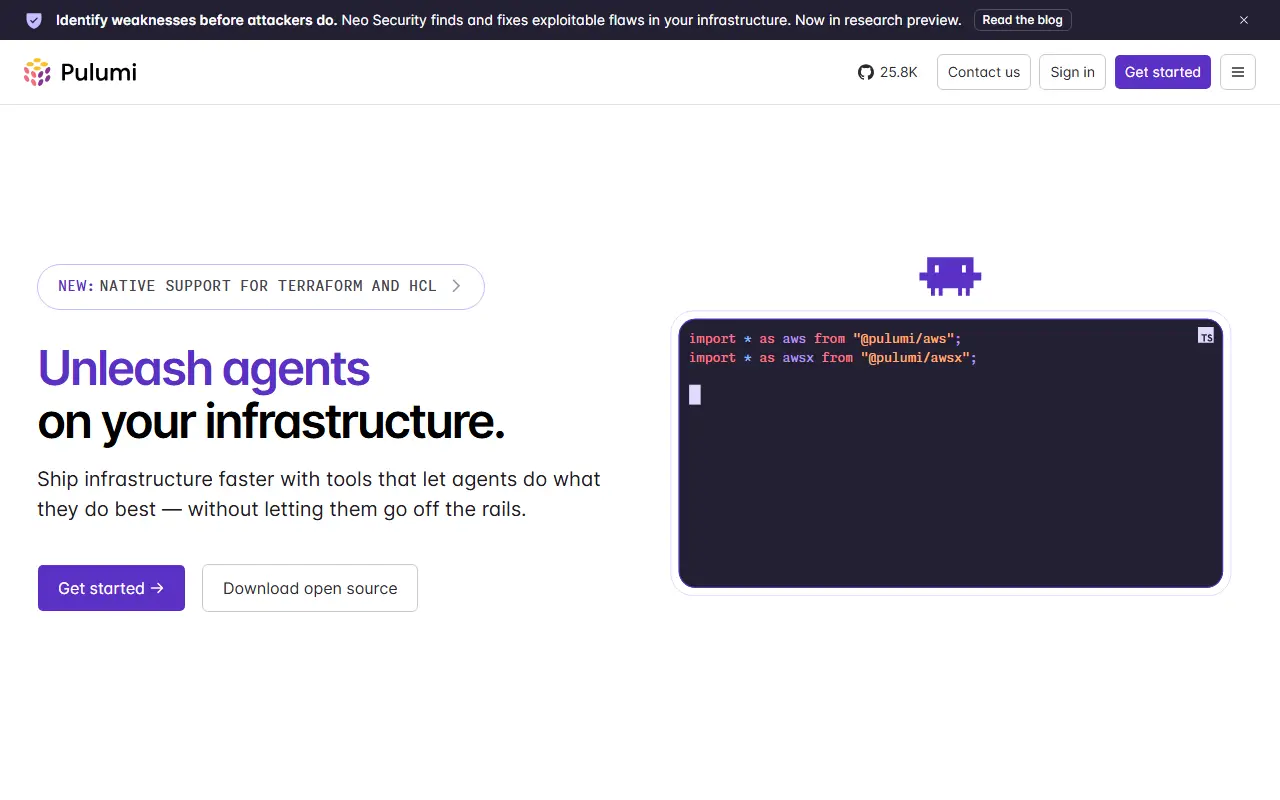
Pulumi is an infrastructure as code platform. Teams describe infrastructure for any cloud in a general-purpose language: Node.js, Python, Go, .NET, Java, or YAML. A registry lists hundreds of cloud providers and packages.
Around the core tool sit services for secrets and configuration, discovery and governance, an internal developer platform, and an AI agent named Neo. The Free plan covers one user with state management and Pulumi Deployments; Essentials, Pro and Enterprise add users, policy, SSO, audit logs and more.
The licence listed for the project is Apache-2.0. The pricing page says Pulumi stays free for open source and individuals, and the Enterprise plan lists self-hosting as available.
Key features
- Infrastructure as code in several languages
- AI infrastructure agent called Neo
- Environments, secrets and configuration management
- Asset management and compliance remediation
- Registry of cloud providers and packages
- Unlimited projects, stacks and environments on Free
- SSO, RBAC and policy enforcement on Pro
Pricing: Free is $0 for 1 user. Essentials is $40/month (up to 500 managed resources), Pro $400/month (up to 2,000), Enterprise $2,000/month (up to 4,750). Credits: 40, 400 and 2,000.
#9
An open-source backend for Node.js and Express that provides REST and GraphQL APIs, Cloud Code and storage on MongoDB or PostgreSQL, deployable on any Node-capable host.
- GitHub stars
- 21k
- Last commit
- 2 days ago
- Latest release
- 8.6.123
- Licence
- Apache-2.0
- Self-hosted
- Yes
parseplatform.org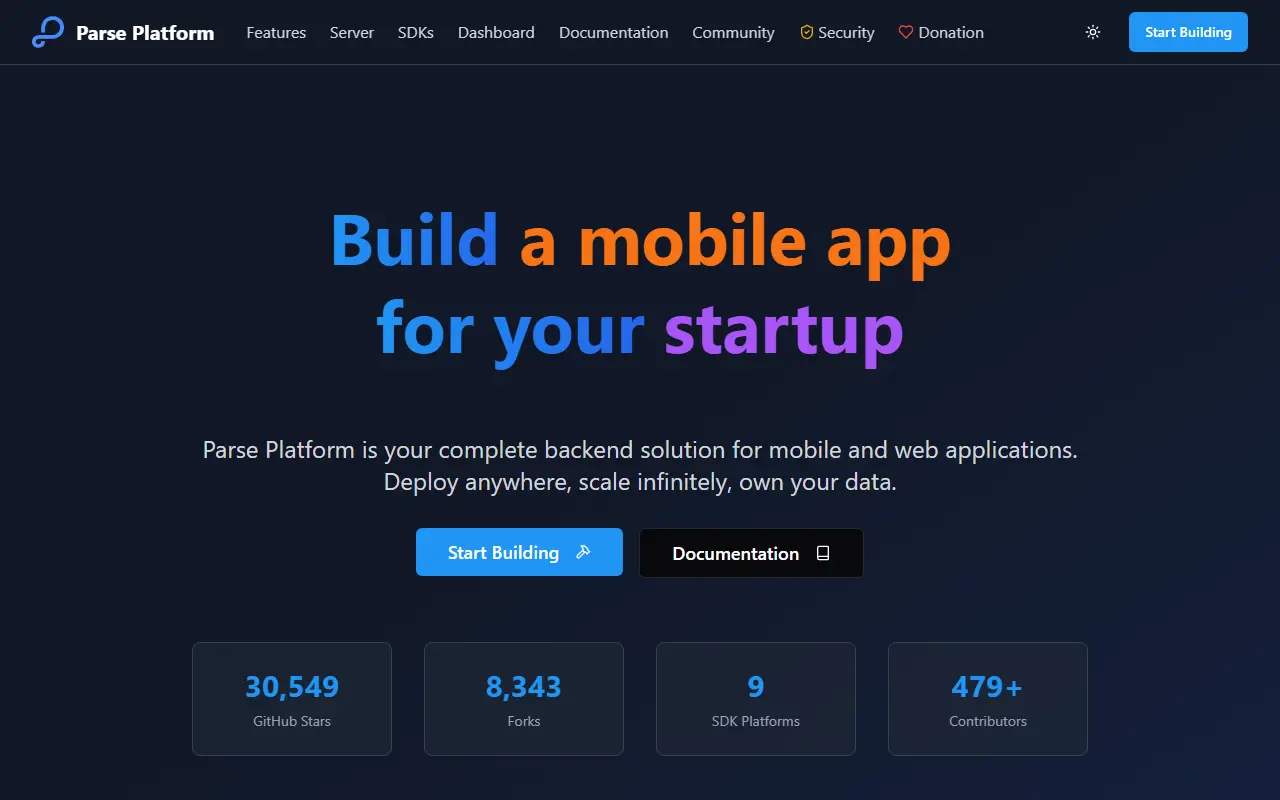
Parse Server is an open-source backend that runs anywhere Node.js can run. It works with the Express web framework, so you can mount it inside an existing web application or run it by itself, and it is the maintained successor to the original hosted Parse platform. Topics identify it as a mobile backend as a service with REST and GraphQL APIs.
The documentation covers the full lifecycle: running Parse Server locally or in a Docker container, saving and querying objects, connecting an SDK, configuring options and access scopes, and deploying elsewhere. It works with MongoDB and PostgreSQL as databases and offers Cloud Code for custom server logic, file storage, and a health endpoint for monitoring. A guide, API reference and Cloud Code guide help with getting started, and long-term-support branches exist alongside the current release.
Parse Server is written in JavaScript and licensed under Apache-2.0, with development supported by sponsors and backers on Open Collective. It suits teams that want a Firebase-style backend they host themselves, particularly mobile developers who already use the Parse SDKs.
Key features
- Node.js and Express backend
- REST and GraphQL APIs
- MongoDB and PostgreSQL support
- Cloud Code for custom server logic
- Client SDKs for mobile and web
- Docker container deployment
Pricing: Free and open source under the Apache-2.0 license.
#10
The open-source reactive database and backend for web app developers, with server functions written in TypeScript and live-updating queries, offered in the cloud or self-hosted.
- GitHub stars
- 13k
- Last commit
- today
- Latest release
- precompiled-2026-10-22-1447815
- Self-hosted
- Yes
- Hosted version
- Available
docs.convex.dev
Convex is an open-source reactive database and backend platform for web app developers. It provides a database, a place to write server functions in TypeScript, and client libraries, and it is designed to make building and scaling live-updating applications straightforward, whether the author is a person or an LLM.
Data is fetched and business logic is run with strong consistency by writing pure TypeScript. Applications built on it update automatically when the underlying data changes, which removes much of the work of wiring up real-time sync. The Convex team leads development of the backend, and the repository, written in Rust and TypeScript, is kept in sync with internal work within days.
The simplest path is Convex's cloud platform, which includes a free tier for small applications and side projects. A self-hosted product with most cloud features, including the dashboard and CLI, can be run with Docker, which is recommended, or a prebuilt binary, and works with databases and hosts such as Postgres, SQLite, Neon and Fly.io. The repository lists the licence as Other, and the extensive internal tests are not included.
Key features
- Reactive database with live-updating queries
- Server functions written in TypeScript
- Strong consistency for reads and logic
- Client libraries for web apps
- Dashboard and CLI included
- Self-hosting with Docker or a binary
Pricing: Cloud platform with a free tier for small apps; a self-hosted version is also available. The repository lists the license as Other.
3 more Zoho Catalyst alternatives
Commercial Zoho Catalyst alternatives
Hosted, closed-source products that compete with Zoho Catalyst. Showing 12 of 18.
- View tool

Back4App
Backend as a Service
Hosted backend built on Parse Server with a database, auth and cloud functions
SaaS
- View tool

Backendless
Backend as a Service
Visual backend platform with a database, user management and API services
SaaS
- View tool

Firebase
Backend as a Service
Firebase is Google's mobile and web app development platform, bundling authentication, databases, hosting, messaging and analytics as a managed backend.
SaaS
- View tool

Huawei AppGallery Connect
Backend as a Service
Huawei backend services suite for auth, storage, cloud functions and push
SaaS
- View tool
No-code backend builder with a database, API editor and business logic
SaaS
- View tool
Serverless compute that runs functions on demand without managing servers
SaaS
- View tool

Google Cloud Run
Hosting & PaaS
Serverless platform for running containers that scale to zero on Google Cloud
SaaS
- View tool

AWS Amplify
Hosting & PaaS
AWS service for hosting web apps and provisioning backends through a CI/CD workflow
SaaS
- View tool
Netlify is a web hosting and deployment platform for building and shipping sites and apps, with deploy previews, serverless functions and an edge network.
SaaS
- View tool

Azure Functions
Hosting & PaaS
Serverless compute on Azure that runs event-driven code without managing servers
SaaS
- View tool

Cloudflare Workers
Hosting & PaaS
Serverless runtime that executes JavaScript and Wasm at Cloudflare edge locations
SaaS
- View tool
Vercel is a cloud platform for deploying web applications and AI agents, from the company behind Next.js, with a CDN, serverless compute and AI tooling.
SaaS
See every Zoho Catalyst alternative on its tool page
Zoho Catalyst alternatives: questions
- What is the best open-source alternative to Zoho Catalyst?
- Supabase is the top-ranked open-source alternative to Zoho Catalyst on Enlisted: An open-source Postgres development platform bundling a database, auth, auto-generated APIs, realtime, storage and vector tools, often chosen as a Firebase alternative. Other strong options are Appwrite, Strapi, PocketBase and Directus.
- What are the best commercial alternatives to Zoho Catalyst?
- Back4App, Backendless, Firebase, Huawei AppGallery Connect and Xano are among the hosted, closed-source alternatives to Zoho Catalyst listed on Enlisted, which lists 18 in total. Compare their pricing and features on each tool page.
- Are these Zoho Catalyst alternatives free?
- All 13 are open source, so the code is free to use under its licence, and all of them can be self-hosted on your own server or computer. 10 also offer a paid or managed cloud version if you'd rather not host it yourself.
- How is this list of Zoho Catalyst alternatives ranked?
- By a score built from GitHub stars, star growth over the last 30 days and how recently the code changed. 13 of these projects shipped code in the last 30 days. Data is refreshed daily, and nobody can pay to move up.
 TrackMedia
 TrackRev