7,363 open-source and SaaS tools, with GitHub stats refreshed every day.

4 alternatives ranked by real activity

Open-source You.com alternatives

A curated, ranked list of the 4 best open-source alternatives to You.com.

The best open-source alternative to You.com is Vane. If that doesn't suit you, other good options are Morphic, Scira and Farfalle.

You.com alternatives are mainly AI tools, but some are also search tools. 1 of them shipped code in the last 30 days, 4 can be self-hosted, and 3 use a permissive licence.

Last updated October 2, 2026 · ranked by GitHub stars, growth and recent commits

Vane

Vane is a privacy-focused, self-hosted AI answering engine that combines web search via SearxNG with local or cloud language models and cites sources.

GitHub stars
37k
Last commit
1 mo ago
Latest release
v1.12.2
Licence
MIT
Self-hosted
Yes

Vane is an AI answering engine that runs on your own hardware. It combines information from the internet with support for local language models through Ollama and cloud providers such as OpenAI, Anthropic Claude, Google Gemini and Groq, and returns answers with cited sources while keeping searches private. Repository topics also reference Perplexica.

Search modes trade speed for depth: Speed Mode for quick answers, Balanced Mode for everyday queries and Quality Mode for deeper research. Sources can be the web, discussions or academic papers, and web search is powered by SearxNG, which queries multiple search engines without exposing your identity. Image and video search, domain-restricted search and file uploads for questions about PDFs, text files and images are included.

Other features include widgets for quick lookups like weather, calculations and stock prices, search suggestions as you type, a Discover feed of articles, and a saved search history. Vane is written in TypeScript and released under the MIT license, and its architecture is documented for readers who want to understand how it works.

Key features

  • Cited AI answers from web search
  • Local models via Ollama or cloud providers
  • Speed, Balanced and Quality search modes
  • SearxNG-powered private web search
  • File uploads for document questions
  • Image and video search

Pricing: Free and open source under the MIT license.

Read more about VaneGitHub

Morphic

Morphic is an open-source AI search engine that returns cited answers and renders them as rich, generated interface components instead of plain text.

GitHub stars
9.2k
Last commit
2 days ago
Latest release
v1.7.0
Licence
Apache-2.0
Self-hosted
Yes
Hosted version
Available
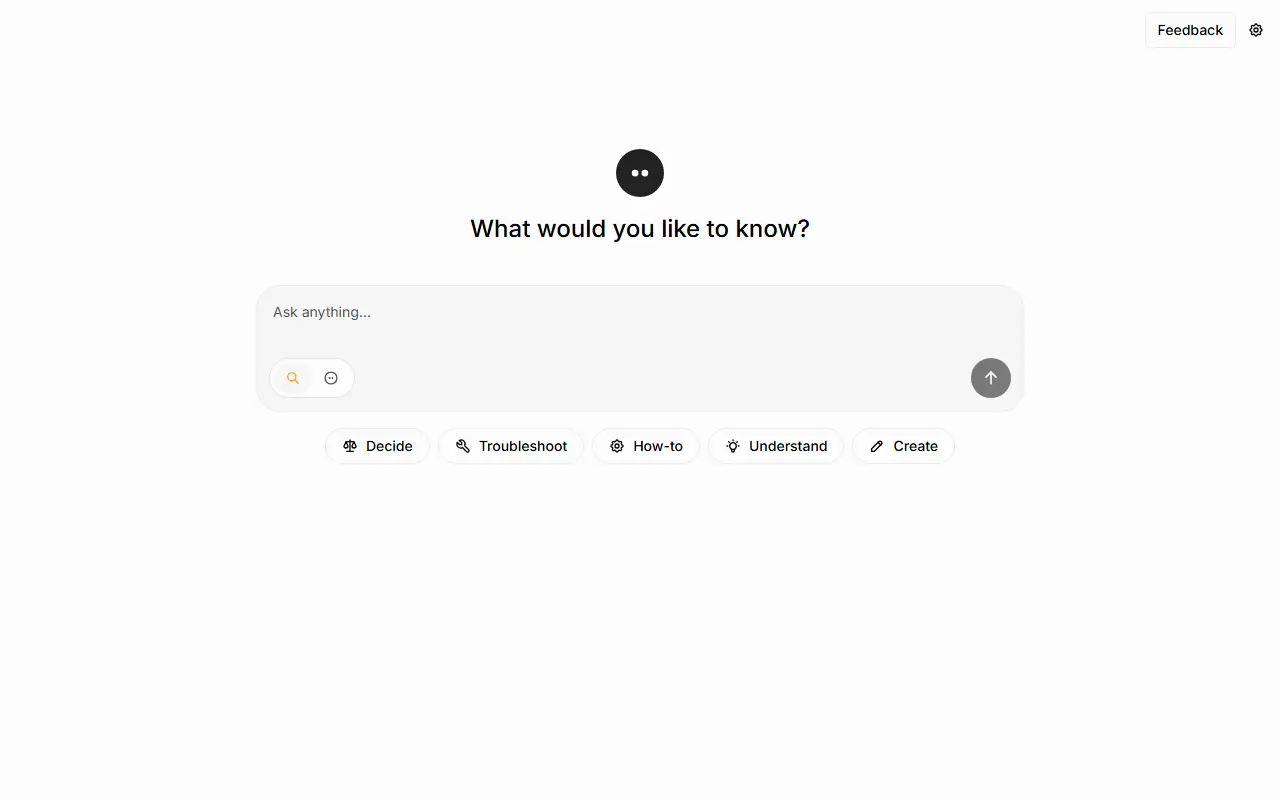
chat.morphic.shMorphic homepage screenshot

Morphic is an AI-powered search engine with a generative user interface. It answers questions with sources attached, and instead of returning plain markdown it renders richer inline components such as source-credited images, grids and headings built from a streamed specification.

It supports Quick and Adaptive search modes and lets you pick from several model providers, including OpenAI, Anthropic, Google and Ollama, as well as OpenAI-compatible endpoints. Search can run through Tavily, SearXNG, Brave or Exa. Chat history is stored in PostgreSQL, results can be shared through unique URLs, files can be uploaded, and Supabase Auth handles sign-in, with a guest mode for anonymous use.

Morphic is built with Next.js, React, TypeScript and Tailwind CSS under the Apache-2.0 licence. A Docker Compose setup starts PostgreSQL, Redis, SearXNG and the app together, so no separate search API key is required, although at least one AI provider key must be configured. It can also be deployed to Vercel.

Key features

  • Cited AI answers grounded in search results
  • Generative UI with rich inline components
  • Quick and Adaptive search modes
  • Selectable model providers including Ollama
  • Shareable search results by unique URL
  • Docker Compose deployment with bundled SearXNG

Pricing: Free and open source under Apache-2.0; self-hosting requires your own API key for at least one AI model provider.

Scira

Scira is an open-source AI search and research tool that plans, retrieves and cites sources, accepting questions, PDFs and URLs.

GitHub stars
12k
Last commit
1 mo ago
Licence
AGPL-3.0
Self-hosted
Yes
Hosted version
Available
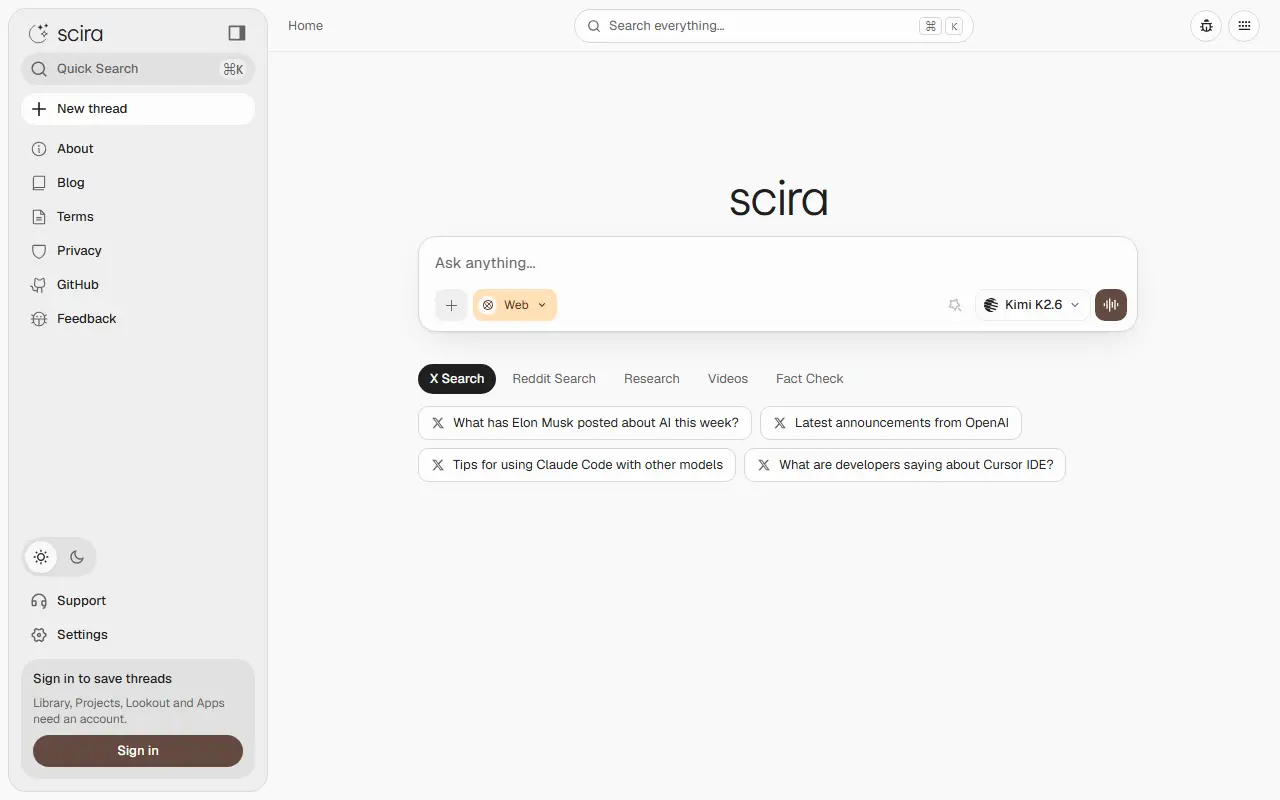
scira.aiScira homepage screenshot

Scira, formerly called MiniPerplx, is a minimalistic AI search tool that finds information online and cites where it came from. The project describes it as an agentic research platform that plans, retrieves and cites, and it is available as a hosted site at scira.ai.

You can start by asking a question, uploading a PDF or pasting a link. Behind it, the README credits the Vercel AI SDK for model integration and streaming, Exa AI for web search and content retrieval, and Upstash for serverless Redis and rate limiting. It is written in TypeScript as a web app you can run yourself with your own provider keys.

Scira is licensed under AGPL-3.0, so modified versions offered over a network must share their source. It suits developers who want a reference AI search app to run or adapt, and individuals who want a cited, minimalistic alternative to conventional search.

Key features

  • AI search with cited sources
  • Agentic research that plans and retrieves
  • PDF upload and URL input
  • Built on the Vercel AI SDK
  • Web search through Exa
  • Self-hostable TypeScript app

Pricing: Free plan allows 3 searches a day. Pro costs $15 per month ($9 with a student email) and Max $60 per month for higher model limits and image generation.

Farfalle

Farfalle is a free, Apache-licensed, self-hostable AI search engine that answers questions using local or cloud LLMs, positioned as an open alternative to Perplexity.

GitHub stars
3.5k
Last commit
2 yr ago
Licence
Apache-2.0
Self-hosted
Yes
Hosted version
Available

Farfalle is an open-source AI-powered search engine, described by its creator as a Perplexity clone, that lets you search the web and get synthesized answers. It is aimed at developers and privacy-minded users who want to self-host this kind of search experience and choose their own model provider rather than depend on a closed commercial service.

It supports local models through Ollama, such as Llama 3, Mistral, Gemma and Phi-3, custom models through LiteLLM, and cloud models including Groq-hosted Llama 3 and OpenAI's GPT-4o. Search results can come from multiple providers, including Tavily, SearXNG, Serper or Bing, and the project supports chat history, an agent mode that plans and executes a search for better results, and expert search.

The stack uses Next.js for the frontend and FastAPI for the backend, with Redis for rate limiting and shadcn/ui components. Running it locally requires Docker and, for local models, Ollama; API keys for search and cloud model providers are optional depending on which features are used. Farfalle is written in TypeScript and released under the Apache-2.0 license, with a cloud-model-only live demo available.

Key features

  • AI-generated answers from web search
  • Local LLM support via Ollama
  • Multiple search providers (Tavily, SearXNG, Serper, Bing)
  • Agent mode that plans multi-step searches
  • Chat history and expert search modes
  • Docker-based self-hosted deployment

Pricing: Free and open source under the Apache-2.0 license; cloud model and search providers used with it are billed separately, while local Ollama models require no provider account.

You.com alternatives: questions

What is the best open-source alternative to You.com?
Vane is the top-ranked open-source alternative to You.com on Enlisted: Vane is a privacy-focused, self-hosted AI answering engine that combines web search via SearxNG with local or cloud language models and cites sources. Other strong options are Morphic, Scira and Farfalle.
Are these You.com alternatives free?
All 4 are open source, so the code is free to use under its licence, and all of them can be self-hosted on your own server or computer. 3 also offer a paid or managed cloud version if you'd rather not host it yourself.
How is this list of You.com alternatives ranked?
By a score built from GitHub stars, star growth over the last 30 days and how recently the code changed. 1 of these projects shipped code in the last 30 days. Data is refreshed daily, and nobody can pay to move up.

People also look for alternatives to…

View all