7,363 open-source and SaaS tools, with GitHub stats refreshed every day.

24 alternatives ranked by real activity

Open-source WeTransfer alternatives

A curated, ranked list of the 24 best open-source alternatives to WeTransfer.

The best open-source alternative to WeTransfer is LocalSend. If that doesn't suit you, other good options are croc, Magic Wormhole, OnionShare and MicroBin.

WeTransfer alternatives are mainly file storage & sharing tools. 16 of them shipped code in the last 30 days, 24 can be self-hosted, and 12 use a permissive licence.

Last updated October 2, 2026 · ranked by GitHub stars, growth and recent commits

LocalSend

A free cross-platform app for sending files and messages to nearby devices over your local network, with no internet connection or account required.

GitHub stars
93k
Last commit
yesterday
Latest release
v1.18.2
Licence
Apache-2.0
Self-hosted
Yes
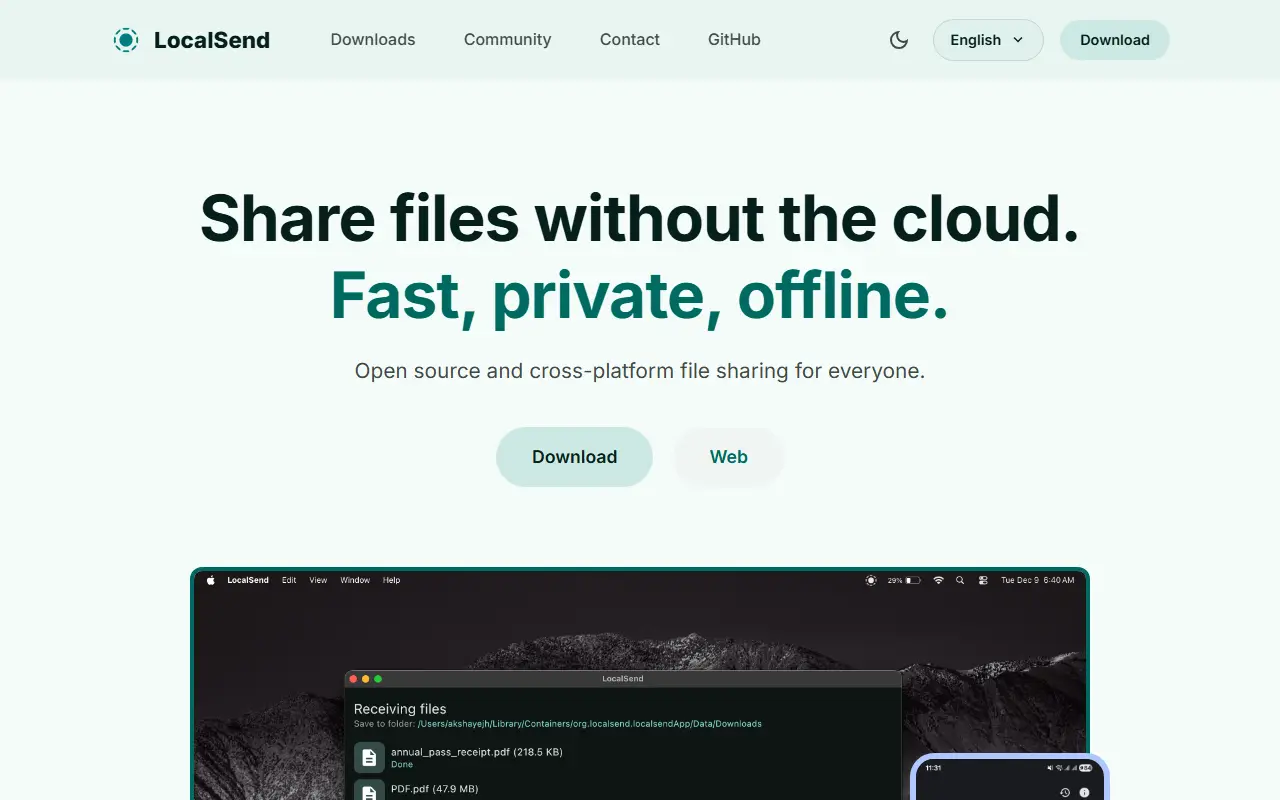
localsend.orgLocalSend homepage screenshot

LocalSend is an open-source app for sharing files and messages between devices on the same local network. It is described as a cross-platform alternative to AirDrop, so phones, tablets and computers running different operating systems can exchange data directly without routing it through a cloud service.

Devices talk to each other through a REST API protected by HTTPS encryption, so no external servers or internet access are needed, which keeps transfers quick and files inside your network. The app is built with Flutter and Dart, and builds are documented for Android, iOS, macOS, Windows and Linux. There is also a command line interface, and community members contribute translations through Weblate.

LocalSend is free under the Apache-2.0 license. The maintainers recommend installing it from an app store or a package manager, and the source is available on both GitHub and Codeberg. Because it needs no account or sign-in, it is a lightweight option for people who regularly move files between their own devices.

Key features

  • Sends files and text between nearby devices
  • Works without internet or third-party servers
  • HTTPS-encrypted transfers over a REST API
  • Apps for Android, iOS, macOS, Windows and Linux
  • Command line interface
  • Translations contributed by the community

Pricing: Free and open source under the Apache-2.0 license.

croc

A cross-platform command line tool for sending files and folders between any two computers with end-to-end encryption, resumable transfers and no port forwarding.

GitHub stars
40k
Last commit
yesterday
Latest release
v11.5.4
Licence
MIT
Self-hosted
Yes
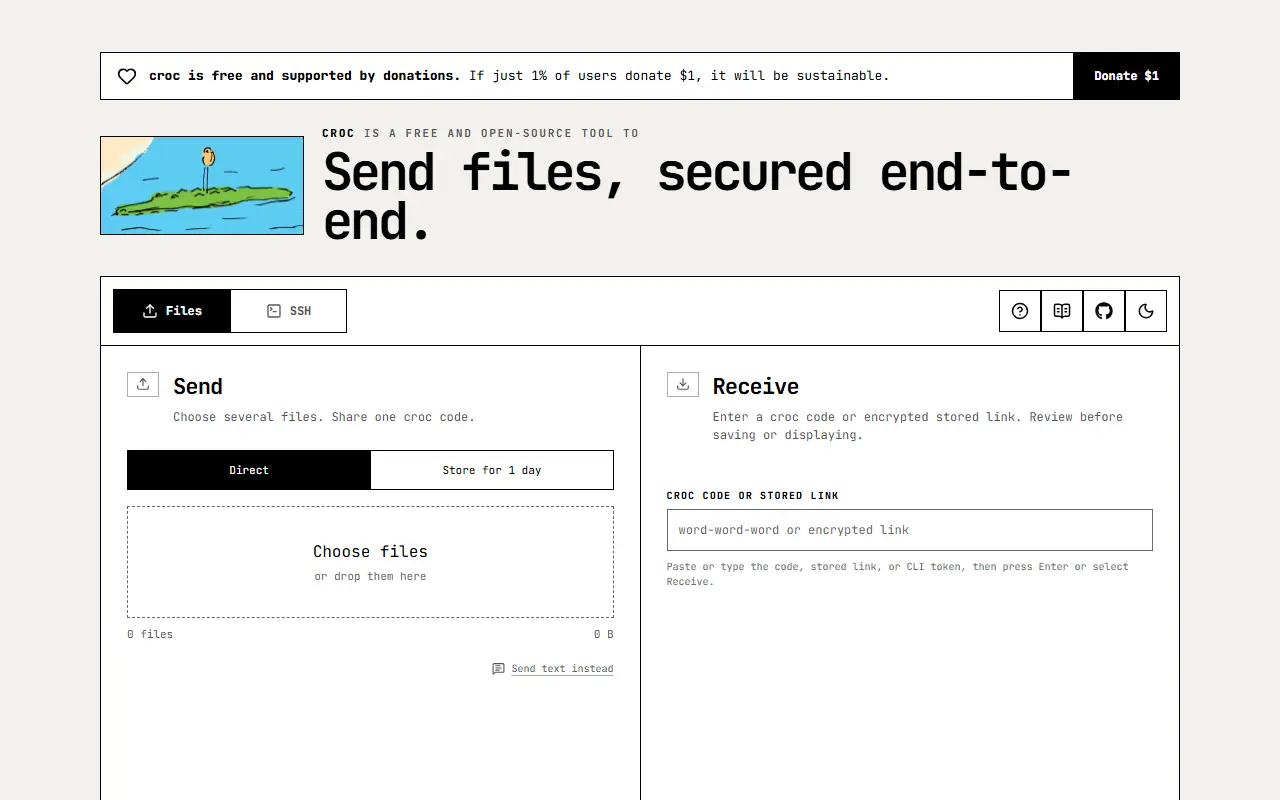
getcroc.comcroc homepage screenshot

croc is a command line tool for transferring files and folders between any two computers. The sender gets a short code phrase, the receiver types it in, and the data moves directly between them where possible, falling back to a relay when a direct connection is not available. It is written in Go and runs on Windows, Linux and macOS.

Transfers are end-to-end encrypted using a password-authenticated key exchange, so the relay cannot read your files. Other capabilities include sending multiple files at once, resuming transfers that were interrupted, IPv6-first networking with IPv4 fallback, and routing through a proxy such as Tor. You do not need to set up a local server or forward ports. A browser version at getcroc.com is compatible with the command line client, so you can send and receive between them without installing anything.

croc is MIT licensed and can be installed from a release download or the command line. The maintainer notes that the project relies on community sponsorship. It suits anyone who regularly needs to move files between machines without cloud storage or accounts.

Key features

  • Code phrase pairing for transfers
  • End-to-end encryption using PAKE
  • Peer-to-peer with relay fallback
  • Resumable transfers and multiple files
  • No server setup or port forwarding
  • Browser version compatible with the CLI

Pricing: Free and open source under the MIT license.

Read more about crocWebsite GitHub

Magic Wormhole

Magic Wormhole is a Python library and command-line tool for safely sending files, folders or text between two computers using short codes.

GitHub stars
23k
Last commit
9 days ago
Licence
MIT
magic-wormhole.readthedocs.ioMagic Wormhole homepage screenshot

Magic Wormhole is a Python package that provides a library and a command-line tool named wormhole. It moves files and directories of any size, or brief snippets of text, between two computers. The two ends are matched by an identical wormhole code: the sending machine generates and shows it, and the receiving person types it in. It is released under the MIT license.

Codes are short, single-use and human-pronounceable, drawn from a phonetically distinct word list, and the receiving side offers tab completion so usually only a few characters are needed. Nothing has to be memorized. The program relies on two servers, a mailbox server and a transit relay, whose source code lives in separate repositories. The library works with Python 3.10 and newer, packages exist in many operating systems, and complete documentation is on Read the Docs along with a PyCon 2016 talk.

Key features

  • Send files, folders or text between computers
  • Short single-use pronounceable codes
  • Tab completion for entering codes
  • Python library and wormhole CLI
  • Mailbox server and transit relay components
  • Packaged for many operating systems

Pricing: Free and open source under the MIT license.

OnionShare

An open-source tool for sharing files, hosting websites and chatting anonymously over the Tor network, with desktop and mobile apps.

GitHub stars
7.1k
Last commit
yesterday
Latest release
v2.6.5
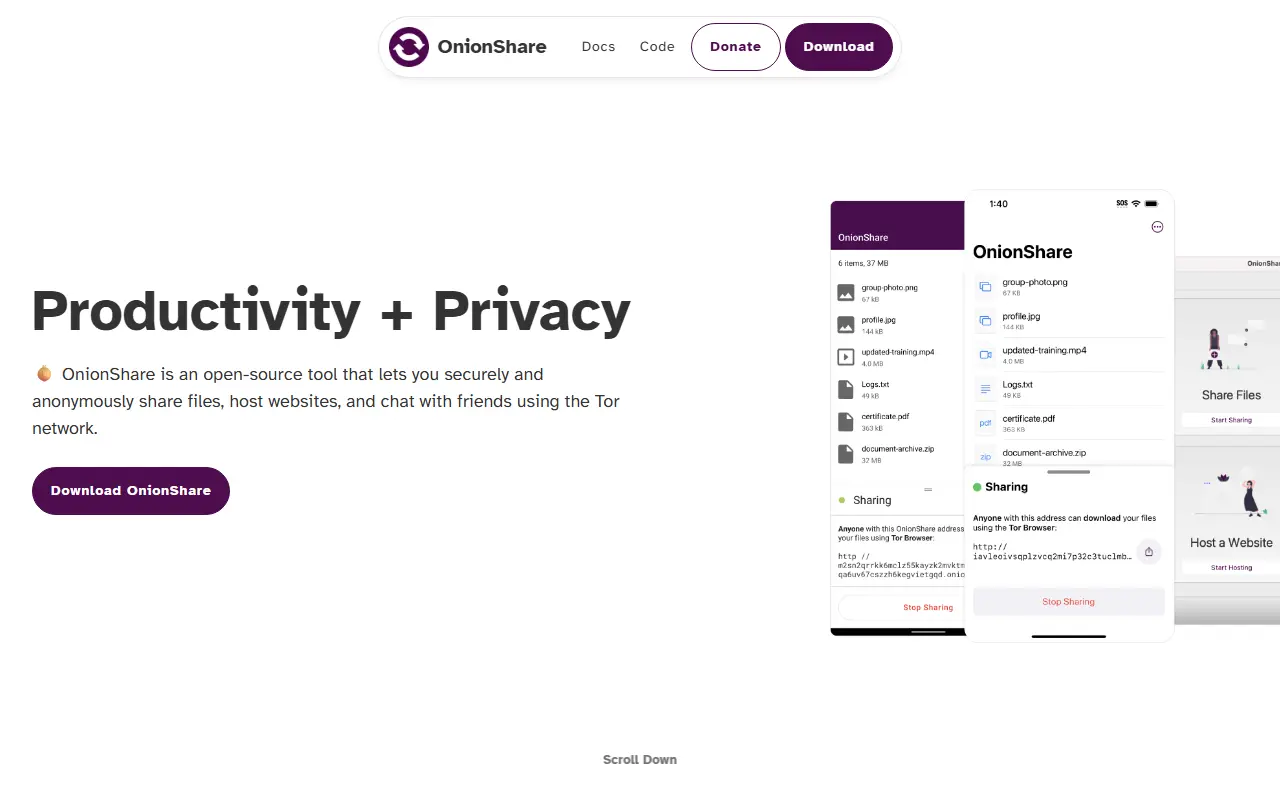
onionshare.orgOnionShare homepage screenshot

OnionShare is a tool, open source, for sharing files, hosting websites and chatting with others securely and anonymously through the Tor network. It works peer to peer: your computer starts a temporary onion service, and recipients use Tor Browser to reach it, so no third-party server holds the files.

Beyond file sharing, it can host an onion site, run a chat room and create a private drop box for receiving files. It is available as desktop apps for Windows, macOS and Linux, and mobile apps for Android and iOS developed in collaboration with the Guardian Project and The Calyx Institute. It comes preinstalled in privacy-focused operating systems such as Qubes OS, Tails and Parrot OS.

OnionShare is written in Python and developed by the Lockdown Systems collective, released under GPLv3 according to its website, while the repository lists the license as Other. Like all software it may contain bugs or vulnerabilities. It suits journalists, activists and anyone needing private file transfer without relying on cloud services.

Key features

  • Anonymous file sharing over Tor
  • Hosting onion websites
  • Chat rooms over Tor
  • Private file drop box
  • Desktop apps for Windows, macOS and Linux
  • Android and iOS apps
  • Preinstalled in Tails and Qubes OS

Pricing: Free and open source; the website states the GPLv3 licence.

MicroBin

A tiny self-hosted paste bin, file-sharing and URL shortening web app written in Rust, shipped as a single executable with optional encryption.

GitHub stars
4.6k
Last commit
24 days ago
Latest release
v2.1.0
Licence
BSD-3-Clause
Self-hosted
Yes

MicroBin is a small, self-contained and self-hosted paste bin web application written in Rust. It is quick to set up and needs only a few megabytes of memory and disk storage, and it ships as a single executable file.

An upload can be a pasted text, one or more attached files, or a URL redirection. Uploads can be private or public, editable or read-only, and set to expire automatically or never. Other features include server-side and client-side end-to-end encryption, QR code support, raw text serving, animal names as upload identifiers, automatic dark mode, and SQLite or JSON storage.

People use it to send long texts or large files, share sensitive documents, shorten URLs and serve configuration files or images through its raw endpoint. It can be installed through a Docker setup script or from Cargo, and is licensed under BSD-3-Clause. The project website offers screenshots, documentation and a roadmap.

Key features

  • Paste bin for text and code
  • File uploads with multiple attachments
  • URL shortening and redirection
  • Server-side and client-side E2E encryption
  • Expiring and non-expiring uploads
  • QR code support
  • SQLite and JSON database support
  • Single self-contained executable

Pricing: Free and open source under the BSD-3-Clause licence.

Zipline

Self-hosted file upload server built around ShareX, with short URLs, folders, tags, and sharing controls for people who want to run their own screenshot and file host.

GitHub stars
3.4k
Last commit
5 days ago
Latest release
v4.8.0
Licence
MIT
Self-hosted
Yes
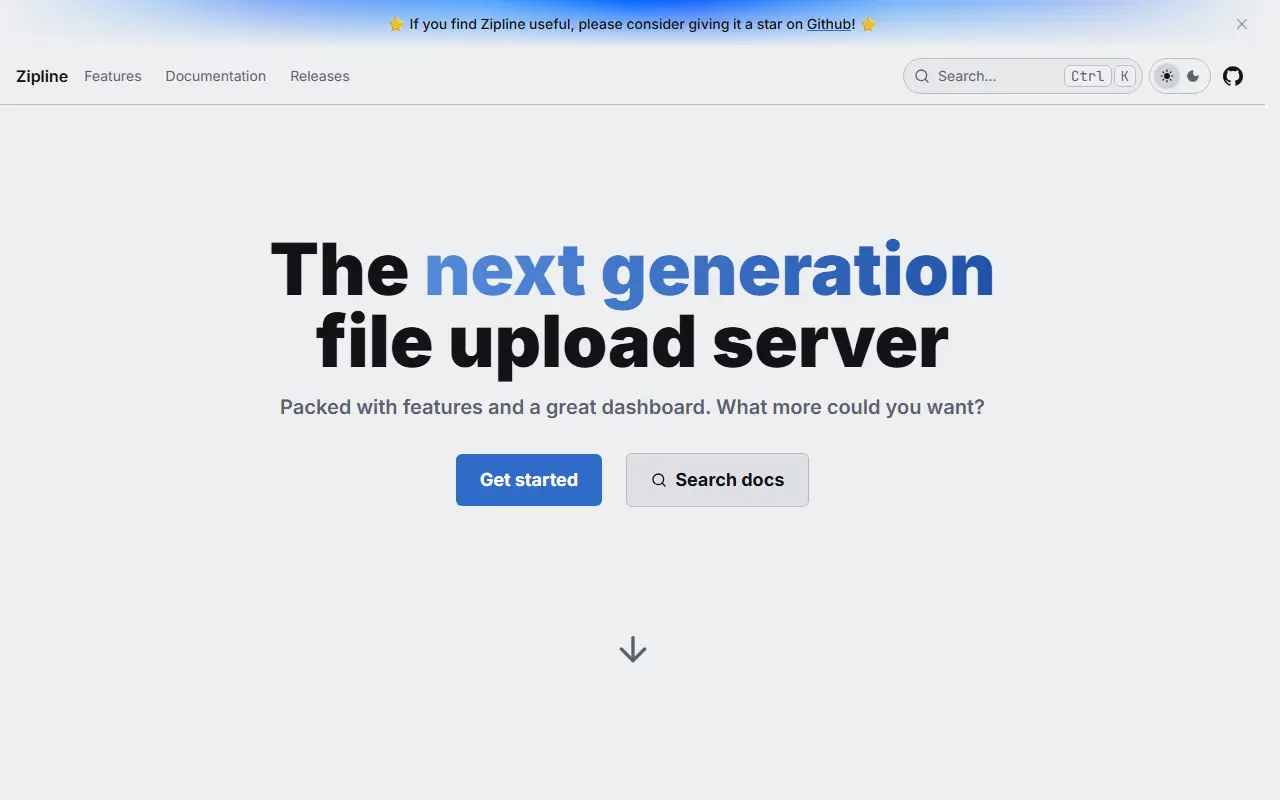
zipline.diced.shZipline homepage screenshot

Zipline is an open-source file upload server that you run yourself. It began as a destination for ShareX screenshot and file uploads and has grown into a general personal or team file host with a web interface, an API, and a gallery view for uploaded media. It is released under the MIT license.

Uploads can be organized into folders and tags, shortened into compact URLs, and shared with embeds that preview cleanly in chat apps. Access can be tightened with password-protected links, invite-only registration, per-user quotas, OAuth2 sign-in, two-factor authentication, and passkeys. Image compression, video thumbnails, and partial uploads help with larger files, and webhooks can notify Discord or any HTTP endpoint.

Deployment is Docker-based: you mount volumes for uploads, public assets, and custom themes, and set a secret value before the first start. The host CPU must support AVX instructions, because the project does not publish builds for older processors. Zipline suits individuals, communities, and small teams who want a private alternative to public image and file hosts.

Key features

  • ShareX-compatible upload endpoint
  • Folders and tags for organizing uploads
  • URL shortening for shared files
  • Password-protected links and invite-only signups
  • OAuth2, two-factor authentication, and passkeys
  • Image compression and video thumbnails
  • Discord and HTTP webhooks
  • Custom themes and per-user quotas

Pricing: Free and open source under the MIT license; you run it on your own server.

Gokapi

Gokapi is a lightweight, self-hosted file sharing server in the spirit of Firefox Send, with expiring links, encryption and S3 storage support.

GitHub stars
2.9k
Last commit
20 days ago
Latest release
v2.2.4
Licence
AGPL-3.0
Self-hosted
Yes

Gokapi is a self-hosted tool for sharing files, presented as an alternative to Firefox Send. It is written in Go and runs on Linux, macOS and Windows or in a Docker container. Unlike many upload services, it does not allow public uploads: only registered users can add files, which keeps the instance under the owner's control.

Shares can expire automatically after a set number of downloads or days. A file request feature gives outside parties a link to upload files that only the link's creator can see. Other features include user management with roles, file deduplication so identical files use no extra space, built-in encryption including end-to-end encrypted uploads, a REST API for automation and a UI that can be customized with CSS and JavaScript.

Storage can be local or AWS S3, including S3-compatible services such as Backblaze B2. OpenID Connect support allows sign-in through providers like Authelia or Keycloak. The minimum requirements are modest, around one CPU core and a few hundred megabytes of memory, and a setup wizard runs on first launch. Gokapi is licensed under AGPL-3.0.

Key features

  • Expiring file shares by downloads or days
  • Upload restricted to registered users
  • File requests for outside uploaders
  • File deduplication to save space
  • End-to-end encrypted uploads
  • S3 and Backblaze B2 storage support
  • OpenID Connect sign-in
  • REST API for automation

Pricing: Free and open source under AGPL-3.0.

Read more about GokapiGitHub

Chibisafe

Chibisafe is a self-hosted file uploader written in TypeScript that returns shareable links, with albums, quotas and S3 storage.

GitHub stars
2.8k
Last commit
today
Latest release
v6.5.5
Licence
MIT
Self-hosted
Yes
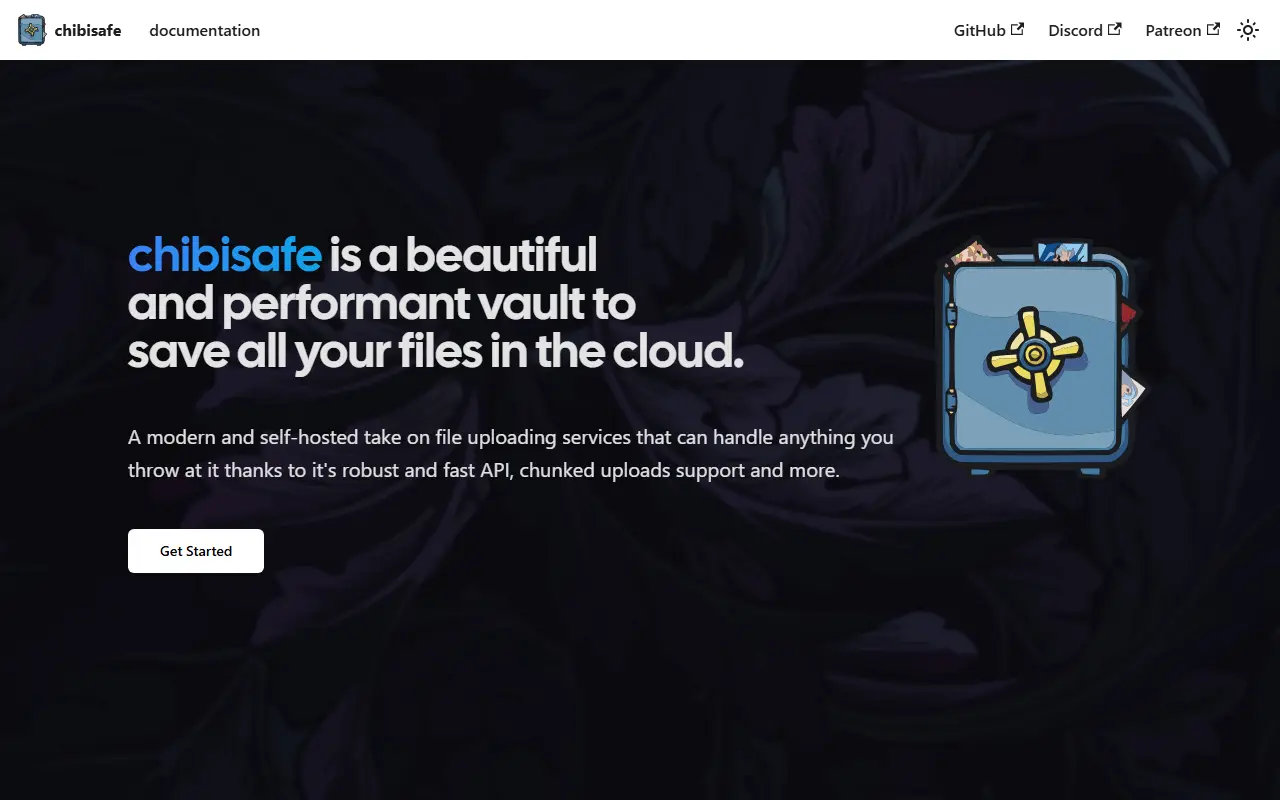
chibisafe.appChibisafe homepage screenshot

Chibisafe is a file uploader service written in TypeScript. You send it files, photos or documents and it gives back a shareable link. It is described as easy to use and deploy, and it can run in public mode, user accounts mode or invite-only mode, depending on how open you want your instance to be.

Large files are uploaded in chunks to reduce failures from network problems, and users can create API keys to use the service programmatically. An admin dashboard exposes most instance settings, including the name, rate limit, maximum file size and accepted extensions, so you rarely need to edit configuration files by hand.

Version 6 adds S3 storage support, a masonry layout for browsing media, albums and folders with direct links, snippets, file management and tagging, user management with quotas and a built-in URL shortener. ShareX support, an iOS shortcut and a browser extension help with uploading from desktops, phones and websites. It is open source under the MIT license, runs without ads, and logs IP addresses of requests.

Key features

  • Shareable links for uploaded files
  • Public, accounts or invite-only modes
  • Chunked uploads for large files
  • Albums, folders and snippets
  • S3 storage and user quotas
  • Admin dashboard for instance settings
  • ShareX, iOS shortcut and browser extension

Pricing: Free and open source under the MIT license.

AlterSend

Free, open-source app for sending files directly between devices with peer-to-peer end-to-end encryption, no accounts, and no cloud storage or size limits.

GitHub stars
1.8k
Last commit
yesterday
Latest release
v2.0.0
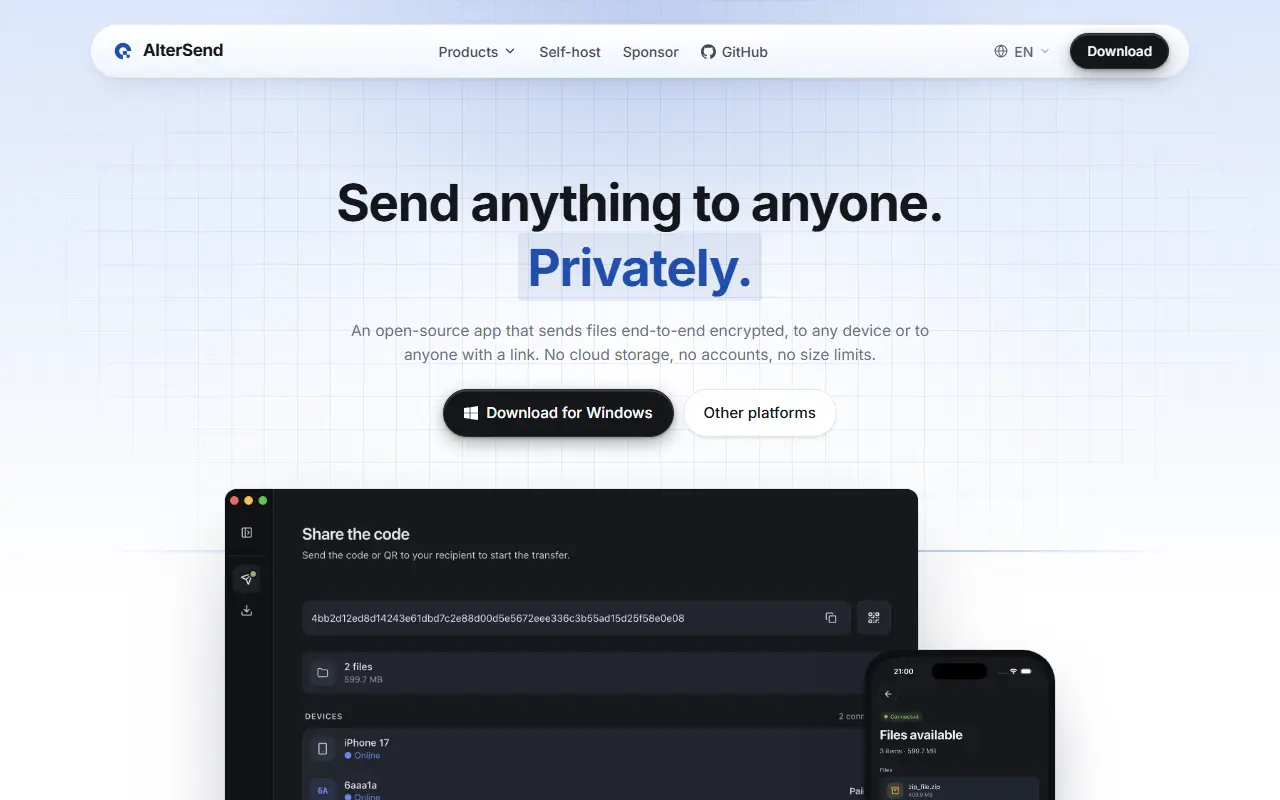
altersend.comAlterSend homepage screenshot

AlterSend is an app for transferring files directly between your devices over the internet. Files go peer to peer with end-to-end encryption, with no cloud storage, no uploads, no accounts, and no size limit. The README frames it as a replacement for WeTransfer, Dropbox, or Google Drive links when you only want to move a file from one device to another. The input lists its license only as other.

It uses techniques such as hole punching to connect devices behind routers. Installers are provided, including Homebrew for macOS and Flatpak for Linux, and the repository has sections on how it works, development setup, internationalization, the tech stack, crash reporting, and security. It is written in TypeScript and was created in 2026.

AlterSend suits people who regularly share large files, such as video or backups, and want privacy without relying on a cloud intermediary. Both devices generally need to be online at the same time for a transfer.

Key features

  • Direct device-to-device file transfer
  • End-to-end encryption
  • No accounts and nothing stored
  • No file size limit
  • NAT hole punching
  • Homebrew and Flatpak installation

Pricing: Free according to the project; see the repository for license terms.

PairDrop

Browser-based AirDrop-style file sharing between devices on the same network or via temporary public rooms, with no setup or signup.

GitHub stars
12k
Last commit
5 mo ago
Latest release
v1.11.2
Licence
GPL-3.0
Self-hosted
Yes
Hosted version
Available
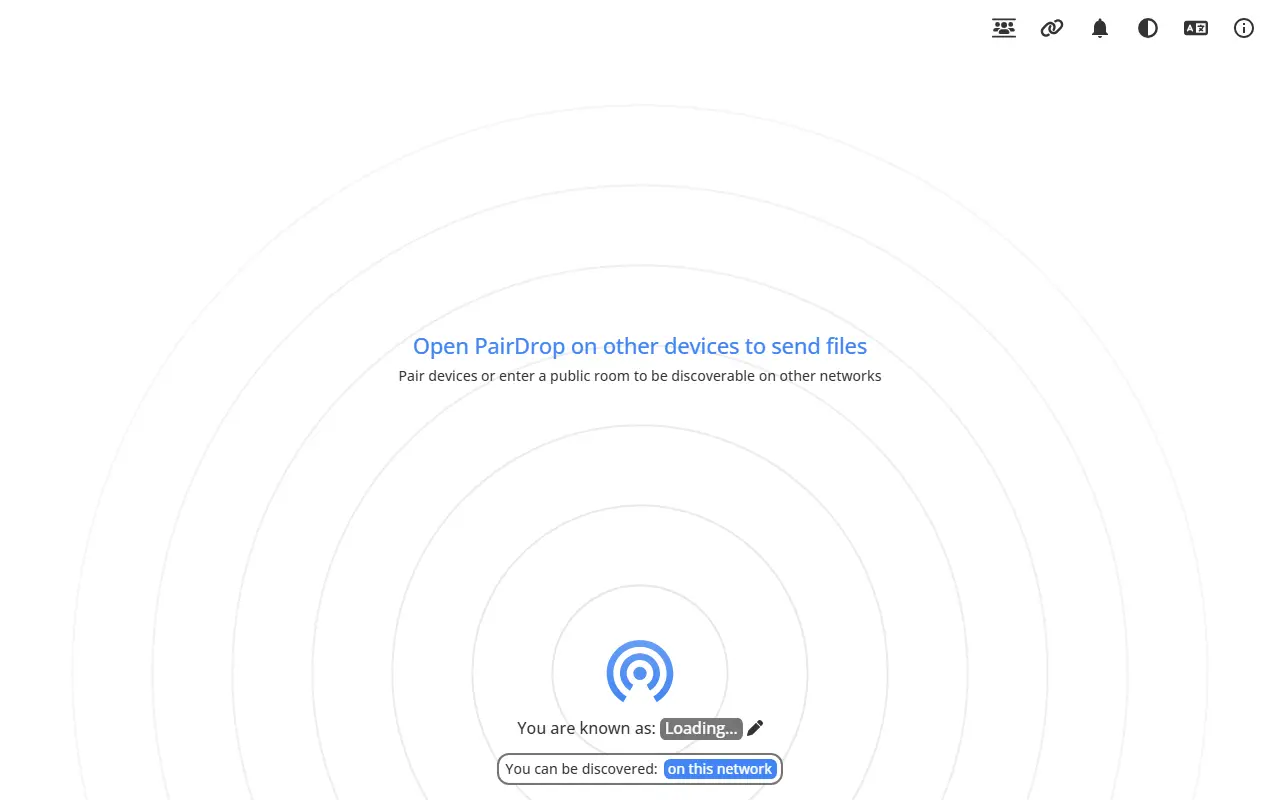
pairdrop.netPairDrop homepage screenshot

PairDrop is a web app for local file sharing in the browser, inspired by Apple's AirDrop. It is a fork of Snapdrop and works on all platforms with a modern browser, which makes it useful for moving files between a phone and a laptop or between Android and iOS devices. It is released under the GPL-3.0 license.

You can send images, documents, or text through peer-to-peer connections to devices on the same local network. For transfers over the internet, you join temporary public rooms to pair devices. It runs as a progressive web app using WebRTC and WebSockets on a Node.js server, and the README lists the differences from the Snapdrop project it is based on.

A public instance is available at pairdrop.net, and the app can be self-hosted. PairDrop suits anyone who needs quick, no-account file transfers across mixed operating systems and wants to keep files off third-party cloud storage.

Key features

  • AirDrop-like sharing in the browser
  • Peer-to-peer transfers on the local network
  • Temporary public rooms for internet transfers
  • Send files and text
  • Progressive web app
  • No setup or signup

Pricing: Free and open source under the GPL-3.0 license; a public instance runs at pairdrop.net.

Read more about PairDropWebsite GitHub

14 more WeTransfer alternatives

WeTransfer alternatives: questions

What is the best open-source alternative to WeTransfer?
LocalSend is the top-ranked open-source alternative to WeTransfer on Enlisted: A free cross-platform app for sending files and messages to nearby devices over your local network, with no internet connection or account required. Other strong options are croc, Magic Wormhole, OnionShare and MicroBin.
Are these WeTransfer alternatives free?
All 24 are open source, so the code is free to use under its licence, and all of them can be self-hosted on your own server or computer. 8 also offer a paid or managed cloud version if you'd rather not host it yourself.
How is this list of WeTransfer alternatives ranked?
By a score built from GitHub stars, star growth over the last 30 days and how recently the code changed. 16 of these projects shipped code in the last 30 days. Data is refreshed daily, and nobody can pay to move up.

People also look for alternatives to…

View all