6,598 open-source and SaaS tools, with GitHub stats refreshed every day.

6 alternatives ranked by real activity

Open-source Spotfire alternatives

A curated, ranked list of the 6 best open-source alternatives to Spotfire.

The best open-source alternative to Spotfire is Superset. If that doesn't suit you, other good options are Metabase, DataEase, Orange and DataLens.

Spotfire alternatives are mainly BI & Dashboards tools, but some are also Analytics. 4 of them shipped code in the last 30 days, 6 can be self-hosted, and 3 use a permissive licence.

Last updated October 2, 2026 · ranked by GitHub stars, growth and recent commits

Superset

A web-based business intelligence platform from the Apache project with a no-code chart builder, SQL editor and dashboards that connects to most SQL databases.

GitHub stars
75k
Last commit
today
Latest release
6.1.0
Licence
Apache-2.0
Self-hosted
Yes
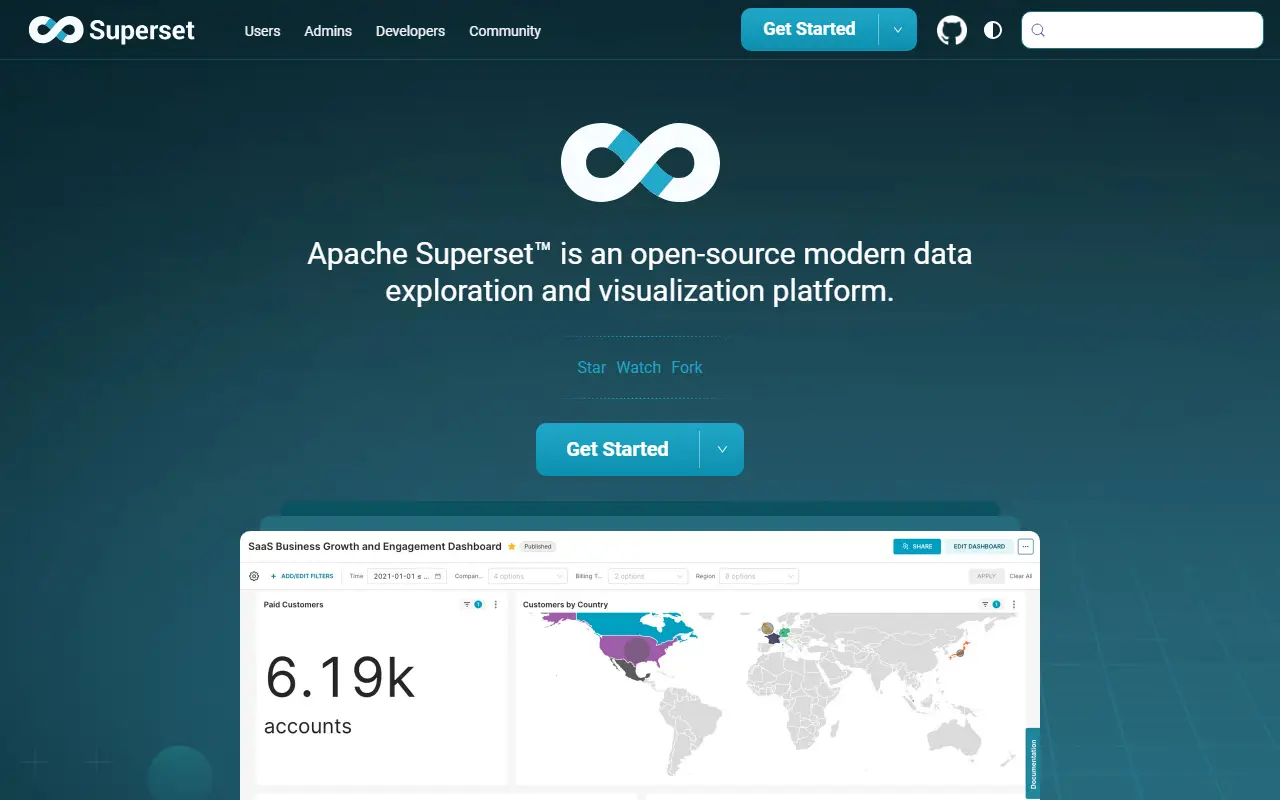
superset.apache.orgSuperset homepage screenshot

Apache Superset is a data exploration and visualization platform that runs as a web application. Analysts and business users can connect it to a database, build charts without code, assemble them into dashboards and share them, so it can augment or replace proprietary business intelligence tools for many teams.

The no-code chart builder sits next to a web-based SQL editor for advanced queries, and a lightweight semantic layer lets teams define reusable dimensions and metrics. Visualizations range from simple bar charts to geospatial views. Superset can query any SQL datastore or engine provided a matching Python database driver and SQLAlchemy dialect exist, including Presto, Trino and Athena. A configurable caching layer reduces database load, and security roles and authentication options are extensible.

The stack is Python with Flask on the back end and React on the front end, under the Apache-2.0 license. A REST API and extension framework allow programmatic control and customization. Documentation is split into guides for users, administrators and developers, and it is a typical choice for organizations that want a self-managed BI layer.

Key features

  • No-code chart builder
  • Web-based SQL editor
  • Shareable interactive dashboards
  • Lightweight semantic layer for metrics
  • Connects to any SQL database with a driver
  • Caching layer and security roles
  • REST API for programmatic customization

Pricing: Free and open source under the Apache-2.0 license.

Metabase

An open-source BI and embedded analytics tool for exploring data, building dashboards and asking questions without SQL, self-hosted or through Metabase Cloud.

GitHub stars
50k
Last commit
today
Latest release
v0.63.19
Self-hosted
Yes
Hosted version
Available
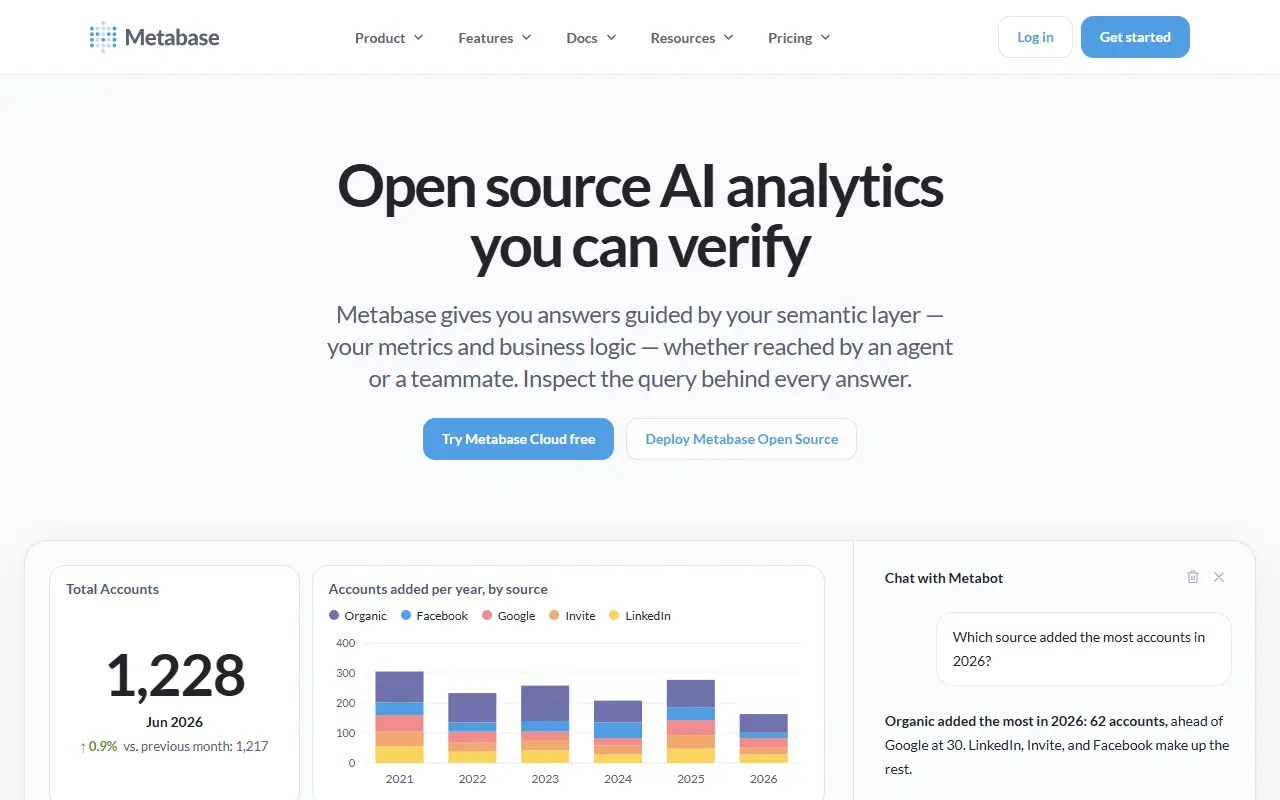
metabase.comMetabase homepage screenshot

Metabase is an open-source business intelligence and embedded analytics tool meant for everyone in a company, not only analysts. People can ask questions about their data without knowing SQL, while an SQL editor is available for more complex queries. Written in Clojure, it connects to databases such as PostgreSQL and MySQL.

Its features include interactive dashboards with filters, auto-refresh and custom click behavior, plus documents for long-form analysis that colleagues can comment on. An AI assistant called Metabot helps answer questions and write queries, and you can build your own AI agent against your data. Data Studio supports transforming raw data into analytics-ready tables and defining canonical metrics. Alerts and scheduled dashboard subscriptions go to email, Slack or a webhook, and a Library plus Git integration help version your work.

Metabase can also be embedded in your own product with components for charts, dashboards, a data browser and AI chat, and granular permissions work for internal teams and embedded customers. You can self-host it or use Metabase Cloud, which the project says includes support, backups, upgrades and a free trial. The repository license is listed as 'Other', so review its terms.

Key features

  • Question builder that needs no SQL
  • SQL editor for complex queries
  • Interactive dashboards with filters and auto-refresh
  • Alerts and scheduled subscriptions to email or Slack
  • Embedding of charts and dashboards in apps
  • Granular permissions for teams and customers
  • Metabot AI assistance for queries

Pricing: The open-source edition is free. Cloud Starter is $100 per month and Pro $575 per month with a 14-day trial; extra users cost $6 or $12 per month. Enterprise starts at $20,000 per year.

DataEase

DataEase is an open-source business intelligence tool for building charts and dashboards by drag and drop, positioned as a Tableau alternative.

GitHub stars
25k
Last commit
2 days ago
Latest release
v3.1.0
Self-hosted
Yes

DataEase is an open-source BI tool that helps users analyze data and spot business trends. It connects to a wide range of data sources, lets you build charts by dragging and dropping, and supports sharing results with others. The project describes itself as an open-source alternative to Tableau and is developed by FIT2CLOUD in Java, with a Chinese-language README.

Supported data sources include OLTP databases such as MySQL, Oracle, SQL Server, PostgreSQL, MariaDB, Db2, TiDB and MongoDB, OLAP engines such as ClickHouse, Apache Doris, Apache Impala and StarRocks, Amazon Redshift, Excel and CSV files, and API sources. The stack uses Vue.js, Spring Boot, AntV for charts, Apache Calcite and SeaTunnel, and Docker. Installation uses an offline package on a Linux server with at least 2 cores and 4 GB of memory, or the 1Panel app store. V3 uses the FIT2CLOUD Open Source License, essentially GPLv3 with extra restrictions, and commercial licensing is available.

Key features

  • Drag-and-drop chart and dashboard building
  • Connectors for MySQL, PostgreSQL, ClickHouse and more
  • Support for Excel, CSV and API data sources
  • Several secure data sharing methods
  • Embedding support for other applications
  • Docker-based deployment on Linux servers

Pricing: Source available under the FIT2CLOUD Open Source License, a GPLv3 variant with extra restrictions; commercial licensing is available on request.

Orange

A visual data mining and machine learning toolbox where analyses are built as workflows of widgets, so users need little programming. Built in Python.

GitHub stars
5.7k
Last commit
4 days ago
Latest release
3.40.0
Self-hosted
Yes
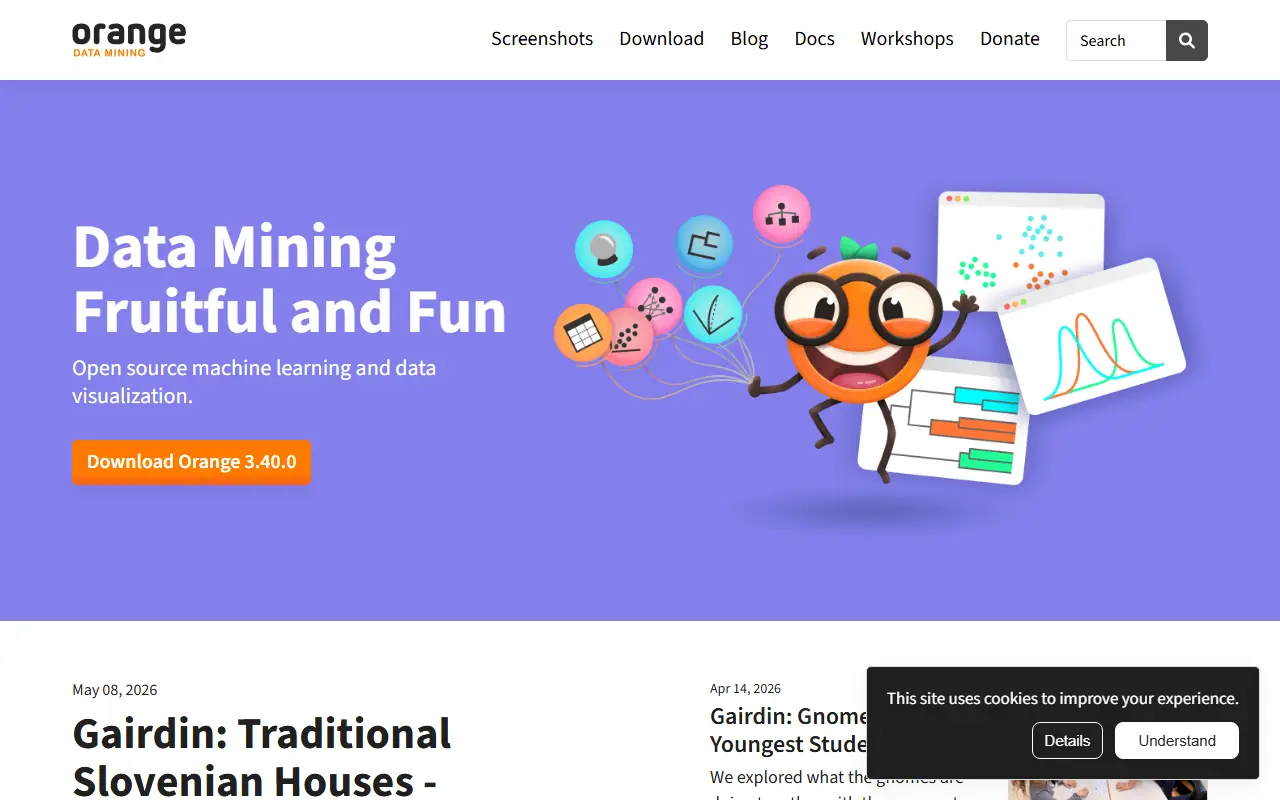
orangedatamining.comOrange homepage screenshot

Orange is a data mining and visualization toolbox aimed at both beginners and experienced analysts. Instead of writing code, users assemble analyses as workflows on a canvas, which hides the underlying mechanics and exposes intuitive concepts. The project's stated goal is that anyone who owns data should be able to explore it.

The toolbox covers interactive data visualization along with classic machine learning methods such as classification, regression, clustering, decision trees and random forests. It is written in Python on top of scikit-learn, NumPy, SciPy and pandas, and extra functionality is added through add-ons installed from the menu bar; developers can write their own widgets from an example template.

Windows and macOS users can download a standalone installer, while Linux users and developers can install with conda, pip or uv, and winget is available on Windows. The project is open source, welcomes new widgets and contributions, and has a community on Discord.

Key features

  • Visual workflow canvas built from widgets
  • Interactive data visualization
  • Classification, regression and clustering
  • Decision trees and random forests
  • Add-ons installable from the menu bar
  • Custom widgets written in Python
  • Standalone installers for Windows and macOS

Pricing: Free and open source.

DataLens

DataLens is a business intelligence and data visualization system, developed at Yandex, that you can run on your own servers with Docker.

GitHub stars
1.7k
Last commit
1 mo ago
Latest release
v2.9.0
Licence
Apache-2.0
Self-hosted
Yes
Hosted version
Available
datalens.techDataLens homepage screenshot

DataLens is a modern business intelligence and data visualization system. It was developed and used extensively as a primary BI tool inside Yandex and is also offered as part of the Yandex Cloud platform, while the open-source version can be run independently.

Topics describe it as an analytics, dashboard, reporting and SQL visualization tool. The quick start needs Docker and the Docker Compose plugin; cloning the repository and running a start command launches all containers, and the UI is then available on port 8080, which can be changed with an environment variable. For production use the maintainers recommend generating a compose file with random secrets, which stores a generated admin password in the environment file.

Charts can use D3.js, or the proprietary Highcharts library if you enable it, in which case you must comply with Highcharts' own license. DataLens is licensed under Apache-2.0, has a roadmap, release notes and a Telegram community, and suits teams that want self-hosted dashboards.

Key features

  • Dashboards and data visualization
  • SQL-based datasets and charts
  • Docker Compose deployment
  • Generated secrets for production setups
  • D3.js charts with optional Highcharts
  • Also available in Yandex Cloud

Pricing: Free and open source under the Apache-2.0 license; a managed version is part of Yandex Cloud.

Datart

Datart is a free, Apache-licensed, open-source data visualization platform for building reports, dashboards and large-screen displays, created by the original Davinci BI team.

GitHub stars
2.3k
Last commit
1 yr ago
Licence
Apache-2.0
Self-hosted
Yes
running-elephant.github.ioDatart homepage screenshot

Datart is a data visualization platform built by the original creators of the Davinci BI project, aimed at enterprises that need to build reports, dashboards, large-screen displays and visual data applications. It positions itself as more open, adaptable and intelligent than typical closed business intelligence products, where users are limited to built-in data sources and chart types.

The platform's design centers on three principles: openness, achieved through standardized processes for managed visualization apps, standardized interactions such as filtering, drilling and linking between charts, and pluggable extension points at the data source, chart and visualization layers; integrability, so Datart can be embedded into other systems using its login, permissions and SDK integration points rather than only used as a standalone platform; and augmented analytics, aiming to go beyond showing what happened in the data toward explaining why, through extensible analytical capabilities.

Datart is written in TypeScript and React and uses chart libraries including ECharts and D3. It is released under the Apache-2.0 license, with a public demo, deployment and quick-start guides, and an active community supported through issue tracking and a WeChat discussion group.

Key features

  • Reports, dashboards and large-screen visualizations
  • Pluggable data source, chart and visualization extensions
  • Standardized filtering, drilling and linking interactions
  • Embeddable via SDK into third-party systems
  • SQL editor for data queries
  • ECharts and D3-based charting

Pricing: Free and open source under the Apache-2.0 license.
Spotfire alternatives: questions

What is the best open-source alternative to Spotfire?
Superset is the top-ranked open-source alternative to Spotfire on Enlisted: A web-based business intelligence platform from the Apache project with a no-code chart builder, SQL editor and dashboards that connects to most SQL databases. Other strong options are Metabase, DataEase, Orange and DataLens.
Are these Spotfire alternatives free?
All 6 are open source, so the code is free to use under its licence, and 6 of them can be self-hosted on your own server. 2 also offer a paid or managed cloud version if you'd rather not host it yourself.
How is this list of Spotfire alternatives ranked?
By a score built from GitHub stars, star growth over the last 30 days and how recently the code changed. 4 of these projects shipped code in the last 30 days. Data is refreshed daily, and nobody can pay to move up.

People also look for alternatives to…

View all