#1
A web-based business intelligence platform from the Apache project with a no-code chart builder, SQL editor and dashboards that connects to most SQL databases.
- GitHub stars
- 75k
- Last commit
- today
- Latest release
- 6.1.0
- Licence
- Apache-2.0
- Self-hosted
- Yes
superset.apache.org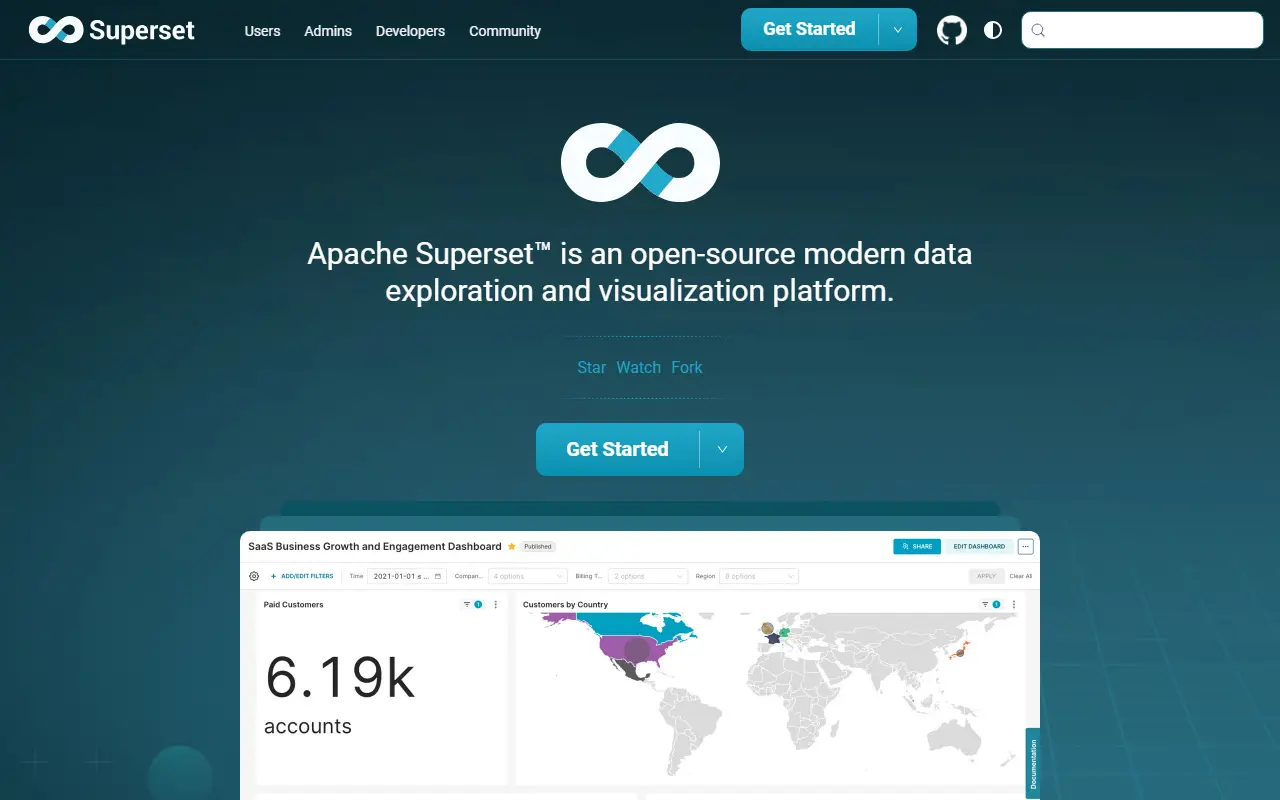
Apache Superset is a data exploration and visualization platform that runs as a web application. Analysts and business users can connect it to a database, build charts without code, assemble them into dashboards and share them, so it can augment or replace proprietary business intelligence tools for many teams.
The no-code chart builder sits next to a web-based SQL editor for advanced queries, and a lightweight semantic layer lets teams define reusable dimensions and metrics. Visualizations range from simple bar charts to geospatial views. Superset can query any SQL datastore or engine provided a matching Python database driver and SQLAlchemy dialect exist, including Presto, Trino and Athena. A configurable caching layer reduces database load, and security roles and authentication options are extensible.
The stack is Python with Flask on the back end and React on the front end, under the Apache-2.0 license. A REST API and extension framework allow programmatic control and customization. Documentation is split into guides for users, administrators and developers, and it is a typical choice for organizations that want a self-managed BI layer.
Key features
- No-code chart builder
- Web-based SQL editor
- Shareable interactive dashboards
- Lightweight semantic layer for metrics
- Connects to any SQL database with a driver
- Caching layer and security roles
- REST API for programmatic customization
Pricing: Free and open source under the Apache-2.0 license.
#2
An open-source BI and embedded analytics tool for exploring data, building dashboards and asking questions without SQL, self-hosted or through Metabase Cloud.
- GitHub stars
- 50k
- Last commit
- today
- Latest release
- v0.65.3
- Self-hosted
- Yes
- Hosted version
- Available
metabase.com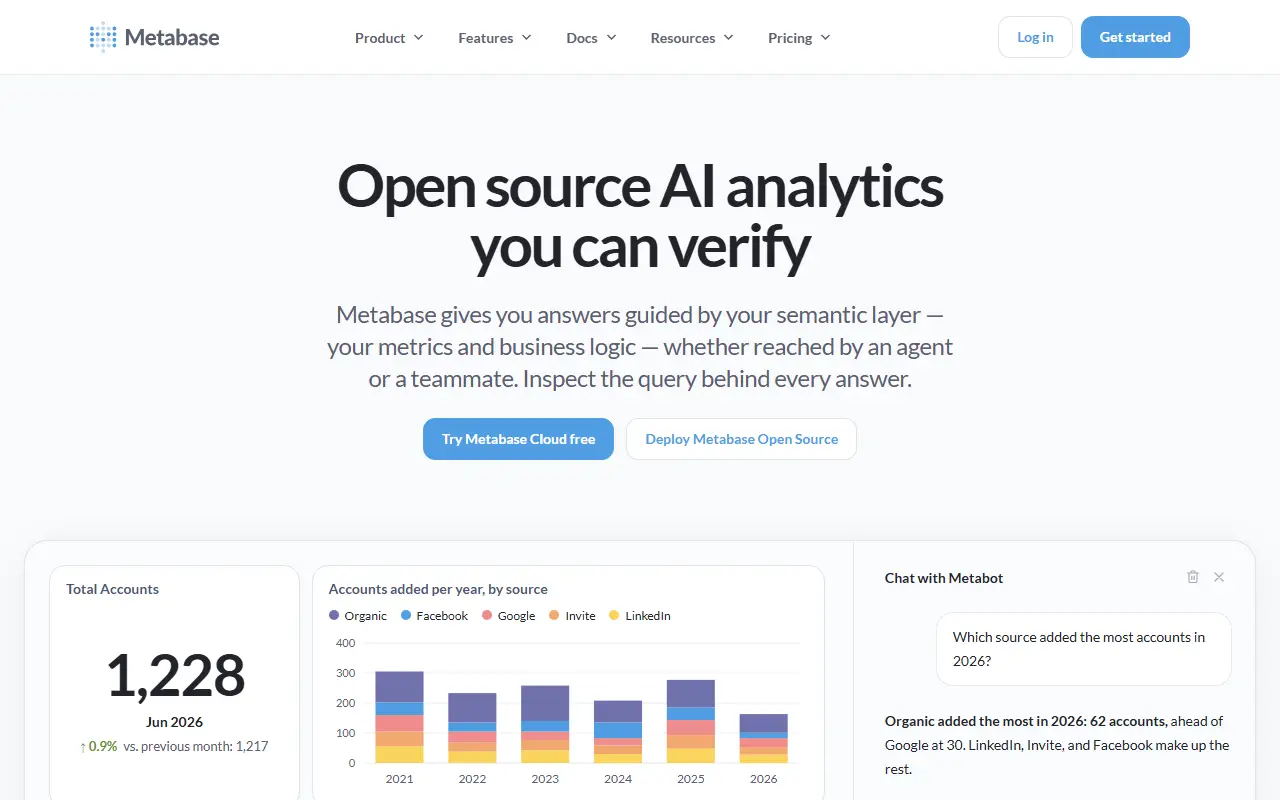
Metabase is an open-source business intelligence and embedded analytics tool meant for everyone in a company, not only analysts. People can ask questions about their data without knowing SQL, while an SQL editor is available for more complex queries. Written in Clojure, it connects to databases such as PostgreSQL and MySQL.
Its features include interactive dashboards with filters, auto-refresh and custom click behavior, plus documents for long-form analysis that colleagues can comment on. An AI assistant called Metabot helps answer questions and write queries, and you can build your own AI agent against your data. Data Studio supports transforming raw data into analytics-ready tables and defining canonical metrics. Alerts and scheduled dashboard subscriptions go to email, Slack or a webhook, and a Library plus Git integration help version your work.
Metabase can also be embedded in your own product with components for charts, dashboards, a data browser and AI chat, and granular permissions work for internal teams and embedded customers. You can self-host it or use Metabase Cloud, which the project says includes support, backups, upgrades and a free trial. The repository license is listed as 'Other', so review its terms.
Key features
- Question builder that needs no SQL
- SQL editor for complex queries
- Interactive dashboards with filters and auto-refresh
- Alerts and scheduled subscriptions to email or Slack
- Embedding of charts and dashboards in apps
- Granular permissions for teams and customers
- Metabot AI assistance for queries
Pricing: The open-source edition is free. Cloud Starter is $100 per month and Pro $575 per month with a 14-day trial; extra users cost $6 or $12 per month. Enterprise starts at $20,000 per year.
#3
An Apache workflow orchestration platform where data teams author, schedule and monitor pipelines as Python code, widely used for data engineering and ELT jobs.
- GitHub stars
- 47k
- Last commit
- today
- Latest release
- 3.4.0
- Licence
- Apache-2.0
- Self-hosted
- Yes
airflow.apache.org
Apache Airflow is a workflow platform where you write, schedule and watch over pipelines in code. Workflows are defined as Python code in the form of directed acyclic graphs, or DAGs, where each task and its dependencies are explicit, so pipelines can be versioned, tested and reviewed like any other software.
A scheduler runs tasks on a defined cadence and workers execute them, while a web interface shows the status of each run, lets you inspect logs and retry failures. Airflow is used heavily in data engineering, including data integration, ELT and ETL pipelines, data orchestration and machine learning workflows, and its topics cover data science and automation. It has a large ecosystem of providers and operators for connecting to databases, cloud services and other systems, and the 3.x line is the current series.
Airflow is an Apache Software Foundation project under the Apache-2.0 license and runs on your own infrastructure, from a single machine to Kubernetes. Several vendors offer managed Airflow services, but the project itself is self-hosted software. It suits data engineers who prefer code-first orchestration over drag-and-drop tools.
Key features
- Workflows defined as Python DAGs
- Scheduler for recurring and dependent tasks
- Web UI for monitoring runs and logs
- Retries and task dependency management
- Large provider ecosystem of integrations
- Runs on single machines or Kubernetes
Pricing: Free and open source under the Apache-2.0 license.
#4
MLflow is an open-source platform for debugging, evaluating and monitoring AI agents, LLM applications and machine learning models.
- GitHub stars
- 29k
- Last commit
- yesterday
- Latest release
- v3.18.0
- Licence
- Apache-2.0
- Self-hosted
- Yes
- Hosted version
- Available
mlflow.org
MLflow is an open-source AI engineering platform for agents, LLM applications and ML models. It helps teams debug, evaluate, monitor and optimize AI applications in production while keeping control of costs and access to models and data. It is written in Python, released under the Apache-2.0 license, and has been developed since 2018, with topics covering MLOps, model management and LLMOps.
For LLM and agent work it offers production observability with traces, plus evaluation, prompt management and prompt optimization, and an AI Gateway that governs costs and model access. It works with Python, TypeScript and JavaScript, Java and other languages, and integrates with OpenTelemetry and MCP. Getting started means starting an MLflow server, enabling logging in your code and running it, then exploring traces and metrics in the web UI on port 5000. A setup wizard can connect to an MLflow server or a Databricks workspace and add tracing with a coding agent.
Key features
- Tracing and observability for LLM apps and agents
- Evaluation tools for models and agents
- Prompt management and prompt optimization
- AI Gateway for cost and model access control
- OpenTelemetry and MCP integration
- Web UI for exploring traces and metrics
Pricing: Free and open source under the Apache-2.0 license; the README also mentions connecting to a Databricks workspace.
#5
Web-based Jupyter Notebook environment for interactive computing, mixing code, output and notes in shareable documents.
- GitHub stars
- 13k
- Last commit
- 3 days ago
- Latest release
- v7.6.5
- Licence
- BSD-3-Clause
- Self-hosted
- Yes
jupyter-notebook.readthedocs.io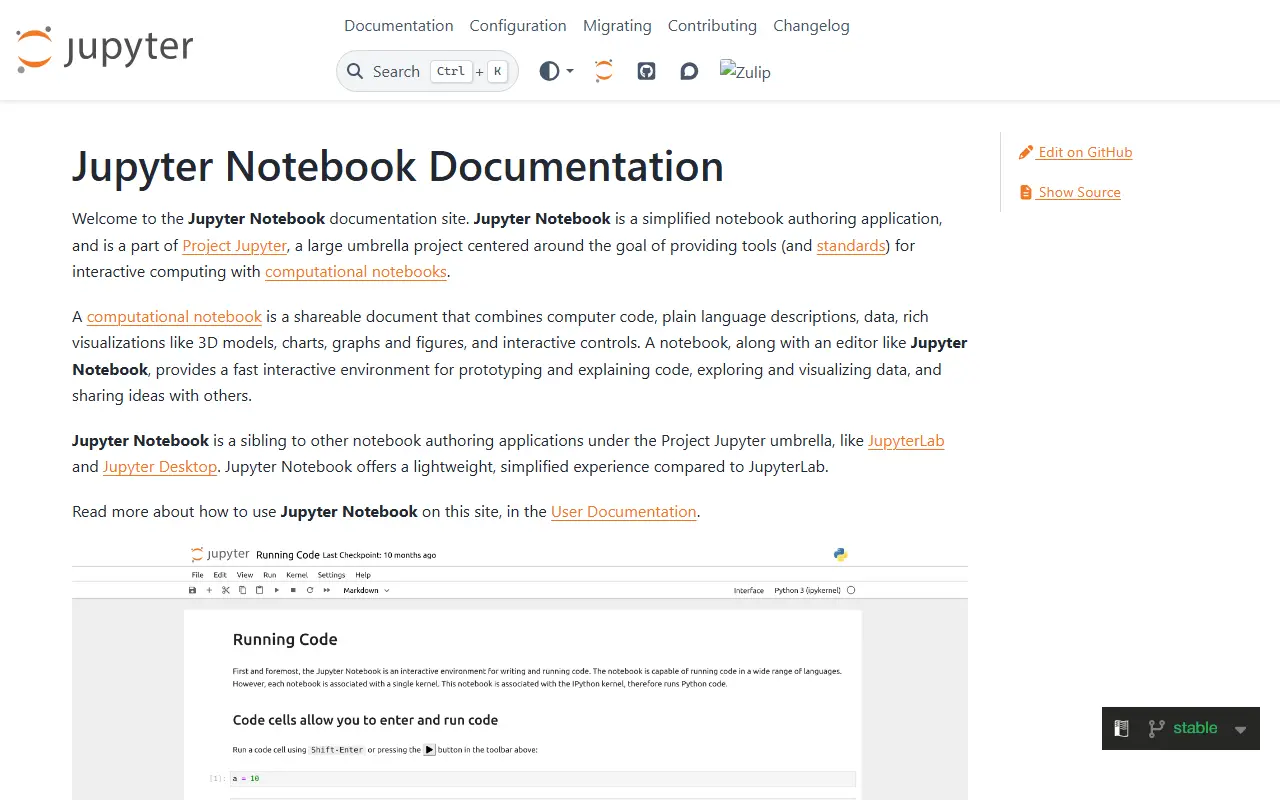
Jupyter Notebook is a web-based notebook environment for interactive computing. Users write code in cells, run it, and see the results next to explanatory text in the same document, which makes it a common choice for data exploration, teaching and documenting analysis.
The project is language-agnostic: it grew out of the IPython notebook, which was split into language-neutral and Python-specific parts in 2015. The current Notebook v7 is built on JupyterLab components for the frontend and the Jupyter Server for the Python backend. Classic Notebook v6 is still maintained for fixes only, and extensions written for older versions are not compatible with v7.
The code is released under the BSD-3-Clause license. The maintainers support the two most recent major versions, Notebook v7 and Classic Notebook v6, and recommend moving off version 5. New features are directed at v7, and contributors are encouraged to build them as Jupyter Server or JupyterLab extensions so they work across Jupyter's interfaces.
Key features
- Browser-based notebooks with executable code cells
- Language-agnostic kernels
- Built on JupyterLab components in v7
- Jupyter Server backend
- Extension support through JupyterLab extensions
Pricing: Free and open source under the BSD-3-Clause license.
#6
Kubeflow is an open source platform for deploying ML workflows on Kubernetes.
- GitHub stars
- 16k
- Last commit
- 1 mo ago
- Latest release
- redirect
- Licence
- Apache-2.0
- Self-hosted
- Yes
kubeflow.org
Kubeflow is the Cloud Native AI platform composed of modular, open source projects that form a Kubernetes-native stack for data and AI workloads. It is designed for AI practitioners, platform administrators, and decision-makers who need modular, scalable, and extensible tools for data, AI/ML, and HPC use-cases.
The platform's mission is to bridge the Data, AI, and Cloud Native ecosystems, enabling teams to deliver more models, agents, and AI applications into production across the AI lifecycle. It is built by an open global community and aims to be the standard for Data & AI workloads on Kubernetes.
Key features
- Runs workloads at any scale without requiring Kubernetes expertise
- Portable across local laptops, on-premises, and any cloud
- Manages hyperscale training jobs and high-throughput AI agents
- Composable tools that can be mixed and matched across the AI lifecycle
- Includes subprojects: Spark Operator, Notebooks, Trainer, Katib, and Hub

Apache Zeppelin is a web-based notebook for interactive data analytics, with real-time collaboration, many language interpreters, visualizations and scheduling.
- GitHub stars
- 6.7k
- Last commit
- yesterday
- Licence
- Apache-2.0
- Self-hosted
- Yes
zeppelin.apache.org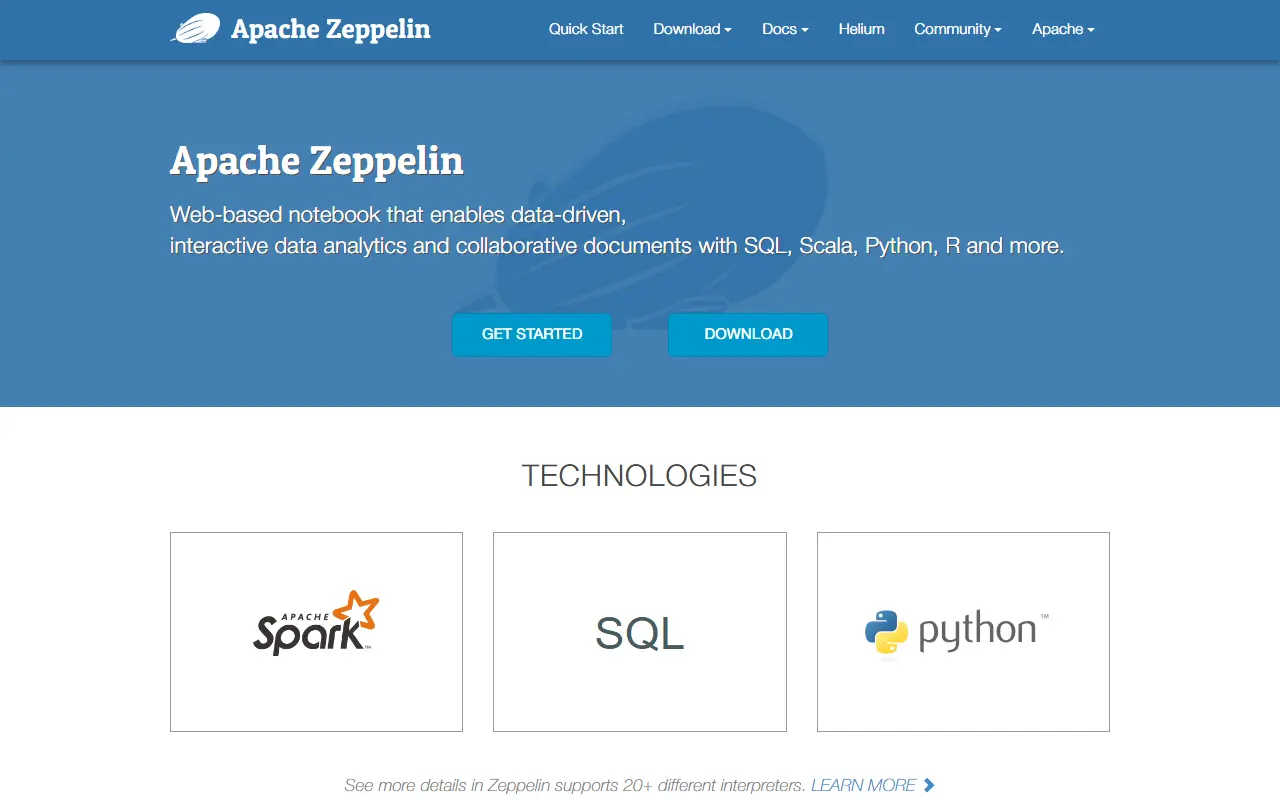
Apache Zeppelin is a web-based notebook for interactive data analytics. You build data-driven, collaborative documents using SQL, Scala and other languages, and the notebook-style editor supports real-time collaboration between users.
Core features include support for many languages through a pluggable interpreter architecture with process isolation, including Spark, Flink, Python, SQL and Shell and more than 20 interpreters, built-in visualization and dynamic forms, and notebook scheduling with cron. Flexible deployment options are local, Docker, Kubernetes and YARN. Topics place it in the big data ecosystem alongside Spark, Flink, NoSQL and databases.
Zeppelin is an Apache Software Foundation project written in Java and JavaScript and licensed under Apache-2.0. You install it from a binary package or build from source, with user guides, mailing lists and a Jira issue tracker. It suits data engineers and analysts who work on cluster-based data platforms and want shareable, scheduled notebooks.
Key features
- Web notebook with real-time collaboration
- 20+ interpreters including Spark and Flink
- Process isolation per interpreter
- Built-in visualizations and dynamic forms
- Cron scheduling of notebooks
- Local, Docker, Kubernetes and YARN deployment
Pricing: Free and open source under the Apache-2.0 licence.
#8
A visual data mining and machine learning toolbox where analyses are built as workflows of widgets, so users need little programming. Built in Python.
- GitHub stars
- 5.7k
- Last commit
- 4 days ago
- Latest release
- 3.41.0
- Self-hosted
- Yes
orangedatamining.com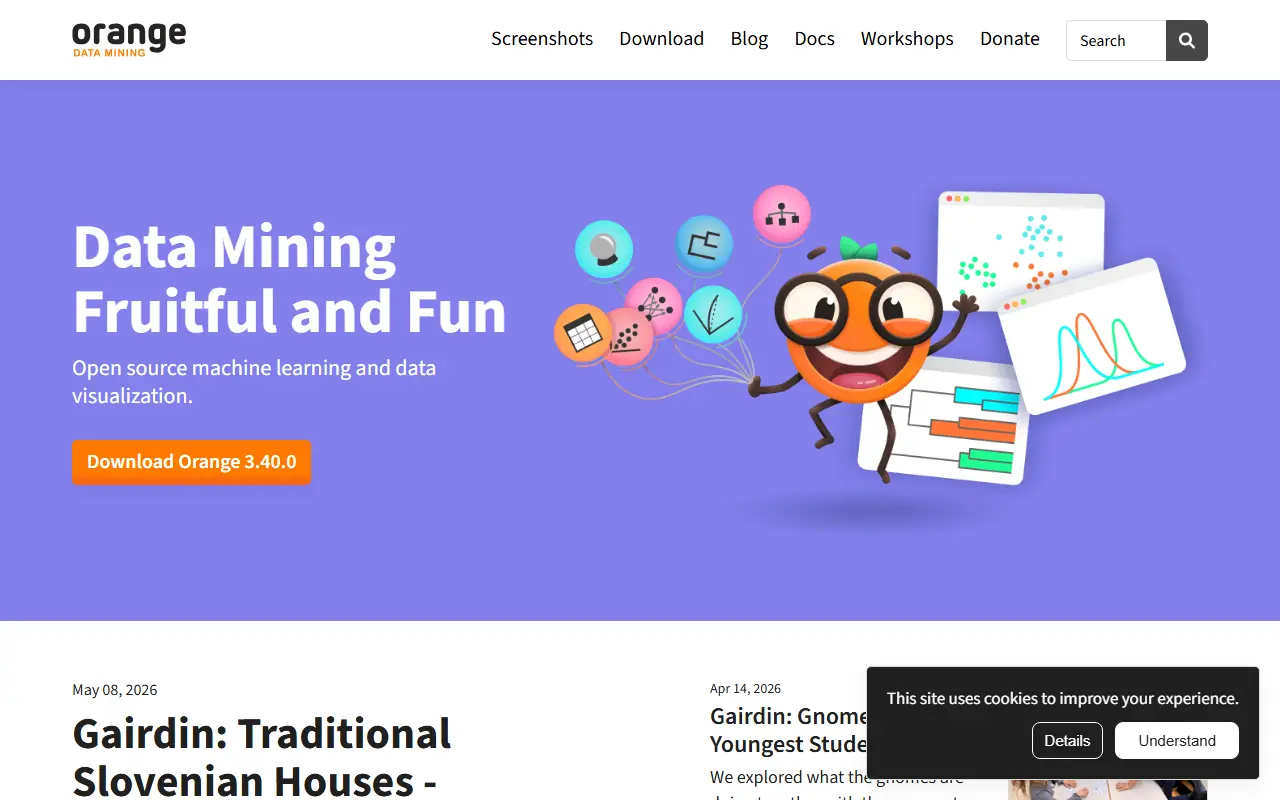
Orange is a data mining and visualization toolbox aimed at both beginners and experienced analysts. Instead of writing code, users assemble analyses as workflows on a canvas, which hides the underlying mechanics and exposes intuitive concepts. The project's stated goal is that anyone who owns data should be able to explore it.
The toolbox covers interactive data visualization along with classic machine learning methods such as classification, regression, clustering, decision trees and random forests. It is written in Python on top of scikit-learn, NumPy, SciPy and pandas, and extra functionality is added through add-ons installed from the menu bar; developers can write their own widgets from an example template.
Windows and macOS users can download a standalone installer, while Linux users and developers can install with conda, pip or uv, and winget is available on Windows. The project is open source, welcomes new widgets and contributions, and has a community on Discord.
Key features
- Visual workflow canvas built from widgets
- Interactive data visualization
- Classification, regression and clustering
- Decision trees and random forests
- Add-ons installable from the menu bar
- Custom widgets written in Python
- Standalone installers for Windows and macOS
Pricing: Free and open source.
#9
RStudio, an integrated development environment for the R language, with a customizable workbench and Quarto support that runs on desktops or as a server.
- GitHub stars
- 5.1k
- Last commit
- yesterday
- Self-hosted
- Yes
posit.co
RStudio is an integrated development environment for the R programming language, developed by Posit. It gathers the tools needed for working in R into one customizable workbench that includes the console, terminal, source editor, plots, environment, history, help, files and packages panes.
The editor offers syntax highlighting and code completion, and code can be run straight from the editor by line, selection or file. RStudio supports writing reproducible documents and reports with Quarto and R Markdown, plus Sweave and TeX documents. Optional AI features include GitHub Copilot completions, Posit AI Pass Next Edit Suggestions and the Posit Assistant.
RStudio runs on Windows, Mac and Linux, with a community-maintained FreeBSD port. It can also be run as a server so that several users can open the IDE in a web browser. The README states that it is licensed under AGPLv3, and the source is written mostly in Java.
Key features
- R console, terminal and editor in one workbench
- Syntax highlighting and code completion
- Run code by line, selection or file
- Quarto and R Markdown authoring
- Sweave and TeX document support
- Optional AI completions and assistant
- Server mode for browser access
Pricing: Posit's commercial team tiers (Basic, Enhanced and Advanced) are priced through sales; the page publishes no prices and invites you to talk to the sales team.
#10
Polyaxon is an open-source AI control plane for Kubernetes that schedules, runs, debugs, observes, and automates AI/ML workloads, agents, and sandboxes on your own infrastructure.
- GitHub stars
- 3.7k
- Last commit
- yesterday
- Licence
- Apache-2.0
- Self-hosted
- Yes
polyaxon.com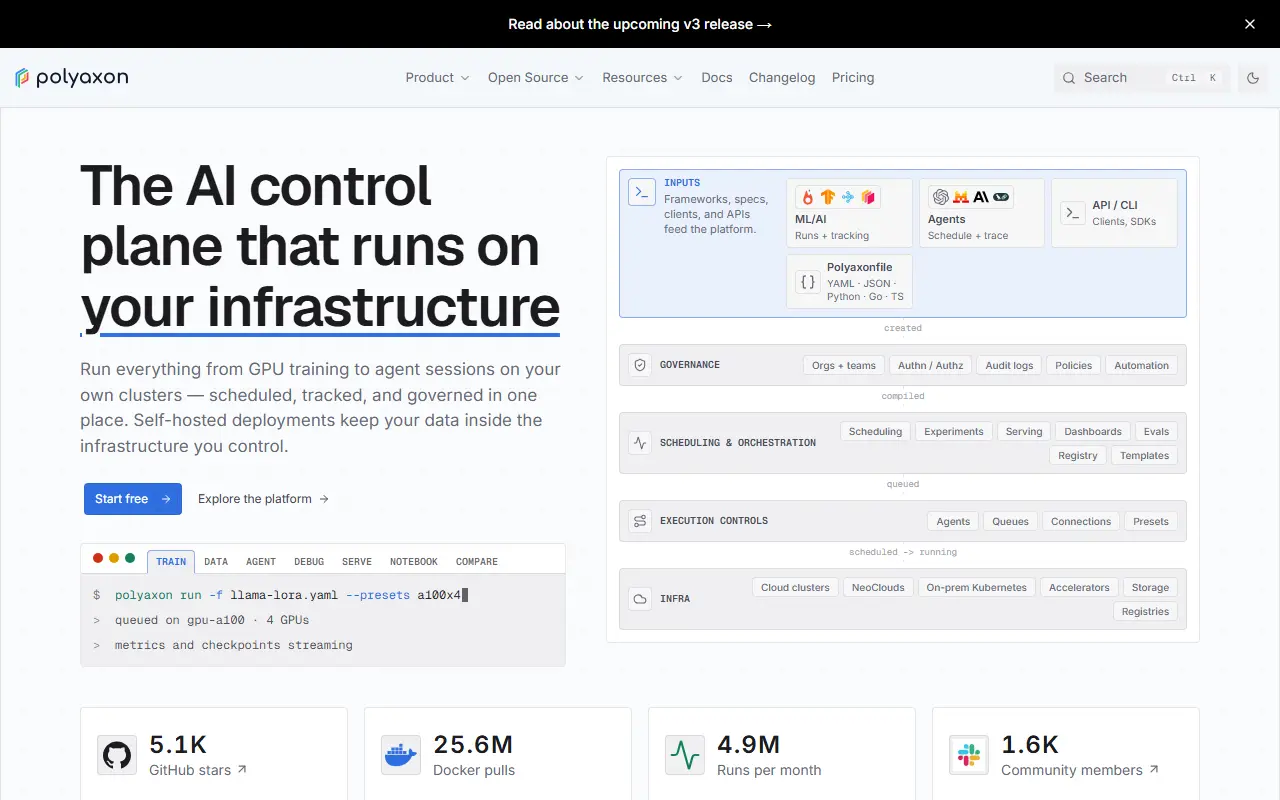
Polyaxon is an open-source AI control plane designed to run on Kubernetes. It enables scheduling, tracking, and governance of AI/ML workloads, including GPU training, agent sessions, and sandboxes, all within self-hosted deployments. The platform supports training, services, and sandboxes using shared specs, queues, governance, and data connections.
It provides a unified interface for training and fine-tuning models, serving inference, running notebooks, and managing interactive sessions. Polyaxon integrates with various frameworks, clients, and APIs, and offers governance features such as organizations, teams, authentication, audit logs, and policies. It is suitable for teams that need to manage AI workloads on their own clusters and storage backends.
Key features
- Scheduling and orchestration of runs, experiments, and batch jobs
- Training and fine-tuning with support for LoRA and SFT
- Services for serving, inference, notebooks, TensorBoard, and ML apps
- Sandboxes with SSH, tmux, interactive, and background modes
- Governance with organizations, teams, authn/authz, audit logs, and policies
- Execution controls via agents, queues, connections, and presets
SAS Viya alternatives: questions
- What is the best open-source alternative to SAS Viya?
- Superset is the top-ranked open-source alternative to SAS Viya on Enlisted: A web-based business intelligence platform from the Apache project with a no-code chart builder, SQL editor and dashboards that connects to most SQL databases. Other strong options are Metabase, Airflow, MLflow and Jupyter Notebook.
- What are the best commercial alternatives to SAS Viya?
- Domino Data Lab, H2O.ai, Alteryx, Azure Machine Learning and IBM watsonx are among the hosted, closed-source alternatives to SAS Viya listed on Enlisted, which lists 20 in total. Compare their pricing and features on each tool page.
- Are these SAS Viya alternatives free?
- All 10 are open source, so the code is free to use under its licence, and all of them can be self-hosted on your own server or computer. 2 also offer a paid or managed cloud version if you'd rather not host it yourself.
- How is this list of SAS Viya alternatives ranked?
- By a score built from GitHub stars, star growth over the last 30 days and how recently the code changed. 9 of these projects shipped code in the last 30 days. Data is refreshed daily, and nobody can pay to move up.
 TrackMedia
 TrackRev