7,363 open-source and SaaS tools, with GitHub stats refreshed every day.

9 alternatives ranked by real activity

Open-source Lindy alternatives

A curated, ranked list of the 9 best open-source alternatives to Lindy.

The best open-source alternative to Lindy is AutoGPT. If that doesn't suit you, other good options are Sim, Agenta, Refly and Magic.

Lindy alternatives are mainly AI tools, but some are also workflow automation tools and AI infrastructure tools. 7 of them shipped code in the last 30 days, 9 can be self-hosted, and 2 use a permissive licence.

Last updated October 2, 2026 · ranked by GitHub stars, growth and recent commits

AutoGPT

An open-source platform for building and running AI agents from plain-English prompts or a visual block builder, with hosted and self-hosted options.

GitHub stars
188k
Last commit
today
Latest release
autogpt-platform-beta-v0.8.2
Self-hosted
Yes
Hosted version
Available
agpt.coAutoGPT homepage screenshot

AutoGPT is an open-source platform for building and running AI agents that carry out complete workflows. You can describe a desired outcome in plain English, or lay out each step yourself in a visual builder. Agents can then run whenever you ask, on a schedule or from a trigger. The project is written mainly in Python.

The platform is organized around four areas: AutoPilot, which turns a conversation into a working agent; Agents, which shows runs, costs and actions needing attention; a Marketplace of ready-made agents you can add to your library and customize; and Build, a block-based editor where you connect, branch and inspect steps for precise control.

A hosted platform is run by the vendor, who manages infrastructure, model access, credentials and updates, and it is a paid service. The code can also be self-hosted, and the README links a self-hosting guide. GitHub lists the license as 'Other', so review the repository terms before reuse. It suits teams automating repeatable tasks with agents.

Key features

  • Plain-English agent creation with AutoPilot
  • Visual block builder with branching
  • Agents that run on demand, schedules or triggers
  • Marketplace of ready-made agents
  • Dashboard of runs, costs and pending actions
  • Connections to many third-party platforms and models

Pricing: The open-source code can be self-hosted for free. Hosted Pro costs $50 per month with a 7-day free trial and Max $320 per month; a Team plan is listed as coming soon.

Sim

A collaborative workspace for building, deploying and monitoring AI agents and workflows, with 1,000+ integrations, built-in tables and knowledge, in cloud or self-hosted form.

GitHub stars
30k
Last commit
yesterday
Latest release
v0.9.10
Licence
Apache-2.0
Self-hosted
Yes
Hosted version
Available

Sim is a workspace for building, deploying and managing AI agents and workflows. You can build visually, conversationally or with code, connect more than a thousand integrations such as Slack, Notion, HubSpot, Salesforce and databases, and use any major LLM provider. The platform includes monitoring of runs, logs, schedules and workflow activity.

Beyond workflows, the same workspace also holds tables, files and knowledge. Tables act as a built-in database, files give the team and every agent one shared store, and knowledge bases serve as the agents' memory, ingesting files and structured data. The workspace is available in the browser and also as a desktop app for macOS 12 and later, for both Apple Silicon and Intel, which can be pointed at a self-hosted deployment.

Sim can be used as a cloud-hosted service at sim.ai or self-hosted, which requires Node.js 20 or newer and Docker. An interactive npx sim-setup wizard creates a deployment directory, provisions the database, generates secrets, writes the environment file and starts the services. The code is Apache-2.0 licensed and written in TypeScript with Next.js.

Key features

  • Visual, conversational and code-based agent building
  • 1,000+ integrations and major LLM support
  • Built-in tables, files and knowledge bases
  • Run, log and schedule monitoring
  • macOS desktop app
  • Interactive self-hosting setup wizard

Pricing: A free plan is available. Pro is $25 and Max $100 per user per month on monthly billing, with about 15% off annually; Enterprise is custom and sold through sales.

Agenta

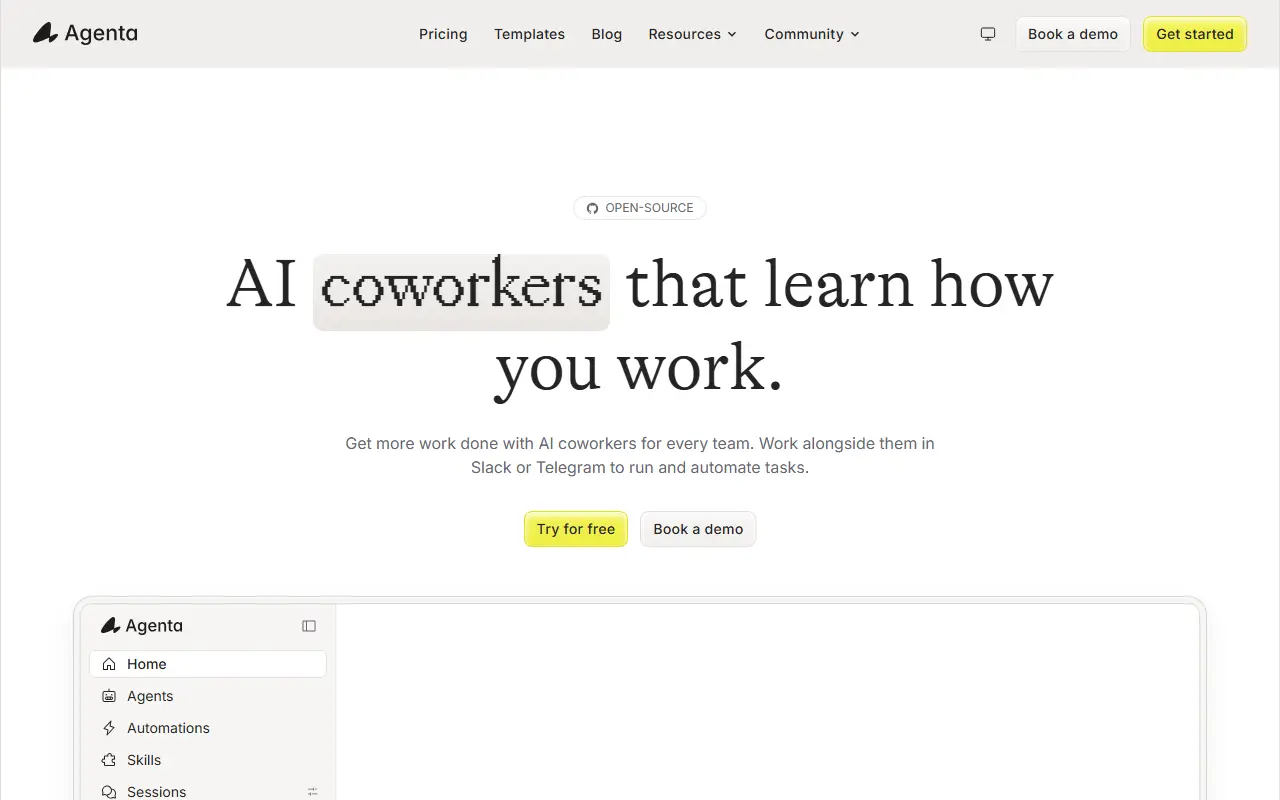
Agenta is an open-source workspace where teams build, share and run AI agents and automations by chatting with them, with cloud and self-hosted options.

GitHub stars
4.8k
Last commit
today
Latest release
v0.121.6
Self-hosted
Yes
Hosted version
Available
agenta.aiAgenta homepage screenshot

Agenta is an open-source workspace for building and running agents that automate and support work. You create an agent by chatting with it: describe the task, connect the apps it needs and improve it through feedback. Agents can be used directly in chat, shared with teammates and set to run in the background for recurring work.

Repository topics point to agent building, orchestration, observability, MCP and an AI skills manager, as well as workflow automation. The project is written in TypeScript and offers documentation, a website and a managed Agenta Cloud, while the repository also supports self-hosting.

The repository license is shown as 'Other' on GitHub, so check the terms before commercial use. Agenta suits teams that want a shared place to create specialized AI coworkers connected to their existing tools, with a choice between a hosted service and running it on their own infrastructure.

Key features

  • Build agents through chat
  • Share agents with your team
  • Connect agents to work apps
  • Background runs for recurring tasks
  • Agent observability and MCP support
  • Cloud and self-hosted deployment

Pricing: Free Hobby cloud plan and a free self-hosted open-source edition. Pro costs $29 and Business $299 per month with unlimited users and billing based on agent runs; Enterprise is custom.

Refly

Open-source agent skills builder for creating versioned, reusable workflows that run in Refly, ship as APIs, or export to tools like Claude Code and Cursor.

GitHub stars
7.5k
Last commit
2 mo ago
Latest release
v1.1.0
Self-hosted
Yes
Hosted version
Available
refly.aiRefly homepage screenshot

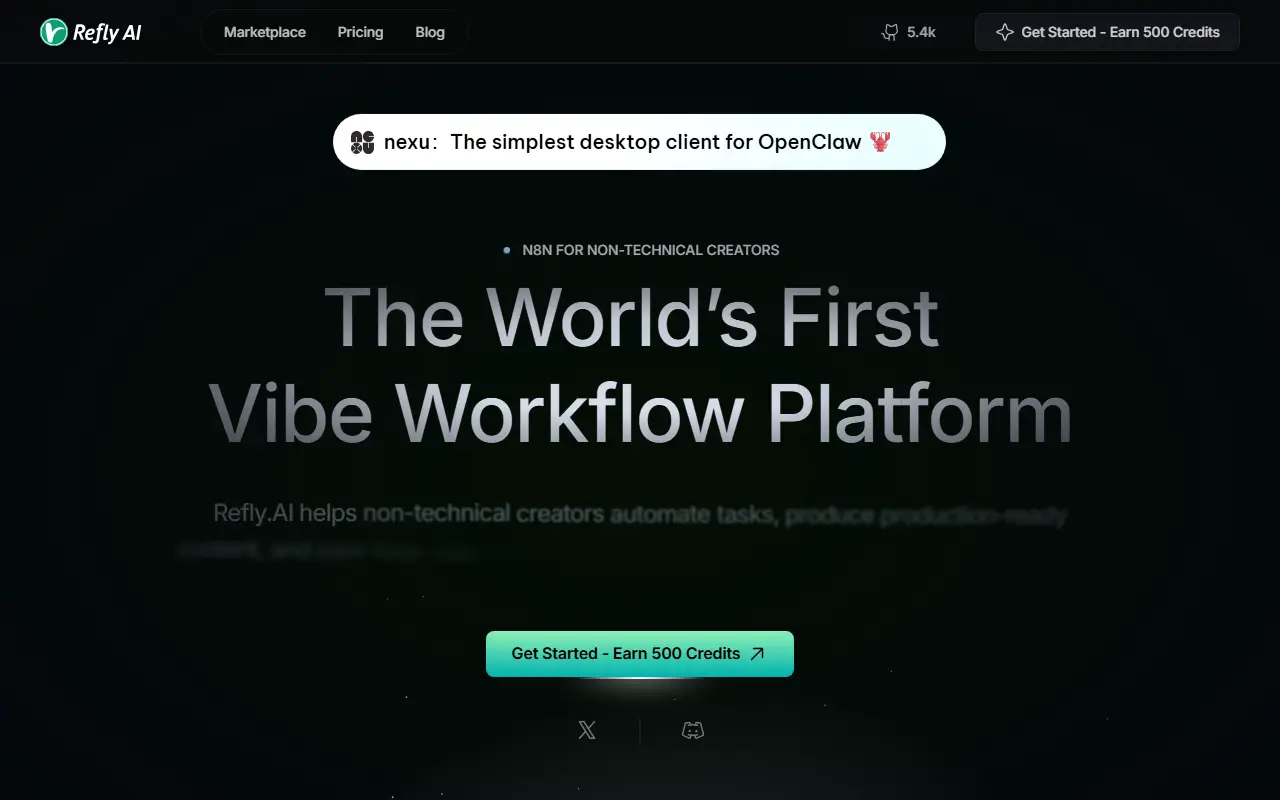
Refly is an open-source platform for building agent skills, which it treats as durable, versioned infrastructure rather than one-off prompts. You describe a workflow, Refly turns it into an executable skill, and that skill can be reused across teams and runtimes. The input lists its license only as other, so check the repository for terms.

Skills can be run in Refly with one click, exported to coding tools such as Claude Code, or deployed as APIs. Webhooks and bots can connect to Slack and Lark or Feishu, and a skills registry lets the community import, fork, and publish skills. Its topics mention n8n as a comparable workflow tool, and the project talks about compiling enterprise operating procedures into skills.

Refly can be deployed on your own server with Docker using the self-deployment guide, which the project recommends for developers, or accessed through a hosted workspace. It suits developers and operations teams automating repeatable work with AI agents and wanting those automations to be reviewable and shareable.

Key features

  • Builds versioned agent skills from workflows
  • Export skills to Claude Code and similar tools
  • Deploy workflows as APIs
  • Slack and Lark or Feishu bot integrations
  • Community skills registry with import and fork
  • Docker self-deployment guide

Pricing: A free plan gives 100 credits per day. Plus costs $19.9 per month, or $190 per year billed yearly, with 2,000 monthly credits.

Magic

Enterprise-oriented open-source AI agent platform that combines a general-purpose AI agent, a workflow engine, messaging, and collaborative office tools.

GitHub stars
5k
Last commit
1 mo ago
magicrew.aiMagic homepage screenshot

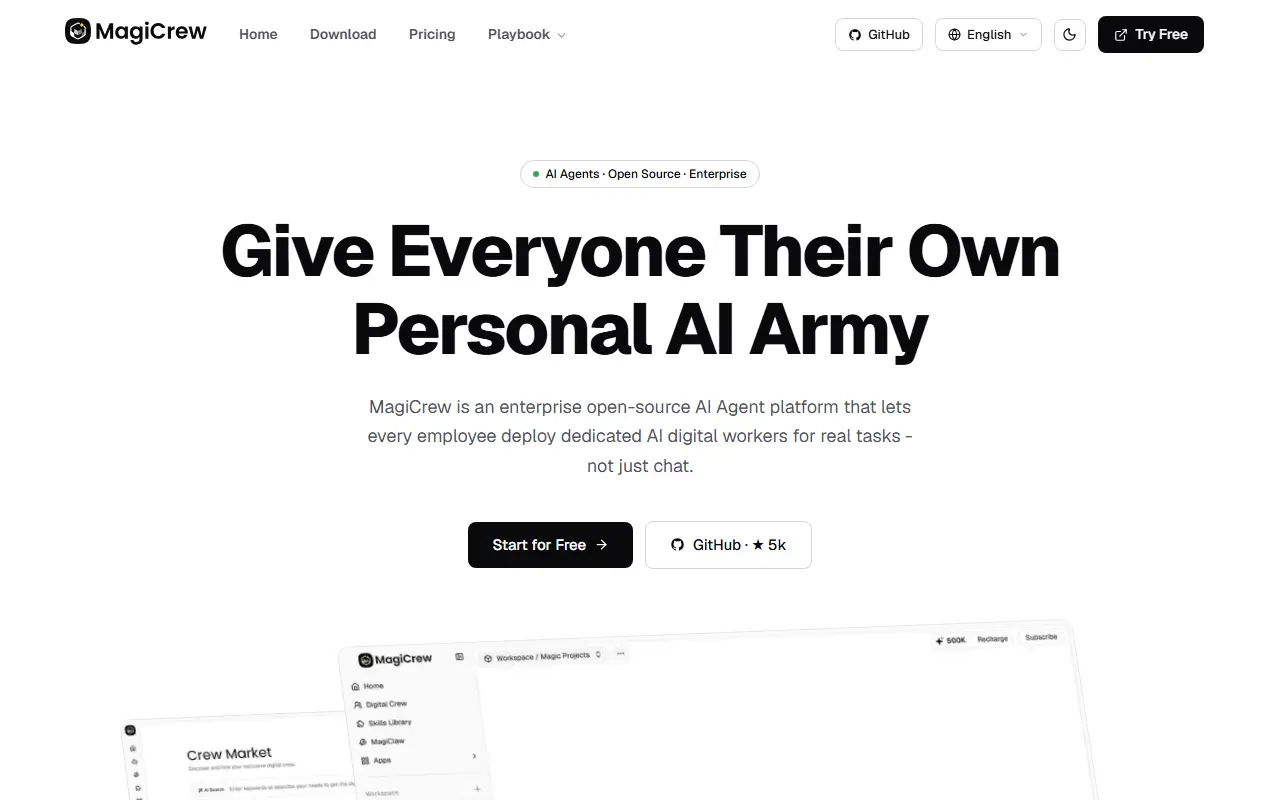
Magic, from the Magicrew project, is an open-source AI agent platform aimed at enterprises. It combines a generalist AI agent, a workflow engine, instant messaging, and an online collaborative office system in one product. The input lists its license only as other, so check the repository for terms.

The README frames it in contrast to personal AI assistants such as OpenClaw, which it credits as strong for individuals. In company settings, it argues, problems arise: data scattered across personal accounts, no budget guardrails, output that stops at plain text, and risky actions without approval gates. Magic is built to address security, control, direct business outcomes, and autonomous round-the-clock operation. Topics reference MCP, sandboxes, low-code and no-code workflows.

It is written in TypeScript and suits organizations that want to deploy AI agents with administrative control rather than adopt consumer tools. As the claims are the vendor's own, teams should evaluate its security and governance features themselves.

Key features

  • Generalist AI agent
  • Workflow engine with low-code building
  • Built-in instant messaging
  • Online collaborative office tools
  • MCP support and sandboxed execution
  • Approval gates for high-risk actions

Pricing: A free plan is given on sign-up. Paid plans are shown at $9.99 (Plus), $24.99 (Pro), $49.99 (Max) and $99.99 (Ultra) per month with points allowances, at a displayed discount.

LiveContext

LiveContext is a source-available, self-hosted AI automation platform where you describe a job in chat and it builds workflows, scoped agents and small apps.

GitHub stars
633
Last commit
2 days ago
Latest release
v0.3.5
Self-hosted
Yes
Hosted version
Available
livecontext.aiLiveContext homepage screenshot

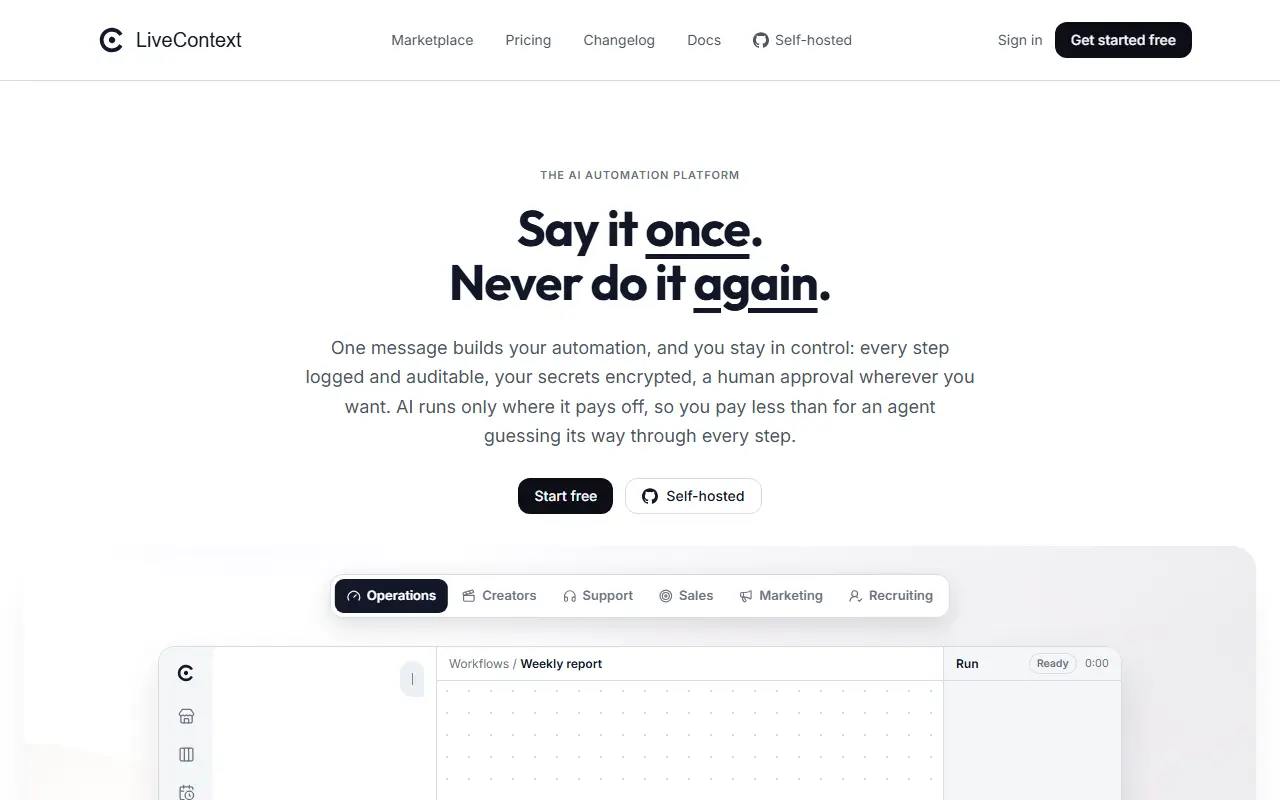
LiveContext is a self-hosted AI automation platform. You describe the job in a chat message, and it builds a readable workflow, AI agents with scoped access and spending budgets, and a small app your team can use, all on one canvas that combines chat, workflow, agent and app.

Workflows are drawn as a readable graph and can be wrapped in an interface with forms, dashboards and approval screens. Each agent has its own model, tools, files, credit budget and audit trail so you can see what it did, built-in data tables are available to workflows and agents without an external database, and every run is charted by calls, tokens, success rate and duration. The stack uses Java with Spring Boot, a Next.js front end and Docker, with topics mentioning MCP.

The project is positioned as a source-available alternative to n8n, Zapier and Make with agents built in, uses a fair-code style license listed as Other, and also offers a hosted version to try. It is aimed at teams that want AI automation they can run on their own infrastructure.

Key features

  • Chat-driven workflow building
  • Scoped AI agents with budgets and audit trails
  • Readable workflow graphs
  • Small apps with forms and dashboards
  • Built-in data tables
  • Run metrics per agent and tool

Pricing: A free plan includes 1,000 credits a month. Starter costs $8, Pro $19 and Team $39 per month (credit packs can be upgraded), with 20% off yearly billing; Enterprise is custom.

CubePlex

Self-hostable platform for team workspaces where a long-lived AI agent has shared skills, memory, MCP tools and persistent sandboxes, reachable from the web and chat apps.

GitHub stars
508
Last commit
yesterday
Latest release
v0.9.0
Self-hosted
Yes
cubeplex.aiCubePlex homepage screenshot

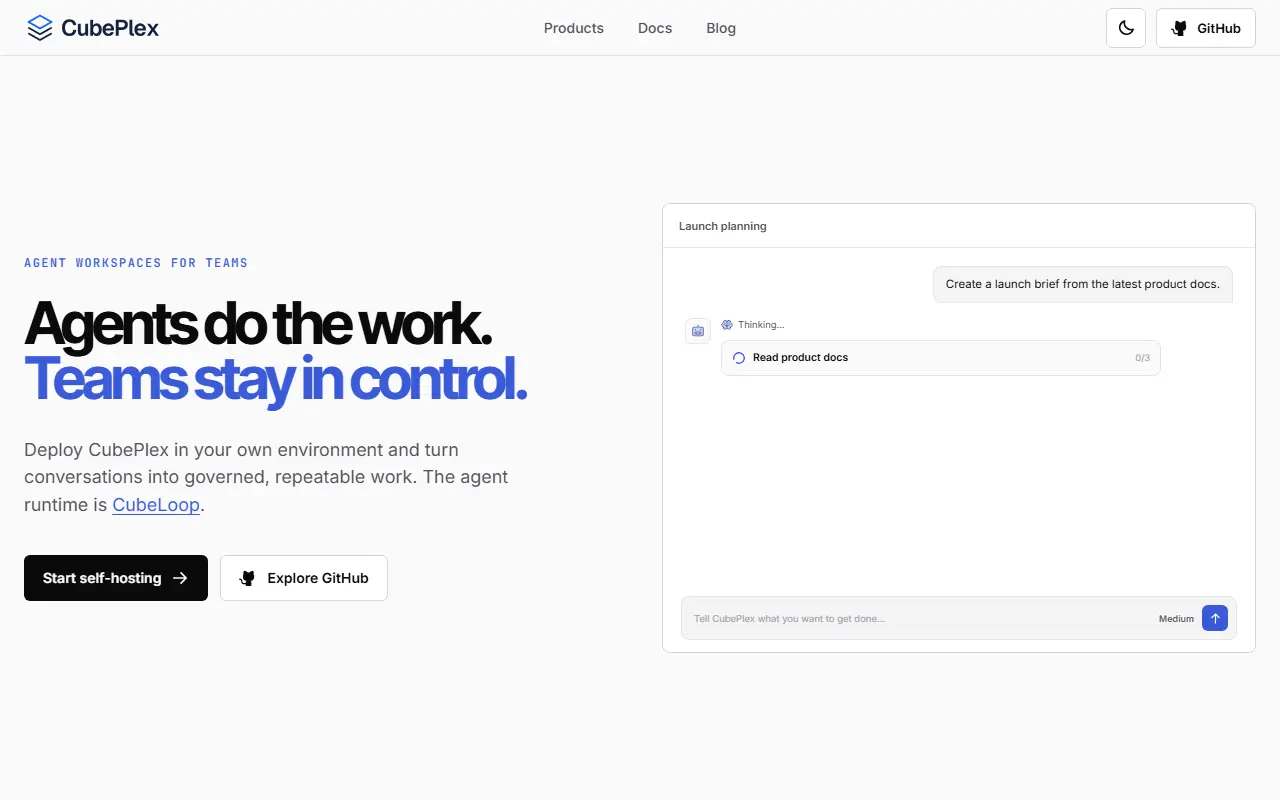
CubePlex is a cloud-native platform for managed AI agents that belong to a team rather than an individual. Each workspace gets one long-lived agent with a stable role, shared knowledge, approved tools and a persistent working environment, so the team returns to the same agent across tasks.

The agent can be used from the web and from messaging channels including Slack, Discord, Teams, Feishu, DingTalk and WeCom, with each conversation keeping its own participants and context. Skills, shared memory and MCP connections are configured per workspace, and isolated persistent sandboxes plus organization-level controls keep the agent's work inspectable and governed.

The agent runtime is built on CubeLoop, an async agent framework covering multi-provider model access, tool execution, streaming, middleware and durable checkpoints. External model providers, MCP servers and chat platforms stay outside CubePlex's trust boundary. It is written in Python and can be deployed with Docker Compose or Kubernetes. The licence is listed as other.

Key features

  • One long-lived agent per team workspace
  • Shared skills, memory and MCP tools
  • Persistent isolated sandboxes
  • Access from Slack, Discord, Teams and more
  • Organization-level governance controls
  • Docker Compose and Kubernetes deployment

GAIA

Open-source proactive AI assistant that triages email, briefs you before meetings, runs workflows and reaches you on chat apps like Slack and Telegram.

GitHub stars
305
Last commit
today
Latest release
desktop-v0.7.1
Self-hosted
Yes
Hosted version
Available
heygaia.ioGAIA homepage screenshot

GAIA is a personal AI assistant built to take over routine coordination work across tools such as Gmail, Calendar, Slack, Notion and Linear. Once you connect an account, it starts working without extra setup: it can triage your inbox each morning, draft replies, turn emails into to-dos, and brief you before meetings. When something needs your attention it contacts you on iMessage, WhatsApp, Telegram, Slack or Discord.

The feature list includes workflows written from plain English that run on a schedule or event, memory that learns people, projects and preferences and can be edited, exported or deleted, and voice with real-time calls and an on-device wake word. It also offers a sandboxed code-execution workspace that returns files such as PDFs, decks and spreadsheets, multi-source deep research, and browser automation that can log in and fill forms. Integrations are available with one click or through any MCP server, and skills follow the open Agent Skills specification.

GAIA works across web, desktop and mobile on a single account, with an inbox, calendar, to-dos and notifications in one workspace. The project is open source and self-hostable with your own keys; the repository metadata lists its license as Other, so check the terms before commercial use. A hosted version is available through the project website.

Key features

  • Proactive inbox triage and reply drafting
  • Meeting briefings from calendar data
  • Workflows generated from plain English
  • Editable long-term memory
  • Voice calls with on-device wake word
  • Sandboxed code execution producing documents
  • Integrations through MCP servers
  • Browser automation for web tasks

Pricing: GAIA can be self-hosted for free. The hosted GAIA plan costs $30 per month billed monthly, with two months free on yearly billing; Enterprise is priced around the team.

LoomFlow

Lightweight AI-first workflow builder that turns a natural-language description into a runnable workflow and publishes it as an authenticated API.

GitHub stars
222
Last commit
17 days ago
Latest release
v0.1.11
Licence
MIT
Self-hosted
Yes
loom-flow-ashen.vercel.appLoomFlow homepage screenshot

LoomFlow is a workflow builder for individuals and small teams that starts from a plain-language idea. You describe what you want, it generates a runnable workflow on a visual canvas, you adjust it, and then you publish it as an authenticated HTTP API with shareable pages. It also includes built-in evaluation, evolution and quality gates for the AI steps. It is aimed at indie developers, content creators, small studios and automation hobbyists.

The README compares it with Dify and n8n. It describes Dify as a heavier platform for team LLM apps with knowledge bases and complex deployment, and n8n as general-purpose automation where AI is one node type among many. LoomFlow positions itself as the lightweight, AI-first option that is quick to start and easy to run.

Deployment is a single Docker command for self-hosting, and the README says the setup runs on modest hardware. The application is built with TypeScript and Next.js, uses Supabase according to its topics, and is licensed under MIT. The README warns users to change the default administrator credentials after installation.

Key features

  • Generates workflows from natural-language descriptions
  • Visual canvas for editing flows
  • One-click publishing as an authenticated API
  • Shareable runnable flow pages
  • Built-in evaluation and quality gates
  • Single-command Docker self-hosting

Pricing: Free and open source under the MIT license.

Lindy alternatives: questions

What is the best open-source alternative to Lindy?
AutoGPT is the top-ranked open-source alternative to Lindy on Enlisted: An open-source platform for building and running AI agents from plain-English prompts or a visual block builder, with hosted and self-hosted options. Other strong options are Sim, Agenta, Refly and Magic.
Are these Lindy alternatives free?
All 9 are open source, so the code is free to use under its licence, and all of them can be self-hosted on your own server or computer. 6 also offer a paid or managed cloud version if you'd rather not host it yourself.
How is this list of Lindy alternatives ranked?
By a score built from GitHub stars, star growth over the last 30 days and how recently the code changed. 7 of these projects shipped code in the last 30 days. Data is refreshed daily, and nobody can pay to move up.

People also look for alternatives to…

View all