#1
Event-driven file transfer server speaking SFTP, FTP/S, HTTP/S and WebDAV, with local, S3, Google Cloud and Azure storage backends.
- GitHub stars
- 13k
- Last commit
- 3 days ago
- Latest release
- v2.7.6
- Licence
- AGPL-3.0
- Self-hosted
- Yes
sftpgo.com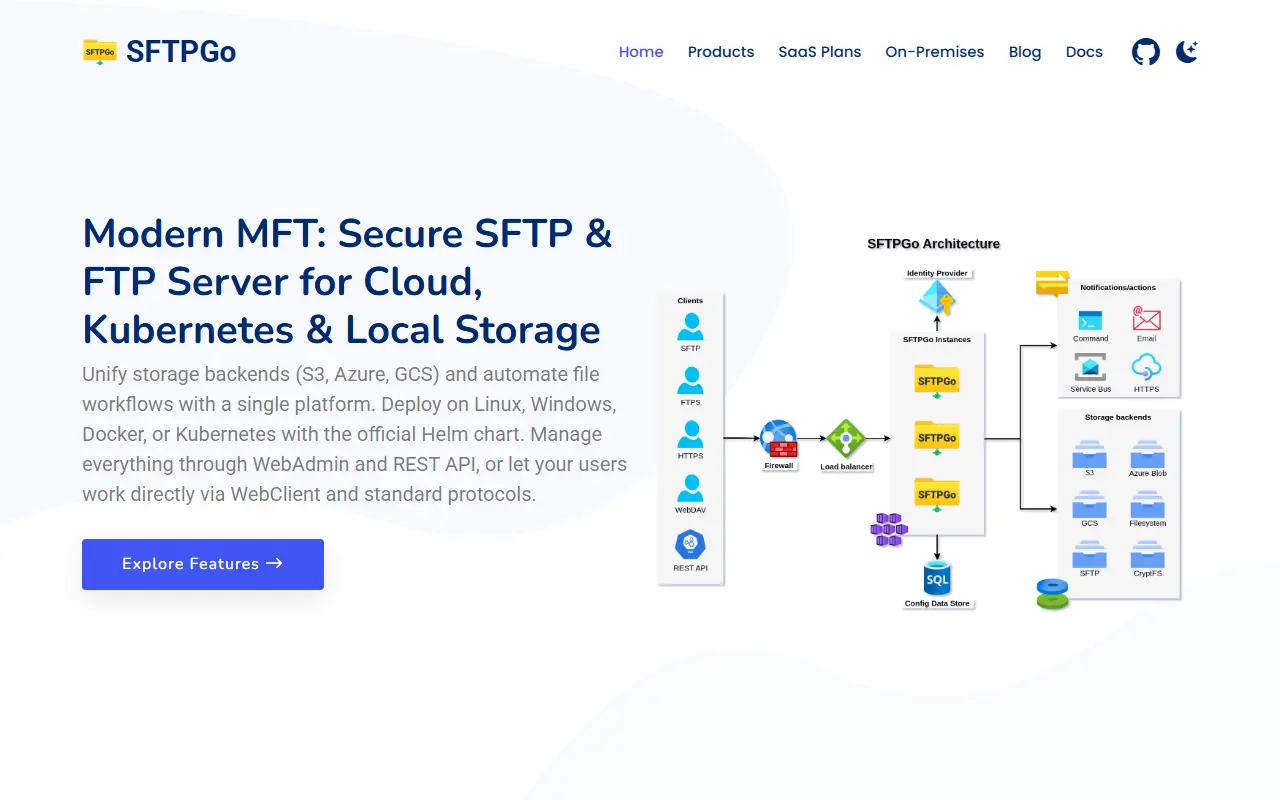
SFTPGo is a configurable file transfer server that exposes SFTP, HTTP/S, FTP/S and WebDAV. Storage can be a local filesystem, an encrypted local filesystem, S3-compatible object storage, Google Cloud Storage, Azure Blob Storage or another SFTP server, so teams can exchange files internally or with business partners using familiar tools and protocols.
The Community edition includes the core protocols, the storage backends and the WebAdmin and WebClient interfaces. The project topics highlight multi-factor authentication, Prometheus metrics, proxy protocol support and data-at-rest encryption. It is also used to place legacy protocols in front of cloud storage, which lets older clients write to S3, Google Cloud Storage or Azure Blob.
SFTPGo is written in Go and released under the AGPL-3.0 license, with community support through GitHub. A separate Enterprise edition is sold under a commercial license with direct support from the authors, ISO 27001 vendor status and extra features for compliance-heavy environments. It is described as a drop-in upgrade from the Community edition.
Key features
- SFTP, FTP/S, HTTP/S and WebDAV protocols
- Local, S3, Google Cloud and Azure Blob storage
- Web admin and web client interfaces
- Multi-factor authentication
- Prometheus metrics and Docker deployment
- Encrypted local filesystem option
Pricing: Managed SFTPGo SaaS runs from 50 euros (Tiny) to 850 euros (Premium) per month by storage and bandwidth, with a 10-day free trial and two months free on annual billing; Custom is quoted.
#2
Peer-to-peer file transfer in the browser using WebRTC, so files go from sender to recipient without a middle server.
- GitHub stars
- 10k
- Last commit
- yesterday
- Self-hosted
- Yes
- Hosted version
- Available
file.pizza
FilePizza sends files directly from one browser to another using WebRTC. Because the data never sits on an intermediary server, the README says the initial upload step of other web-based file sharing services is eliminated. A hosted instance runs at file.pizza, and the code can also be run yourself.
Version 2 added a new interface with dark mode, support for most mobile browsers including Mobile Safari, password protection, reporting and multi-file uploads that downloaders receive as a zip. Uploaders can watch transfer progress and stop it. Downloads stream through a Service Worker, and server state can be kept in Redis.
The stack is Next.js, Tailwind, TypeScript and React, with PeerJS for WebRTC. It can be run with pnpm or Docker. Environment variables configure Redis, TURN support for peers behind NAT, STUN and a self-hosted PeerJS server. The project is released under the BSD 3-Clause license.
Key features
- Browser-to-browser transfer with WebRTC
- Several files at once, delivered as a zip
- Optional password for uploads
- Uploader can monitor and stop the transfer
- Works on most mobile browsers
- Optional Redis for server state
- TURN support for peers behind NAT

Self-hosted file upload server built around ShareX, with short URLs, folders, tags, and sharing controls for people who want to run their own screenshot and file host.
- GitHub stars
- 3.5k
- Last commit
- 4 days ago
- Latest release
- v4.8.3
- Licence
- MIT
- Self-hosted
- Yes
zipline.diced.sh
Zipline is an open-source file upload server that you run yourself. It began as a destination for ShareX screenshot and file uploads and has grown into a general personal or team file host with a web interface, an API, and a gallery view for uploaded media. It is released under the MIT license.
Uploads can be organized into folders and tags, shortened into compact URLs, and shared with embeds that preview cleanly in chat apps. Access can be tightened with password-protected links, invite-only registration, per-user quotas, OAuth2 sign-in, two-factor authentication, and passkeys. Image compression, video thumbnails, and partial uploads help with larger files, and webhooks can notify Discord or any HTTP endpoint.
Deployment is Docker-based: you mount volumes for uploads, public assets, and custom themes, and set a secret value before the first start. The host CPU must support AVX instructions, because the project does not publish builds for older processors. Zipline suits individuals, communities, and small teams who want a private alternative to public image and file hosts.
Key features
- ShareX-compatible upload endpoint
- Folders and tags for organizing uploads
- URL shortening for shared files
- Password-protected links and invite-only signups
- OAuth2, two-factor authentication, and passkeys
- Image compression and video thumbnails
- Discord and HTTP webhooks
- Custom themes and per-user quotas
Pricing: Free and open source under the MIT license; you run it on your own server.
#4
Browser-based AirDrop-style file sharing between devices on the same network or via temporary public rooms, with no setup or signup.
- GitHub stars
- 12k
- Last commit
- 6 mo ago
- Latest release
- v1.11.2
- Licence
- GPL-3.0
- Self-hosted
- Yes
- Hosted version
- Available
pairdrop.net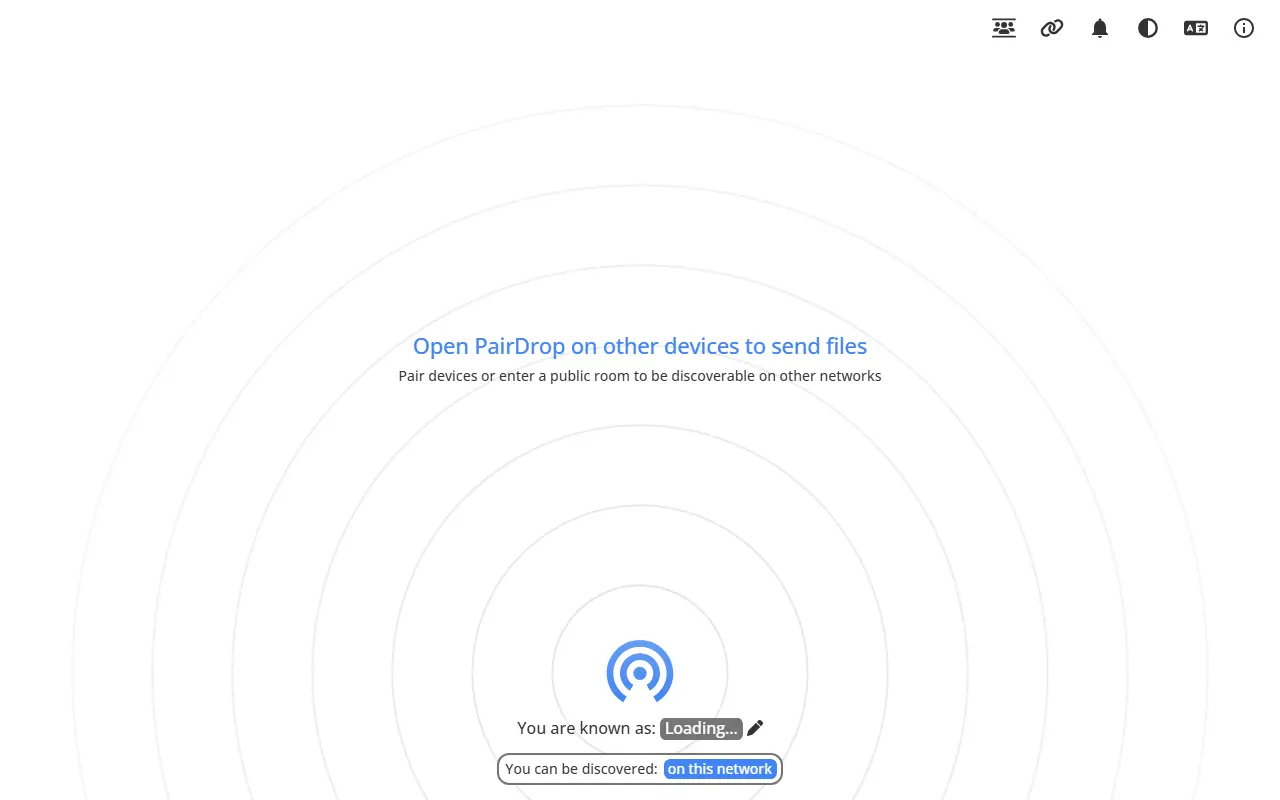
PairDrop is a web app for local file sharing in the browser, inspired by Apple's AirDrop. It is a fork of Snapdrop and works on all platforms with a modern browser, which makes it useful for moving files between a phone and a laptop or between Android and iOS devices. It is released under the GPL-3.0 license.
You can send images, documents, or text through peer-to-peer connections to devices on the same local network. For transfers over the internet, you join temporary public rooms to pair devices. It runs as a progressive web app using WebRTC and WebSockets on a Node.js server, and the README lists the differences from the Snapdrop project it is based on.
A public instance is available at pairdrop.net, and the app can be self-hosted. PairDrop suits anyone who needs quick, no-account file transfers across mixed operating systems and wants to keep files off third-party cloud storage.
Key features
- AirDrop-like sharing in the browser
- Peer-to-peer transfers on the local network
- Temporary public rooms for internet transfers
- Send files and text
- Progressive web app
- No setup or signup
Pricing: Free and open source under the GPL-3.0 license; a public instance runs at pairdrop.net.
#5
Safebucket is an open-source, self-hosted file sharing platform where uploads and downloads go directly to storage via presigned URLs.
- GitHub stars
- 995
- Last commit
- 2 days ago
- Latest release
- v0.8.1
- Licence
- Apache-2.0
- Self-hosted
- Yes
docs.safebucket.io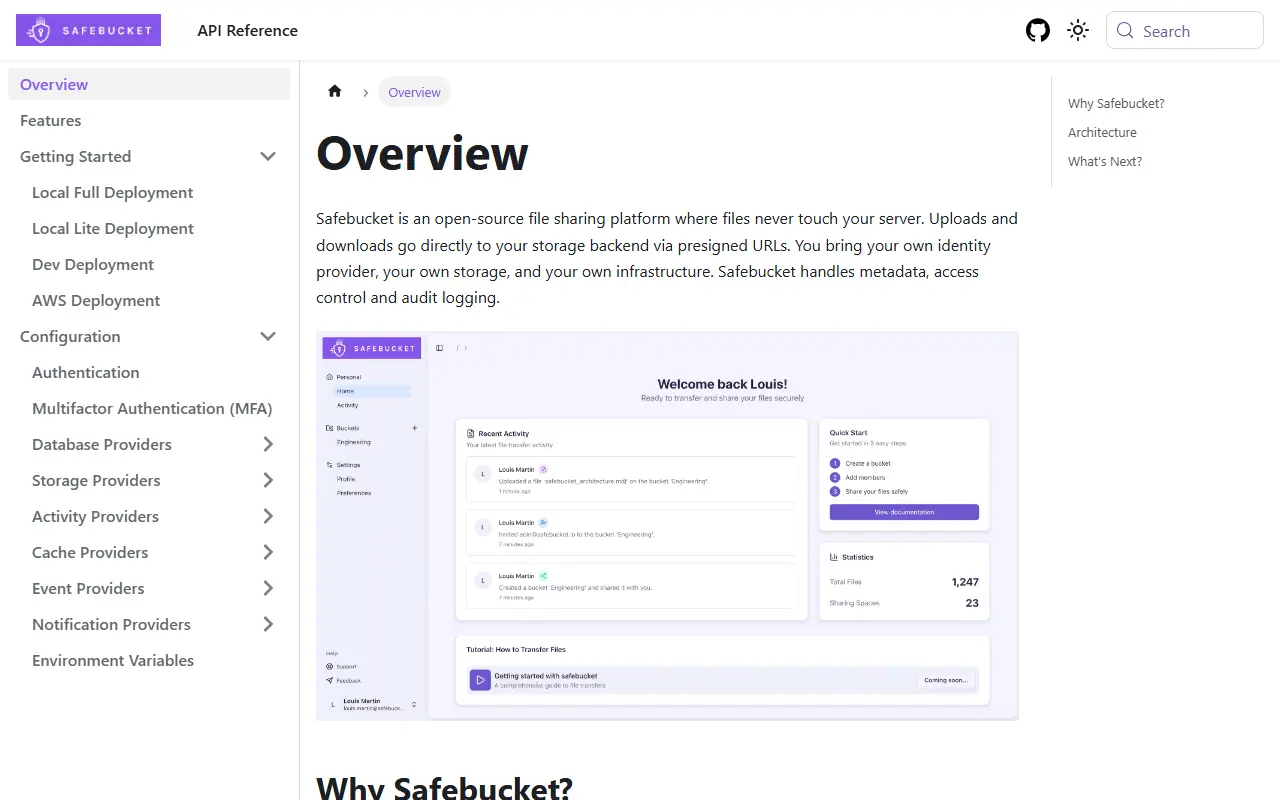
Safebucket is an open-source platform for sharing files on infrastructure you control. Its distinguishing design choice is that uploads and downloads use presigned URLs, so file data goes straight between the user and the storage backend and bypasses the application server. That keeps the server light and avoids it becoming a bottleneck for large transfers.
The platform covers the sharing workflow with quick and reverse share links that can be protected by a password or limited by download or view count, role-based access control at platform and bucket level, and file expiration with a configurable trash retention period. Sign-in works through any OIDC provider, local accounts exist for external users, and TOTP multifactor authentication is supported. Administrators get an activity feed, audit logs and a dashboard with platform-wide statistics.
Each component, including storage, database, events, cache and notifier, can be swapped for another implementation. The backend is written in Go, is licensed under Apache-2.0 and ships as container images that are signed with cosign. A Docker-based quick start brings it up locally on port 8080.
Key features
- Direct uploads via presigned URLs
- Password-protected public share links
- Reverse share for receiving files
- OIDC single sign-on and TOTP
- Role-based access at bucket level
- Audit logs and admin dashboard
- File expiration and configurable trash
Pricing: Free and open source under the Apache-2.0 license.
#6
A self-hosted temporary file upload system written in Go, comparable to WeTransfer, with a web interface and a command line client.
- GitHub stars
- 1.8k
- Last commit
- 8 days ago
- Latest release
- 1.4.3
- Self-hosted
- Yes
Plik is a temporary file upload service written in Go that you run yourself. The README describes it as scalable and friendly, in the manner of WeTransfer. Files are shared by link, and uploads can be configured with a time to live that is cleaned up automatically.
Uploads can be made through a Vue 3 web interface available in 12 languages with light, dark and custom themes, through a command line client, or with a plain curl form post. A OneShot option deletes a file after its first download, and a stream mode passes data from uploader to downloader without storing it. Uploads can also be password protected and encrypted end to end with Age.
On the server side Plik supports several storage backends, including local disk, S3, OpenStack Swift and Google Cloud Storage, and metadata in SQLite, PostgreSQL or MySQL. Sign-in can use local accounts, Google, GitHub, OVH or OIDC. It runs from Docker, release archives, a Debian or Ubuntu package, source or a Helm chart for Kubernetes.
Key features
- Web interface in 12 languages with themes
- Local, S3, Swift and Google Cloud storage backends
- Several authentication providers including OIDC
- OneShot downloads and stream mode
- File preview with syntax highlighting and media player
- Installs via Docker, packages, source or Helm
- Temporary uploads with expiry and one-time downloads

A tiny self-hosted paste bin, file-sharing and URL shortening web app written in Rust, shipped as a single executable with optional encryption.
- GitHub stars
- 4.6k
- Last commit
- 2 mo ago
- Latest release
- v2.1.0
- Licence
- BSD-3-Clause
- Self-hosted
- Yes
microbin.eu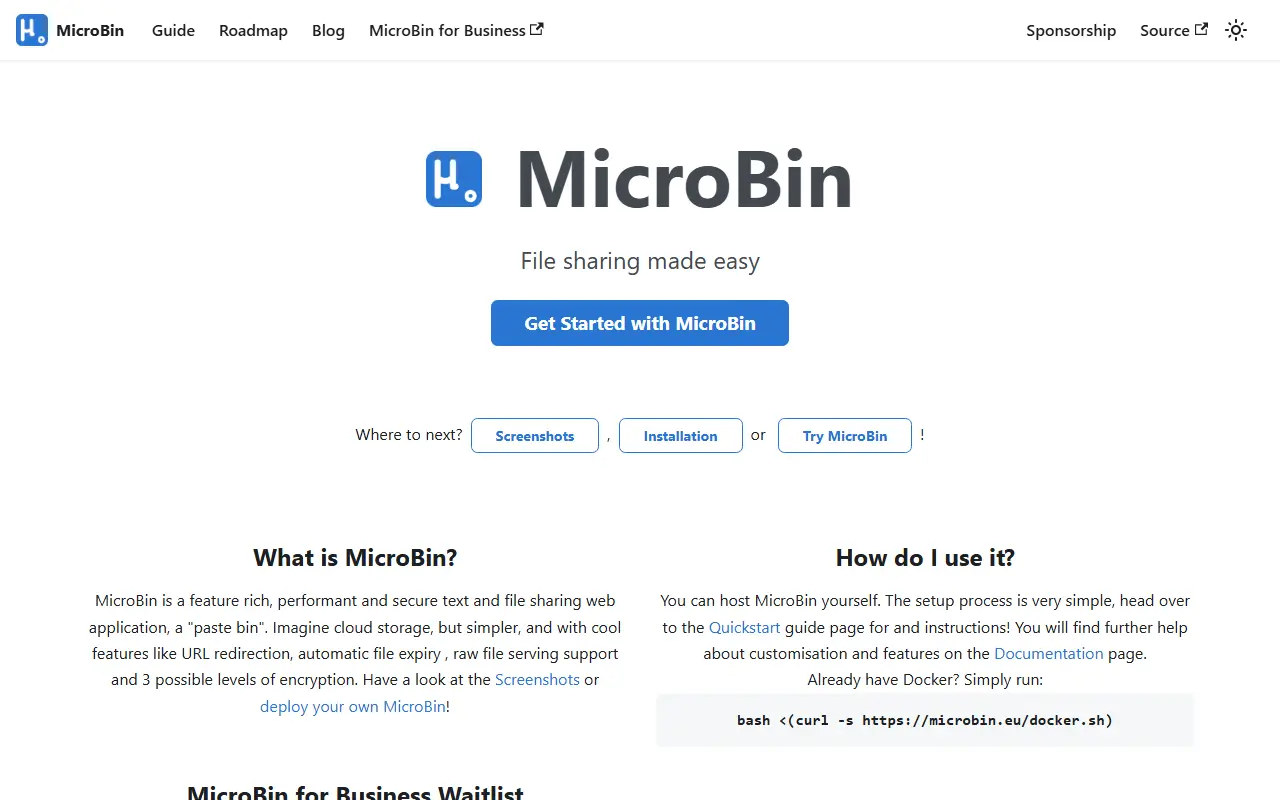
MicroBin is a small, self-contained and self-hosted paste bin web application written in Rust. It is quick to set up and needs only a few megabytes of memory and disk storage, and it ships as a single executable file.
An upload can be a pasted text, one or more attached files, or a URL redirection. Uploads can be private or public, editable or read-only, and set to expire automatically or never. Other features include server-side and client-side end-to-end encryption, QR code support, raw text serving, animal names as upload identifiers, automatic dark mode, and SQLite or JSON storage.
People use it to send long texts or large files, share sensitive documents, shorten URLs and serve configuration files or images through its raw endpoint. It can be installed through a Docker setup script or from Cargo, and is licensed under BSD-3-Clause. The project website offers screenshots, documentation and a roadmap.
Key features
- Paste bin for text and code
- File uploads with multiple attachments
- URL shortening and redirection
- Server-side and client-side E2E encryption
- Expiring and non-expiring uploads
- QR code support
- SQLite and JSON database support
- Single self-contained executable
Pricing: Free and open source under the BSD-3-Clause licence.
#8
Lightweight PHP file host for quick temporary or permanent uploads, with drag-and-drop, an upload API, rate limiting and file-type controls.
- GitHub stars
- 1.2k
- Last commit
- 8 days ago
- Latest release
- v.2.0.0
- Licence
- GPL-3.0
- Self-hosted
- Yes
- Hosted version
- Available
uguu.se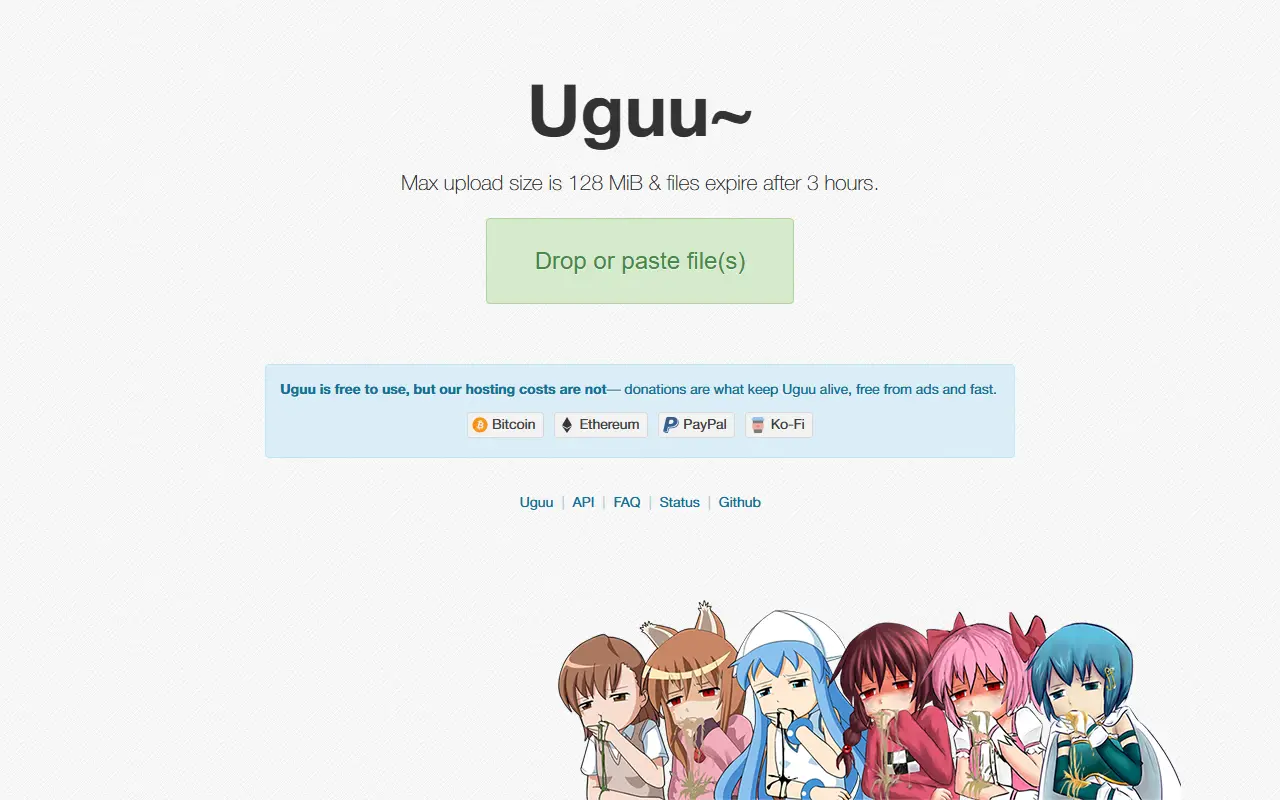
Uguu is a simple, lightweight platform for temporary file hosting and sharing that can also serve as a permanent file host. Uploading takes one click and needs no registration, and the web interface is minimal and modern, supporting drag and drop, paste and click-to-select. It is aimed at anyone who wants to run their own quick-share service, and a public instance runs at uguu.se.
An upload API can return responses in JSON, HTML, plain text or CSV, and the service works with ShareX and other screenshot tools. Administrators can restrict files by extension or MIME type with black or whitelists, apply upload rate limiting, and blacklist files by hash. The README lists tested requirements of Nginx with PHP 8.3 and SQLite, MySQL or PostgreSQL; Bun is used to compile front-end assets before the app runs on PHP.
Installation and configuration are covered in the project documentation. Uguu is based on the earlier Pomf project, follows the PSR-12 coding standard enforced with PHPCS, and is licensed under GPL-3.0.
Key features
- One-click uploads without registration
- Drag and drop and clipboard paste
- Upload API with JSON, HTML, text and CSV responses
- ShareX support
- Extension and MIME allow and block lists
- Rate limiting and file hash blacklisting
Pricing: Free and open source under the GPL-3.0 license.
#9
Sharry is a self-hosted web application for sharing files through hard-to-guess links, with optional passwords and expiry times.
- GitHub stars
- 1.4k
- Last commit
- today
- Latest release
- v1.17.0
- Licence
- GPL-3.0
- Self-hosted
- Yes
eikek.github.io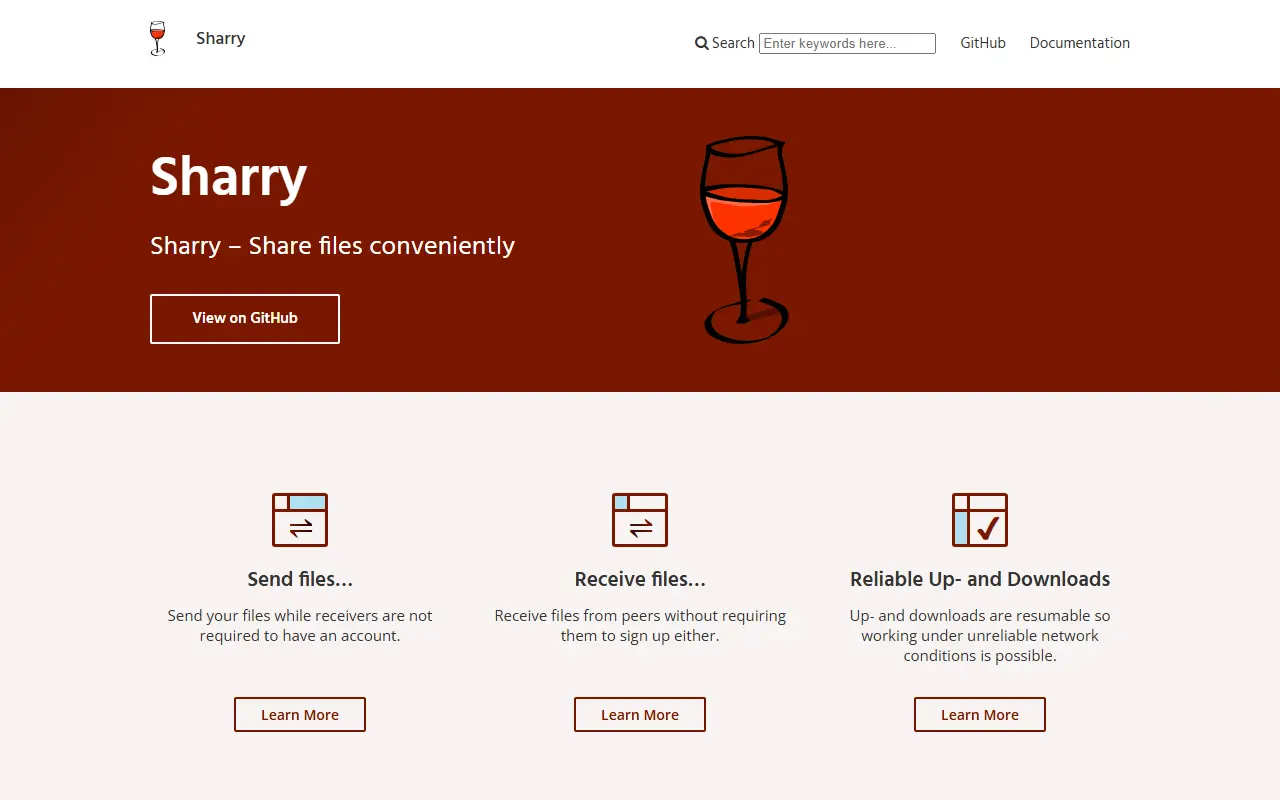
Sharry is a self-hosted file sharing web application. The basic idea is simple: you upload files and receive a URL that you can pass on to others, instead of sending large attachments or using a third-party sharing service.
Authenticated users can upload files with an optional password and a time period that controls how long the files remain downloadable, and the resulting public link can be shared by email. In the other direction, each registered user can maintain alias pages behind hard-to-guess URLs, which let anyone upload files to that user with a description, optionally notifying them by email. Alias pages can be disabled or deleted at any time. The upload implementation follows the tus protocol.
Sharry is built with Scala and Elm and licensed under GPL-3.0. It can be installed from a Debian package or zip file, with the Nix package manager and a NixOS module, or with Docker. Documentation is published on its website. It suits individuals and small organizations that want a private way to exchange large files.
Key features
- Upload files and share by link
- Optional passwords and expiry periods
- Alias pages for receiving uploads
- Email notifications to users
- Resumable uploads via the tus protocol
- Install via deb, zip, Nix, or Docker
Pricing: Free and open source under the GPL-3.0 licence.
ffsend is a command-line client for Send that uploads files and directories as encrypted, expiring share links, written in Rust.
- GitHub stars
- 7.4k
- Last commit
- 11 mo ago
- Latest release
- v0.2.77
- Licence
- GPL-3.0
gitlab.com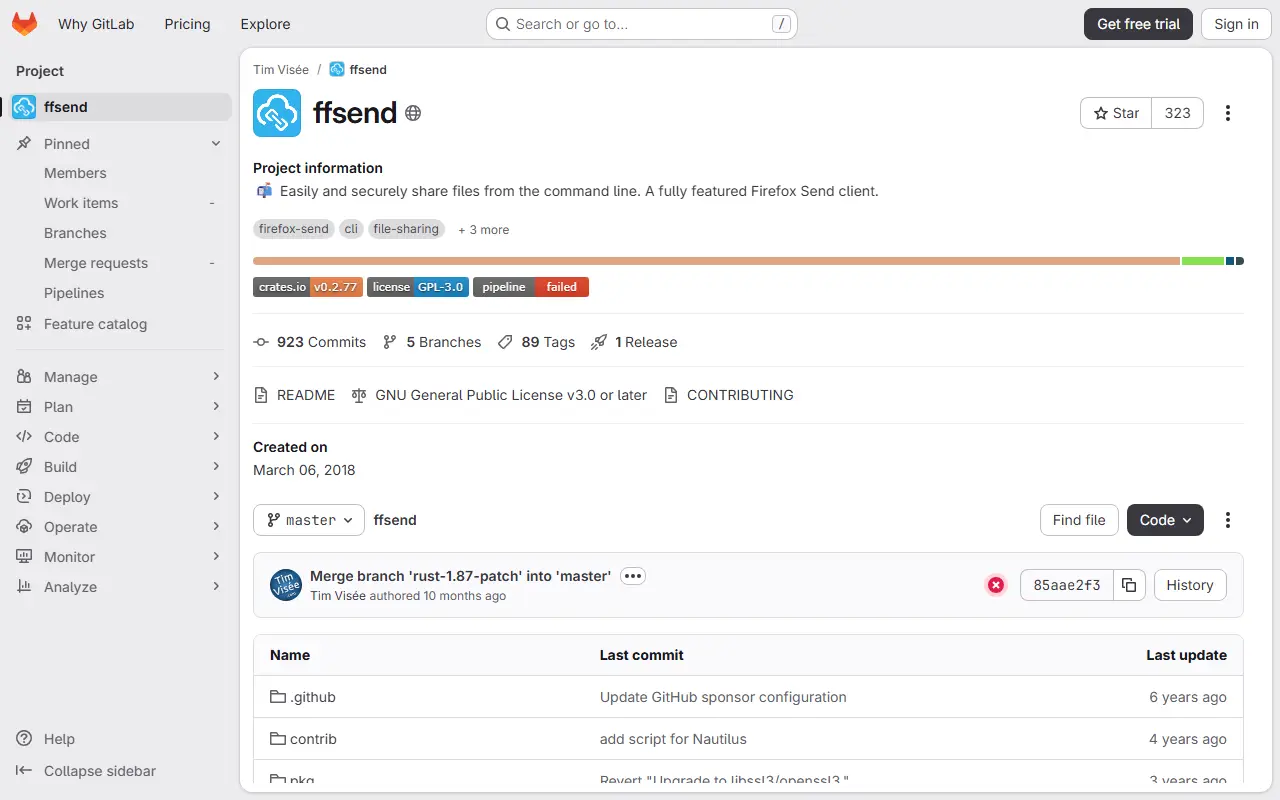
ffsend is a command-line tool for sharing files and directories through a private, encrypted link, using one command. It is a client for the Send file service, and recipients can download with the same tool or through a web browser. Files shared this way can be up to 1GB.
Encryption happens on the client, and secrets are never sent to the remote host. An optional password can be set, and a default lifetime of 1 download (up to 20) or 24 hours is enforced so files do not stay online indefinitely. The project is not affiliated with Firefox or Mozilla.
The tool can also inspect, check and delete uploads, keep a history of shared files, and talk to a Send host you run yourself. The default public host is provided by the author, who asks users to consider donating. The README lists Linux, macOS, Windows, FreeBSD and Android as supported, and marks the tool as beta.
Key features
- Encrypted upload and download of files and directories
- Password protection and configurable download limits
- Built-in URL shortener and QR code generator
- Works with Send v3 and v2
- Choice of your own Send host
- Scriptable without interactive prompts
- Streaming transfers with low memory use
5 more Filemail alternatives
Filemail alternatives: questions
- What is the best open-source alternative to Filemail?
- SFTPGo is the top-ranked open-source alternative to Filemail on Enlisted: Event-driven file transfer server speaking SFTP, FTP/S, HTTP/S and WebDAV, with local, S3, Google Cloud and Azure storage backends. Other strong options are FilePizza, Zipline, PairDrop and Safebucket.
- What are the best commercial alternatives to Filemail?
- Send Anywhere, Smash, TransferNow, WeTransfer and SwissTransfer are among the hosted, closed-source alternatives to Filemail listed on Enlisted, which lists 21 in total. Compare their pricing and features on each tool page.
- Are these Filemail alternatives free?
- All 15 are open source, so the code is free to use under its licence, and all of them can be self-hosted on your own server or computer. 4 also offer a paid or managed cloud version if you'd rather not host it yourself.
- How is this list of Filemail alternatives ranked?
- By a score built from GitHub stars, star growth over the last 30 days and how recently the code changed. 8 of these projects shipped code in the last 30 days. Data is refreshed daily, and nobody can pay to move up.
 TrackMedia
 TrackRev