7,363 open-source and SaaS tools, with GitHub stats refreshed every day.

10 alternatives ranked by real activity

Open-source Feedly alternatives

A curated, ranked list of the 10 best open-source alternatives to Feedly.

The best open-source alternative to Feedly is FreshRSS. If that doesn't suit you, other good options are NetNewsWire, Fluent Reader, Miniflux and NewsBlur.

Feedly alternatives are mainly productivity tools. 9 of them shipped code in the last 30 days, 10 can be self-hosted, and 8 use a permissive licence.

Last updated October 3, 2026 · ranked by GitHub stars, growth and recent commits

FreshRSS

A lightweight, self-hosted RSS and news aggregator with multi-user support, an API for mobile clients, WebSub push and extensions.

GitHub stars
16k
Last commit
yesterday
Latest release
1.30.0
Licence
AGPL-3.0
Self-hosted
Yes
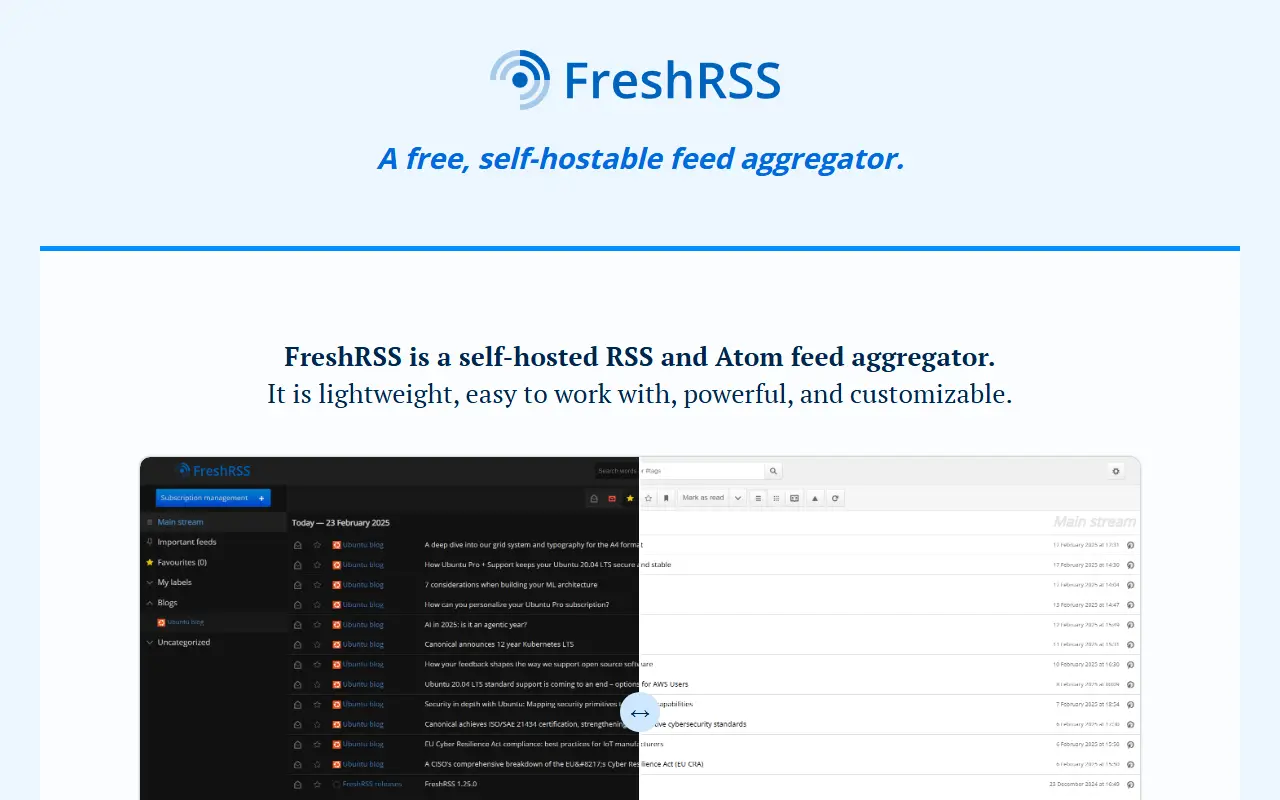
freshrss.orgFreshRSS homepage screenshot

FreshRSS is a self-hosted RSS feed aggregator written in PHP. It is described as lightweight, easy to work with and customizable, has been translated into many languages, and works for several users at once while also offering an anonymous reading mode. Articles can be organized with custom tags, and there is a demo to try.

It supports the WebSub standard, so compatible sources can push new articles instantly instead of waiting for polling. For sites that offer no feed, it has basic web scraping using XPath, and it can also read JSON documents. Selections of articles can be reshared as HTML, RSS or OPML. An API serves mobile clients, and a command line interface is included, and several login methods are supported, including a web form with an anonymous option, HTTP authentication that works with proxy delegation, and OpenID Connect. Extensions allow further tuning.

FreshRSS is licensed under AGPL-3.0 and run on your own server. It suits individuals, families or small teams who want a private feed reader that works with the usual mobile RSS apps and does not depend on a commercial service.

Key features

  • Multi-user RSS aggregation
  • WebSub instant push updates
  • XPath-based scraping for sites without feeds
  • API for mobile clients and a CLI
  • OpenID Connect and HTTP authentication
  • Extensions and custom tags

Pricing: Free and open source under the AGPL-3.0 license.

NetNewsWire

Free, open-source feed reader for macOS and iOS that supports RSS, Atom, JSON Feed and RSS-in-JSON.

GitHub stars
10k
Last commit
today
Latest release
mac-7.1.5
Licence
MIT
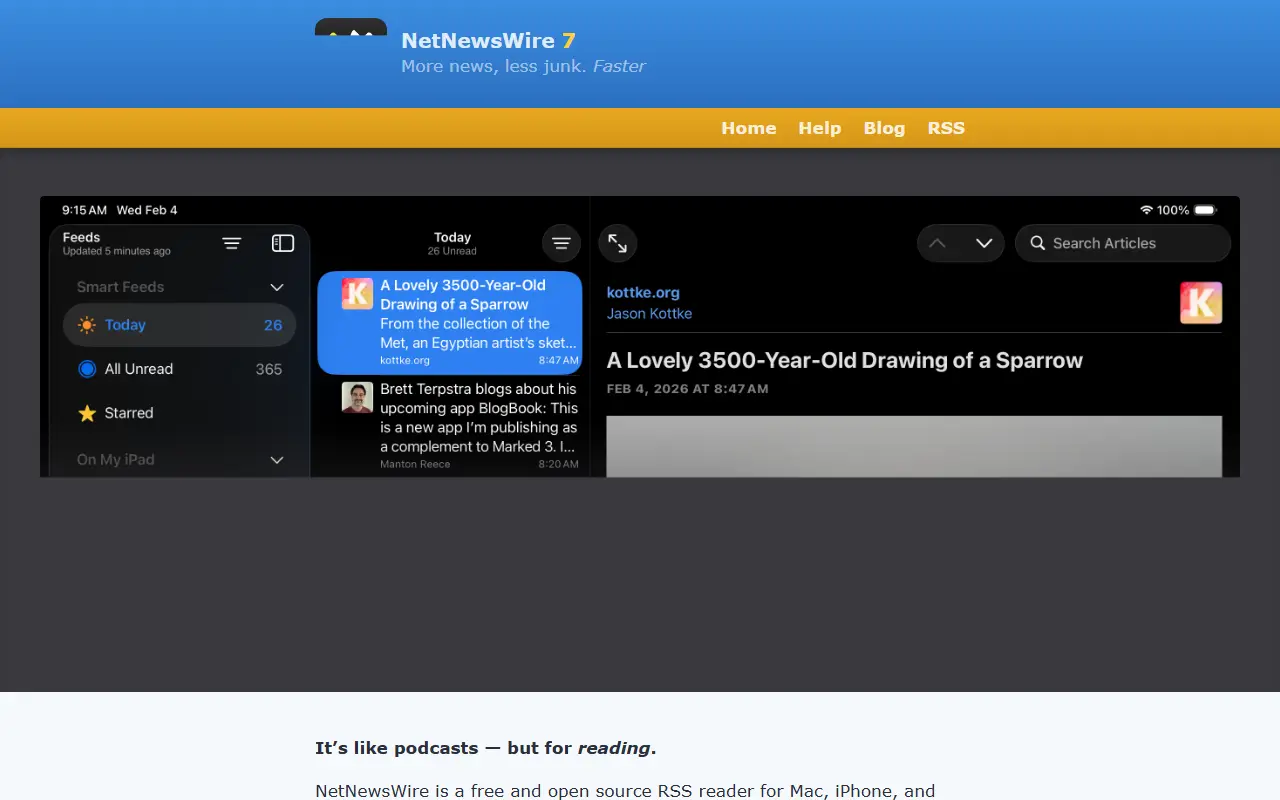
netnewswire.comNetNewsWire homepage screenshot

NetNewsWire is a free and open-source feed reader for macOS and iOS. It reads RSS, Atom, JSON Feed and RSS-in-JSON formats, letting people follow blogs, news sites and other sources in one place without algorithmic feeds.

The project accepts bug reports and feature requests on GitHub and publishes change notes for current and previous releases. A community forum lets users talk to each other and help with testing, coding, writing and feedback. Contributors are asked to follow the code of conduct and to ask before starting any pull request, because the Contributing page describes a process that begins with a conversation.

NetNewsWire is written in Swift and licensed under the MIT license. It can be built and tested without a paid Apple developer account, using a local DeveloperSettings.xcconfig file for code-signing overrides, either created by the included setup.sh script or manually. The project asks supporters to help in ways other than sending money.

Key features

  • Feed reader for macOS and iOS
  • RSS, Atom, JSON Feed and RSS-in-JSON support
  • Open Swift source code
  • Community forum and release notes
  • Buildable without a paid developer account

Pricing: Free and open source under the MIT license.

Fluent Reader

Desktop RSS reader with a Fluent Design interface, dark mode and sync with services such as Inoreader and Feedbin.

GitHub stars
9.7k
Last commit
17 days ago
Latest release
v1.2.2
Licence
BSD-3-Clause
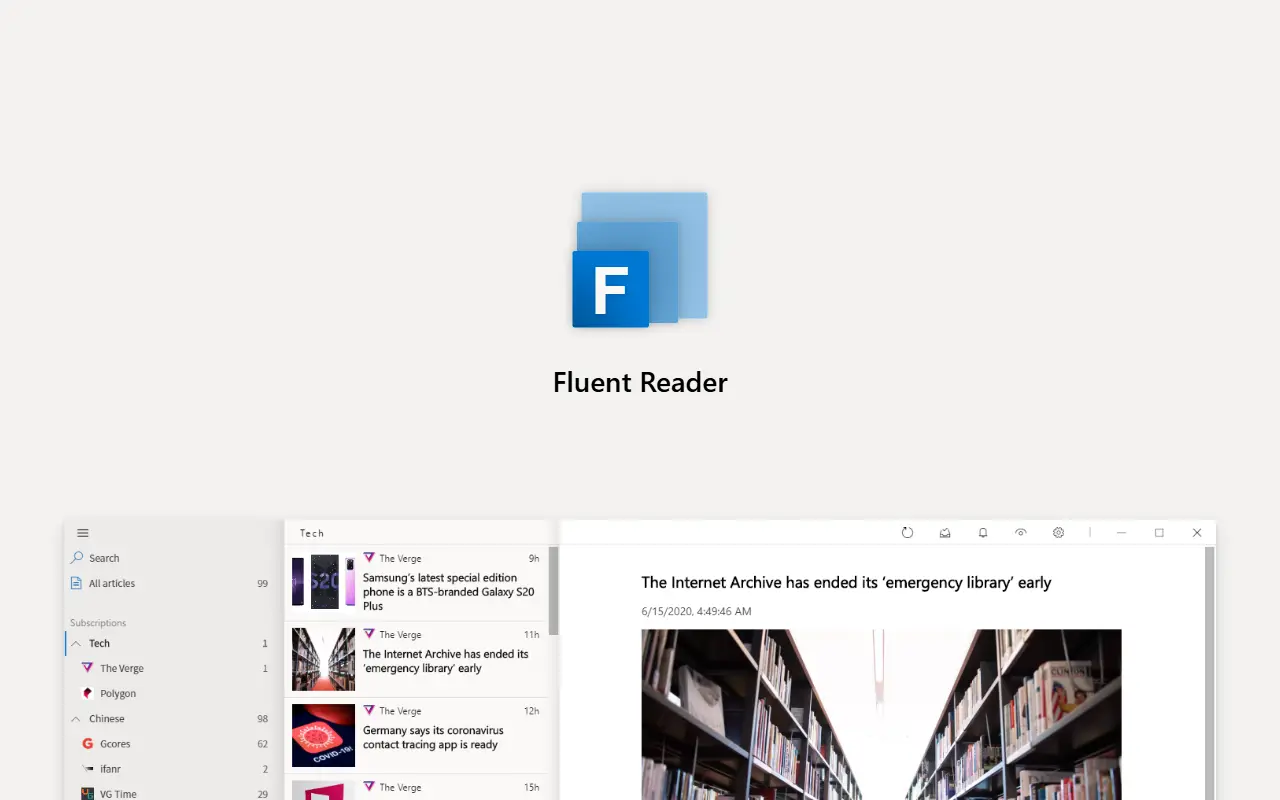
hyliu.meFluent Reader homepage screenshot

Fluent Reader is a modern desktop RSS reader built with Electron, React and Fluent UI. Its interface is inspired by the Fluent Design System and has full dark mode support. It can be used purely locally or connected to online services.

Sync works with self-hosted services compatible with the Fever or Google Reader API and with RSS services such as Inoreader, Feedbin, The Old Reader and BazQux Reader. Users can import and export OPML files, back up and restore application data, read the full content in a built-in article view, search with regular expressions, group subscriptions into folders, use single-key shortcuts, and apply regex rules that hide, star or mark articles as read. Articles can be fetched in the background with push notifications.

Windows 10 users are advised to install it from the Microsoft Store and macOS users from the Mac App Store, while Linux and older Windows versions use GitHub releases. A separate repository holds the mobile app. The code is TypeScript under the BSD-3-Clause license, with translations handled through react-intl-universal.

Key features

  • Fluent Design interface with dark mode
  • Local reading or sync with RSS services
  • OPML import and export with data backup
  • Regex search and automatic article rules
  • Single-key keyboard shortcuts
  • Background fetching with notifications

Pricing: Free and open source under the BSD-3-Clause license; donations are accepted.

Miniflux

Miniflux, a minimalist self-hosted feed reader written in Go that supports Atom, RSS and JSON Feed with PostgreSQL storage.

GitHub stars
9.8k
Last commit
yesterday
Latest release
2.3.3
Licence
Apache-2.0
Self-hosted
Yes
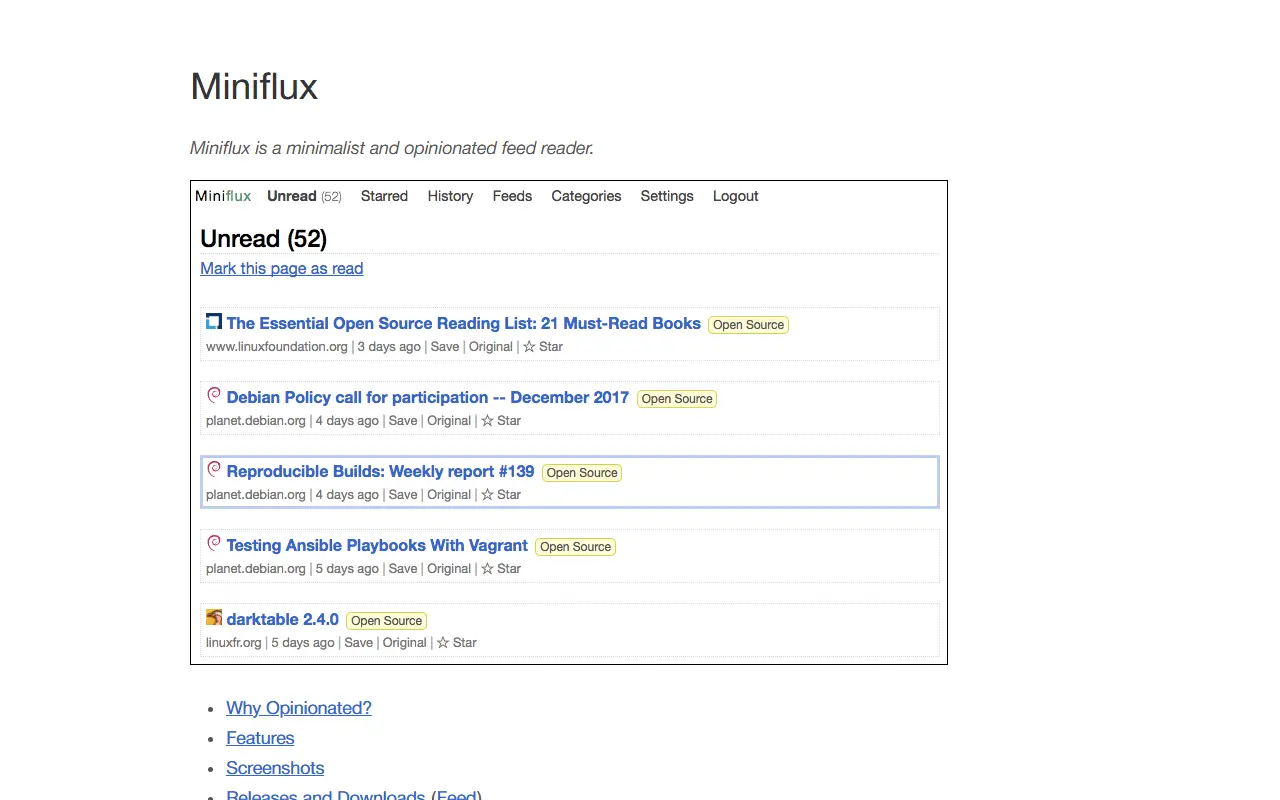
miniflux.appMiniflux homepage screenshot

Miniflux 2 is a minimalist and opinionated feed reader. It is designed to be simple, lightweight and easy to install, and it reads Atom, RSS and JSON Feed formats. Users can import and export OPML files, organize articles with categories and bookmarks, share individual articles publicly and search the full text through PostgreSQL.

A strong focus is placed on privacy and security. It removes pixel trackers and tracking parameters from URLs, opens external links with no-referrer attributes, proxies media to avoid tracking, plays YouTube videos through the privacy-focused youtube-nocookie domain or alternative players such as Invidious, blocks external JavaScript, sanitizes content and enforces content security and Trusted Types policies.

The interface is available in about 20 languages, and articles can be saved to third-party services. Miniflux is written in Go, uses PostgreSQL, and is released under the Apache-2.0 license. More information is on miniflux.app, and the repository slug v2 refers to the second major version of the project.

Key features

  • Atom, RSS and JSON Feed reading
  • OPML import and export
  • Categories, bookmarks and public article sharing
  • Full-text search powered by PostgreSQL
  • Tracker and tracking-parameter removal
  • Interface in about 20 languages

Pricing: Free and open source under the Apache-2.0 license.

NewsBlur

NewsBlur is a personal news reader and RSS feed reader with training filters, original site view and sharing, available hosted or self-hosted.

GitHub stars
7.6k
Last commit
yesterday
Latest release
v0.2.2
Licence
MIT
Self-hosted
Yes
Hosted version
Available
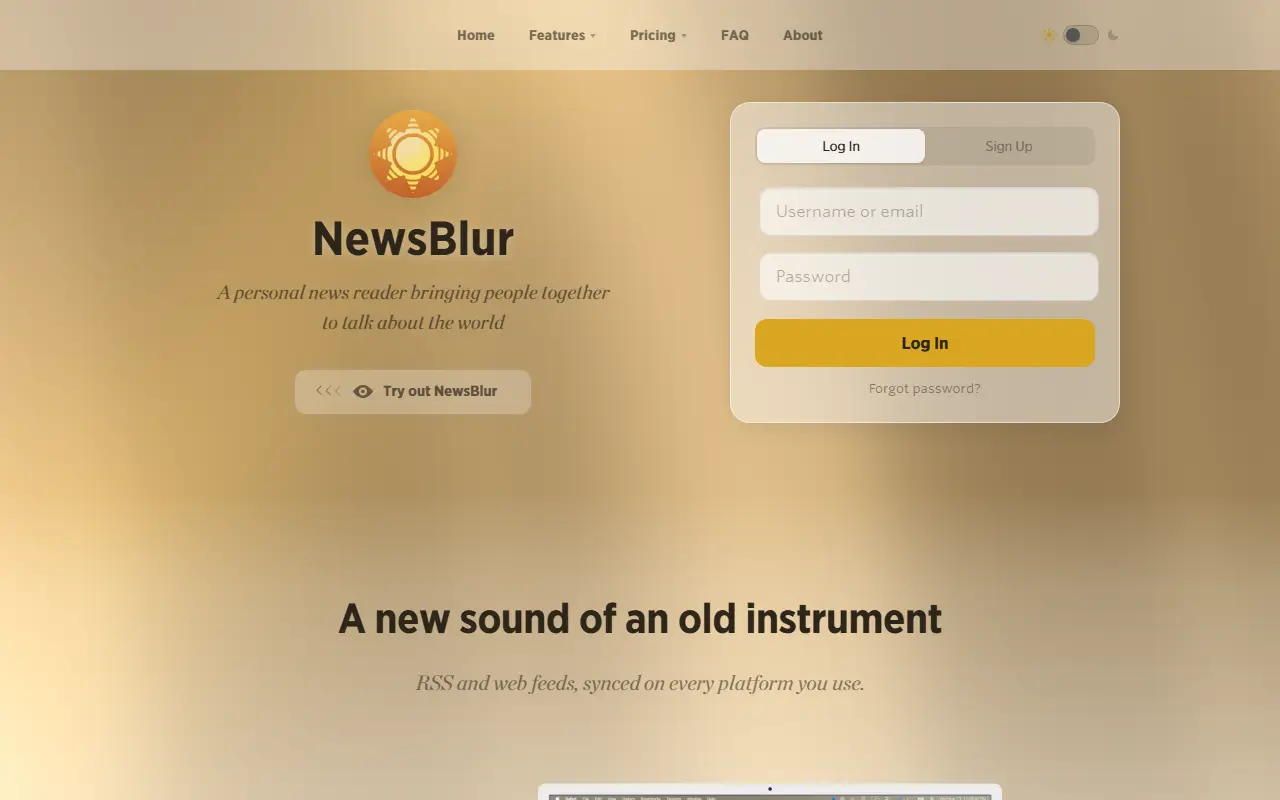
newsblur.comNewsBlur homepage screenshot

NewsBlur is a personal news reader that combines an RSS feed reader with a social news network. It shows stories on the original site while offering filtering tools, and you can train it by marking what you like and dislike so it highlights and hides stories automatically.

Features include real-time RSS, full text search across subscriptions, story tagging, saved searches, expanded text for truncated feeds, change tracking for edited stories and email newsletter reading. Stories can be shared on a public or friends-only blurblog. Multiple layouts such as grid, list, split and magazine are available per site, along with dark mode on web, iOS and Android, YouTube channel support and compatibility with third-party apps like Reeder.

NewsBlur is written in Python with MongoDB, PostgreSQL, Redis and Elasticsearch, and the code is licensed under MIT. The hosted service at newsblur.com is free for up to 64 sites and also has premium plans; alternatively you can run your own instance from the repository.

Key features

  • Real-time RSS feeds
  • Training filters that highlight or hide stories
  • Original site view
  • Full text search and saved searches
  • Sharing through public or private blurblogs
  • Email newsletter reading
  • Multiple layouts and dark mode

Pricing: Free plan follows up to 64 sites. Premium is $36 per year, Premium Archive $99 per year and Premium Pro $29 per month; new accounts get a 30-day premium trial. Self-hosting is free.

Yarr

A web-based RSS and Atom feed aggregator written in Go, shipped as a single binary that runs as a desktop app or a self-hosted server.

GitHub stars
4.1k
Last commit
2 days ago
Latest release
v2.9
Licence
MIT
Self-hosted
Yes
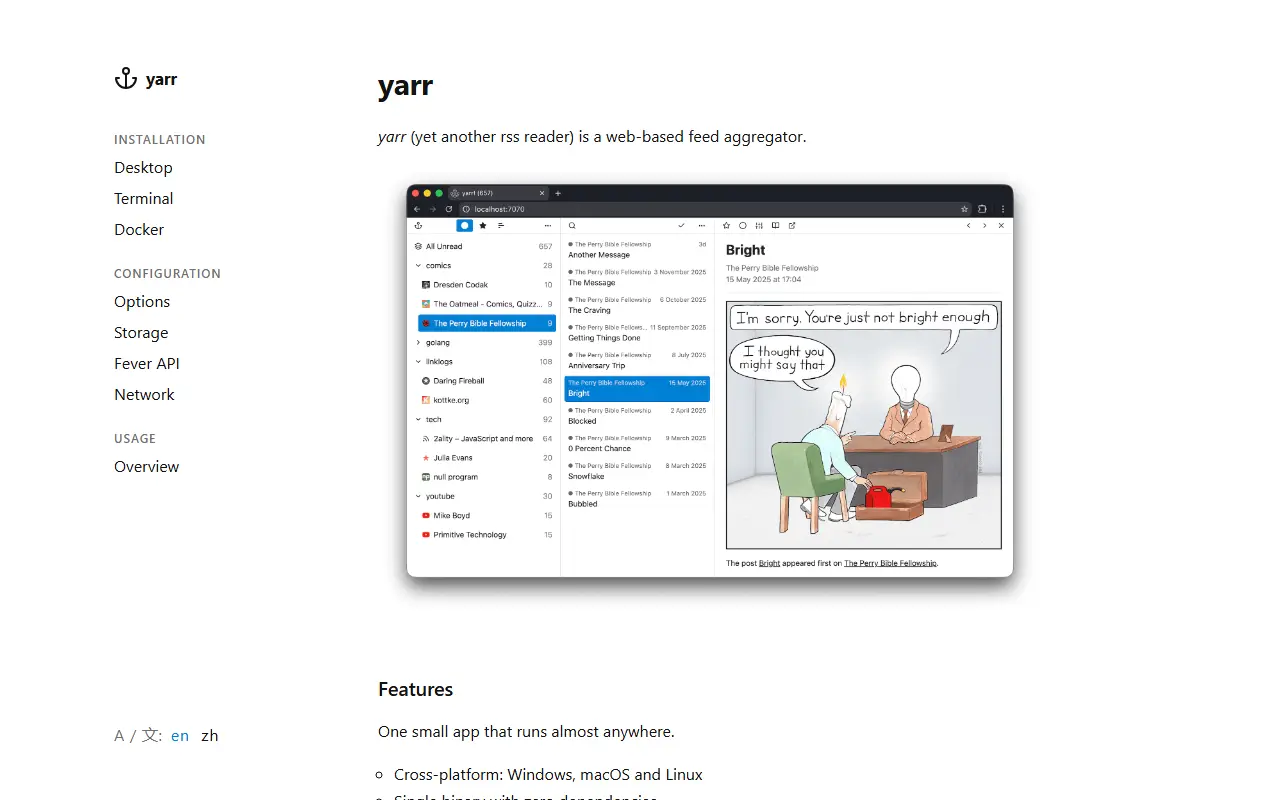
nkanaev.github.ioYarr homepage screenshot

yarr, short for yet another rss reader, is a web-based feed aggregator. It ships as a single binary with no dependencies, runs on Windows, macOS and Linux, and can be used either as a desktop app or as a self-hosted server.

Feeds in Atom, RSS, RDF and JSON formats are supported, with OPML import and export, a background scheduler and full-text search across all articles. The responsive web interface works on desktop, tablet and mobile, can be installed as a home-screen app, and offers light, beige, night and automatic themes plus keyboard shortcuts. A readability engine provides a local reading view and enclosures such as podcasts and videos can play inside the reader.

Storage can be SQLite or Postgres. A Fever-compatible API lets third-party mobile apps connect, and a REST API supports scripting. Privacy and security features include basic auth for remote access, HTTPS with custom TLS certificates, strict referrer policies and content sanitization. yarr is written in Go and licensed under MIT.

Key features

  • Single binary with no dependencies
  • Desktop app or self-hosted server
  • Atom, RSS, RDF and JSON feeds
  • OPML import and export
  • Full-text search across articles
  • Fever-compatible API for mobile apps
  • SQLite or Postgres storage
  • Basic auth and custom TLS certificates

Pricing: Free and open source under the MIT licence.

Newsboat

A terminal RSS and Atom feed reader, an actively maintained fork of Newsbeuter with filters, meta-feeds, macros and bookmarking scripts.

GitHub stars
3.9k
Last commit
6 days ago
Licence
MIT
Self-hosted
Yes
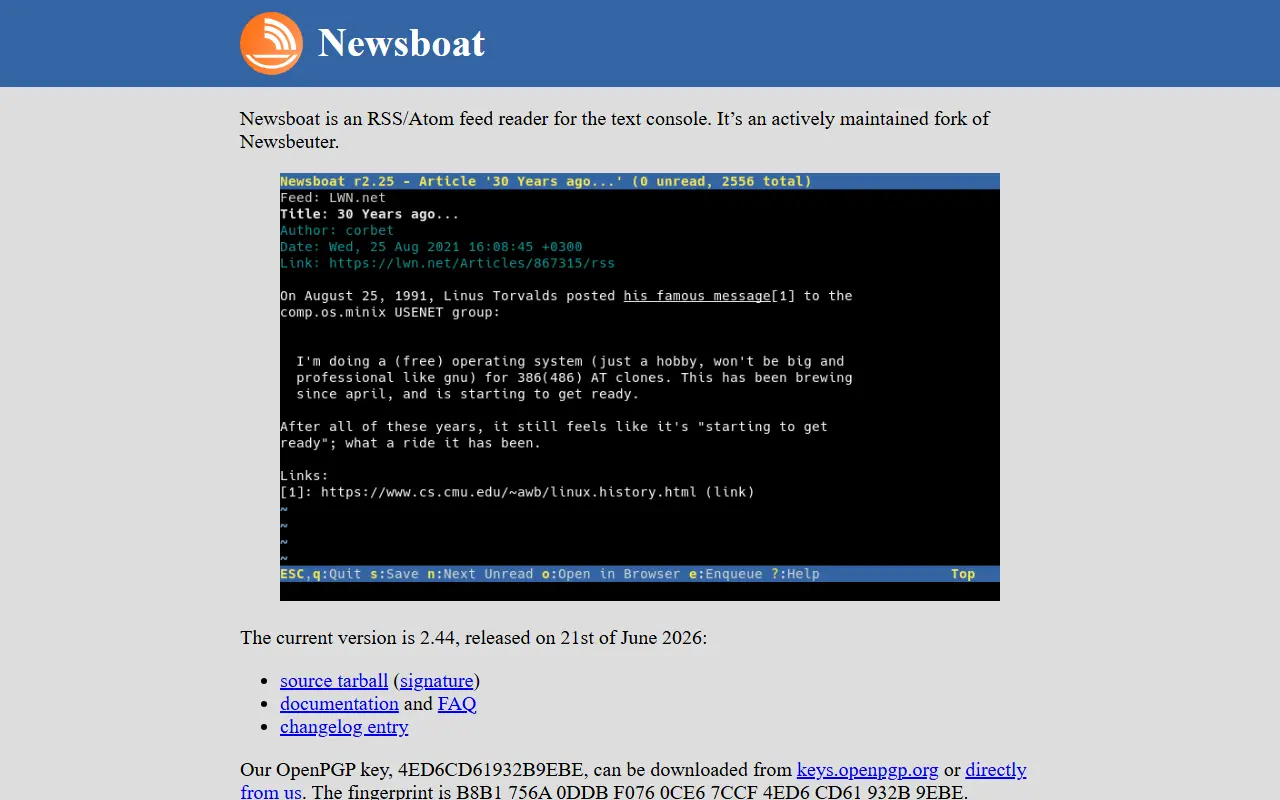
newsboat.orgNewsboat homepage screenshot

Newsboat is an RSS and Atom feed reader for the text console, maintained as a fork of Newsbeuter. A feed reader pulls updates from sites such as blogs and news agencies and lets you read them in a single interface, often with the full text, so a browser may not be needed.

Notable features include a built-in HTML renderer for text-only entries, bookmarking scripts that send links or whole articles to other services, filters based on title, author or content, and meta-feeds that aggregate articles by arbitrary criteria. Feeds can be transformed before they reach Newsboat, macros run sequences of actions with two keystrokes, and there is rudimentary podcast support.

It integrates with services like The Old Reader, NewsBlur and FeedHQ. Newsboat is written in C++ and Rust, licensed under MIT, and builds with GNU Make, a C++17 compiler, stable Rust, STFL, SQLite3 and libcurl. Downloads and documentation are on newsboat.org.

Key features

  • Terminal RSS and Atom reading
  • Built-in HTML renderer
  • Filters by title, author and content
  • Meta-feeds aggregating articles
  • Feed transformations before display
  • Macros for repeated actions
  • Sync with The Old Reader and NewsBlur
  • Rudimentary podcast support

Pricing: Free and open source under the MIT licence.

Feedbin

A web-based RSS reader with a REST-like API, available as a hosted service and as open-source code for self-hosting, built with Ruby on Rails.

GitHub stars
3.8k
Last commit
yesterday
Licence
MIT
Self-hosted
Yes
Hosted version
Available
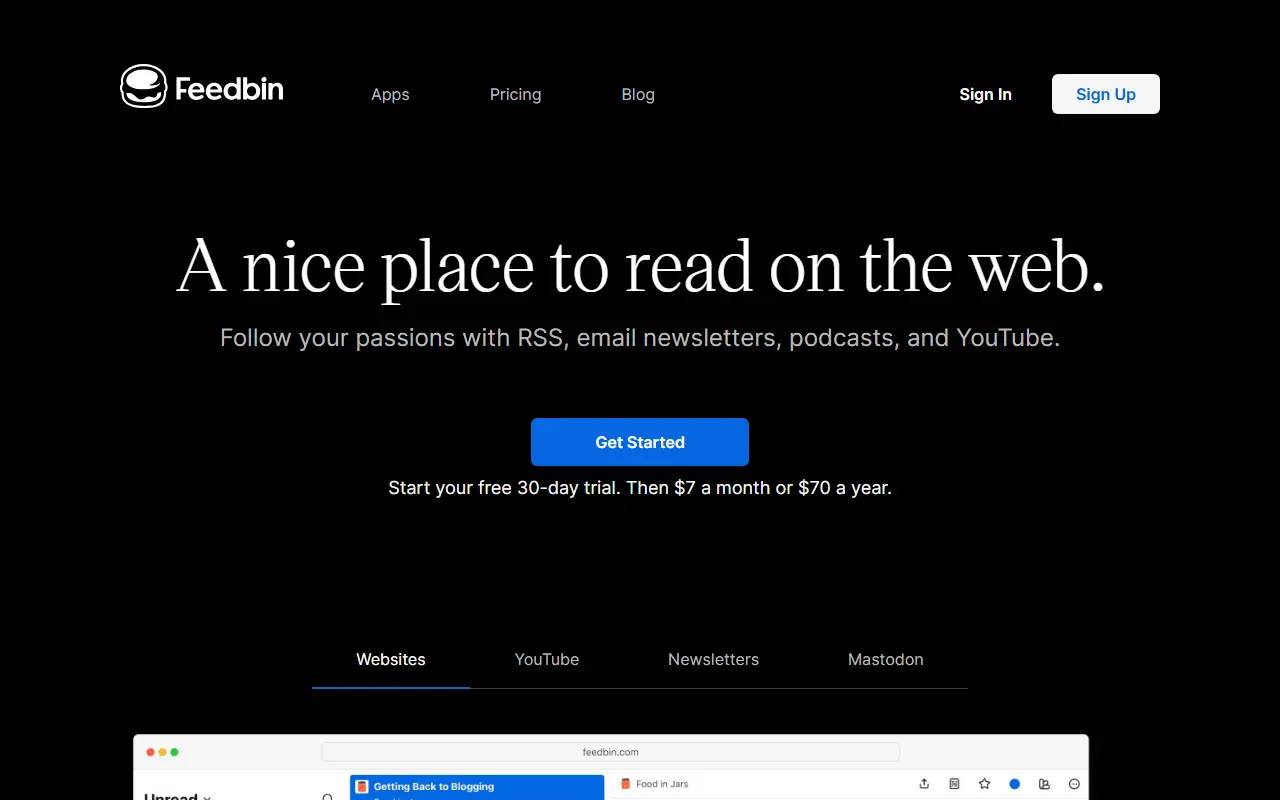
feedbin.comFeedbin homepage screenshot

Feedbin is a web-based RSS reader with a simple, fast and nice-looking interface and a REST-like API that clients can connect to. The main project is a Ruby on Rails application, with several optional services that add extra functionality.

Support is provided to Feedbin customers by email, and installation of the open-source code is not supported. The author states that the goal is a great web-based RSS service, which conflicts with being a great self-hosted reader, so running the full stack in production is not recommended without plenty of time for configuration. People who want a self-hosted reader are pointed to yarr, Tiny Tiny RSS and FreshRSS.

Optional extras include Privacy Please, an HTTPS image proxy that avoids insecure-content warnings and adds privacy, and extract, a Node.js service that pulls the full content of articles from pages when a feed only gives a summary. A Docker version of the full stack exists, and anyone can sign up for an account to try the hosted service. The code is MIT-licensed.

Key features

  • Web-based RSS reading
  • REST-like API for clients
  • Optional HTTPS image proxy
  • Full-content extraction service
  • Docker version of the full stack

Pricing: One plan with every feature at $7 per month or $70 per year, with a free 30-day trial and no credit card needed.

CommaFeed

CommaFeed is a self-hosted RSS reader modeled on Google Reader, with several layouts, keyboard shortcuts and a free public instance.

GitHub stars
3.6k
Last commit
8 days ago
Latest release
7.3.2
Licence
Apache-2.0
Self-hosted
Yes
Hosted version
Available
commafeed.comCommaFeed homepage screenshot

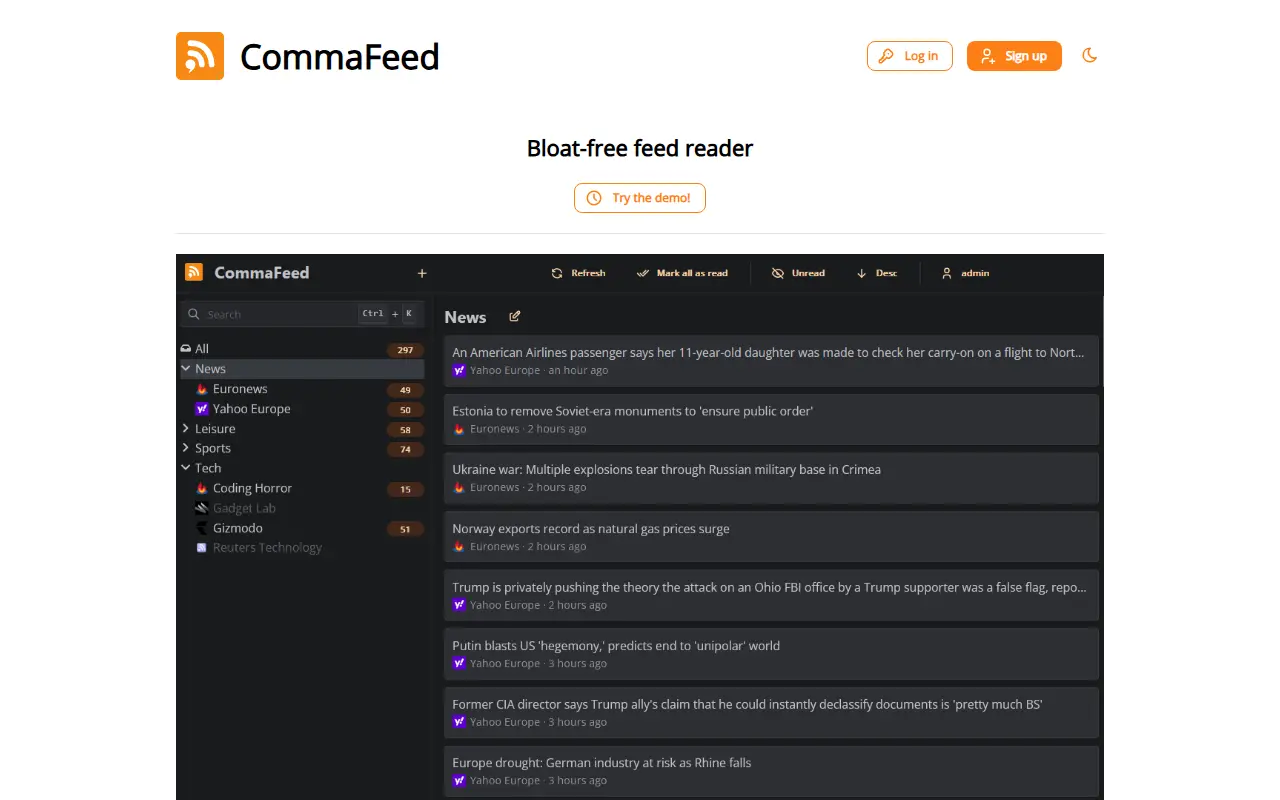
CommaFeed is an open-source RSS reader whose interface takes its cues from Google Reader. You subscribe to feeds, read articles in a clean web interface and keep track of what you have already read. It can be self-hosted for personal use, and a free public instance is also available for people who would rather not run anything themselves.

The reader offers four layouts, light and dark themes, a responsive design for phones and desktops, keyboard shortcuts for most actions and support for right-to-left feeds. It imports and exports OPML, exposes a REST API plus Fever and Google Reader compatible APIs for native mobile apps, and can mark articles as read automatically using rules you define. Custom CSS and JavaScript allow further tweaking.

The backend is built on Quarkus with a React and TypeScript front end, and it stores data in H2, PostgreSQL, MySQL or MariaDB. You can deploy it with Docker, with a precompiled package for Linux or Windows, or through a one-click cloud host such as PikaPods. It is released under the Apache-2.0 license, and the public instance is funded by donations.

Key features

  • Four layouts with light and dark themes
  • Keyboard shortcuts for most actions
  • OPML import and export
  • Fever and Google Reader APIs for mobile apps
  • Rules to mark articles as read automatically
  • Custom CSS and JavaScript support
  • Runs on H2, PostgreSQL, MySQL or MariaDB

Pricing: Free and open source under Apache-2.0; a free donation-funded public instance exists, and third-party one-click hosting is sold separately.

Oksskolten

Self-hosted RSS reader that fetches and stores the full text of every article, then adds AI summaries, translation, chat and full-text search.

GitHub stars
485
Last commit
2 mo ago
Latest release
v0.5.0
Licence
AGPL-3.0
Self-hosted
Yes
oksskolten.comOksskolten homepage screenshot

Oksskolten is an AI-native RSS reader that aims to show every article in full, inside the app. Instead of relying on the title and summary a feed provides, it fetches each original article, extracts the main text with Mozilla's Readability plus a large set of noise-removal patterns, converts it to clean Markdown and stores it locally. The README contrasts this with readers such as Miniflux and FreshRSS, where full-text fetching is an opt-in per-feed setting.

Because complete text is always available, the AI features work on real articles rather than excerpts. Summarization and translation can be run on demand through Anthropic, Gemini or OpenAI with streaming responses, and an interactive chat supports multi-turn conversations with MCP tooling to search articles and ask questions about your feeds. Meilisearch powers full-text search across the archive. Smart fetching includes adaptive per-feed schedules, conditional HTTP requests, content deduplication, exponential backoff and tracking-parameter removal.

The app is a progressive web app with offline reading, and supports password, passkey and GitHub OAuth sign-in. It is self-hosted, licensed under AGPL-3.0, written in TypeScript with React, and has a live demo.

Key features

  • Automatic full-text extraction for every article
  • AI summarization and translation
  • Chat with MCP tooling over your feeds
  • Meilisearch-powered full-text search
  • Adaptive per-feed fetch scheduling
  • Offline-capable progressive web app
  • Password, passkey and GitHub sign-in

Pricing: Oksskolten is free and open source with no subscription. You run it yourself in a single container and supply your own AI provider keys for summaries and translation.

Feedly alternatives: questions

What is the best open-source alternative to Feedly?
FreshRSS is the top-ranked open-source alternative to Feedly on Enlisted: A lightweight, self-hosted RSS and news aggregator with multi-user support, an API for mobile clients, WebSub push and extensions. Other strong options are NetNewsWire, Fluent Reader, Miniflux and NewsBlur.
Are these Feedly alternatives free?
All 10 are open source, so the code is free to use under its licence, and all of them can be self-hosted on your own server or computer. 3 also offer a paid or managed cloud version if you'd rather not host it yourself.
How is this list of Feedly alternatives ranked?
By a score built from GitHub stars, star growth over the last 30 days and how recently the code changed. 9 of these projects shipped code in the last 30 days. Data is refreshed daily, and nobody can pay to move up.

People also look for alternatives to…

View all