7,363 open-source and SaaS tools, with GitHub stats refreshed every day.

7 alternatives ranked by real activity

Open-source Dorik alternatives

A curated, ranked list of the 7 best open-source alternatives to Dorik.

The best open-source alternative to Dorik is Instatic. If that doesn't suit you, other good options are Webstudio, Microweber, Silex and Frappe Builder.

Dorik alternatives are mainly CMS tools. 6 of them shipped code in the last 30 days, 7 can be self-hosted, and 3 use a permissive licence.

Last updated October 2, 2026 · ranked by GitHub stars, growth and recent commits

Instatic

A self-hosted visual CMS and site builder that runs in one Bun server and outputs clean static HTML and CSS, positioned as an open alternative to Webflow, Framer and WordPress.

GitHub stars
8.8k
Last commit
19 days ago
Latest release
v0.0.20
Licence
MIT
Self-hosted
Yes
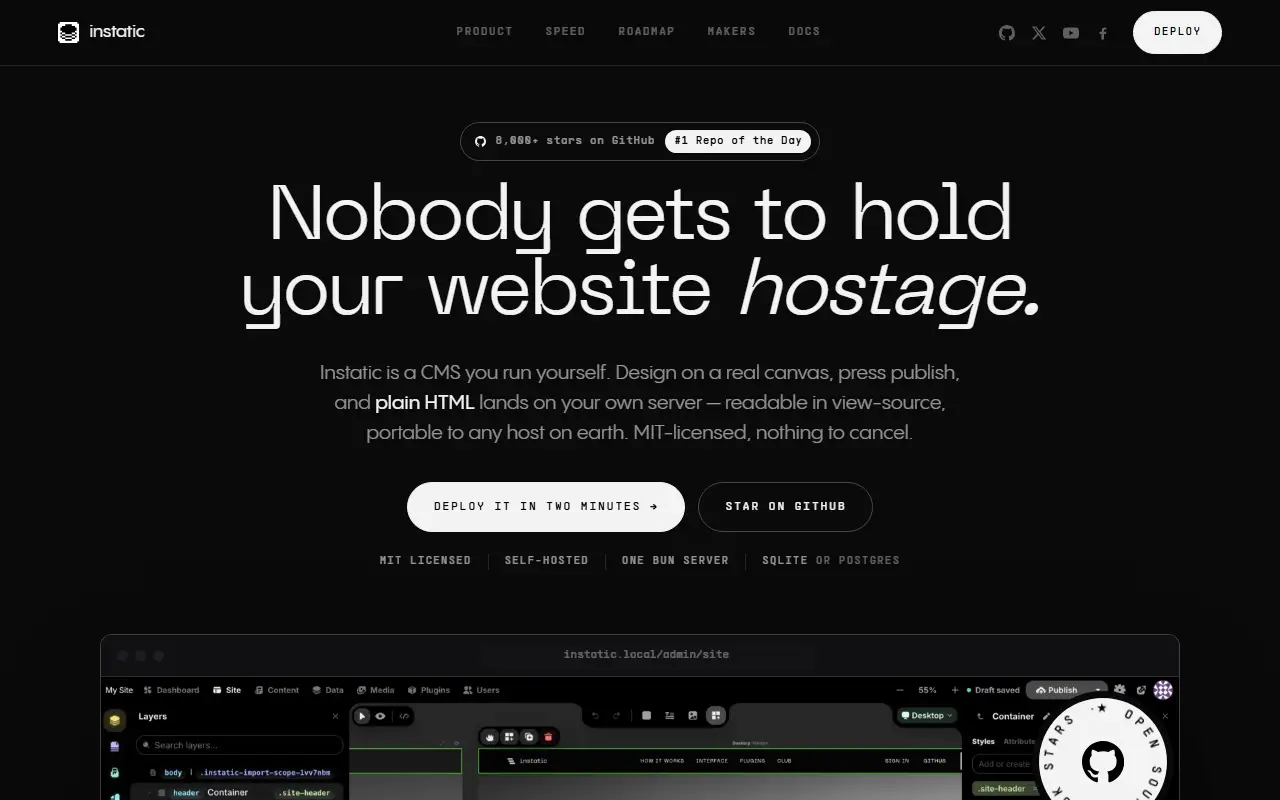
instatic.comInstatic homepage screenshot

Instatic is a self-hosted content management system with a visual editor, content engine and publisher all running in a single Bun server. It is presented as an open-source alternative to Webflow, Framer and WordPress, and aims to replace the usual pile of separate services for CMS, framework, hosting, forms and analytics.

One server holds the canvas editor, content engine, media, authentication, forms, plugins and the publisher, with users, roles and a database included, backed by SQLite or Postgres. Pages it generates are plain semantic HTML with compact CSS, without framework runtime or builder attributes, so they behave like static files. The README suggests one-click deployment on Railway, with options for Render and Docker or a VPS with Caddy TLS.

Instatic is MIT licensed and very new: the repository was created in April 2026 and the latest release is v0.0.20, so expect rapid change. It targets developers, designers and small businesses who want to own their site stack and keep the published output lean.

Key features

  • Visual canvas editor for pages
  • Clean static HTML and CSS output
  • Single Bun server for everything
  • Users, roles and plugins built in
  • SQLite or Postgres storage
  • Forms and media management
  • One-click Railway deployment

Pricing: Free and open source under the MIT licence.

Webstudio

An open-source visual website builder positioned as a Webflow alternative, connecting to any headless CMS and supporting all CSS properties, hosted by Webstudio or yourself.

GitHub stars
9k
Last commit
today
Latest release
0.304.0
Licence
AGPL-3.0
Self-hosted
Yes
Hosted version
Available
webstudio.isWebstudio homepage screenshot

Webstudio is a visual development platform, released as open source, for developers, designers and cross-functional teams, and is presented as an alternative to Webflow. It is a visual builder that connects to any headless CMS and supports all CSS properties, and you own the data, components and infrastructure.

You can choose the hosted version or deploy your own instance, and the topics mention Cloudflare Workers, React, Remix and accessibility via Radix UI. The project provides a blog, documentation, a roadmap and an issue tracker for the builder, and a community on Discord.

Licensing is split. The Webstudio core, meaning all functionality in the repository, is free and open source under AGPL-3.0-or-later, while the optional sdk-components-animation package is proprietary and requires accepting the Webstudio, Inc. EULA. It is written in TypeScript. It suits designers and developers who want Webflow-style visual building with the option to self-host.

Key features

  • Visual builder for websites
  • Support for all CSS properties
  • Connects to any headless CMS
  • Host on Webstudio or self-host
  • React and Remix based codebase
  • Optional proprietary animation package

Pricing: Core is open source under AGPL-3.0-or-later; an optional animation package is proprietary. A hosted version is offered.

Microweber

Microweber pairs a visual drag-and-drop site builder with a Laravel CMS, and adds e-commerce, blogging and ready-made modules.

GitHub stars
3.4k
Last commit
3 days ago
Latest release
v2.0.20
Licence
MIT
Self-hosted
Yes

Microweber combines a drag-and-drop page builder with a content management system on the PHP Laravel framework. It aims to let people create websites, online stores and blogs without technical skills, while still giving developers a modern code base to extend.

The README describes an array of modules, customizations and features tailored for e-commerce, and the current 2.0 version runs on Laravel 10. A shopping cart and content management features sit alongside the visual editor, and the documentation covers system requirements, installation and getting started. Topics include website builder and drag-and-drop.

Microweber is MIT-licensed and can be installed on your own hosting. It suits small businesses, freelancers and agencies that want to build a site or store visually, on an open-source PHP stack they can still modify.

Key features

  • Drag-and-drop page builder
  • CMS built on Laravel
  • Built-in e-commerce and shopping cart
  • Blog and content management
  • Modules and customizations
  • Runs on Laravel 10

Pricing: Free and open source under the MIT license.

Silex

Free, open-source visual website builder that exports clean static HTML and CSS, positioned as a libre alternative to Webflow.

GitHub stars
3k
Last commit
yesterday
Latest release
v3.9.0
Licence
AGPL-3.0
Self-hosted
Yes
Hosted version
Available
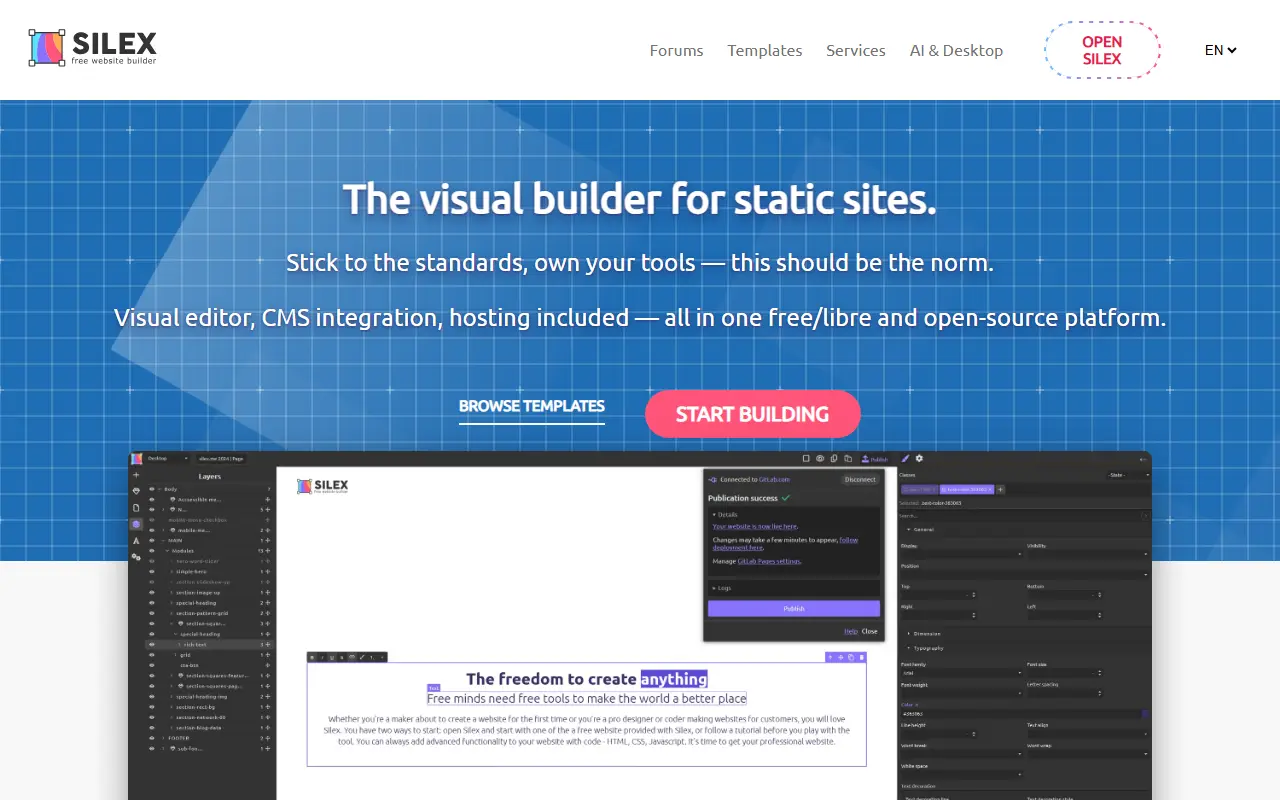
silex.meSilex homepage screenshot

Silex is a visual builder for static websites that can also pull in dynamic data. You design pages visually and export standard HTML and CSS that can be hosted anywhere, so there is no proprietary format, forced hosting, or subscription. It is released under the AGPL-3.0 license and presented as an open alternative to Webflow.

It is maintained by Silex Labs, a non-profit organization, and describes itself as free forever with all features included and no premium tier. It follows JAMstack practices, uses the GrapesJS editor according to its topics, and can pull content from WordPress through GraphQL. An MCP server is also mentioned among the project topics, and a desktop app can be downloaded alongside the online version.

You can try Silex online or run it yourself with Node.js. It suits web agencies, WordPress developers, freelance designers, and no-code builders who want a visual workflow with output they fully own. Because the output is standard web files, learning it also builds transferable HTML, CSS, and JAMstack skills.

Key features

  • Visual page design with clean HTML and CSS export
  • Host the exported site anywhere
  • Dynamic data for static sites
  • WordPress content through GraphQL
  • Desktop app and online editor
  • Built on the GrapesJS editor

Pricing: Silex is free to use hosted through a free GitLab account, as a desktop app, or self-hosted. Training, development and managed hosting are optional services quoted separately.

Frappe Builder

Low-code visual website builder from Frappe for designing responsive pages and publishing them with one click, integrated with the Frappe ecosystem.

GitHub stars
2.4k
Last commit
yesterday
Latest release
v1.35.0
Licence
MIT
Self-hosted
Yes
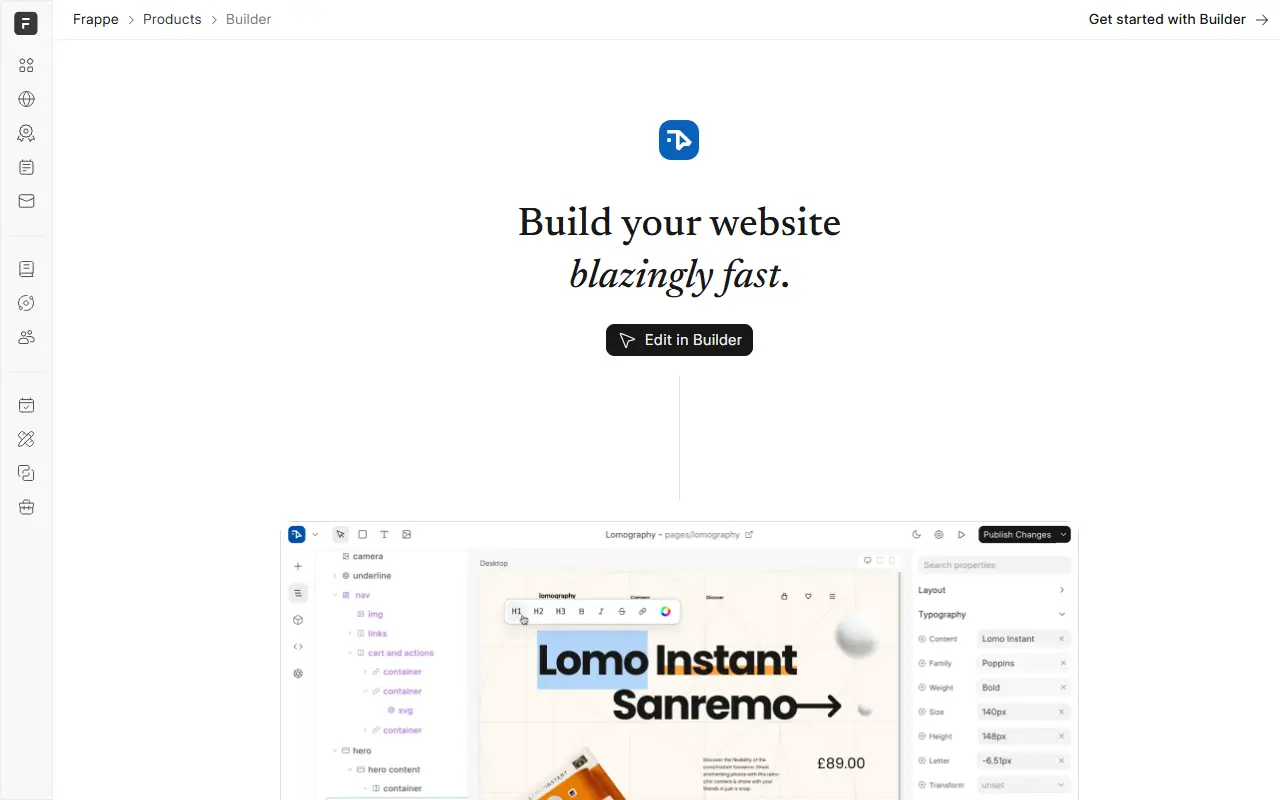
frappe.ioFrappe Builder homepage screenshot

Frappe Builder is a low-code website builder designed for simplicity, speed, and flexibility. Designers can lay out pages visually, and developers can customize them. A click-to-publish option covers the end-to-end process of making a site live. It is part of the Frappe ecosystem, written with Python, Vue, and TypeScript, and released under the MIT license.

The author says existing tools were too complex, too restrictive, or hard to integrate with Frappe, and that pages made with them often carried unnecessary scripts and styles. Builder aims to produce lean pages. The topics mention responsive layouts, Figma, a CMS, ERPNext website integration, and an AI website builder.

It suits teams already running Frappe or ERPNext who want to design public pages such as landing pages and marketing sites without leaving the platform, and developers who want a visual tool that integrates with their Frappe data. Documentation and a project website are available.

Key features

  • Visual drag-and-drop page builder
  • Click-to-publish workflow
  • Responsive page layouts
  • Integration with the Frappe ecosystem
  • Lean pages without extra scripts
  • Customization for developers

Pricing: Free and open source under the MIT license.

Web Builder

Web Builder is an AI-assisted low-code platform for building responsive, multilingual TailwindCSS websites by drag and drop, with Drupal as a headless back end.

GitHub stars
585
Last commit
21 days ago
Latest release
V11.4.0
Licence
AGPL-3.0
Self-hosted
Yes
builder.designWeb Builder homepage screenshot

Web Builder, also called Messenger Web Builder, is a low-code platform for generating and publishing user interfaces with AI. It builds on TailwindCSS and lets users create modern responsive UIs, dynamic customizable components, multi-theme and multi-language web applications visually by dragging components. The project describes itself as the first open-source low-code of its kind in China to use Drupal as a headless back end, and its documentation is mostly in Chinese.

Builder features include a dynamic layout builder with static or API data sources, component editing, copying and reordering, a media library, management of mini-program pages and components, page version history, draft detection, a library of templates and examples, copying a page's JSON to deploy, scroll animations with AOS and GSAP, a full-width mode, quick page generation from rules, multi-theme preview, light and dark styles, page preview and responsive preview across device sizes. AI models can generate UI, pages and tool apps.

It also ships Web Builder Skills, a Claude Code skill pack covering UI building in Storybook, translating page JSON and generating web image prompts. The front end uses Angular, the license is AGPL-3.0, and Docker deployment is documented.

Key features

  • Drag-and-drop page builder on TailwindCSS
  • AI generation of UI and pages
  • Template and example library
  • Page version history and draft detection
  • Multi-theme and responsive preview
  • Claude Code skills for UI and translation

Pricing: Free and open source under the AGPL-3.0 license; a Builder Pro preview is mentioned.

Vvveb

PHP content management system with a drag-and-drop page builder, multi-site support and built-in e-commerce, usable as a traditional or headless CMS.

GitHub stars
1.2k
Last commit
1 mo ago
Latest release
1.0.8.6
Licence
AGPL-3.0
Self-hosted
Yes
vvveb.comVvveb homepage screenshot

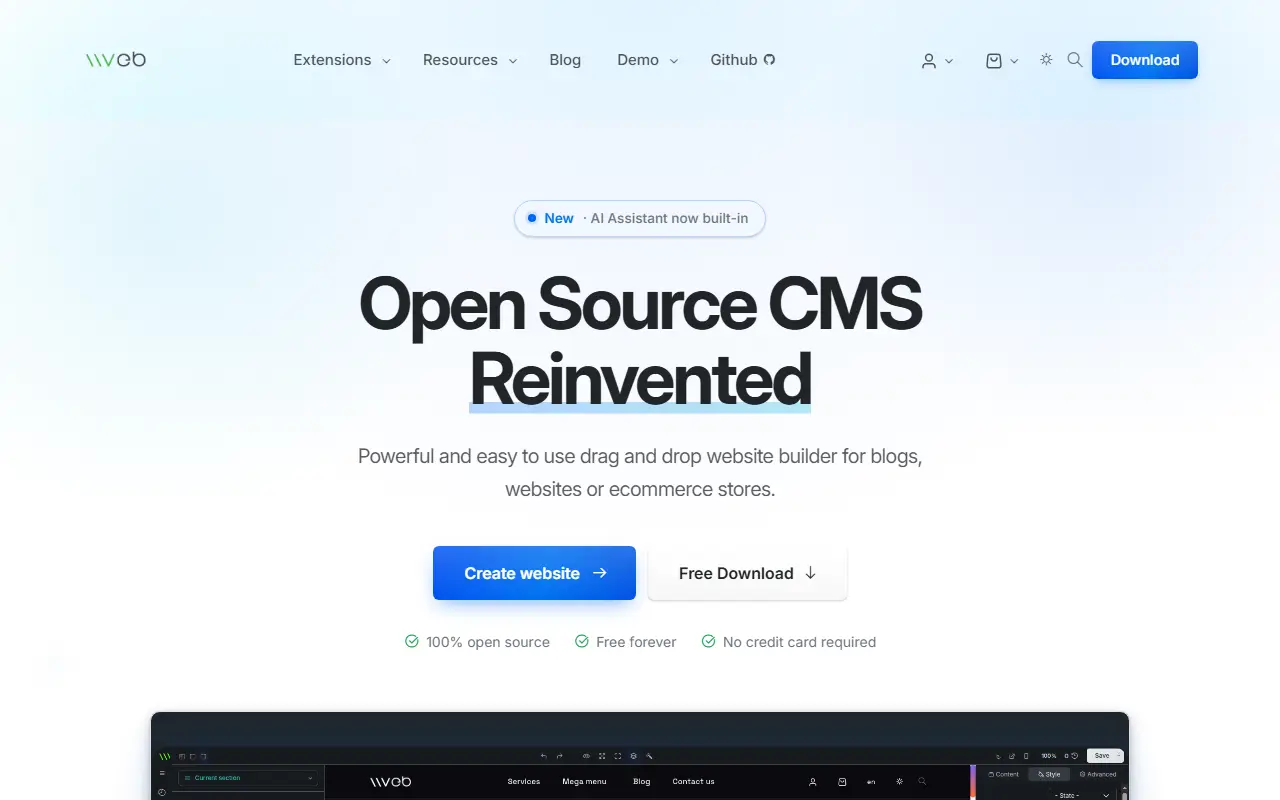
Vvveb is a self-hosted CMS for building websites, blogs and online stores. It combines a drag-and-drop page builder with publishing tools such as revisions, media management, multi-user access and role permissions, plus localization and multi-language support.

For selling online it adds one-page checkout, subscriptions, digital assets, vouchers and coupons, and product options, attributes, variants, reviews and questions. A marketplace allows themes and plugins to be installed from the admin dashboard, custom fields, posts and products are supported, and a plugin system with events enables extensions. It can also run as a hybrid headless CMS through GraphQL and REST APIs.

The project highlights a small resource footprint, caching that makes pages load like static files, a bundled SEO plugin, brute-force and SQL injection protection, a hidden admin login page and an install where only one PHP file is publicly exposed. It needs PHP 7.4 or later, with 8.3 recommended, and a MySQL, SQLite or PostgreSQL driver. It is licensed under AGPL-3.0.

Key features

  • Drag-and-drop page builder
  • Built-in e-commerce with one-page checkout
  • Multi-site and multi-language support
  • Headless mode with GraphQL and REST APIs
  • Theme and plugin marketplace
  • Bundled SEO plugin and security protections
  • Backup and import/export for migration

Pricing: Free and open source under the AGPL-3.0 licence.

Dorik alternatives: questions

What is the best open-source alternative to Dorik?
Instatic is the top-ranked open-source alternative to Dorik on Enlisted: A self-hosted visual CMS and site builder that runs in one Bun server and outputs clean static HTML and CSS, positioned as an open alternative to Webflow, Framer and WordPress. Other strong options are Webstudio, Microweber, Silex and Frappe Builder.
Are these Dorik alternatives free?
All 7 are open source, so the code is free to use under its licence, and all of them can be self-hosted on your own server or computer. 2 also offer a paid or managed cloud version if you'd rather not host it yourself.
How is this list of Dorik alternatives ranked?
By a score built from GitHub stars, star growth over the last 30 days and how recently the code changed. 6 of these projects shipped code in the last 30 days. Data is refreshed daily, and nobody can pay to move up.

People also look for alternatives to…

View all