7 open-source alternatives ranked by real activity

Open-source Base44 alternatives

A curated, ranked list of the 7 best open-source alternatives to Base44.

The best open-source alternative to Base44 is Appsmith. If that doesn't suit you, other good options are ToolJet, Onlook, Magic Cloud and Sandboxd.

Commercial alternatives to Base44 include v0, Lovable, Bolt.new and Replit. See all 38.

Base44 alternatives are mainly AI tools, but some are also low-code & internal tools. 5 of them shipped code in the last 30 days, 7 can be self-hosted, and 5 use a permissive licence.

Last updated November 13, 2026 · ranked by GitHub stars, growth and recent commits

Appsmith

An open-source low-code platform for building admin panels, internal tools and dashboards that connect to more than 25 databases and any API.

GitHub stars
41k
Last commit
today
Latest release
v2.7.0
Licence
Apache-2.0
Self-hosted
Yes
Hosted version
Available
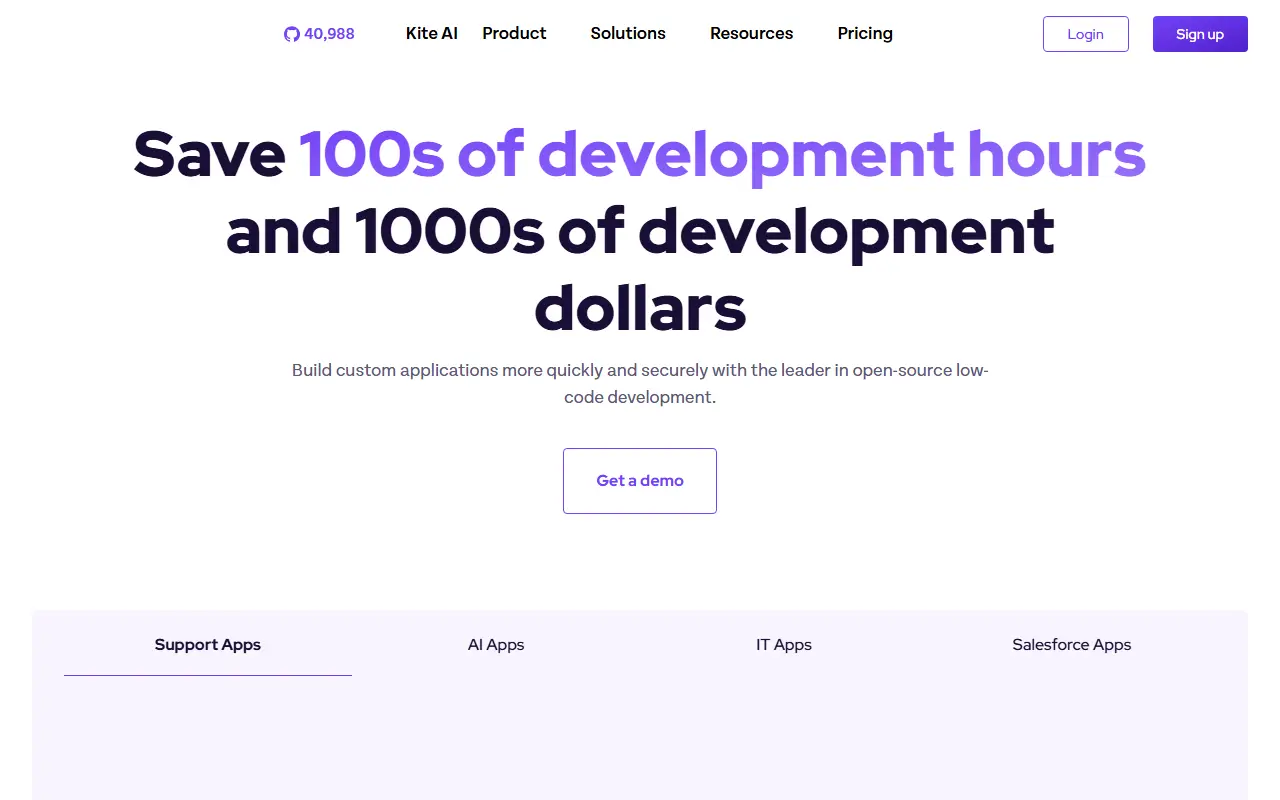
appsmith.comAppsmith homepage screenshot

Appsmith is an open-source low-code platform for building custom internal applications such as dashboards, admin panels, customer 360 views, IT automation and service management tools. It aims to simplify building, deploying and maintaining these apps, which otherwise tend to be tedious to code from scratch.

You assemble interfaces visually and connect them to data through integrations with more than 25 databases and any REST or GraphQL API, with JavaScript available where you need custom logic. Topics also point to CRUD generation, workflows and automation. The front end is built with React and TypeScript, and the server side is mostly Java.

You can sign up for Appsmith Cloud or install it on your own machine, with Docker as the recommended method, plus Kubernetes and an AWS AMI. The code is Apache-2.0 licensed. It is a common choice for engineering teams that want to ship internal tools quickly without maintaining a bespoke front-end codebase.

Key features

  • Visual builder for internal tools
  • Integrates with 25+ databases and any API
  • JavaScript for custom logic
  • Admin panels, dashboards and CRUD apps
  • Docker, Kubernetes and AWS AMI installation
  • Cloud or self-hosted deployment

Pricing: Free for up to 5 cloud users. Business is $15 per user per month with a 15-day trial; Enterprise is listed at $2,500 per month for 100 users. The open-source Community edition is free.

ToolJet

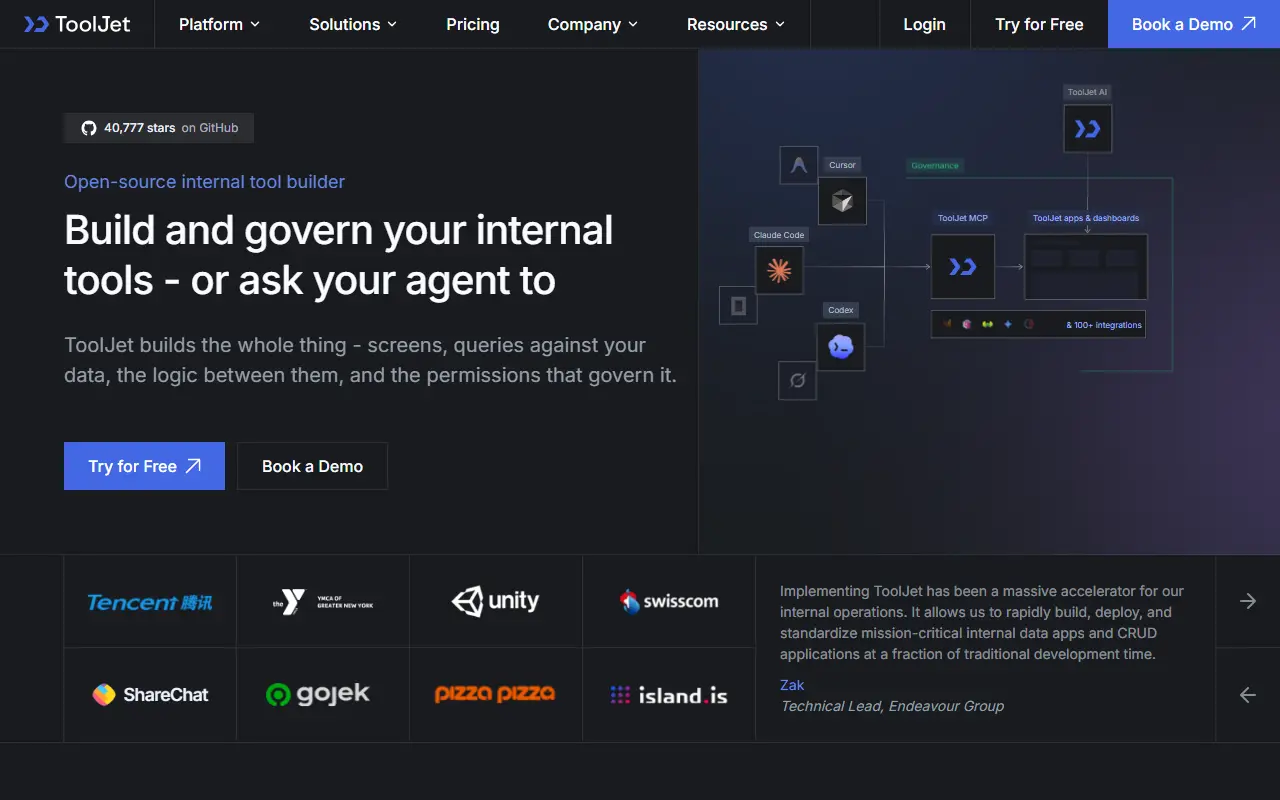
An open-source platform for building internal tools, dashboards and workflows visually or from prompts, with an MCP server so coding agents can build apps.

GitHub stars
41k
Last commit
today
Latest release
v3.20.257-lts
Licence
AGPL-3.0
Self-hosted
Yes
Hosted version
Available
tooljet.comToolJet homepage screenshot

ToolJet is an open-source platform for creating internal software, including admin panels, dashboards and operational apps that sit on top of your existing databases, APIs and SaaS systems. Apps are assembled visually in a builder, so teams can ship tools without writing a full front end.

AI plays a large role. ToolJet AI turns a text description into pages, queries and components, and a Model Context Protocol server lets coding agents such as Claude Code and Codex build and modify ToolJet apps directly. Agents work against the platform's real component and data contracts, so the output is an ordinary ToolJet app that the team can keep editing in the visual builder with the same permissions, environments and version history. Workflows and AI agents are part of the offering.

You can self-host ToolJet or use ToolJet Cloud, and the open-source foundation is AGPL-3.0 licensed with a JavaScript and TypeScript codebase. It targets teams that need internal software quickly and want an open-source option with a managed alternative.

Key features

  • Visual builder for internal tools and dashboards
  • AI generation of pages, queries and components
  • MCP server for coding agents
  • Permissions, environments and version history
  • Workflows and AI agents
  • Self-hosted or ToolJet Cloud

Pricing: A free plan covers 2 builders. Paid plans are priced per builder per month: Basic $29, Pro $99 and Team $249 on monthly billing, with 20% off annually; Enterprise is custom.

Onlook

An open-source visual editor for Next.js and Tailwind apps that lets designers and developers edit real code in the browser with AI, an alternative to Bolt.new and Lovable.

GitHub stars
27k
Last commit
22 days ago
Latest release
v0.2.32
Licence
Apache-2.0
Self-hosted
Yes
Hosted version
Available
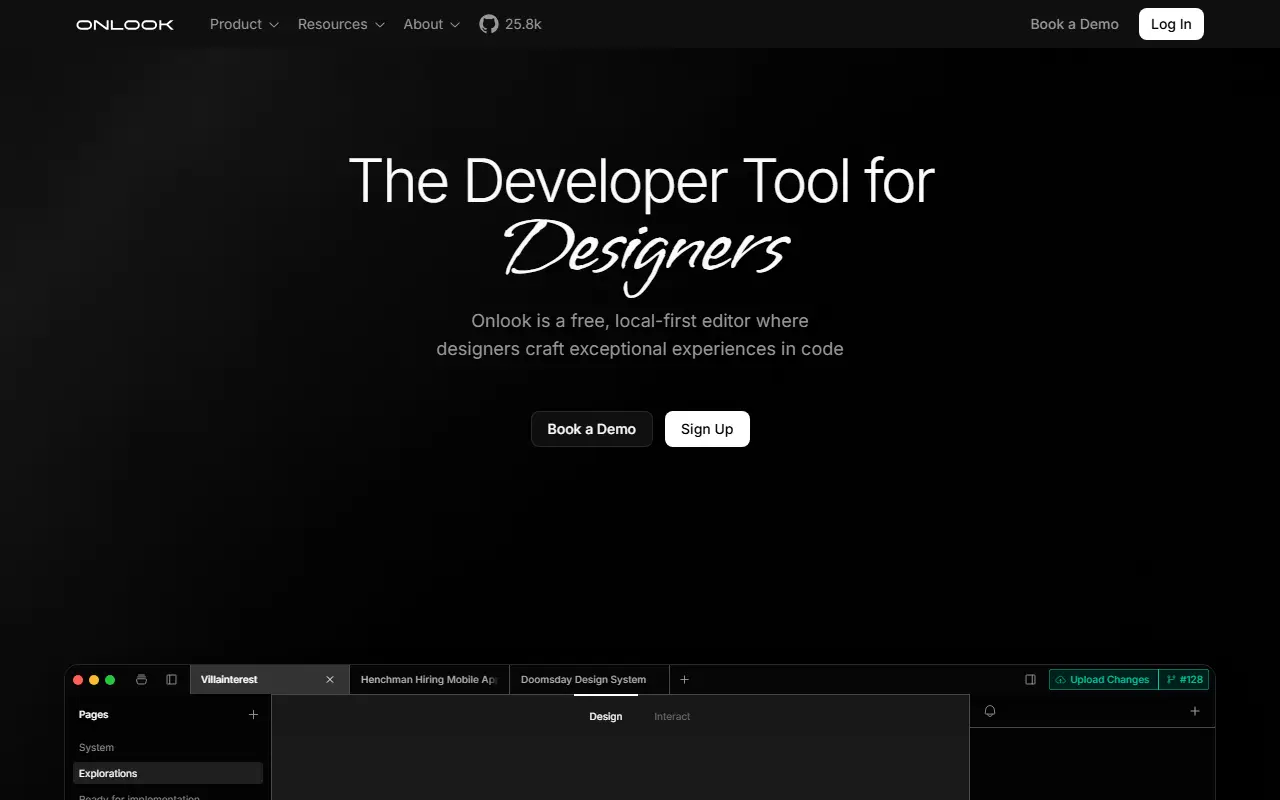
onlook.comOnlook homepage screenshot

Onlook is an open-source, visual-first code editor for building websites, prototypes and designs in Next.js and Tailwind CSS. Edits are made directly on the browser DOM with a Figma-like interface, while the changes are written to real code, so design and development share one source of truth.

You can create a Next.js app from text or an image or start from templates, then edit it visually, manage brand assets and tokens, create pages, browse layers and manage images. Developer tools include a real-time code editor, checkpoints you can restore, branching for design experiments, a CLI, an app marketplace, one-click deploys, shareable links and custom domains. Team collaboration is on the roadmap.

The README describes this repository as the open-source editor that started Onlook, while the hosted product for AI-native designers is in early access through a waitlist. It is licensed under Apache-2.0 and presented as an open alternative to tools such as Webflow, Figma Make, V0, Replit Agent, Lovable and Bolt.new. It suits designers who want to ship real code and developers who want a visual layer.

Key features

  • Visual editing on the browser DOM
  • Figma-like interface for Next.js apps
  • Start from text prompts or images
  • Real-time code editor with checkpoints
  • Branching for design experiments
  • Brand assets and design tokens
  • One-click deployment with custom domains

Pricing: Onlook can be self-hosted for free. The hosted cloud version is in closed beta with custom team pricing arranged by contacting the team.

Magic Cloud

Magic turns plain-English descriptions into full-stack apps and AI agents with a database, secure API and MCP server, running on your own hardware.

GitHub stars
1.3k
Last commit
yesterday
Latest release
v24.4.21
Licence
MIT
Self-hosted
Yes
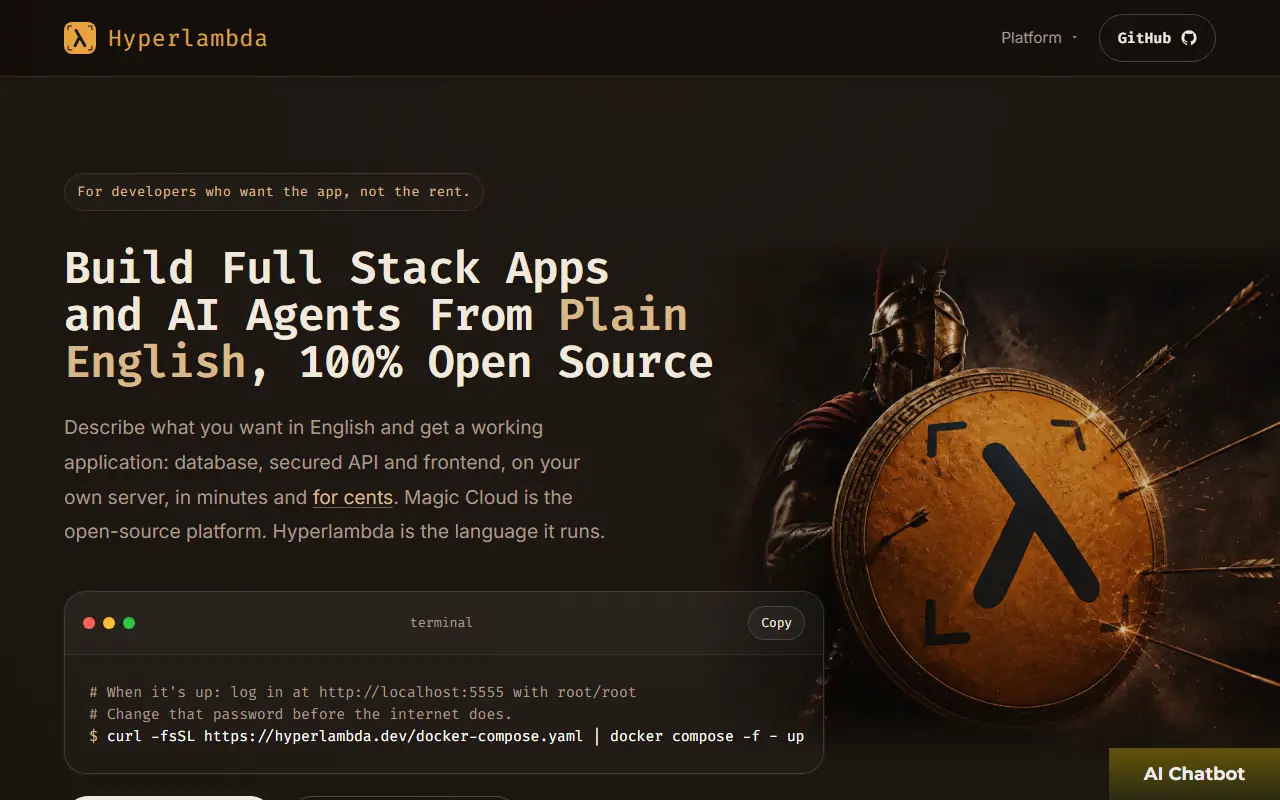
hyperlambda.devMagic Cloud homepage screenshot

Magic is an open-source platform for generating full-stack applications and AI agents from natural language. It produces the database layer, a secured API, business logic and a frontend, and positions itself as an alternative to Lovable, Bolt and Replit that gives you the whole backend on your own hardware without lock-in.

An API wizard can point at an existing MySQL, PostgreSQL, SQL Server or MariaDB database and generate a complete secured REST API, which you can then extend in plain English without a build or deploy step. It can wrap third-party APIs from an OpenAPI or Swagger URL, build database-driven agents behind role-based access control, create embeddable chatbots grounded in crawled website content, run scheduled jobs and serve static sites and single-page apps. An MCP server exposes every endpoint as a tool for Claude, Cursor or Codex.

Magic is built on .NET with the Hyperlambda language and is licensed under MIT. It runs locally in about a minute using Docker, and its stated use cases include CRM systems, admin panels, booking systems and internal tools. It suits developers who want AI-generated apps with a self-hosted, auditable backend.

Key features

  • Natural-language app and API generation
  • API wizard for existing SQL databases
  • MCP server exposing endpoints as tools
  • Database-driven AI agents with RBAC
  • Wrappers for OpenAPI and Swagger APIs
  • Scheduled background jobs

Pricing: The software is free to self-host. Managed cloudlets cost $100 (Professional) or $300 (Enterprise) per month with unlimited users and a 14-day trial; a Managed Services add-on is $3,000 per month.

Sandboxd

Sandboxd is an open-source, self-hosted AI app builder that runs a coding agent in isolated Docker sandboxes and serves each app at a preview URL.

GitHub stars
988
Last commit
2 days ago
Latest release
v0.3.26
Licence
MIT
Self-hosted
Yes
Hosted version
Available
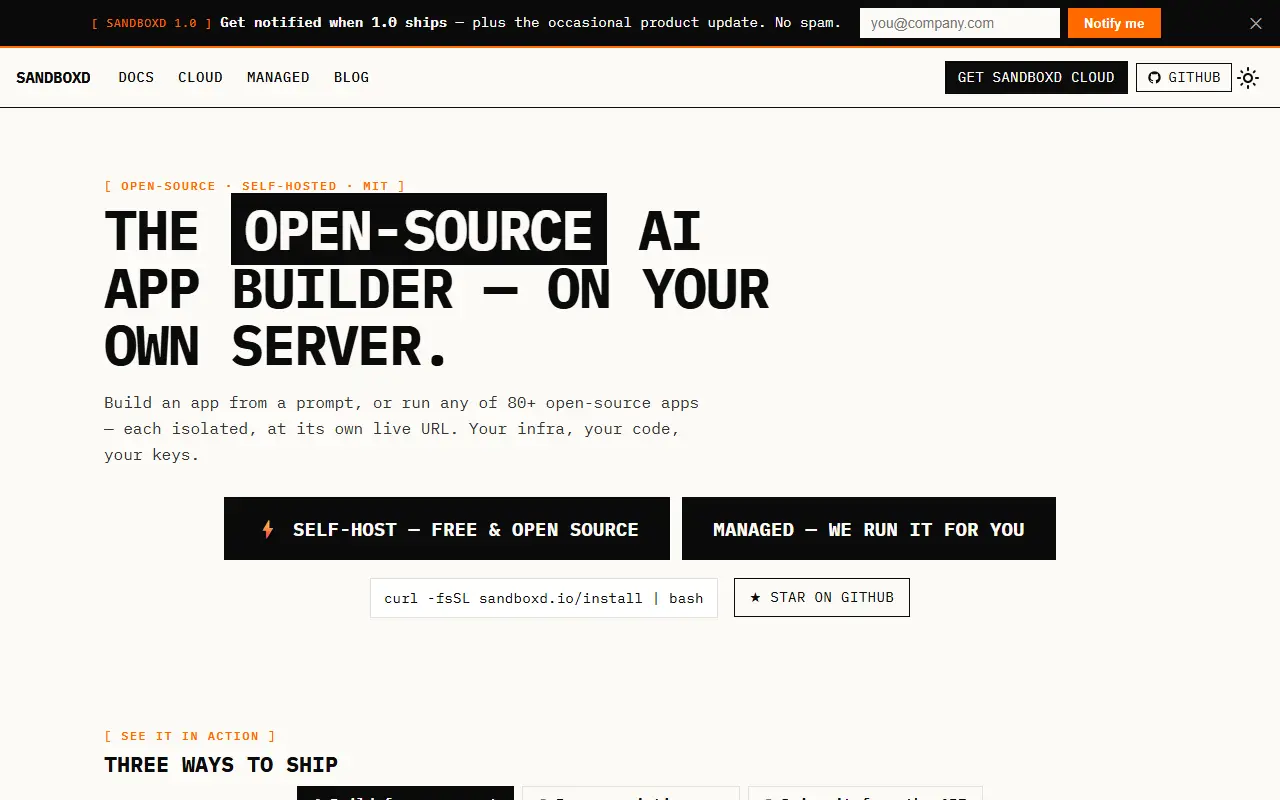
sandboxd.ioSandboxd homepage screenshot

Sandboxd is an open-source, self-hosted take on prompt-to-app builders like Lovable, Bolt, v0 and Replit. A single HTTP request creates a private, isolated container, runs an AI coding agent in it against your prompt, and returns a live preview URL for the resulting app, all on a server you own.

Beyond building from a prompt, it can also run existing apps from a curated catalog of more than 80 apps such as n8n, Ghost and Grafana, and every action is exposed as a /v1 API call for headless, scriptable use. Idle sandboxes go to sleep and wake on demand, so one ordinary server can hold many apps rather than a virtual machine each.

The design is intentionally small: a single Go program drives Docker, uses Traefik to route preview URLs and keeps state in SQLite, with no Kubernetes, separate database or queue. Self-hosting is free under the MIT license, and the maintainers also mention an optional managed cloud and a live demo console with sample data.

Key features

  • Prompt-to-app builds by a coding agent
  • Isolated Docker sandbox per app
  • Live preview URL for each app
  • One-click catalog of 80+ apps
  • Scriptable /v1 HTTP API
  • Idle sandboxes sleep and wake on demand

Pricing: Self-hosting is free and MIT licensed. The Managed option, where the team runs it on your server, is $79 per month, and a Cloud URL service for your own server is $4.99 per month.

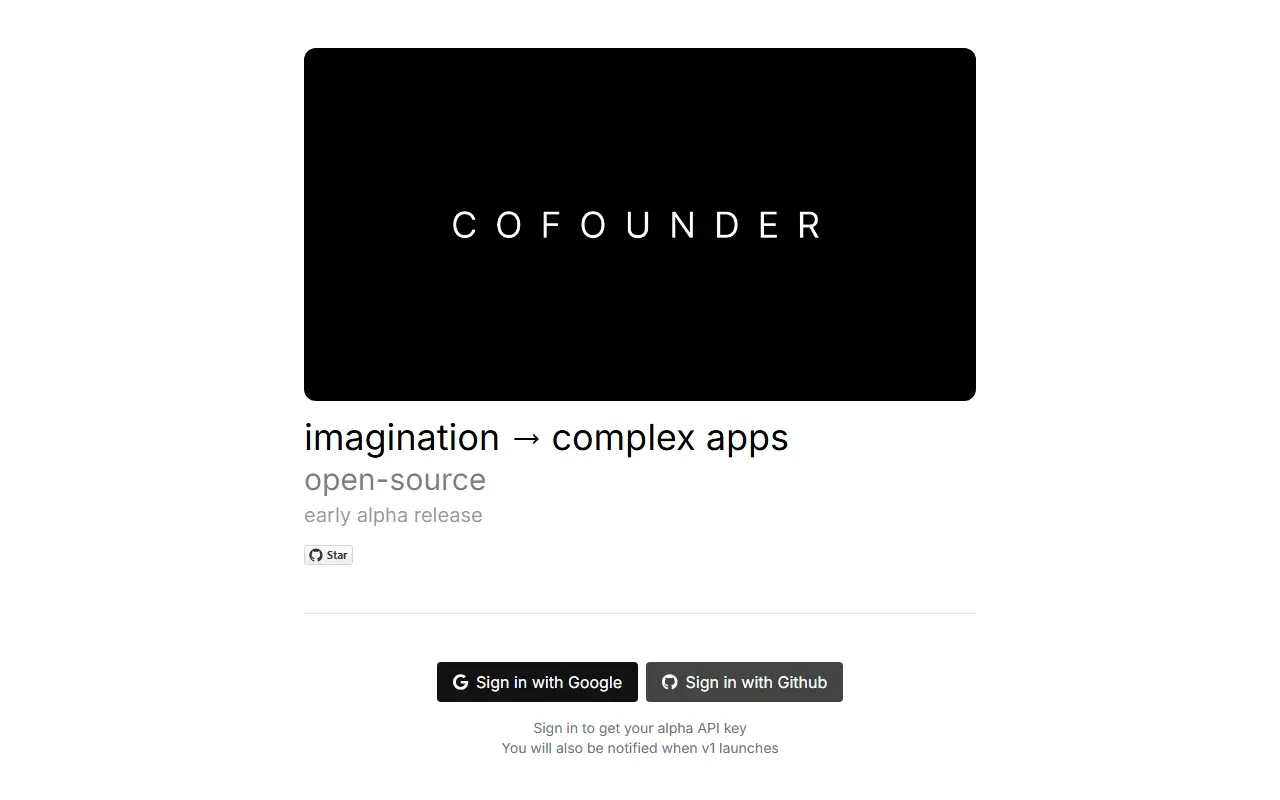
Cofounder

Cofounder is an early-alpha, MIT-licensed AI tool that generates full-stack web apps, including backend, database and generative UI, from a description.

GitHub stars
6.6k
Last commit
2 yr ago
Licence
MIT
Self-hosted
Yes
cofounder.openinterface.aiCofounder homepage screenshot

Cofounder is an experimental AI framework for generating full-stack web applications. Given a description of what to build, it aims to produce not just a front end but a working backend, database schema and stateful web app, pairing an AI-guided mockup designer with a modular design system to create a generative UI rooted in the app's own architecture.

The stack it generates targets TypeScript and JavaScript with React, Tailwind CSS, Vite and PostgreSQL. The README is unusually blunt about the project's maturity: it is an early, unstable preview release that is expected to break often and consumes a large number of AI tokens, and the maintainers explicitly tell most potential users to wait for a version 1 release rather than try the current code.

Cofounder is released under the MIT license and is run locally or self-hosted, calling out to an AI provider such as OpenAI for generation, so API usage is billed separately by that provider. It is best suited to developers comfortable with experimental, work-in-progress open-source tools.

Key features

  • AI-generated full-stack app scaffolding
  • Generative UI tied to app architecture
  • AI-guided mockup designer
  • Modular design system support
  • PostgreSQL-backed generated backends

Pricing: Free and open source under the MIT license. It relies on external AI APIs that are billed separately and can consume a large number of tokens.

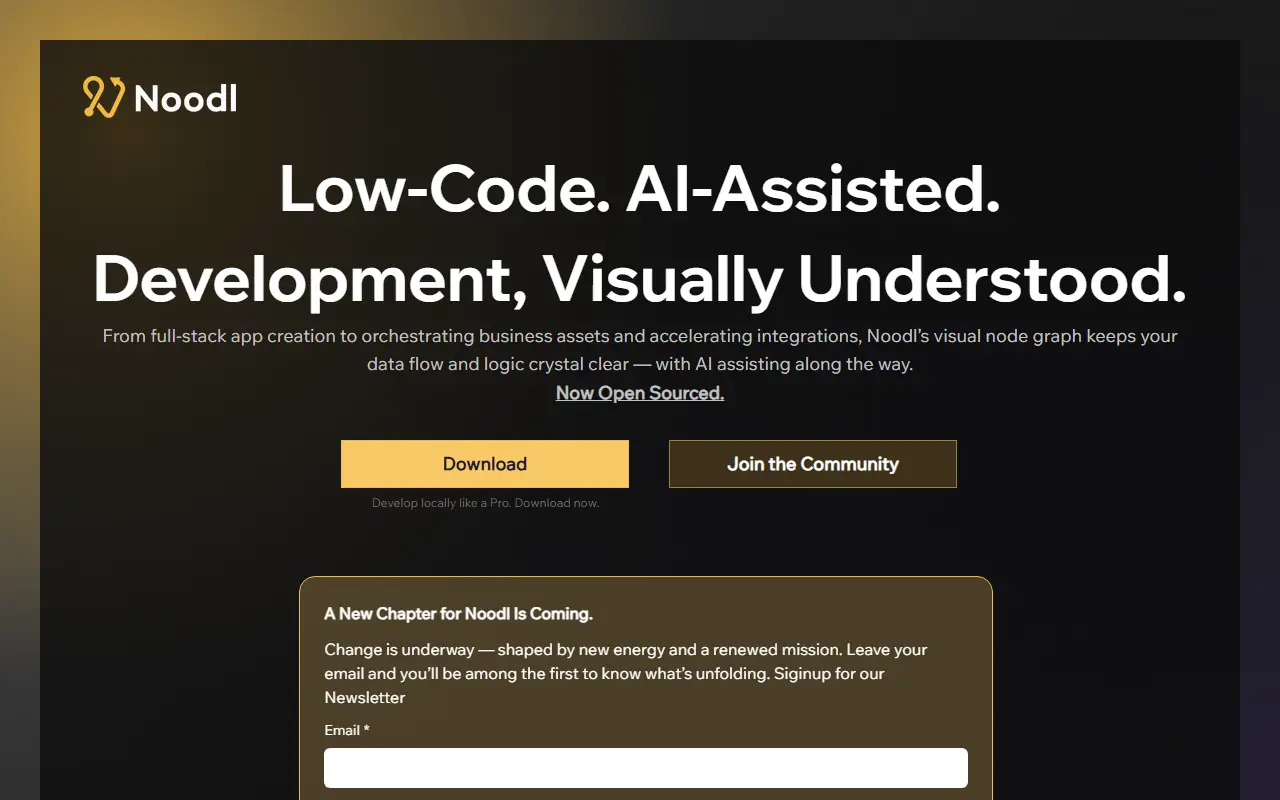
Noodl

Noodl is a visual low-code platform where designers and developers build full-stack web applications, with a GPL-licensed editor and MIT runtime.

GitHub stars
555
Last commit
2 yr ago
Latest release
v1.0.1
Licence
GPL-3.0
Self-hosted
Yes
noodl.netNoodl homepage screenshot

Noodl is a low-code platform for creating custom applications and experiences, built as a visual programming environment. It aims to speed up development and lets designers and developers produce apps with minimal coding knowledge.

The repository is the open-source continuation of the formerly closed-source product, with pre-built binaries on GitHub and guidance for migrating projects to a Git provider, moving the backend and database, and self-hosting the frontend. Documentation is available on a docs site and the main support channel is Discord. The editor is built with TypeScript, React and JavaScript.

Licensing is split: editor components are under GPLv3, while the runtime packages used by deployed applications (noodl-runtime, noodl-viewer-cloud and noodl-viewer-react) are under MIT. Source code of applications you create is MIT, so project-specific runtime changes need not be redistributed.

Key features

  • Visual programming environment
  • Full-stack web app building
  • React-based runtime
  • Visual workflows for app logic
  • Self-hostable frontend
  • Pre-built desktop releases

Pricing: Free and open source: editor under GPLv3, runtime packages under MIT.

Commercial Base44 alternatives

Hosted, closed-source products that compete with Base44. Showing 12 of 38.

See every Base44 alternative on its tool page

Base44 alternatives: questions

What is the best open-source alternative to Base44?
Appsmith is the top-ranked open-source alternative to Base44 on Enlisted: An open-source low-code platform for building admin panels, internal tools and dashboards that connect to more than 25 databases and any API. Other strong options are ToolJet, Onlook, Magic Cloud and Sandboxd.
What are the best commercial alternatives to Base44?
v0, Lovable, Bolt.new, Replit and Anything are among the hosted, closed-source alternatives to Base44 listed on Enlisted, which lists 38 in total. Compare their pricing and features on each tool page.
Are these Base44 alternatives free?
All 7 are open source, so the code is free to use under its licence, and all of them can be self-hosted on your own server or computer. 4 also offer a paid or managed cloud version if you'd rather not host it yourself.
How is this list of Base44 alternatives ranked?
By a score built from GitHub stars, star growth over the last 30 days and how recently the code changed. 5 of these projects shipped code in the last 30 days. Data is refreshed daily, and nobody can pay to move up.

People also look for alternatives to…

View all