7,363 open-source and SaaS tools, with GitHub stats refreshed every day.

3 alternatives ranked by real activity

Open-source AtScale alternatives

A curated, ranked list of the 3 best open-source alternatives to AtScale.

The best open-source alternative to AtScale is Cube. If that doesn't suit you, other good options are MetricFlow and Saiku.

AtScale alternatives are mainly BI & dashboard tools, but some are also data pipeline & ETL tools. 3 of them shipped code in the last 30 days, 3 can be self-hosted, and 2 use a permissive licence.

Last updated October 3, 2026 · ranked by GitHub stars, growth and recent commits

Cube

An open-source, headless semantic layer where you define metrics and access rules once in code and expose them to BI tools, apps and AI agents through SQL, REST and GraphQL.

GitHub stars
21k
Last commit
today
Latest release
v1.7.48
Self-hosted
Yes
Hosted version
Available
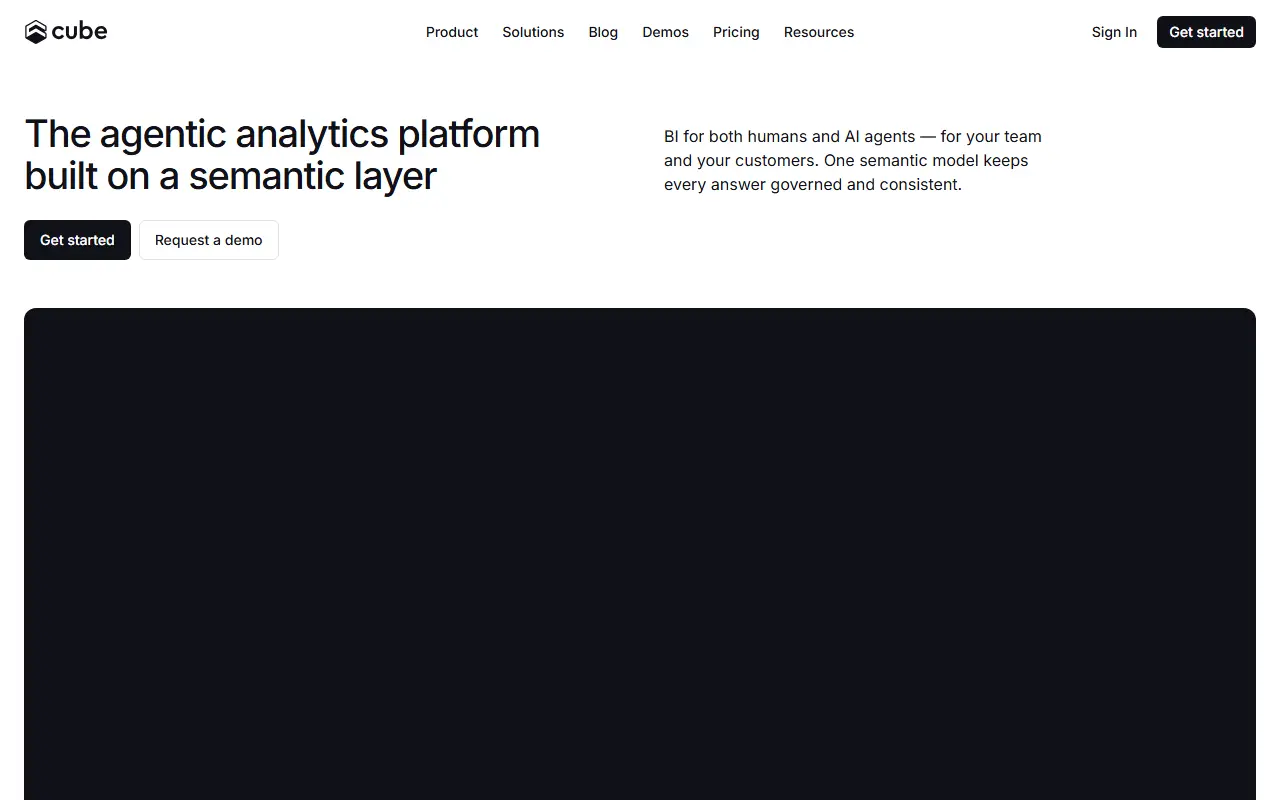
cube.devCube homepage screenshot

Cube Core is an open-source semantic layer. You describe your metrics, dimensions, joins and permissions a single time, as code, and Cube exposes that model through SQL, REST and GraphQL APIs to whatever sits downstream: BI tools, custom applications or AI agents. It is headless, meaning it ships no user interface of its own, which leaves you free to design the analytics experience your product needs.

The project argues that every BI tool already relies on a semantic layer to hide data complexity, but most are proprietary and tied to a single platform. Cube aims to make that layer reusable. It connects to any SQL data source, including warehouses such as BigQuery, Snowflake and Databricks, engines such as Amazon Athena and Presto, and application databases such as Postgres. A built-in relational caching engine delivers fast responses and high concurrency for API requests.

The core is written in Rust and JavaScript, and its license is listed as 'Other' on GitHub, so review the terms for commercial use. Cube can be self-hosted, and the company also offers Cube Cloud. It suits data teams building embedded analytics or wanting consistent metric definitions across tools.

Key features

  • Metrics and dimensions defined as code
  • SQL, REST and GraphQL APIs
  • Headless design with no built-in UI
  • Connects to Snowflake, BigQuery and Databricks
  • Built-in caching engine
  • Access rules for governed data

Pricing: Free forever plan for hobby projects. Starter costs $40 and Premium $80 per developer per month; Enterprise is custom via a demo request.

MetricFlow

Semantic layer from dbt Labs that defines metrics in code and compiles requests into optimized, reusable SQL with consistent dimensions and joins.

GitHub stars
1.8k
Last commit
3 days ago
Latest release
v0.213.0
Licence
Apache-2.0
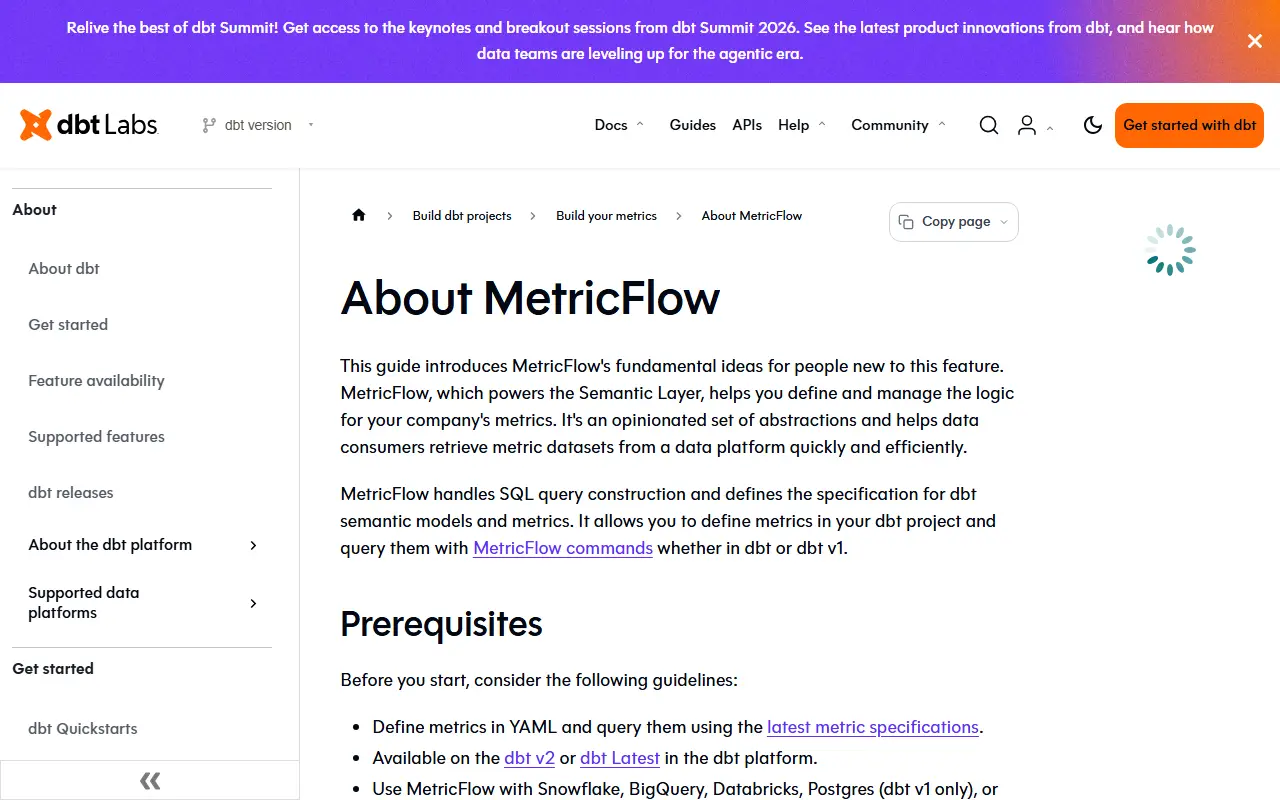
docs.getdbt.comMetricFlow homepage screenshot

MetricFlow is a semantic layer that makes it simpler to define and manage metrics in code. It compiles those metric definitions into clear, reusable SQL, so results stay consistent and accurate when analyzed by relevant attributes, or dimensions. It is maintained by dbt Labs, written in Python, and released under the Apache-2.0 license.

The name reflects its method: a request for a metric is compiled into a dataflow-based query plan that is optimized and translated into engine-specific SQL. It helps with complicated logic such as multi-hop joins between fact and dimension sources and complex metric types, generating queries dynamically instead of requiring hand-written SQL for every cut of the data.

Documentation is hosted in the dbt docs, and a changelog tracks updates. MetricFlow suits analytics engineers and data teams who want a single source of truth for business metrics that can feed dashboards, notebooks, and other tools.

Key features

  • Metric definitions managed as code
  • Compiles metrics to engine-specific SQL
  • Dataflow-based query planning
  • Multi-hop joins across fact and dimension sources
  • Support for complex metric types
  • Consistent dimensions across queries

Pricing: Free and open source under the Apache-2.0 license.

Saiku

Saiku is an open-source semantic layer and OLAP analytics tool built on Mondrian and Apache Calcite, serving Excel, dashboards and AI agents.

GitHub stars
1.3k
Last commit
today
Latest release
v4.8.0
Licence
Apache-2.0
Self-hosted
Yes
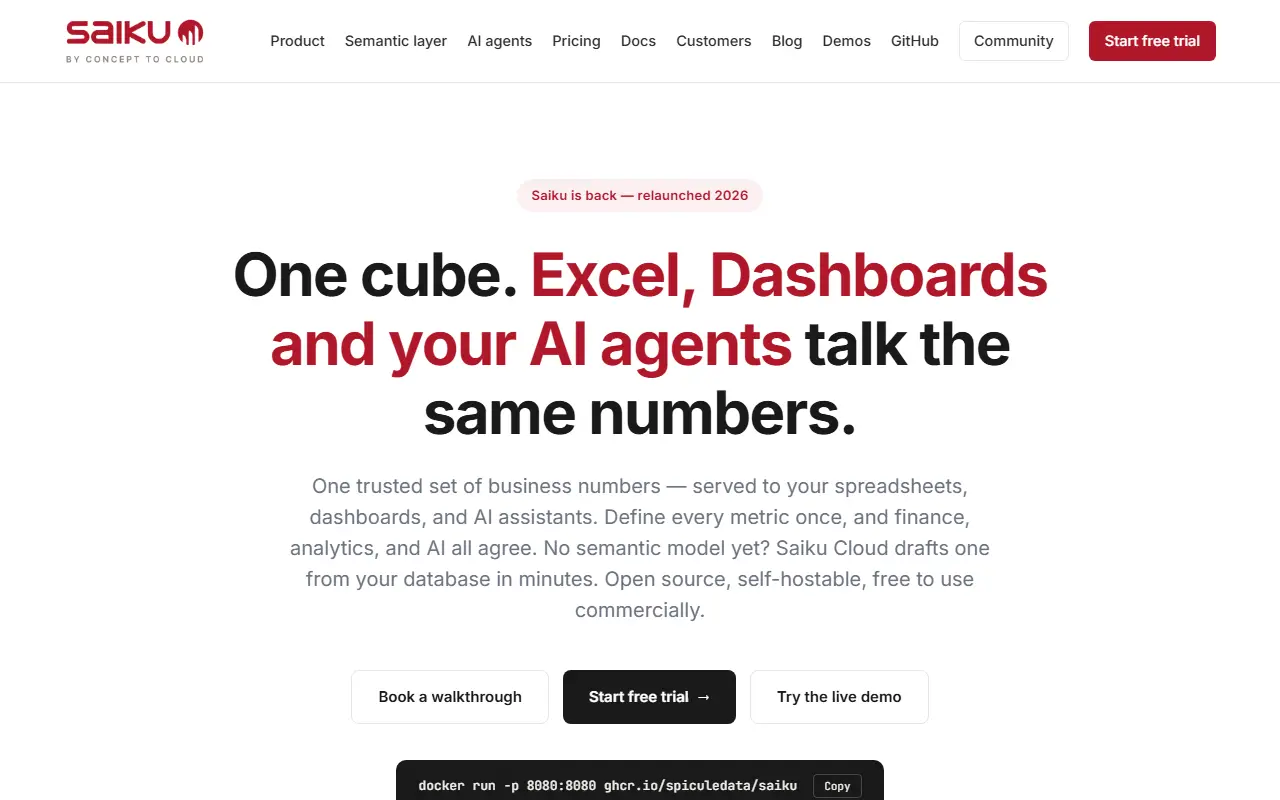
saiku.biSaiku homepage screenshot

Saiku began in 2010 as an open-source OLAP browser for Mondrian and was rebuilt in 2026 as a modern semantic layer for analytics. It defines business cubes once and then exposes them to different consumers: a drag-and-drop browser interface, Excel through MDX and XMLA, dashboards, and AI agents through MCP.

In the browser, users drag fields onto rows, columns and filters and the application writes MDX for them. The back end uses a fork of Mondrian 4.8 with an Apache Calcite-based SQL planner, which can reach modern engines such as lakehouse systems. A typed REST interface allows AI agents to query data without handling MDX. A demo mode ships with a self-contained H2 database and the FoodMart sample cube.

Saiku is written in Java and licensed under Apache-2.0. It runs from a Docker image, which runs as a non-root user and requires setting an admin password for real deployments, and a hosted demo instance resets nightly. It suits analytics and BI teams that need governed, reusable metric definitions across spreadsheets, dashboards and AI tools.

Key features

  • Drag-and-drop OLAP browser
  • MDX and XMLA access from Excel
  • Mondrian with Apache Calcite SQL planner
  • MCP and typed REST API for AI agents
  • Docker image with demo mode
  • Support for modern lakehouse engines

Pricing: Free and open source under the Apache-2.0 licence.

AtScale alternatives: questions

What is the best open-source alternative to AtScale?
Cube is the top-ranked open-source alternative to AtScale on Enlisted: An open-source, headless semantic layer where you define metrics and access rules once in code and expose them to BI tools, apps and AI agents through SQL, REST and GraphQL. Other strong options are MetricFlow and Saiku.
Are these AtScale alternatives free?
All 3 are open source, so the code is free to use under its licence, and all of them can be self-hosted on your own server or computer. 1 also offers a paid or managed cloud version if you'd rather not host it yourself.
How is this list of AtScale alternatives ranked?
By a score built from GitHub stars, star growth over the last 30 days and how recently the code changed. 3 of these projects shipped code in the last 30 days. Data is refreshed daily, and nobody can pay to move up.

People also look for alternatives to…

View all