7,363 open-source and SaaS tools, with GitHub stats refreshed every day.

6 alternatives ranked by real activity

Open-source Amazon Bedrock alternatives

A curated, ranked list of the 6 best open-source alternatives to Amazon Bedrock.

The best open-source alternative to Amazon Bedrock is Dify. If that doesn't suit you, other good options are vLLM, LiteLLM, SGLang and Portkey AI Gateway.

Amazon Bedrock alternatives are mainly AI infrastructure tools. 5 of them shipped code in the last 30 days, 6 can be self-hosted, and 3 use a permissive licence.

Last updated October 2, 2026 · ranked by GitHub stars, growth and recent commits

Dify

An LLM application platform for building AI workflows, RAG pipelines and agents on one canvas, deployable in the cloud, a private VPC or self-hosted.

GitHub stars
158k
Last commit
yesterday
Latest release
1.17.1
Self-hosted
Yes
Hosted version
Available
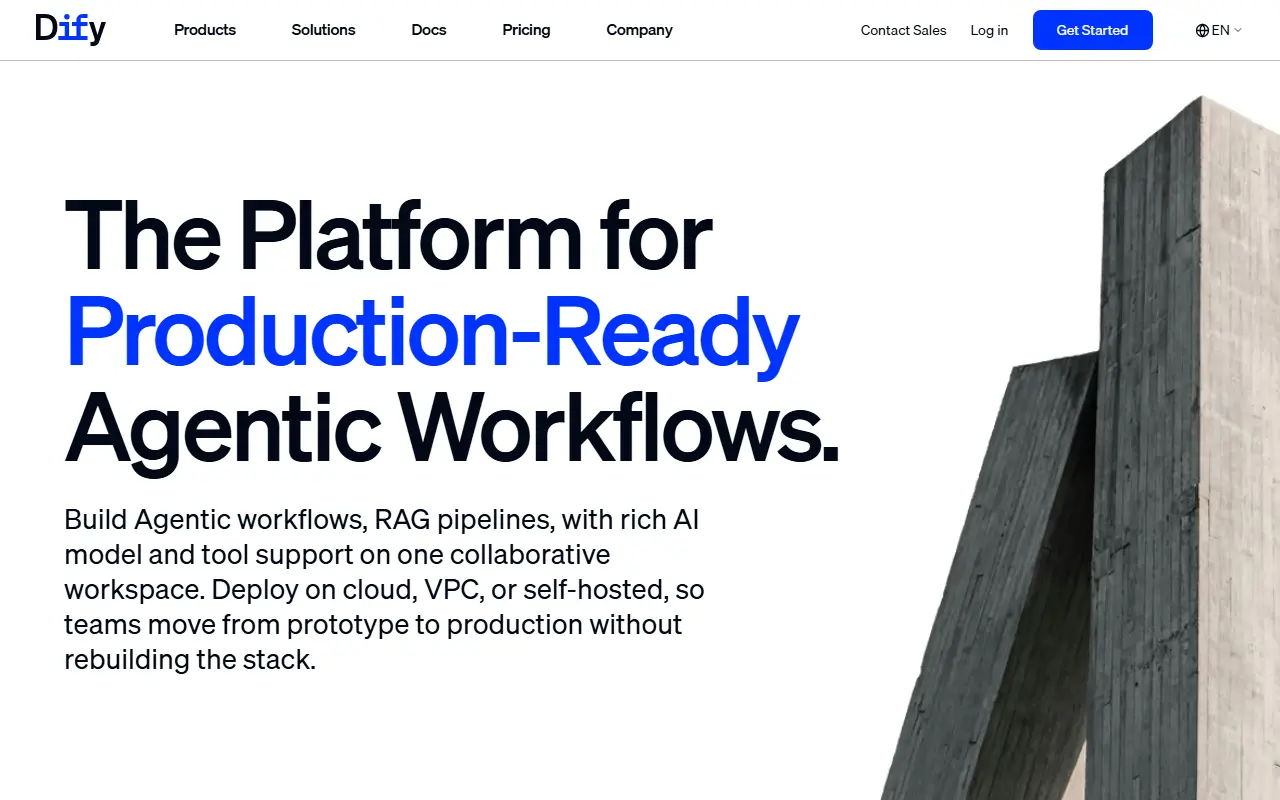
dify.aiDify homepage screenshot

Dify is a platform for building applications on top of large language models. Instead of wiring together prompts, retrieval code and model APIs by hand, teams assemble AI workflows, knowledge pipelines and agents in a shared visual workspace, then move them from prototype to production without changing stacks.

The product covers a workflow studio for agentic flows, a knowledge pipeline that prepares searchable knowledge bases for retrieval-augmented generation, model management across many providers, and a marketplace of tools, models and integrations. Observability integrations such as Opik, Langfuse and Arize Phoenix help trace and debug runs once an app is live.

Dify comes in a few editions: a community edition you deploy yourself with Docker, a hosted cloud service, and an enterprise edition for private deployments. The repository carries a custom license rather than a standard one, so check its terms before offering Dify as a service to others.

Key features

  • Visual workflow studio for agentic apps
  • Knowledge pipelines for retrieval-augmented generation
  • Model management across many LLM providers
  • Marketplace of tools, models and integrations
  • Observability integrations such as Langfuse
  • Deploy on cloud, VPC or Docker

Pricing: Free Sandbox on Dify Cloud and a free self-hosted Community edition. Cloud Professional costs $590 and Team $1590 per workspace per year; Enterprise is custom.

Read more about DifyWebsite GitHub

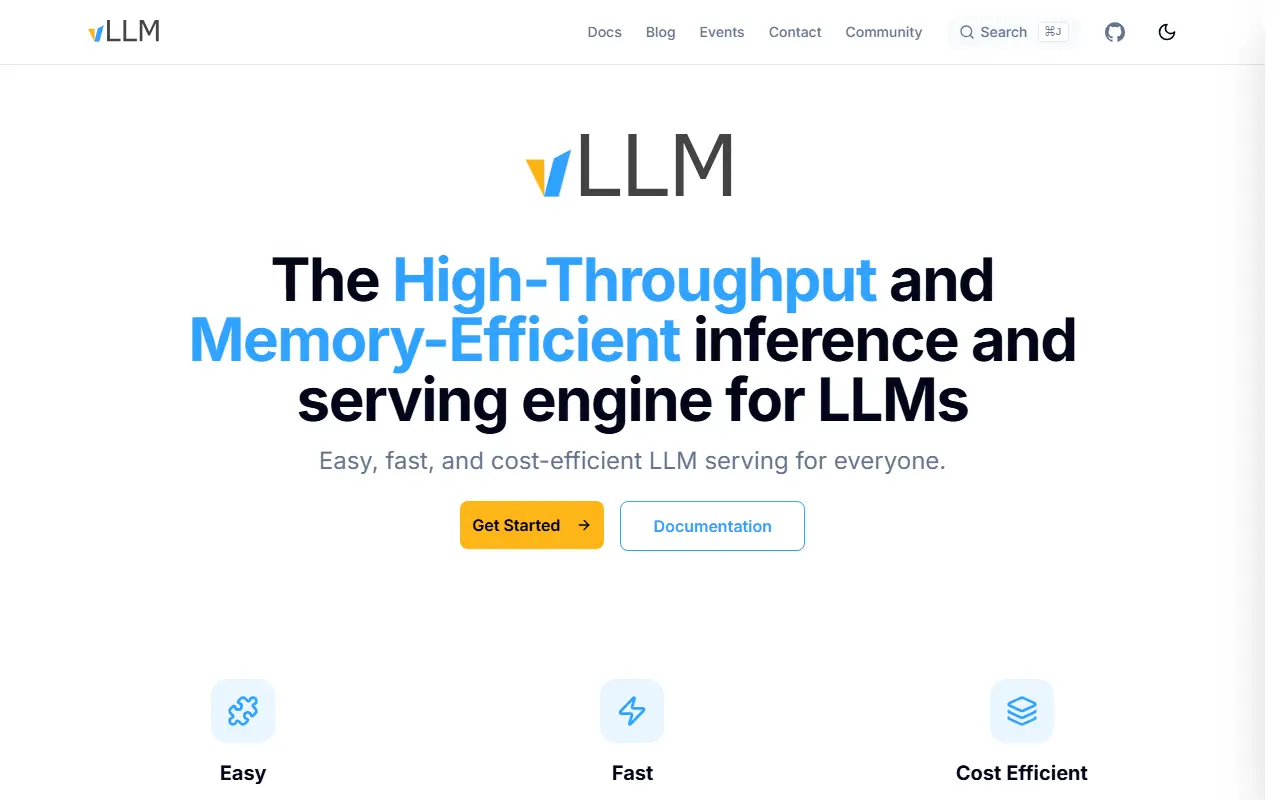
vLLM

A Python library and server for fast, memory-efficient LLM inference and serving, with PagedAttention, continuous batching and broad quantization support.

GitHub stars
93k
Last commit
today
Latest release
v0.30.0
Licence
Apache-2.0
Self-hosted
Yes
vllm.aivLLM homepage screenshot

vLLM is an open-source library for running and serving large language models efficiently. It originated at UC Berkeley's Sky Computing Lab and is now developed by a large community of contributors from academia and industry. It is written in Python and released under the Apache-2.0 license.

Speed comes from techniques such as PagedAttention for attention key-value memory, batching incoming requests continuously, chunked prefill, prefix caching, CUDA and HIP graphs, and optimized attention and mixture-of-experts kernels. It supports many quantization formats, including FP8, INT8, INT4, GPTQ and AWQ, as well as speculative decoding and disaggregated prefill and decode.

On the usability side, vLLM integrates with Hugging Face models and supports parallel sampling, beam search, streaming outputs, structured outputs and tool calling, plus several parallelism modes (tensor, pipeline, data, expert and context) for distributed inference. It targets NVIDIA, AMD and TPU hardware and suits teams that serve open models in production and need high throughput.

Key features

  • PagedAttention and continuous batching
  • Quantization including FP8, INT8, GPTQ and AWQ
  • Speculative decoding support
  • Tensor, pipeline and expert parallelism
  • OpenAI-compatible API server
  • Hugging Face model integration
  • Streaming and structured outputs

Pricing: Free and open source under the Apache-2.0 license.

Read more about vLLMWebsite GitHub

LiteLLM

An open-source AI gateway and Python SDK that lets you call 100+ LLM providers through one OpenAI-style interface, with spend tracking and load balancing.

GitHub stars
60k
Last commit
today
Latest release
v1.103.2
Self-hosted
Yes
Hosted version
Available
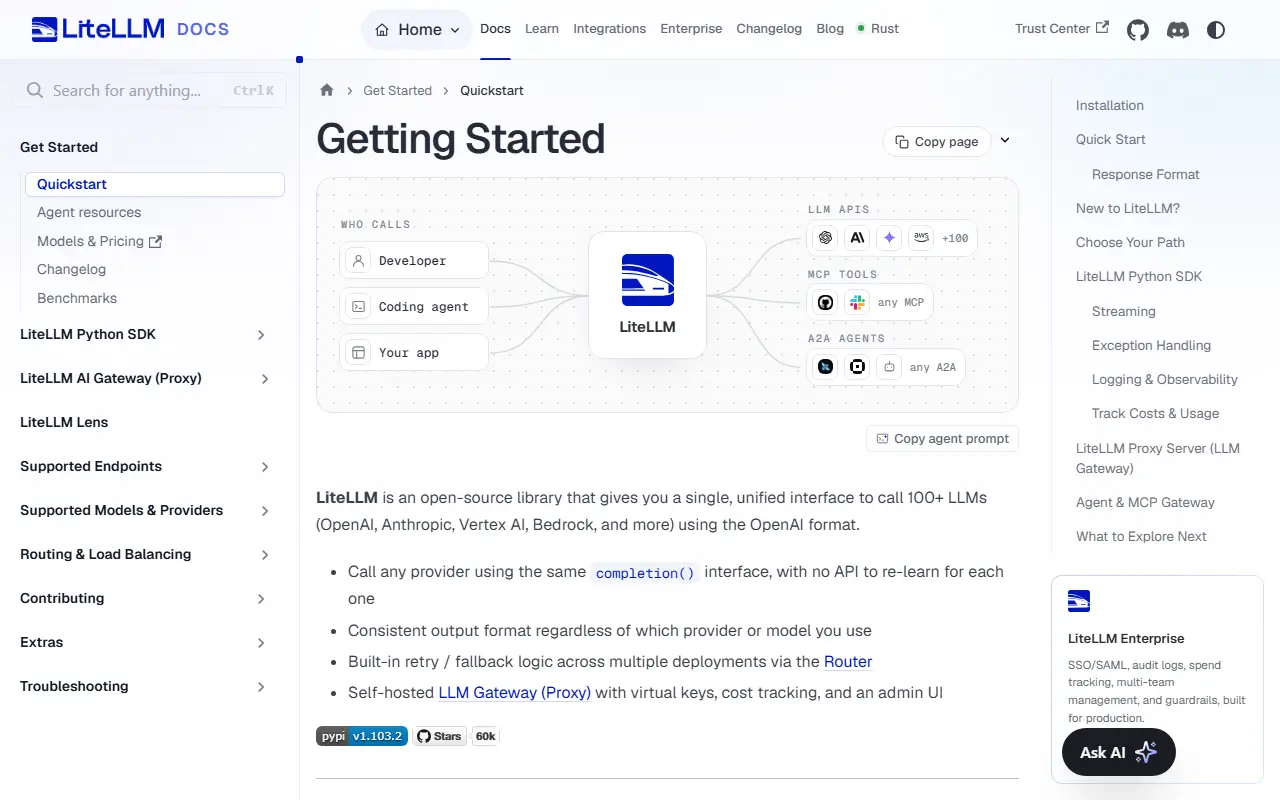
docs.litellm.aiLiteLLM homepage screenshot

LiteLLM is an AI gateway, open source, offering one unified interface for calling more than 100 LLM providers, including OpenAI, Anthropic, Gemini, Bedrock and Azure, using the OpenAI request format. It can be used as a Python SDK inside an application or deployed as a proxy server that serves a whole team or organization. The core is Python with a Rust component, and GitHub lists the license as 'Other'.

The project aims to remove the hassle of handling a separate SDK, login scheme, request format and set of errors for each model. On top of that the gateway provides load balancing, guardrails, spend tracking, virtual keys and an admin dashboard, and it exposes endpoints for chat completions, responses, embeddings, images, audio, batches and reranking.

Because requests keep the OpenAI format, teams can swap providers without rewriting application code. It is self-hosted, with hosted-proxy and enterprise tier options linked in the README, and its topics also reference an MCP gateway and LLMOps. It suits platform and AI engineering teams that need central control over model access, budgets and logging.

Key features

  • Unified OpenAI-format interface for 100+ LLMs
  • Python SDK and proxy server modes
  • Virtual keys and spend tracking
  • Guardrails and load balancing
  • Built-in admin dashboard
  • Endpoints for chat, embeddings, images and audio

Pricing: The open-source gateway can be self-hosted; the README also links hosted proxy and enterprise tier offerings.

Read more about LiteLLMWebsite GitHub

SGLang

SGLang is an open-source framework for serving language, vision-language and diffusion models, built for fast inference at scale.

GitHub stars
37k
Last commit
today
Latest release
v0.5.21
Licence
Apache-2.0
Self-hosted
Yes
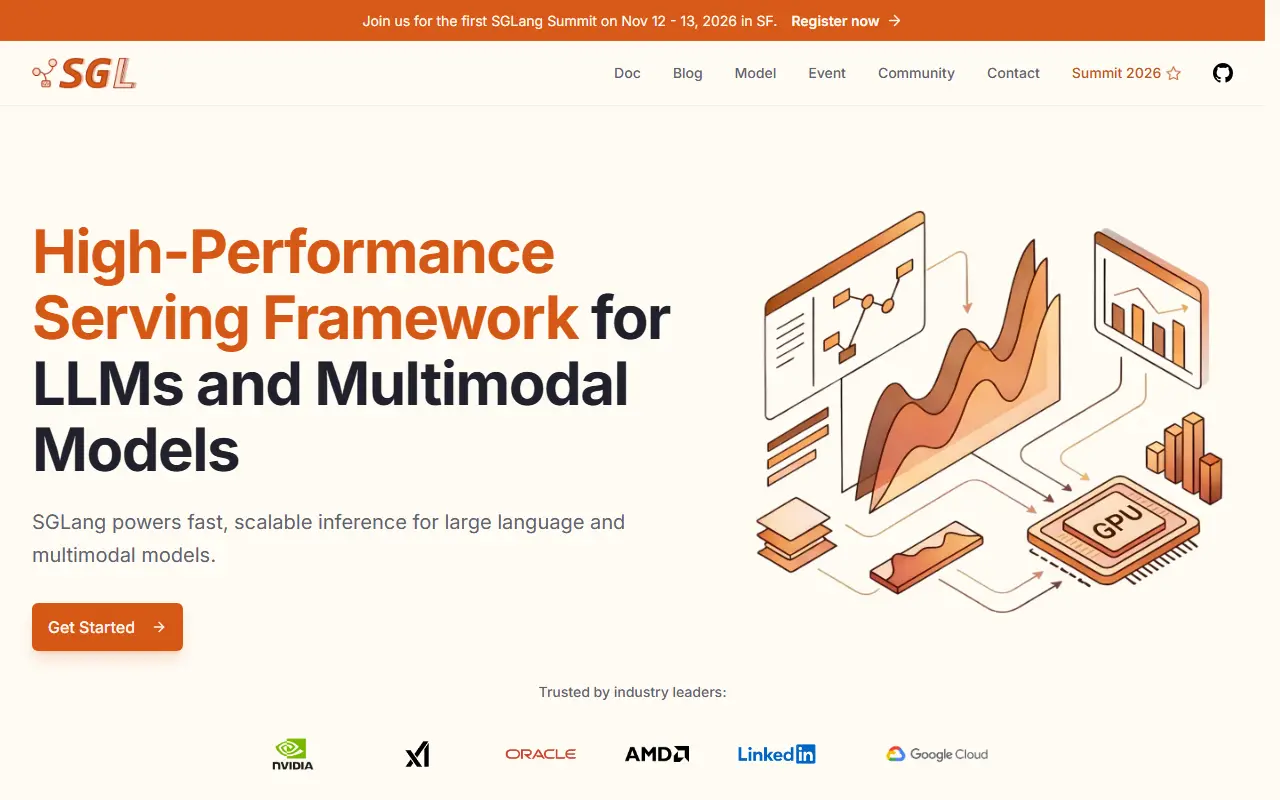
sglang.ioSGLang homepage screenshot

SGLang is an inference framework, released as open source, for language models, vision-language models and diffusion models. It is optimized for agentic workloads, reinforcement-learning rollouts and large-scale serving. The project includes SGLang Diffusion, a built-in engine for image and video generation that ships in the same repository and Python package. It is released under the Apache-2.0 license.

Getting started takes either a prebuilt Docker image or a Python install using uv, followed by a launch command for the chosen model. A cookbook helps pick a model and hardware pair and generates a ready-to-run command. Supported hardware spans NVIDIA and AMD GPUs, Google TPUs, Intel GPUs and CPUs, Apple Silicon through Metal and MLX, and Huawei Ascend NPUs, with more integrations in progress. The wider SGLang ecosystem adds educational projects and community events.

Key features

  • Serving for LLMs, vision-language and diffusion models
  • Docker image and uv-based Python install
  • Cookbook with ready-to-run launch commands
  • Runs on NVIDIA, AMD, TPU, Intel and Ascend hardware
  • Built-in image and video generation engine
  • Tuned for agentic and RL rollout workloads

Pricing: Free and open source under the Apache-2.0 license.

Read more about SGLangWebsite GitHub

Portkey AI Gateway

Portkey's AI Gateway routes requests to many language and multimodal models through a single API, with guardrails and several deployment options.

GitHub stars
13k
Last commit
4 mo ago
Latest release
v1.15.2
Licence
MIT
Self-hosted
Yes
Hosted version
Available
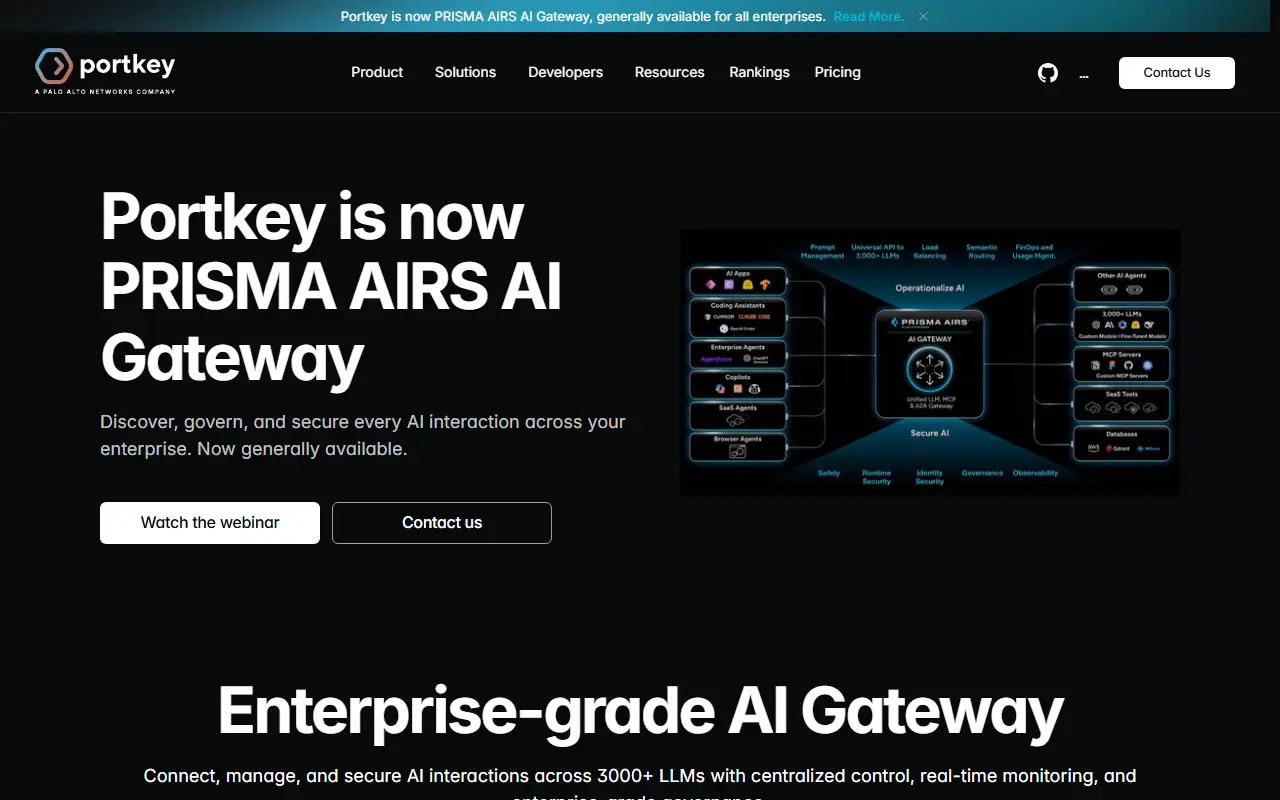
portkey.aiPortkey AI Gateway homepage screenshot

Gateway is Portkey's open-source AI gateway, a lightweight service for routing requests to a large catalog of language, vision, audio and image models through one API. It is designed to be fast, reliable and enterprise-ready, and the project says you can integrate with any language model quickly. It also bundles AI guardrails and, per its topics, supports MCP gateway use. It is written in TypeScript under the MIT license.

A quickstart runs the gateway locally, serving the API on port 8787 along with a console. Deployment guides cover Portkey Cloud, Docker, Node.js, Cloudflare, Replit and other targets. Libraries and SDKs listed include JavaScript, Python, REST, the OpenAI SDKs, LangChain and LlamaIndex, so existing applications can point at the gateway with small changes.

The README announces a Gateway 2.0 pre-release in which Portkey's core enterprise gateway merges into open source, and it mentions an open-source model pricing dataset called Portkey Models. A hosted gateway and enterprise offering exist from the vendor, so the project suits both teams who want to self-host routing and those who prefer a managed service.

Key features

  • Single API for routing to many LLMs
  • Integrated AI guardrails
  • Local console for monitoring requests
  • Deploys via Docker, Node.js and Cloudflare
  • Works with OpenAI SDKs and LangChain
  • MCP gateway support

Pricing: The gateway is free to self-host and the hosted Developer plan is free forever. Production costs $49 per month with $9 overage per extra 100K requests; Enterprise is custom.

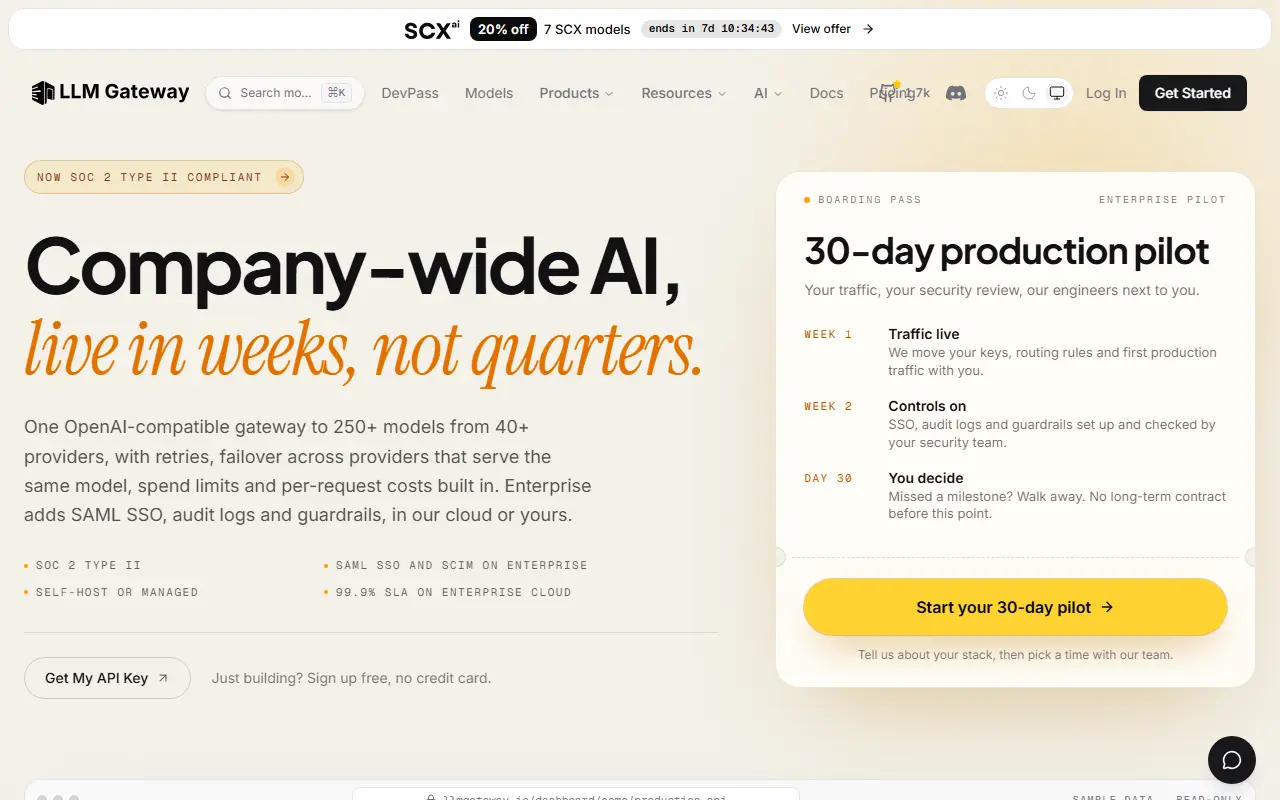
LLM Gateway

An open-source API gateway that routes requests to many LLM providers through one OpenAI-compatible interface, with usage analytics and key management.

GitHub stars
1.7k
Last commit
yesterday
Latest release
v1.19.0
Self-hosted
Yes
Hosted version
Available
llmgateway.ioLLM Gateway homepage screenshot

LLM Gateway is an open-source API gateway for large language models. It sits between your applications and multiple providers such as OpenAI, Anthropic and Google Vertex AI, so your code talks to one interface while the gateway decides where each request goes. Its API follows the OpenAI format, which keeps migration from existing code straightforward.

Beyond routing, it centralizes the management of provider API keys and tracks requests, token usage, response times and costs so teams can see what their LLM usage is doing. Performance monitoring lets you compare models on speed and cost-effectiveness. Topics on the repository also mention guardrails, rate limiting, observability and enterprise use.

You can use LLM Gateway in two ways: a hosted version at llmgateway.io where you create an account and get an API key, or a self-hosted deployment on your own infrastructure using a unified Docker image with PostgreSQL. The code is written in TypeScript and its licence is listed as other, so check the repository terms. It suits developers and platform teams who juggle several model vendors.

Key features

  • Unified OpenAI-compatible API
  • Routing across multiple LLM providers
  • Central management of provider API keys
  • Token usage and cost tracking
  • Model performance comparison
  • Docker image for self-hosting

Pricing: A free plan has no subscription: you pay provider token rates plus a 5% fee on credit purchases, or nothing extra with your own keys. Enterprise is custom, and the gateway can be self-hosted.

Read more about LLM GatewayWebsite GitHub

Amazon Bedrock alternatives: questions

What is the best open-source alternative to Amazon Bedrock?
Dify is the top-ranked open-source alternative to Amazon Bedrock on Enlisted: An LLM application platform for building AI workflows, RAG pipelines and agents on one canvas, deployable in the cloud, a private VPC or self-hosted. Other strong options are vLLM, LiteLLM, SGLang and Portkey AI Gateway.
Are these Amazon Bedrock alternatives free?
All 6 are open source, so the code is free to use under its licence, and all of them can be self-hosted on your own server or computer. 4 also offer a paid or managed cloud version if you'd rather not host it yourself.
How is this list of Amazon Bedrock alternatives ranked?
By a score built from GitHub stars, star growth over the last 30 days and how recently the code changed. 5 of these projects shipped code in the last 30 days. Data is refreshed daily, and nobody can pay to move up.

People also look for alternatives to…

View all