7,363 open-source and SaaS tools, with GitHub stats refreshed every day.

5 alternatives ranked by real activity

Open-source Aqua Security alternatives

A curated, ranked list of the 5 best open-source alternatives to Aqua Security.

The best open-source alternative to Aqua Security is Trivy. If that doesn't suit you, other good options are Grype, Kubescape, Falco and tfsec.

Aqua Security alternatives are mainly security tools. 4 of them shipped code in the last 30 days, 5 can be self-hosted, and 5 use a permissive licence.

Last updated October 3, 2026 · ranked by GitHub stars, growth and recent commits

Trivy

A security scanner that finds vulnerabilities, misconfigurations, secrets and license issues in container images, filesystems, Git repositories and Kubernetes.

GitHub stars
38k
Last commit
today
Latest release
v0.75.0
Licence
Apache-2.0
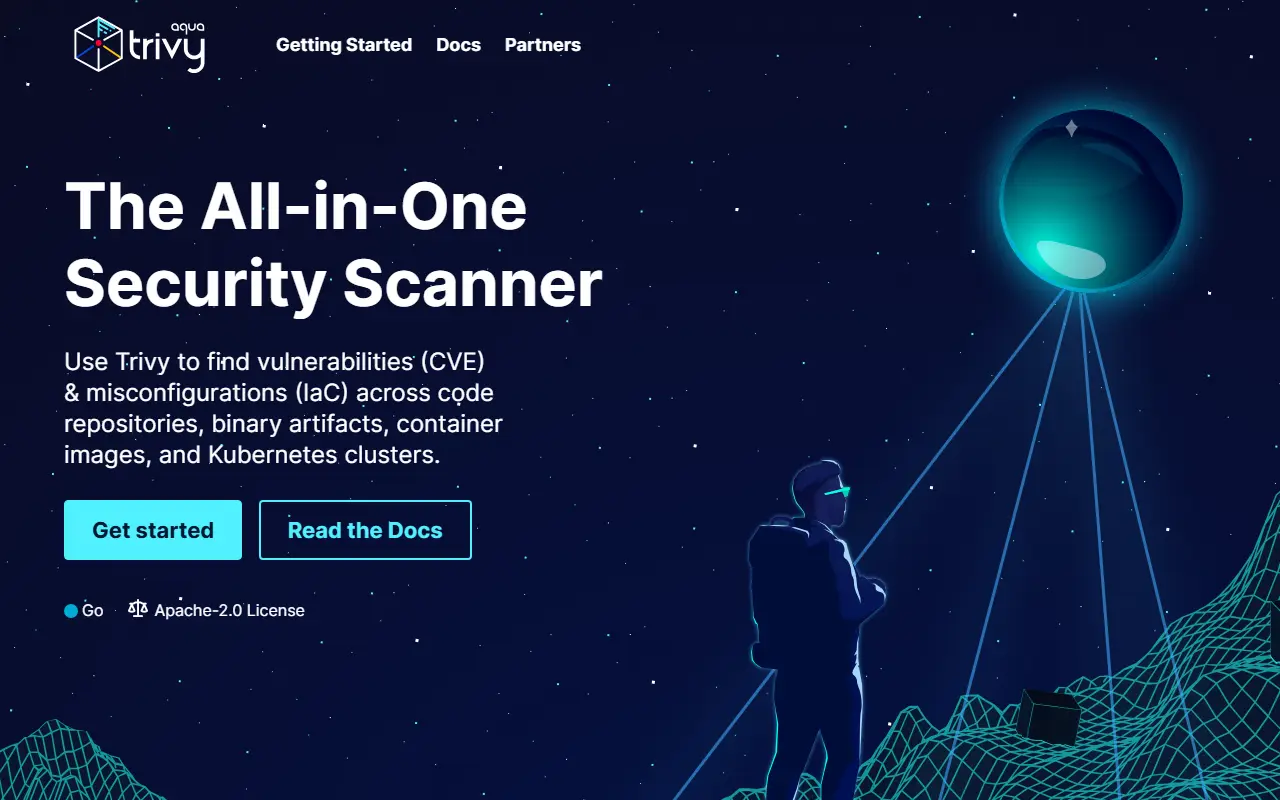
trivy.devTrivy homepage screenshot

Trivy is a security scanner from Aquasec, written in Go and released under the Apache-2.0 license. It has scanners that look for different security issues and targets where those issues can be found. The README describes it as comprehensive and versatile, and it covers the major programming languages, operating systems and platforms.

Targets include container images, filesystems, remote Git repositories, virtual machine images and Kubernetes. Scanners look for OS packages and software dependencies in use, which produces an SBOM, known vulnerabilities (CVEs), infrastructure-as-code issues and misconfigurations, sensitive information and secrets, and software licenses. Its topics reference DevSecOps and vulnerability scanning.

Trivy is available through most common channels, including Homebrew, a Docker image and downloadable binaries, and integrates with platforms such as GitHub Actions, a Kubernetes operator and a VS Code plugin. Canary builds are produced with each push to the main branch. It suits developers, platform teams and security engineers who want to scan images and code in CI pipelines.

Key features

  • Scans container images and filesystems
  • Scans Git repositories and Kubernetes
  • Known vulnerability (CVE) detection
  • IaC misconfiguration and secret detection
  • SBOM generation and license scanning
  • GitHub Actions and VS Code integrations

Pricing: Free and open source under the Apache-2.0 license.

Read more about TrivyWebsite GitHub

Grype

Command-line vulnerability scanner that checks container images, filesystems and SBOMs for known security issues in OS and language packages.

GitHub stars
13k
Last commit
today
Latest release
v0.120.0
Licence
Apache-2.0

Grype is an open-source vulnerability scanner for container images and filesystems. You point it at an image, a directory or a software bill of materials (SBOM), and it reports known vulnerabilities in the packages it finds, so teams can catch risky dependencies before software ships.

It covers major operating system package ecosystems such as Alpine, Debian, Ubuntu, RHEL, Oracle Linux and Amazon Linux, as well as language packages for Ruby, Java, JavaScript, Python, .NET, Go, PHP and Rust. Docker, OCI and Singularity image formats are supported. Results can be prioritized with EPSS, KEV and risk scoring, and OpenVEX documents can filter or augment findings.

Grype is written in Go and released under the Apache-2.0 license. It can be installed through Homebrew, Docker, Chocolatey, MacPorts and other routes, and the documentation includes a getting started guide, CLI reference and configuration reference. Development is sponsored by Anchore, which also handles commercial support requests for Grype and its companion tool Syft.

Key features

  • Scans container images, filesystems and SBOMs
  • OS package support for Alpine, Debian, Ubuntu, RHEL
  • Language package support including Python, Go, Java
  • Docker, OCI and Singularity image formats
  • EPSS, KEV and risk-score prioritization
  • OpenVEX filtering of scan results

Pricing: Free and open source under the Apache-2.0 license; commercial support is available from Anchore.

Read more about GrypeGitHub

Kubescape

Open-source Kubernetes security platform covering misconfiguration scanning, image vulnerabilities, compliance checks and runtime monitoring.

GitHub stars
12k
Last commit
today
Latest release
v4.0.15
Licence
Apache-2.0
Self-hosted
Yes
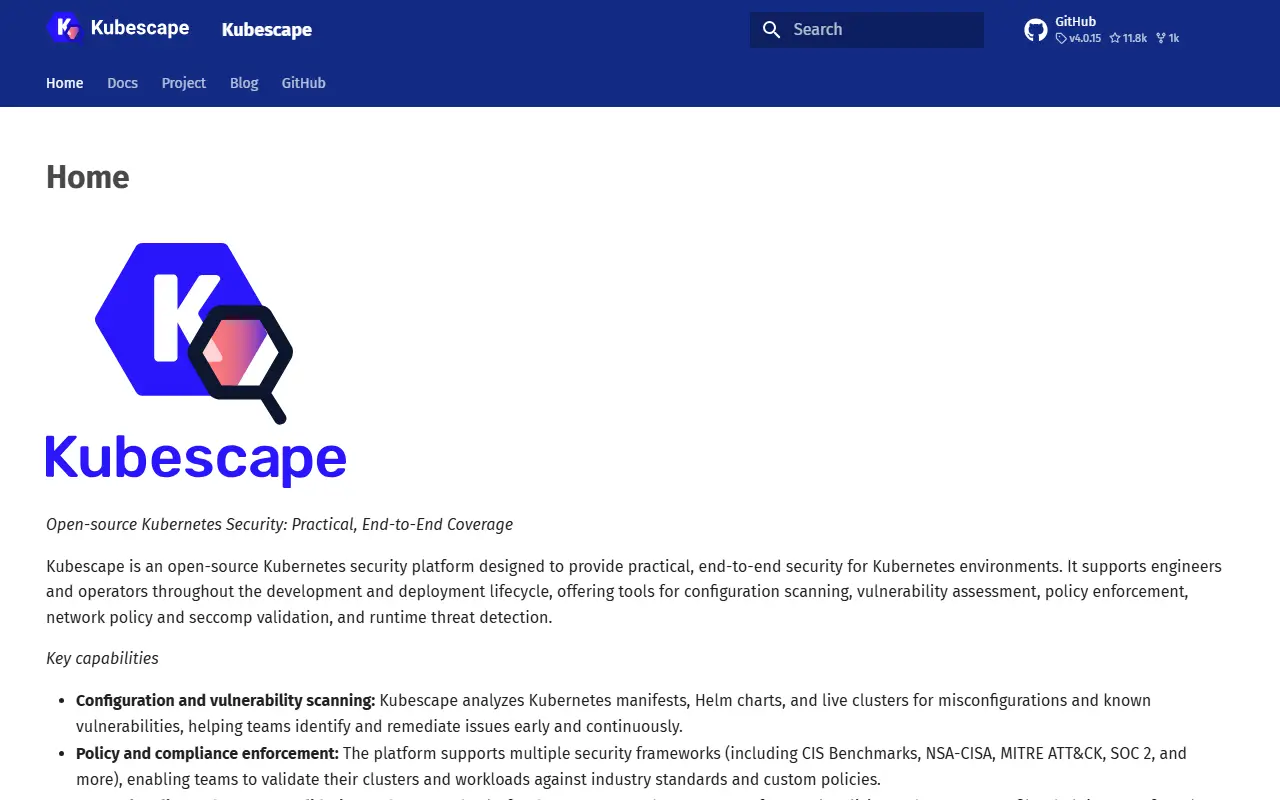
kubescape.ioKubescape homepage screenshot

Kubescape is an open-source Kubernetes security platform that covers the lifecycle from development to runtime. It was created by ARMO and is a Cloud Native Computing Foundation incubating project. It works in an IDE, in CI/CD pipelines and against running clusters, with the aim of saving administrators time on risk analysis and compliance work.

Misconfiguration scanning checks clusters, YAML files and Helm charts against NSA-CISA guidance, MITRE ATT&CK and CIS Benchmarks. Image vulnerability scanning detects CVEs using Grype, image patching uses Copacetic, and auto-remediation can fix manifest issues. Admission control uses Validating Admission Policies, runtime monitoring is eBPF-based through Inspektor Gadget, and an MCP server connects AI assistants.

Kubescape is written in Go and released under the Apache-2.0 license. It installs through options such as Homebrew and Krew, and an in-cluster operator is available for continuous scanning. Results include an overview of control plane status, access control risks, workload misconfigurations, network policy gaps and compliance scores.

Key features

  • Misconfiguration scanning against NSA-CISA, MITRE, CIS
  • Image vulnerability scanning with Grype
  • Automatic image patching with Copacetic
  • Auto-remediation for Kubernetes manifests
  • eBPF-based runtime security monitoring
  • In-cluster operator and MCP server

Pricing: Free and open source under the Apache-2.0 license.

Read more about KubescapeWebsite GitHub

Falco

Cloud native runtime security tool that monitors Linux kernel events and alerts on abnormal behavior and threats in real time.

GitHub stars
9.4k
Last commit
2 days ago
Latest release
0.45.0
Licence
Apache-2.0
Self-hosted
Yes
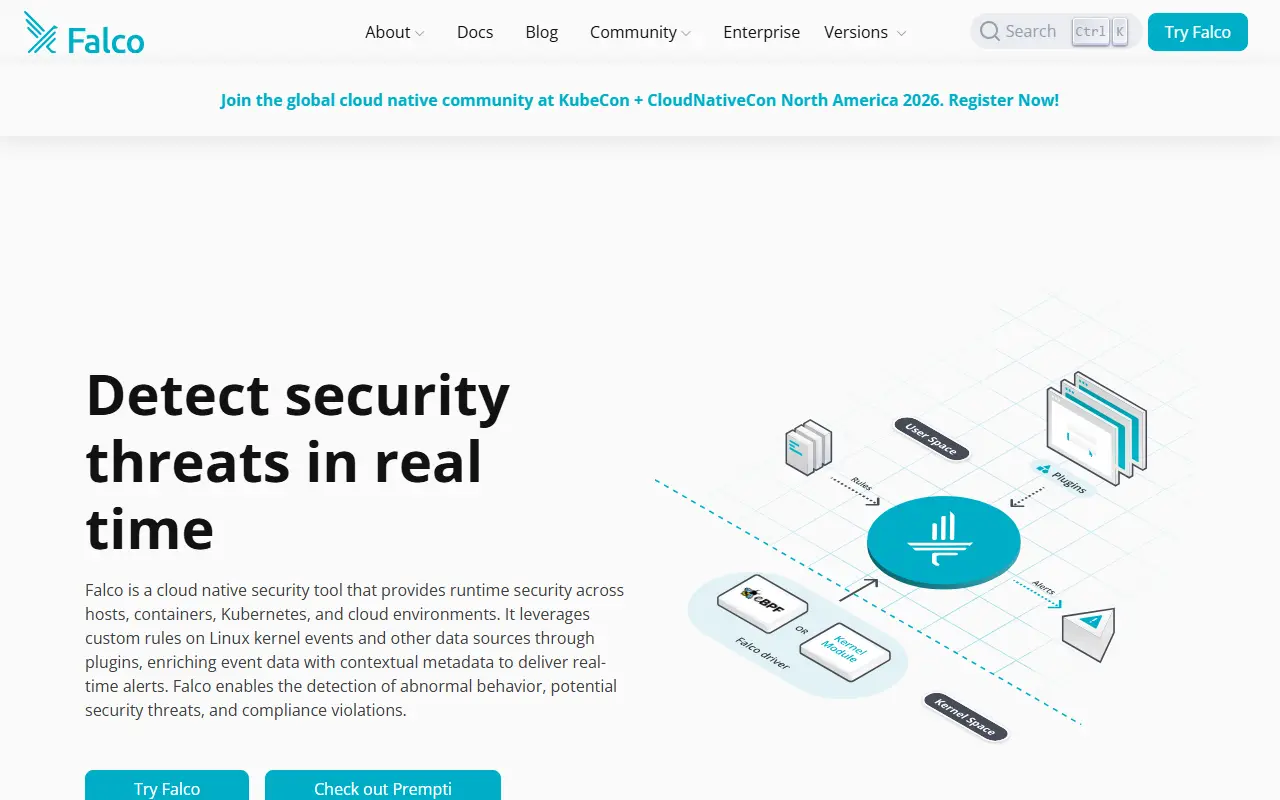
falco.orgFalco homepage screenshot

Falco is a cloud native runtime security tool for Linux. It detects and alerts on abnormal behavior and potential security threats in real time. At its core it is a kernel monitoring and detection agent that watches events such as system calls and evaluates them against custom rules.

Falco can enrich events with metadata from the container runtime and from Kubernetes, and the collected events can be analyzed off-host in SIEM or data lake systems. The project is split across repositories in the falcosecurity organization: the main repo holds the Falco binary, while others hold the core libraries and kernel drivers, the official ruleset, and plugins that extend detection beyond syscalls and container events.

Falco was originally created by Sysdig and is a graduated project of the Cloud Native Computing Foundation, used in production by various organizations. It is written in C++ and released under the Apache-2.0 license, with a change log and detailed documentation on falco.org. Topics in the repository mention eBPF-based collection.

Key features

  • Kernel-level syscall monitoring
  • Custom detection rules
  • Container and Kubernetes metadata enrichment
  • Official ruleset for common threats
  • Plugins for additional event sources
  • Export to SIEM or data lake systems

Pricing: Free and open source under the Apache-2.0 license.
Read more about FalcoWebsite GitHub

tfsec

tfsec is a static analysis scanner for Terraform code that finds cloud misconfigurations, now being folded into Aqua Security's Trivy.

GitHub stars
7k
Last commit
6 mo ago
Latest release
v1.28.14
Licence
MIT
Self-hosted
Yes
aquasecurity.github.iotfsec homepage screenshot

tfsec is a security scanner that uses static analysis of Terraform code to spot potential misconfigurations. It checks infrastructure as code against hundreds of built-in rules for the major cloud providers, so problems such as open storage or weak settings can be caught in review or CI before resources are deployed.

It scans local and remote modules, evaluates HCL expressions, Terraform functions and relationships between resources, works with the Terraform CDK, and applies user-defined Rego policies. Output is available in several formats, including a readable default and JSON. The README announces that tfsec is now part of Trivy, the broader Aqua Security scanner, and encourages users to migrate, with a guide comparing the two tools.

tfsec stays available for the time being, but engineering attention goes to Trivy, which offers more languages and integrations and commercial support from Aqua. tfsec is written in Go and licensed under MIT, and runs locally or in CI with nothing to host. It suits DevSecOps teams with existing Terraform scanning who are planning their move to Trivy.

Key features

  • Static analysis of Terraform code
  • Hundreds of built-in misconfiguration rules
  • Scans local and remote modules
  • Custom Rego policy support
  • Multiple output formats
  • Migration path to Trivy

Pricing: Free and open source under the MIT licence.

Read more about tfsecWebsite GitHub

Aqua Security alternatives: questions

What is the best open-source alternative to Aqua Security?
Trivy is the top-ranked open-source alternative to Aqua Security on Enlisted: A security scanner that finds vulnerabilities, misconfigurations, secrets and license issues in container images, filesystems, Git repositories and Kubernetes. Other strong options are Grype, Kubescape, Falco and tfsec.
Are these Aqua Security alternatives free?
All 5 are open source, so the code is free to use under its licence, and all of them can be self-hosted on your own server or computer.
How is this list of Aqua Security alternatives ranked?
By a score built from GitHub stars, star growth over the last 30 days and how recently the code changed. 4 of these projects shipped code in the last 30 days. Data is refreshed daily, and nobody can pay to move up.

People also look for alternatives to…

View all