7,380 open-source and SaaS tools, with GitHub stats refreshed every day.

4 alternatives ranked by real activity

Open-source Private Internet Access alternatives

A curated, ranked list of the 4 best open-source alternatives to Private Internet Access.

The best open-source alternative to Private Internet Access is Headscale. If that doesn't suit you, other good options are wg-easy, OpenVPN and IPsec VPN Server.

Private Internet Access alternatives are mainly networking & VPN tools. 4 of them shipped code in the last 30 days, 4 can be self-hosted, and 1 uses a permissive licence.

Last updated October 2, 2026 · ranked by GitHub stars, growth and recent commits

Headscale

A self-hosted, open-source replacement for the Tailscale control server, built for personal networks, labs and small organizations.

GitHub stars
44k
Last commit
today
Latest release
v0.29.4
Licence
BSD-3-Clause
Self-hosted
Yes

Headscale is a self-hosted, open-source take on the Tailscale control server. Tailscale is a VPN built on WireGuard that works as an overlay network between your computers using NAT traversal, and the control server is the piece that exchanges WireGuard public keys, assigns IP addresses, separates users and shares routes. Headscale replaces that coordination role with software you run yourself. It is written in Go under the BSD-3-Clause license.

The project has a deliberately narrow scope. It implements a single Tailscale network, called a tailnet, which is suitable for personal use or a small open-source organization, and it aims to give self-hosters and hobbyists a server for their projects and labs. The README explains that Tailscale's own clients and control server are not all open source, which is the gap Headscale fills.

Documentation is published for both stable and development versions, and the maintainers advise using the same Git tag as the release you run so the example configuration matches. A Discord server offers community chat. Headscale suits homelab users and small teams who want private mesh networking without relying on a hosted coordination service.

Key features

  • Self-hosted Tailscale control server
  • Key exchange and IP address assignment for nodes
  • Single tailnet for personal or small-team use
  • User separation and machine sharing
  • Advertised route support
  • Documentation for stable and development versions

Pricing: Free and open source under the BSD-3-Clause license.

Read more about HeadscaleGitHub

wg-easy

WireGuard Easy is a Docker-friendly tool that bundles a WireGuard VPN server with a web UI for managing clients on a Linux host.

GitHub stars
27k
Last commit
2 days ago
Latest release
v15.4.0
Licence
AGPL-3.0
Self-hosted
Yes
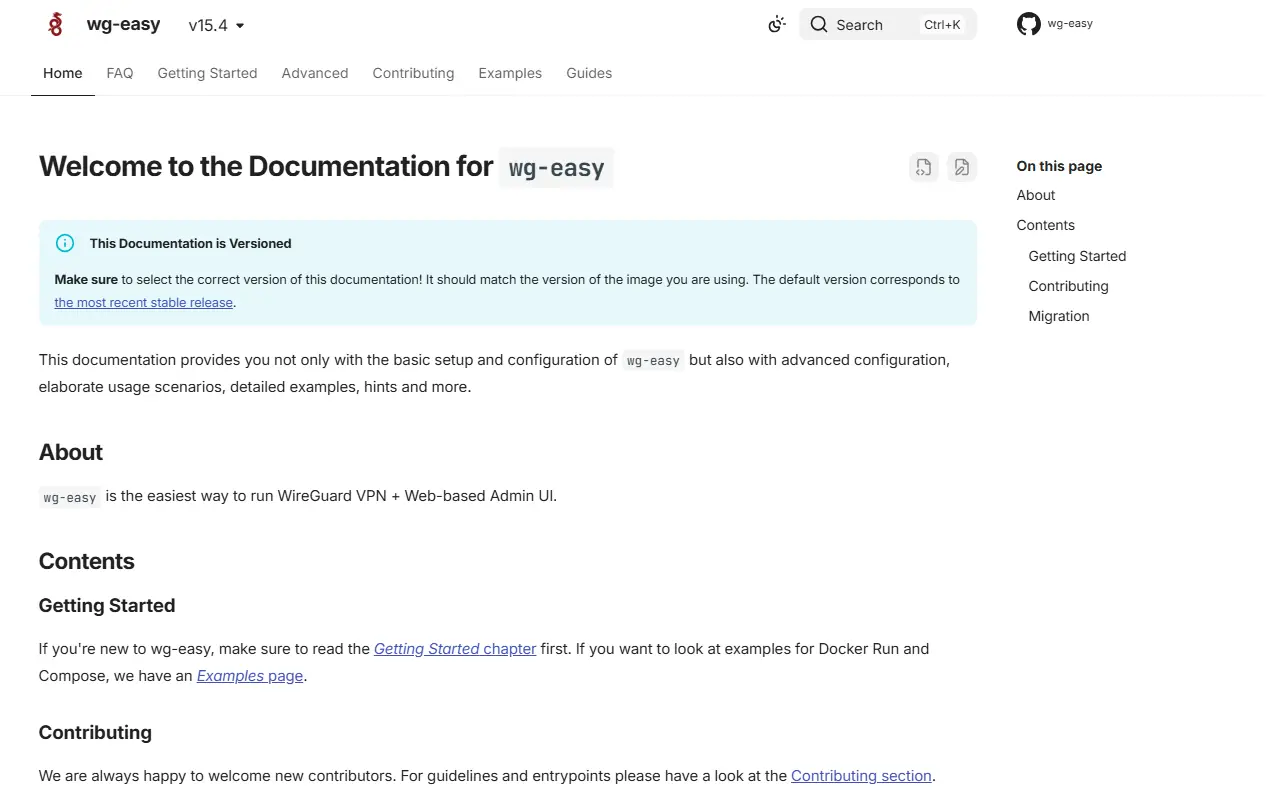
wg-easy.github.iowg-easy homepage screenshot

WireGuard Easy (wg-easy) combines a WireGuard VPN server and a web-based admin interface into a single package for Linux hosts. The web UI lets you list, create, edit, delete, enable and disable VPN clients, show a client's QR code, and download its configuration file. It is written in TypeScript and released under the AGPL-3.0 license.

Monitoring and security options include connection statistics, transmit and receive charts for each client, Prometheus metrics, client expiration, one-time links, two-factor authentication, OIDC sign-in with providers such as Google, GitHub, Authelia and Authentik, and per-client firewall filtering that requires iptables. The interface supports light and dark modes, multiple languages, IPv6 and CIDR. Installation uses Docker Compose, docker run or Podman, and the documentation covers reverse proxy setups with Caddy and Traefik as well as a migration guide from older versions.

Key features

  • WireGuard server with a web admin UI
  • Client QR codes and config downloads
  • Per-client traffic charts and connection status
  • Client expiration and one-time links
  • Two-factor and OIDC sign-in support
  • Prometheus metrics and IPv6 support

Pricing: Free and open source under the AGPL-3.0 license.

Read more about wg-easyWebsite GitHub

OpenVPN

OpenVPN is an open-source VPN daemon, developed in C, for creating secure virtual private network connections.

GitHub stars
15k
Last commit
today
Latest release
v2.7.7
Self-hosted
Yes

This entry is the OpenVPN source repository. OpenVPN is an open-source VPN daemon, a program that creates secure virtual private network connections between machines. The code is written in C, and the repository is tagged for security and VPN.

No readme or homepage details were available for this entry, so specifics about features, deployment and licensing are not listed here. The repository lists its license as 'Other', and the project community site is community.openvpn.net, which is the place to look for downloads, documentation and support.

Key features

  • Open-source VPN daemon
  • Secure virtual private network connections
  • Written in C
  • Community-supported project

Pricing: Self-hosted Access Server is free for up to 2 connections. Growth is $7 per connection per month on yearly billing with a 14-day trial; Enterprise is custom.

Read more about OpenVPNWebsite GitHub

IPsec VPN Server

A Docker image that runs an IPsec VPN server supporting IPsec/L2TP, Cisco IPsec and IKEv2, with auto-generated credentials and client setup profiles.

GitHub stars
7.1k
Last commit
11 days ago
Self-hosted
Yes
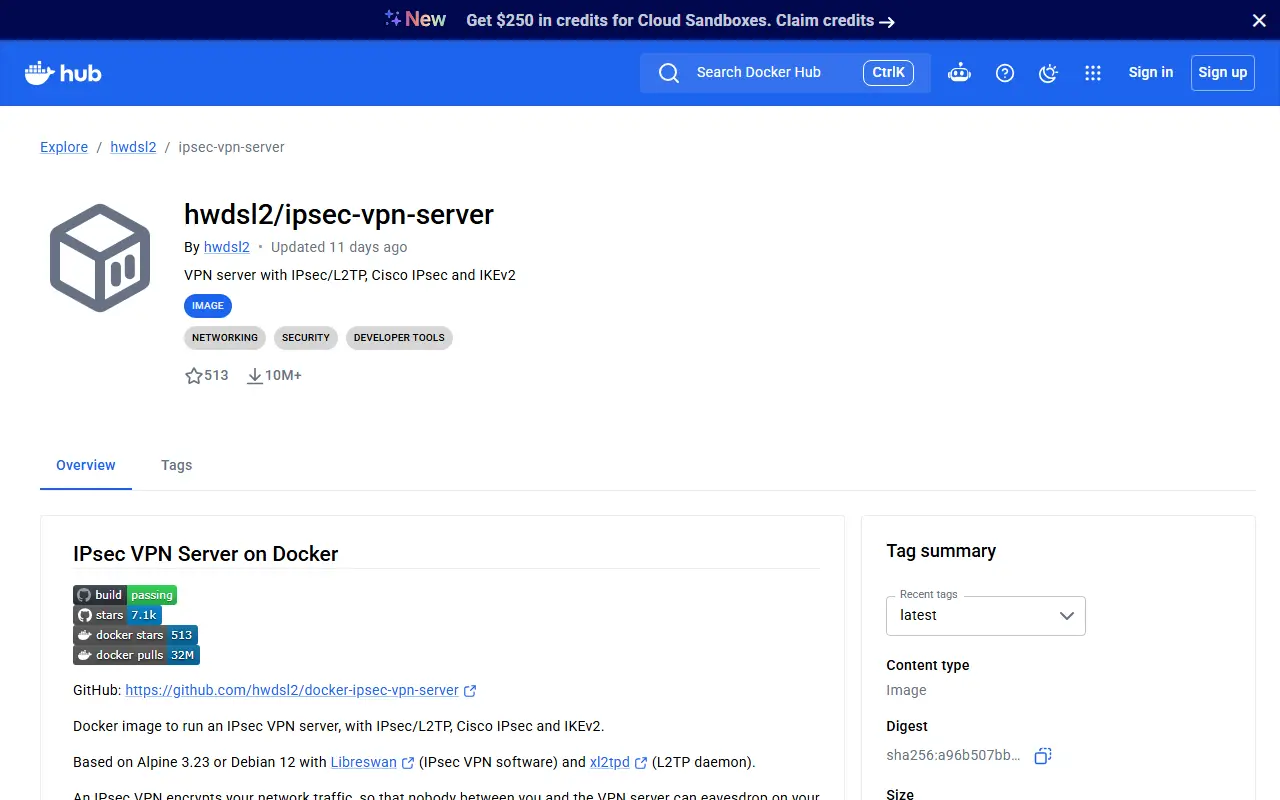
hub.docker.comIPsec VPN Server homepage screenshot

This project provides a Docker image for running your own IPsec VPN server. It supports IPsec/L2TP, Cisco IPsec and IKEv2 modes, is built on Alpine or Debian, and uses Libreswan as the IPsec software and xl2tpd as the L2TP daemon. A VPN like this encrypts traffic between a device and the server, which helps on untrusted networks such as cafes, airports and hotels.

On first start it automatically generates VPN credentials and the IKEv2 configuration. It supports IKEv2 with modern ciphers such as AES-GCM, creates profiles that configure iOS, macOS and Android devices, and works with Windows, macOS, iOS, Android, Chrome OS and Linux clients. A helper script manages IKEv2 users and certificates, data persists in a Docker volume, and images are built for amd64, arm64 and arm/v7 through GitHub Actions.

Setup is a single docker run command, or the IPsec VPN can be installed without Docker. The author also publishes related projects for WireGuard, OpenVPN and Headscale. The repository lists the license as Other, so check the licence file. It suits individuals and small teams running a personal or private VPN on a VPS, home server or Raspberry Pi.

Key features

  • IPsec/L2TP, Cisco IPsec and IKEv2 modes
  • Auto-generated credentials on first start
  • Client profiles for iOS, macOS and Android
  • Helper script for IKEv2 users and certificates
  • Persistent data in a Docker volume
  • Images for amd64, arm64 and arm/v7

Pricing: Free to use; the repository lists the license as Other.

Read more about IPsec VPN ServerWebsite GitHub

Private Internet Access alternatives: questions

What is the best open-source alternative to Private Internet Access?
Headscale is the top-ranked open-source alternative to Private Internet Access on Enlisted: A self-hosted, open-source replacement for the Tailscale control server, built for personal networks, labs and small organizations. Other strong options are wg-easy, OpenVPN and IPsec VPN Server.
Are these Private Internet Access alternatives free?
All 4 are open source, so the code is free to use under its licence, and all of them can be self-hosted on your own server or computer.
How is this list of Private Internet Access alternatives ranked?
By a score built from GitHub stars, star growth over the last 30 days and how recently the code changed. 4 of these projects shipped code in the last 30 days. Data is refreshed daily, and nobody can pay to move up.

People also look for alternatives to…

View all