7,363 open-source and SaaS tools, with GitHub stats refreshed every day.

6 alternatives ranked by real activity

Open-source Azure API Management alternatives

A curated, ranked list of the 6 best open-source alternatives to Azure API Management.

The best open-source alternative to Azure API Management is Kong. If that doesn't suit you, other good options are Apache APISIX, Tyk, Higress and KrakenD.

Azure API Management alternatives are mainly API tools. 5 of them shipped code in the last 30 days, 6 can be self-hosted, and 5 use a permissive licence.

Last updated October 2, 2026 · ranked by GitHub stars, growth and recent commits

Kong

A cloud-native, plugin-extensible API gateway that also handles LLM and MCP traffic, runs natively on Kubernetes and can be self-hosted or used as a cloud service.

GitHub stars
44k
Last commit
today
Latest release
3.9.3
Licence
Apache-2.0
Self-hosted
Yes
Hosted version
Available
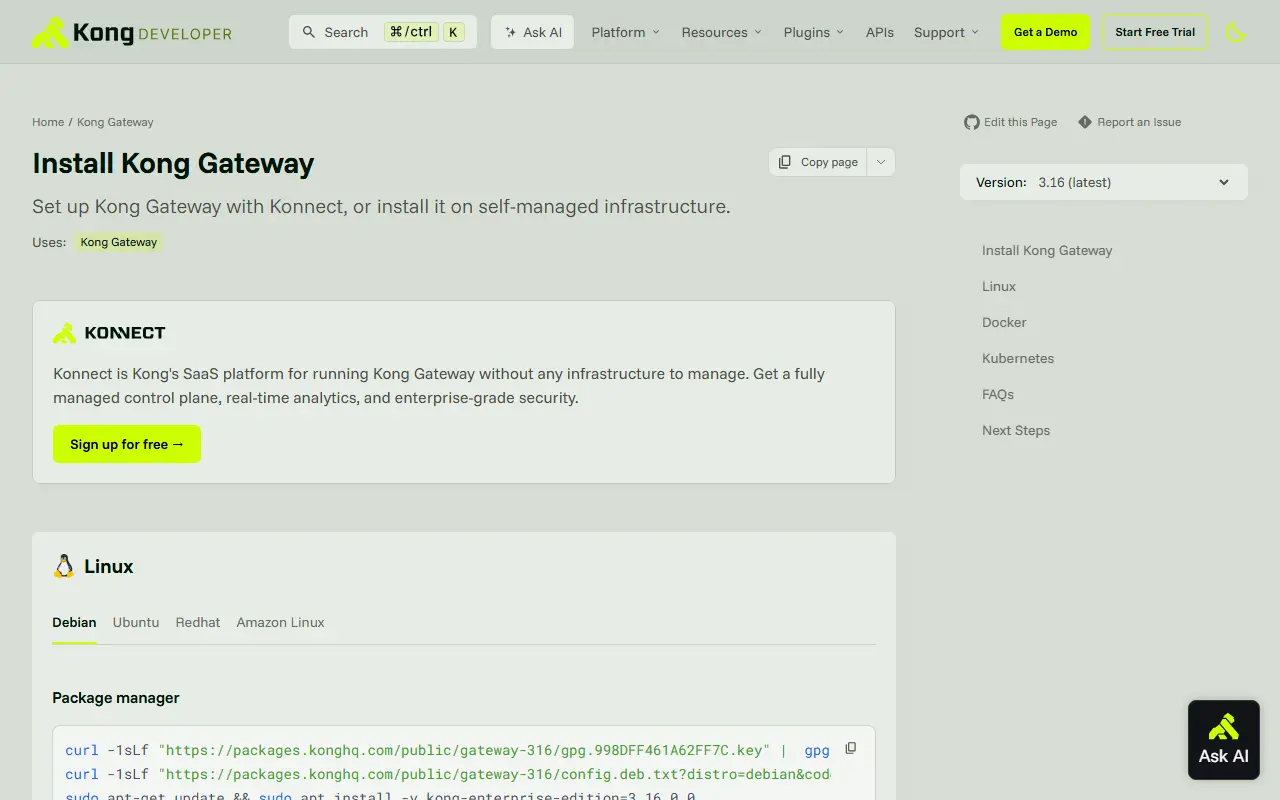
konghq.comKong homepage screenshot

Kong, also called Kong Gateway, is a cloud-native and platform-agnostic API gateway that has expanded to cover LLM and MCP traffic. It is written in Lua, released under the Apache-2.0 license, and extended through plugins. It proxies, routes, load balances and health checks traffic and handles authentication, sitting as a central layer in front of microservices or conventional APIs.

For AI workloads it adds multi-LLM support, semantic security, and security and analytics for MCP traffic. Kong runs natively on Kubernetes through its official Ingress Controller. The quickstart uses docker-compose, adds authentication to an API in a few minutes, and a Docker procedure covers a DB-less mode, with other distributions listed on the official installation page.

You can run Kong on your own infrastructure, in the cloud, on bare metal or in containers, or sign up for a free trial of the cloud-hosted Kong Konnect. It suits platform and API teams managing many services who need a gateway with a plugin ecosystem and an upgrade path to AI traffic management.

Key features

  • API gateway with routing and load balancing
  • Extensible through a plugin system
  • Authentication and health checking
  • Multi-LLM and MCP gateway capabilities
  • Kubernetes Ingress Controller
  • Docker, DB-less and cloud-hosted deployment

Pricing: Kong Konnect's AI Management Plus plan starts at $25 per month plus usage, with a 30-day free trial. Enterprise is custom and billed annually; API and event management rates are not shown.

Read more about KongWebsite GitHub

Apache APISIX

Apache APISIX is an open-source, high-performance API gateway and AI gateway built on NGINX and etcd with dynamic routing and plugins.

GitHub stars
17k
Last commit
5 days ago
Latest release
3.19.0
Licence
Apache-2.0
Self-hosted
Yes
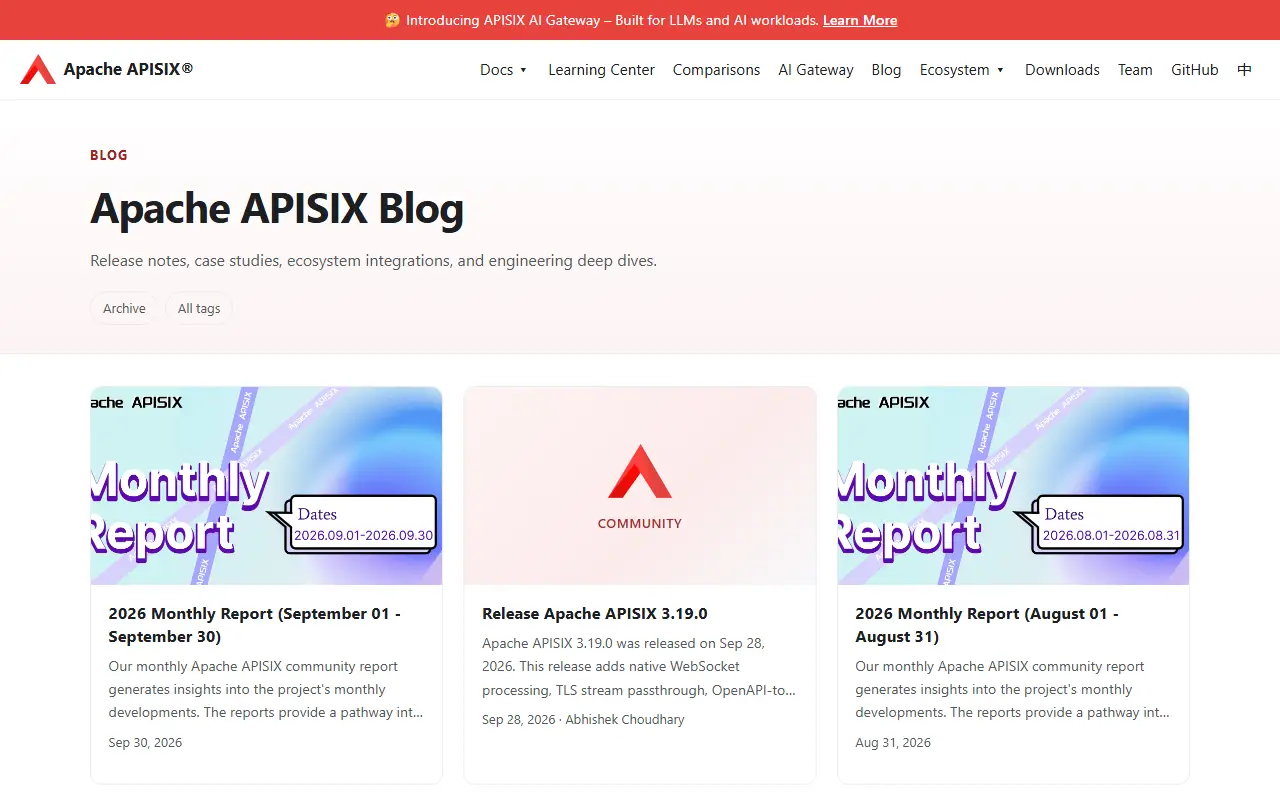
apisix.apache.orgApache APISIX homepage screenshot

Apache APISIX is a dynamic, real-time API gateway that handles traffic management for microservice architectures. It provides load balancing, dynamic upstreams, canary releases, circuit breaking, authentication and observability, and it can manage both north-south traffic and east-west traffic between services. It can also run as a Kubernetes ingress controller.

APISIX is built on NGINX and etcd. Compared with traditional gateways, it supports dynamic routing and hot-loading of plugins, which suits API management in microservices. Through its plugin system it can act as an AI gateway, proxying traffic to different LLM providers through a single interface, with load balancing, retries and fallbacks across models, and token-based rate limiting to control cost. An mcp-bridge plugin converts stdio-based MCP servers into HTTP SSE services.

The project is developed under the Apache Software Foundation, written mainly in Lua, and released under the Apache 2.0 license. A quickstart script requires Docker and starts APISIX together with its etcd configuration store, after which routes can be created through the Admin API. It is deployed on infrastructure you control.

Key features

  • Dynamic routing and plugin hot-loading
  • Load balancing, canary release and circuit breaking
  • Authentication and observability plugins
  • Kubernetes ingress controller
  • AI gateway proxying to multiple LLM providers
  • Token-based rate limiting for AI traffic

Pricing: Free and open source under the Apache 2.0 license.

Read more about Apache APISIXWebsite GitHub

Tyk

Open-source API and AI gateway for REST, GraphQL, TCP, gRPC and MCP traffic, with rate limiting, authentication and analytics.

GitHub stars
11k
Last commit
today
Latest release
v5.14.0
Self-hosted
Yes
Hosted version
Available
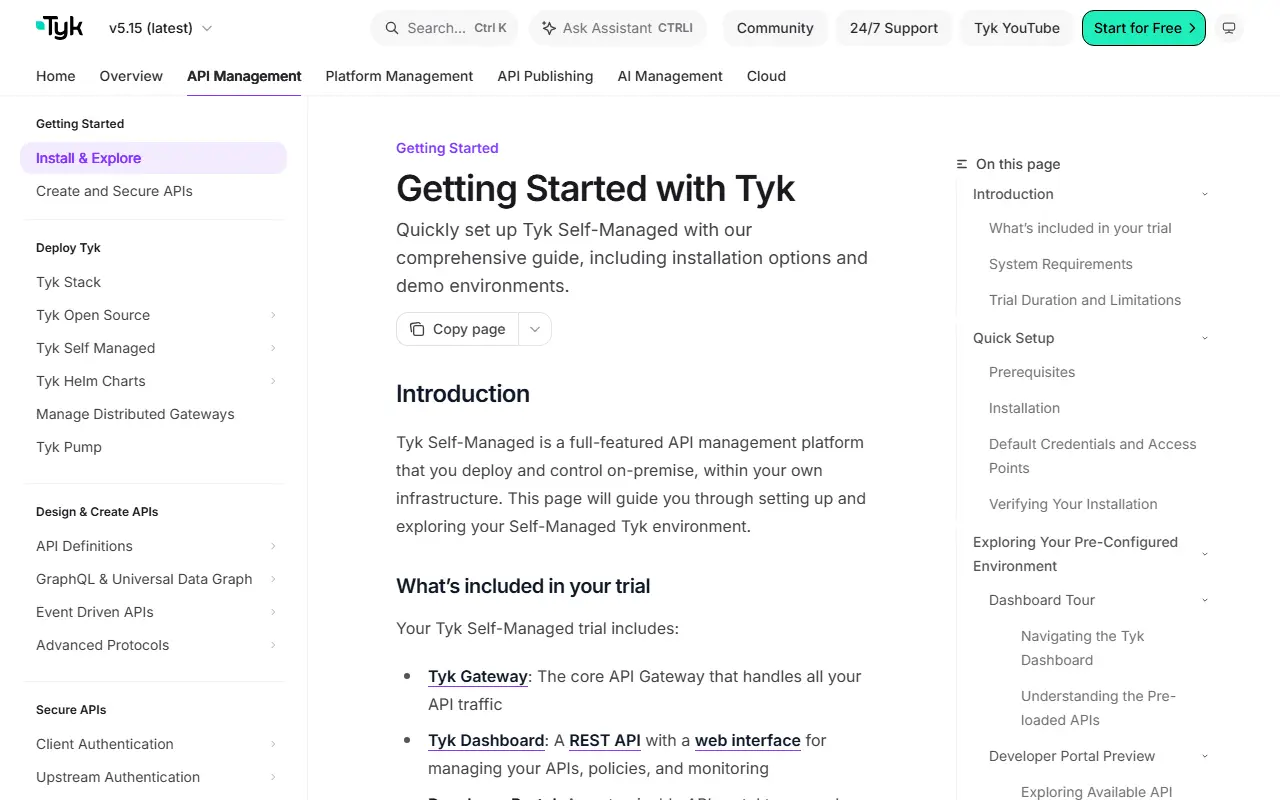
tyk.ioTyk homepage screenshot

Tyk Gateway is a cloud-native, open-source API and AI gateway that handles REST, GraphQL, TCP, gRPC and Model Context Protocol traffic. The project describes it as batteries-included with no feature lockout, so organizations can apply rate limits, authentication, analytics and microservice patterns in one place.

The open-source gateway can be run with Docker and Docker Compose alongside Redis, using a tyk.conf configuration file and an apps folder for API definitions. Beyond the gateway there are two commercial routes: Tyk Self Managed, an enterprise API management platform with a management control plane, GUI and developer portal, and Tyk Cloud, a hosted version of that platform with a free trial.

Tyk is written in Go and has been developed since 2014. Its license is stated in the repository, and documentation covers the quick start, the Gateway API, and the MCP and AI gateway features. A community forum and blog complement the docs. It targets teams that want to publish and secure internal or public APIs.

Key features

  • REST, GraphQL, TCP, gRPC and MCP support
  • Rate limiting and authentication
  • API usage analytics
  • AI gateway capabilities
  • Docker and Docker Compose quick start
  • Redis-backed gateway

Pricing: The open-source gateway is free, and Tyk Cloud has a 48-hour free trial. Core (usage-based), Professional (flat-rate) and Enterprise plans have no published prices.

Read more about TykWebsite GitHub

Higress

AI-native API gateway built on Istio and Envoy, extensible with Wasm plugins and able to host MCP servers and route LLM traffic.

GitHub stars
9.5k
Last commit
today
Latest release
v2.2.4
Licence
Apache-2.0
Self-hosted
Yes
higress.aiHigress homepage screenshot

Higress is a cloud-native API gateway based on Istio and Envoy. It can be extended with Wasm plugins written in Go, Rust or JavaScript, and comes with dozens of ready-to-use general-purpose plugins plus an out-of-the-box management console.

Its AI gateway capabilities support mainstream model providers, and it can host Model Context Protocol servers through its plugin mechanism so that AI agents can call tools and services. An openapi-to-mcp tool converts OpenAPI specifications into remote MCP servers, and both LLM APIs and MCP APIs are managed together. A Docker quick start exposes the console on port 8001 and the gateway on ports 8080 and 8443.

Higress originated at Alibaba to deal with connection disruption during gateway reloads and to improve gRPC and Dubbo load balancing, and it is now developed as a vendor-neutral CNCF project. The code is written in Go and licensed under Apache-2.0. Documentation includes a blog, roadmap, developer guide and a Wasm plugin hub.

Key features

  • Gateway based on Istio and Envoy
  • Wasm plugins in Go, Rust or JavaScript
  • AI gateway for mainstream model providers
  • Hosts MCP servers via plugins
  • OpenAPI to MCP conversion tool
  • Docker quick start with web console

Pricing: Free and open source under the Apache-2.0 license.

Read more about HigressWebsite GitHub

KrakenD

KrakenD Community Edition is a stateless, declarative API gateway written in Go for microservices, aggregation and secure API traffic.

GitHub stars
2.7k
Last commit
2 days ago
Latest release
v3.0.0
Licence
Apache-2.0
Self-hosted
Yes
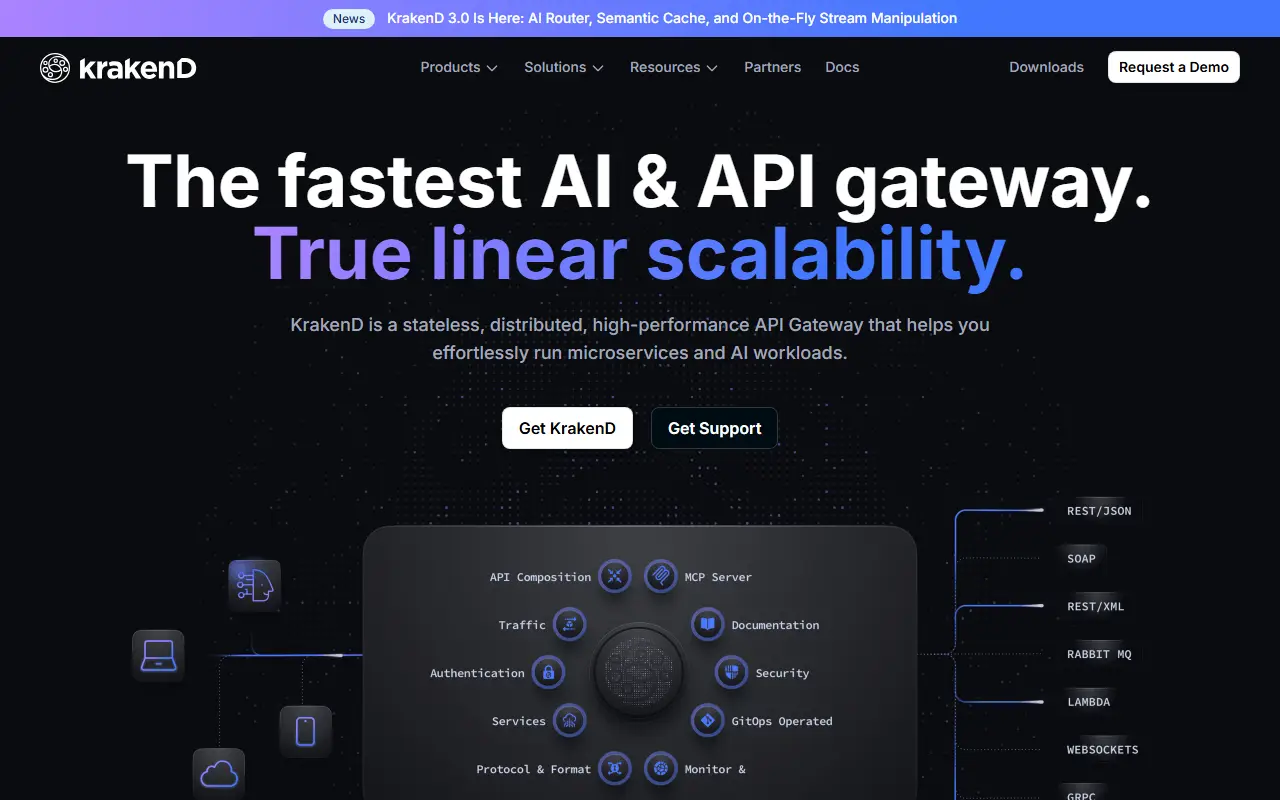
krakend.ioKrakenD homepage screenshot

KrakenD Community Edition is the open-source distribution of the KrakenD API gateway, written in Go and licensed under Apache-2.0. The gateway sits in front of backend services to help teams adopt microservices and backend-for-frontend patterns while securing communications. It is stateless, so each node works independently in a cluster with no central coordination.

Configuration is declarative, which fits a GitOps approach to managing the API lifecycle. The gateway can aggregate, compose and filter content from several APIs into one response, transform formats such as XML to JSON and back, and make concurrent calls to speed up responses. Security features include zero-trust policies, CORS, OAuth, JWT, HSTS and protections against clickjacking and XSS.

It is platform-agnostic, running in cloud-native environments such as Kubernetes or on-premises, and it avoids lock-in by leaving telemetry and identity to existing tools. Project topics also mention GraphQL, NATS, async handling and AI gateway use. It decouples clients from existing services, so new APIs can be created without changing current API contracts.

Key features

  • Stateless API gateway written in Go
  • Declarative configuration for GitOps workflows
  • Aggregation and filtering of multiple API responses
  • XML and JSON format transformation
  • JWT, OAuth and CORS security options
  • Runs on Kubernetes or on-premises

Pricing: Community Edition is free and open source under Apache-2.0.

Read more about KrakenDWebsite GitHub

Orange API Gateway

Orange is a free, MIT-licensed OpenResty and Nginx-based API gateway for monitoring and managing APIs, written in Lua on top of the Lor framework.

GitHub stars
2.3k
Last commit
3 yr ago
Latest release
v0.8.1
Licence
MIT
Self-hosted
Yes

Orange is an API gateway built on OpenResty, the Nginx and Lua platform, aimed at teams that want API monitoring and management capabilities built directly into their reverse proxy layer. It is designed for environments running on OpenResty rather than a general-purpose gateway independent of Nginx.

It is built using the Lor web framework for Lua and stores its configuration and plugin data in a MySQL database. After installation, Orange exposes both a dashboard, for monitoring and managing API policies, and a separate API server for programmatic configuration, each running on its own port.

Installation uses LuaRocks to reduce dependency issues across operating systems, requires OpenResty, resty-cli and the Lor framework as prerequisites, and currently does not support macOS for either production or development setups. Orange is written in Lua and released under the MIT license, with documentation available in both English and Chinese.

Key features

  • OpenResty and Nginx-based API gateway
  • API monitoring dashboard
  • Separate API server for configuration
  • MySQL-backed policy storage
  • Plugin-based request handling via Lor

Pricing: Free and open source under the MIT license.

Read more about Orange API GatewayWebsite GitHub

Azure API Management alternatives: questions

What is the best open-source alternative to Azure API Management?
Kong is the top-ranked open-source alternative to Azure API Management on Enlisted: A cloud-native, plugin-extensible API gateway that also handles LLM and MCP traffic, runs natively on Kubernetes and can be self-hosted or used as a cloud service. Other strong options are Apache APISIX, Tyk, Higress and KrakenD.
Are these Azure API Management alternatives free?
All 6 are open source, so the code is free to use under its licence, and all of them can be self-hosted on your own server or computer. 2 also offer a paid or managed cloud version if you'd rather not host it yourself.
How is this list of Azure API Management alternatives ranked?
By a score built from GitHub stars, star growth over the last 30 days and how recently the code changed. 5 of these projects shipped code in the last 30 days. Data is refreshed daily, and nobody can pay to move up.

People also look for alternatives to…

View all